What Rune Othala Means
Othala is the rune of ancestral possession. The Old Norse “óðal” referred to land permanently assigned to a family: it could not be sold to a stranger, seized for debt, or arbitrarily divided — it passed from parents to children as part of the lineage itself. Therefore, Othala speaks not of wealth acquired, but of what already belongs to a person by birthright: home, surname, land, way of life, ancestral memory.
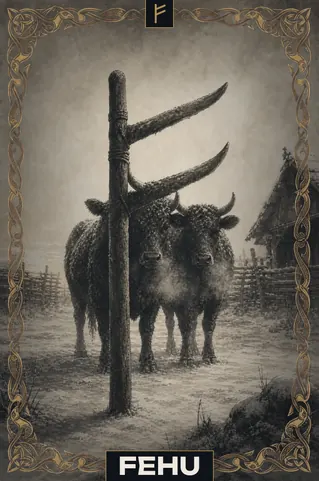
It is the last rune of the Elder Futhark, and this has meaning: the circle that began with Fehu — property to be acquired — closes with Othala, property that is already given and that needs to be preserved and passed on. Othala rarely speaks of change; it speaks of the support on which one can stand to move forward.
In a spread, Othala often answers questions about roots: where you come from, what you inherited from your family, and what is worth carrying forward, and what to leave behind.
 Free to try · Rune tattoo
A tattoo sketch with the Othala rune
AI will draw a tattoo sketch with this rune in the style you pick
Free to try · Rune tattoo
A tattoo sketch with the Othala rune
AI will draw a tattoo sketch with this rune in the style you pick
How Othala Looks and How to Draw it Correctly
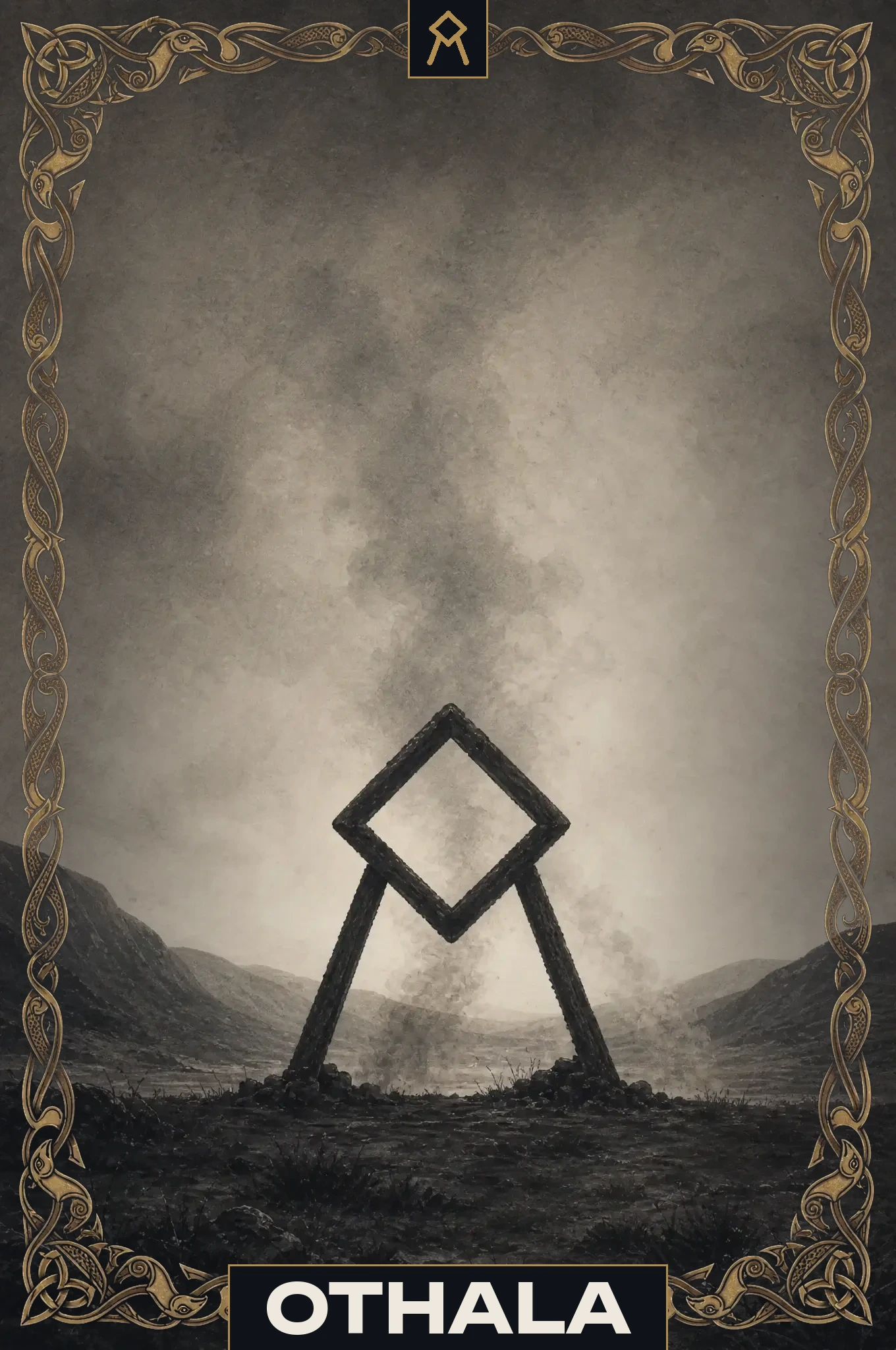
The inscription of Othala is ᛟ: a rhombus at the top of the symbol and two lines diverging from its lower vertex downwards-left and downwards-right, like a roof ridge on two supporting piles.
Othala is written from top to bottom: first the rhombus, then both supporting lines. Unlike Gebo or Isa, the Othala symbol does not look the same when rotated: the rhombus remains a rhombus, but the legs that pointed down will now point up — resulting in a different, visually distinguishable pattern. It is possible to draw a reversed Othala; the question is only whether tradition assigns it a separate meaning.
On our card, Othala is formed from the pediment of an ancestral estate: the rhombus of the roof ridge and the two supporting piles repeat the geometry of the rune, and smoke curls from the chimney — a sign that the house is inhabited and the lineage has not been broken.
Othala in the Upright Position
Othala in a spread is reliable support from below: home, family, ancestral property that supports a person, even when everything else is shaky. It can literally indicate real estate — an inherited apartment, land, a dacha from parents, — or it can speak of something less tangible: ancestral character traits, a profession inherited from a father, a family tradition that keeps a person afloat.
Othala also has a binding aspect. Ancestral property cannot simply be received and forgotten — one is responsible for it: a house requires maintenance, a family business requires continuation, the reputation of the lineage requires соответствие. Othala rarely speaks of quick results; it is about what is received once and stays with a person for a long time.
In a spread about choosing a path, Othala often advises not to break sharply from one's roots, but to rely on what is already available in the family — knowledge, connections, craft.
Why Othala Has No Reversed Position
Unlike Isa or Gebo, Othala's symbol is not geometrically symmetrical: a reversed rhombus with legs sticking upwards is perfectly distinguishable from the upright inscription — if desired, it can be drawn and read as a separate sign. But our deck, following most runic systems, does not assign a reversed meaning to Othala: the last rune of the row closes the circle, rather than being reversed along with the other twenty-three. Here, the rule of tradition applies, not the geometry of the sign.
Instead of reversal, its neighbors in the spread indicate difficulty. Othala next to Hagalaz or Nauthiz is read as a lost home: a break with family, exile, inheritance dispute, sale of ancestral property to outsiders. Othala next to Isa means stalled inheritance: a property division case that is not moving. The rune itself remains the same — only its surroundings change.
Othala in Relationships and Feelings
In a relationship spread, Othala speaks of a union involving not only the couple but also both families. It can answer questions about meeting a partner's parents, moving into a shared home, or traditions adopted from elders. It is not a rune of love at first sight, but of a connection that takes root and becomes part of family history.
Upright Othala is a good sign for the question “will his family accept me” and for decisions about shared living: if building a home, then solidly. It can also indicate a strong parental influence in the couple — sometimes supportive, sometimes restrictive.
In the company of difficult neighbors, Othala warns of conflict between personal choice and family traditions: a partner not approved by the lineage, or a relationship built against tradition rather than with it.
Othala in Work and Money
In business spreads, Othala most often indicates a family business, inheritance, or real estate. It answers well questions about continuing a parental business, a home inherited from elders, or money received not through earnings but through inheritance.
It is a rune of stability, not rapid growth. It rarely promises a sharp increase in income — instead, it speaks of a solid foundation: real estate that holds its value, a business that has existed for generations, a reputation earned long before you. For the question “is it worth investing in real estate,” Othala sounds like support.
Next to difficult runes, Othala warns of disputes over property: division of inheritance, conflict between co-owners, a family business where relatives' interests diverge. In such cases, it is worth defining in advance what exactly belongs to whom.
Othala — Yes or No
Othala answers yes if the question concerns home, family, inheritance, or something stable and time-tested. It supports decisions related to rooting: buying a home, returning to one's hometown, continuing a family business.
It is less responsive to questions about drastic changes and quick beginnings — this is not its domain, and Othala is more likely to remain silent than to say “no” to such a question. Its answer is more accurately phrased as “yes, but through a proven path” — where the decision relies on what already exists, rather than on starting from scratch.
In the company of difficult runes, Othala warns: before answering, sort out your obligations to your family or property — otherwise, the answer will be incomplete.
If Othala Appears in a Spread
The position of Othala in a spread indicates the time frame to which its support applies. In the past position, it says that the situation had a strong family foundation — what was given by parents or lineage, and which still influences the present. In the present position, Othala describes the support itself: home, property, or family are keeping the person afloat right now. In the future position, it promises rooting: moving into one's own home, reconciliation with family, inheritance.
Othala sets the tone first in a spread: the issue should be resolved by relying on the known, rather than inventing anew. Othala concludes a long spread — what was started will return home, to roots, to family.
Since Othala closes the row and is followed by Fehu again, in long spreads it often reads as the end of one cycle and a hint of the beginning of the next.
Combinations of Othala with Other Runes
Othala and Fehu — ancestral property meets acquired: an inheritance that a couple invested in a common cause, or a comparison of what was received with what was earned.
Othala and Gebo — a gift passed down within the family: help from parents, a family business for two, an exchange sealed by kinship, not a contract.
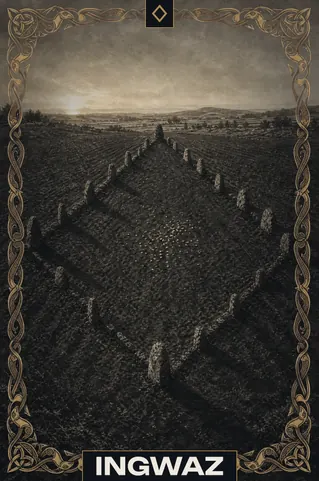
Othala and Inguz — a completed matter within the family: a house built, offspring continuing the lineage, a harvest gathered and kept on the farm.
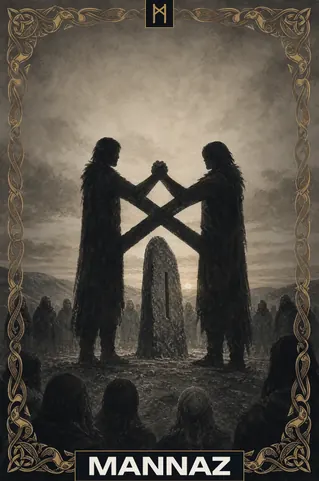
Othala and Mannaz — family as part of the community: a lineage that is visible to and recognized by neighbors, a reputation important not only within the home.
Othala and Berkana — a new generation under the old roof: the birth of a child, care for the home where children will grow up.
Othala and Dagaz — a turning point in the family's fate: a change in lifestyle, an inheritance that changes everyday life.
Othala and Hagalaz — loss of ancestral property: a destroyed home, a quarrel over inheritance, a break with the family.
Othala as a symbol: a talisman, tattoo, and amulet
Othala is one of the most frequent runic symbols in family symbolism: it is chosen for family crests, wedding engravings, and jewelry passed down from mother to daughter. In tradition, the symbol was applied to things associated with home and land — on a door frame, a boundary stone, a dowry chest.
Othala is usually worn by those for whom connection to roots is important: returning to family, pride in lineage, a desire to preserve what was inherited from ancestors. The inscription is drawn in one, familiar form — there is no inverted version in tradition, and making a mistake in the symbol's position here is no more dangerous than mixing up letters of the alphabet.
All of this is part of cultural tradition, not a way to influence events or receive an inheritance ahead of time. The Othala symbol should be understood as a reminder of roots, not as a guarantee that your lineage will take care of you.
 Free to try · Try it
A funny caricature from a photo
AI will draw a friendly caricature — for a gift or an avatar
Free to try · Try it
A funny caricature from a photo
AI will draw a friendly caricature — for a gift or an avatar
Frequently asked questions about the Othala rune
What does the Othala rune mean in simple terms?
Ancestral heritage: home, land, family — everything a person received not by their own merits, but by right of birth. The easiest way to remember it is: if Fehu means 'earned by oneself,' then Othala means 'received from the lineage and must be preserved.'
Does the Othala rune have an inverted position?
The inscribed inverted symbol is distinguishable from the direct one, but tradition does not give Othala a separate reverse meaning — it is one of the nine runes without reversal in our deck. The heavy shade is read not by position, but by neighboring runes in the spread.
Is Othala a rune about money or family?
Primarily about family and the little material things closely associated with it: home, land, inheritance. It differs from Fehu by the origin of wealth — not earned, but inherited through lineage.
Is Othala in a relationship spread a good sign?
Usually yes, if the question is about a couple settling down: a common home, acceptance into the family, traditions they build together. It reads worse when it indicates a conflict between personal choice and parental will.
How to distinguish Othala from other runes in the row?
By shape: a rhombus on top and two diverging lines below, resembling a roof ridge on supports. It is the only rune in the futhark with such geometry, making it difficult to confuse with its neighbors.
Othala came up last in the spread — what does it mean?
That the issue will be resolved by returning to roots: home, family, inheritance. Since Othala closes the row of runes and is followed again by Fehu, in long spreads it is also read as the end of one cycle before the beginning of a new one.