What Mannaz Rune Means
Mannaz is the rune of the person, but not a solitary person, rather a person among their own. Its name literally translates to "person," "man," however, the Norse tradition understood this word more broadly: an individual person did not exist outside of their kin, community, or thing—an assembly where common affairs were decided. Mannaz describes precisely this connection: a personality that finds meaning and strength through belonging to people.
The rune is in the third aett, dedicated to a person's relationship with fate, society, and their fellow beings, and Mannaz here is the central figure. It's not about a solo feat, but about reason that is smarter in company: the advice of elders, the support of neighbors, the exchange of knowledge. In a reading, it often indicates not an action, but with whom it is worth sharing it.
The second layer of meaning is the person themselves as the measure of things: their intellect, their weaknesses, their dignity. Mannaz asks not "what to do," but what kind of person you are in this situation—are you honest, ready to ask for help, capable of offering it?
 Free to try · Rune tattoo
A tattoo sketch with the Mannaz rune
AI will draw a tattoo sketch with this rune in the style you pick
Free to try · Rune tattoo
A tattoo sketch with the Mannaz rune
AI will draw a tattoo sketch with this rune in the style you pick
How Mannaz Looks and How to Draw It Correctly
The inscription of Mannaz is ᛗ: two vertical strokes and one diagonal line between them, running from the top of the left stroke to the base of the right. It is not a symmetrical cross, like some neighboring runes, but precisely a diagonal with a clear direction—it sets the top and bottom for the rune.
Mannaz is written from bottom to top: first the left stroke, then the right, then the connecting diagonal line—from top to bottom, left to right. If drawn in the reverse direction, from the top of the right stroke to the base of the left, the symbol is read as reversed.
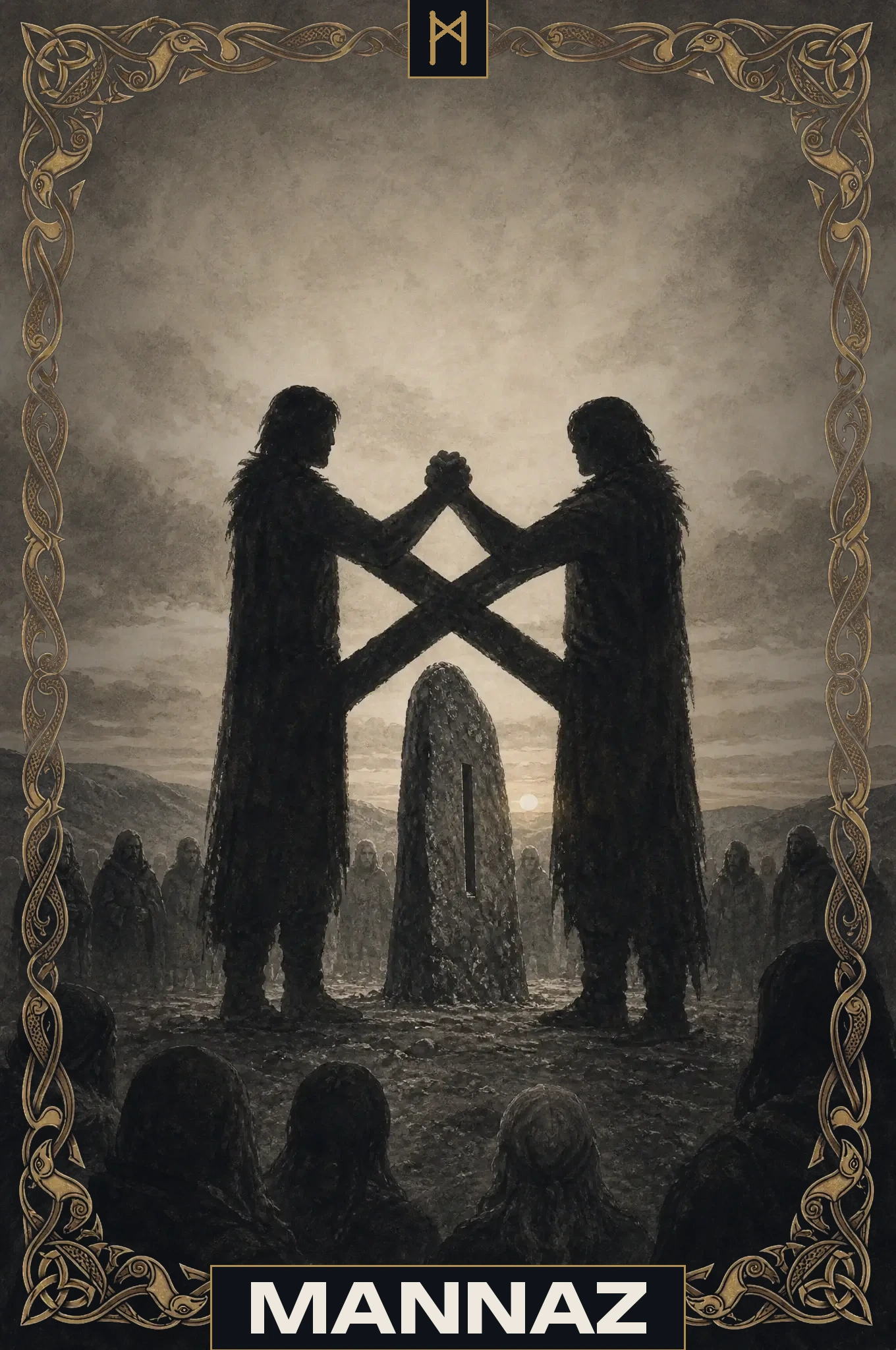
On our card, Mannaz is formed by two figures facing each other at a thing—a meeting place: their bodies form both strokes, and their clasped forearms form that very diagonal line. Around them is the circle of the community, which is the meaning of the rune. It's easy to make a mistake in direction if drawing the symbol hastily: keep in mind the image of a handshake, not a random cross.
Mannaz Upright
Upright Mannaz is the rune of relying on people. It says: you are not alone, and it is easier to find a solution together than alone. It often appears where a person is used to handling things themselves, and reminds them—asking for help is not shameful, but reasonable.
This is the rune of common sense, honesty, and sober self-assessment. Mannaz praises not strength or luck, but the ability to negotiate: to hear others, to admit when you are wrong, to find common ground where emotions interfere. In business readings, it concerns reputation—how people you work with see you.
Another meaning is community as a resource. Friends, colleagues, family, like-minded people: upright Mannaz shows that there are those nearby whom you can rely on, and the only question is whether you will turn to them.
Mannaz Reversed
Reversed Mannaz signifies a break in connection with people. Not necessarily a quarrel: more often it's alienation, a feeling that you are not understood, or that asking for help is futile. A person is left alone where support could have been.
This position has three common interpretations. The first is self-isolation: the person isolates themselves from others, fearing to appear weak or dependent. The second is distrust: deception, intrigue, manipulation by others, which spoils the connection with the environment. The third is losing oneself in the crowd: the opposite extreme, when a person dissolves into others' opinions and stops hearing themselves.
Reversed Mannaz is not a sentence to loneliness—it is an indication to reconsider whom you share your affairs with. If there are runes of deception or conflict nearby, it refers to a specific person who should not be trusted. If there are runes of stagnation nearby—it refers to the habit of coping alone where it is long overdue to ask for help.
Mannaz in Relationships and Feelings
In a relationship reading, upright Mannaz speaks of a mature connection: two people see each other as equals, talk directly, rather than assuming things about each other. It is the rune of partnership in a broad sense—not necessarily romantic, but definitely honest.
When asked about a person's feelings, it answers with respect, not passion: they treat you as their equal, value your opinion, consult you. Mannaz speaks less of infatuation and more of trust, which builds longer but lasts stronger.
Reversed Mannaz in relationships signifies unspoken issues and distance. One partner withdraws, conversation is replaced by silence or manipulation. Sometimes the rune points to a third party—not necessarily a rival, but someone whose opinion interferes with the couple and spoils the trust between them.
Mannaz in Work and Money
In a business reading, Mannaz is the rune of teamwork and reputation, not direct money. Upright Mannaz praises working relationships: a team where people help rather than undermine each other, a partner you can rely on, a mentor whose advice is worth listening to.
For hiring and negotiations, it's a good sign: you are perceived as someone easy to work with, which often matters more than dry resume numbers. For the decision of 'should we take on a joint project,' Mannaz answers yes, if the people involved are honest and open.
Reversed Mannaz at work signifies spoiled relationships within the team: distrust, rumors, others' intrigues, a boss or partner playing unfairly. It also warns of overestimating your own strength alone: where a team is needed, attempting to do everything yourself usually fails. The rune advises not to remain silent about the problem, but to discuss it with those it concerns.
Mannaz — yes or no
Upright Mannaz is yes, if the decision affects more than just you. It answers well to questions about cooperation, help, and joint ventures: yes, it's worth uniting, talking, and asking for advice.
Reversed Mannaz is more of a no, and the reason is almost always people: someone is dishonest, someone is unwilling to listen, trust has been broken. This doesn't mean 'never' — it means 'not with this person' or 'not in silence'.
If the question is purely personal, not about relationships with anyone, Mannaz answers less strongly than direct money or event runes: its strength lies in advice about people, not in predicting a specific outcome.
If Mannaz appears in a reading
The rune's position in the spread changes a lot. In the past, Mannaz indicates that the situation was not formed alone: there was someone's influence, family support, or, conversely, external pressure. In the present, it means there are people nearby capable of influencing the outcome, and they should be paid attention to. In the future, it promises a meeting, advice, or alliance that will be decisive.
Mannaz first in the spread sets the tone: 'it's not just about you' — and all subsequent runes should be read considering others' involvement. Mannaz last in the spread signifies an outcome through people: what happens will be determined not by circumstances, but by a specific person or group.
If the question is not about people at all, read Mannaz as advice to look at the situation from the outside — through another person's eyes, not from within.
Combinations of Mannaz with other runes
Mannaz and Gebo — honest exchange: a partnership where both invest equally and don't count who owes more.
Mannaz and Wunjo — warm community: a team or family where it's genuinely good, not just convenient.
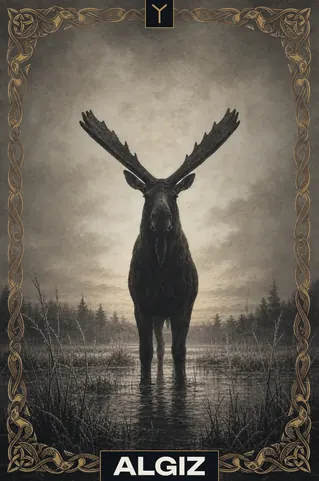
Mannaz and Algiz — family protection: people who will stand by your side in difficult times without hesitation.
Mannaz and Nauthiz — asking for help through strength: pride prevents you from turning to people, even though you can't do without them.
Mannaz and Isa — frozen relationships: a connection exists but is frozen — resentment, unspoken words, a pause that no one dares to break.
Mannaz and Teiwaz — justice through people: a dispute resolved by a third party, community court, an honest mediator.
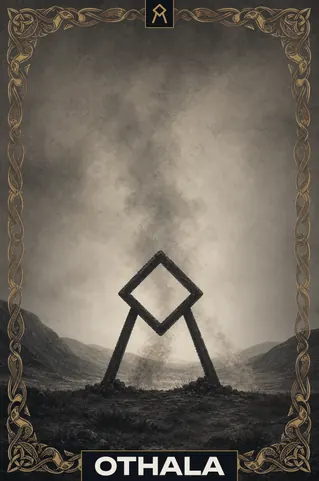
Mannaz and Othala — family and kin as support: help specifically from your own people, not outsiders; a legacy of connections, not property.
Mannaz as a symbol: talisman, tattoo, and amulet
Mannaz is less common in personal jewelry than money or protection runes, but it has its niche: it was worn by those who wanted to emphasize belonging to a clan, brotherhood, or retinue — something collective, not personal. Traditionally, the symbol was placed on objects related to gatherings and councils: on an elder's staff, on the door of a longhouse, on a communal cauldron.
The meaning of Mannaz as an amulet is not protection from loneliness, but a reminder that it is not the only path. The symbol is more often chosen by people who value their community, family, or team and want to emphasize this connection, rather than hide behind a symbol.
In modern practice, Mannaz is used as a paired or group symbol — on jewelry worn by several people simultaneously: friends, partners, participants in the same endeavor. The direction of the inscription is also important here: a reversed symbol carries its own, less inviting meaning.
All of this is part of cultural tradition, not a way to influence events or receive magical help. The runic symbol should be seen as a reminder of the value of the connections you choose yourself.
 Free to try · Try it
A funny caricature from a photo
AI will draw a friendly caricature — for a gift or an avatar
Free to try · Try it
A funny caricature from a photo
AI will draw a friendly caricature — for a gift or an avatar
Frequently asked questions about the Mannaz rune
What does the Mannaz rune mean in simple terms?
A person among their own — not an individualist, but someone seeking support and reason in connection with other people. Mannaz rarely advises to cope alone: its main message is that it's easier and more honest together.
Is Mannaz a rune of relationships or a rune of the mind?
Both: in the Norse tradition, human intellect unfolded precisely in communication with people, not in solitude. Therefore, Mannaz answers equally well to questions about connections and about sober assessment of the situation.
What does reversed Mannaz mean?
Severing ties with people: self-isolation, distrust, unfair play by others. This is not a sentence to loneliness, but a signal to reconsider who you share your endeavors with, and not to remain silent about the problem.
Is Mannaz in a relationship reading a good sign?
Yes, if the question is about the maturity and honesty of the connection: the rune speaks of respect and partnership on equal terms. It speaks less of passionate infatuation — its domain is trust, not passion.
How to distinguish upright Mannaz from reversed?
By the direction of the diagonal line between the two uprights: for the upright rune, it goes from the top of the left upright to the base of the right. If drawn in the opposite direction, the symbol is read as reversed — the rune is not symmetrical, and the position can only be confused by careless drawing.
Mannaz appeared first in the spread — what does it mean?
That the situation will not be resolved alone: there are people nearby whose involvement will determine the outcome, and they should be paid attention to from the very beginning. In the first position, Mannaz is usually read as advice — do not undertake the task alone.