What the Algiz Rune Means
Algiz is the penultimate rune of the second aettir, a row that Scandinavian tradition associates with Heimdall, the guardian of the gods at the Bifrost bridge. This is no coincidence: Algiz is the rune of the guardian, and its meaning grew out of the image of a creature ready for defense, not attack.
The name of the rune is interpreted in two ways: as "elk" – an animal whose spread antlers themselves resemble the three rays of the sign extending to the sides, and as "sedge", marsh grass with sharp, cutting leaf edges that are easy to injure if grabbed carelessly. Both images converge in one thing: neither the elk nor the sedge attack first, but they know how to defend themselves if approached too closely.
Therefore, Algiz in a spread rarely speaks of action. It says that it is worth being vigilant, looking around, and protecting what you already have – yourself, your family, your business – before moving on.
 Free to try · Rune tattoo
A tattoo sketch with the Algiz rune
AI will draw a tattoo sketch with this rune in the style you pick
Free to try · Rune tattoo
A tattoo sketch with the Algiz rune
AI will draw a tattoo sketch with this rune in the style you pick
How Algiz Looks and How to Draw It Correctly
The inscription of Algiz is ᛉ: a vertical trunk and two oblique lines diverging upwards from its middle, like raised hands or spread antlers. Three rays point upwards – this is the main feature of the upright position.
The rune is written from bottom to top: first the trunk, then the left ray, then the right, both at the same angle. It is important that the side lines diverge precisely from the middle of the trunk, not from the very top – otherwise, the sign is confused with runes whose hooks diverge differently.
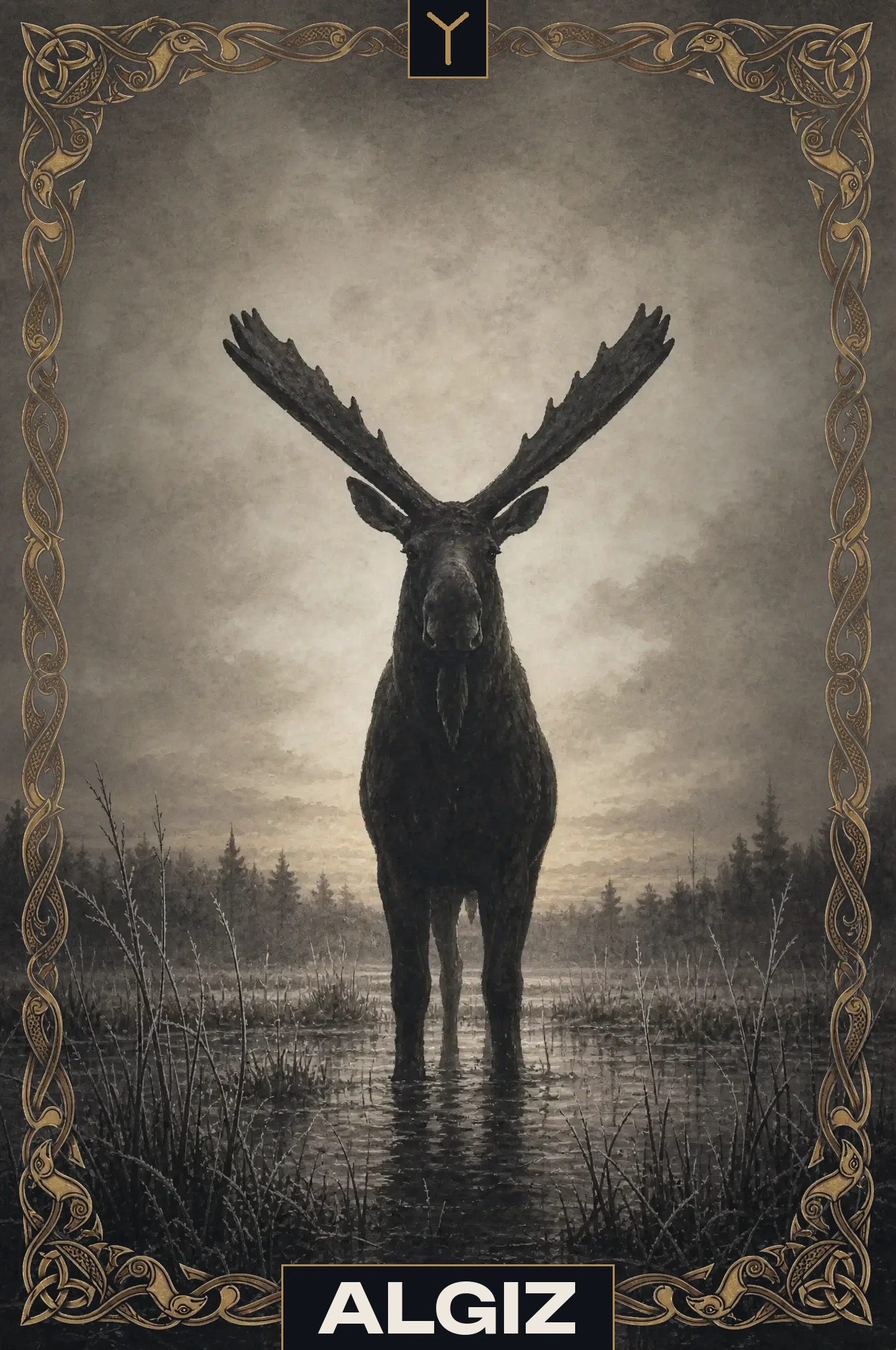
In our card, the rune is formed from the figure of an elk: it stands in shallow water at sunset, its antlers and the line of its neck form the sign itself, and the reeds in the foreground repeat its shape in a second layer. Algiz is asymmetrical: if you turn it with the rays down, the vigilant gesture turns into defenselessness, the three rays point at your feet, not at the sky.
Algiz Upright
Upright Algiz is one of the most benevolent runes in the row, but its benevolence is of a special kind: it does not promise profit or victory, it promises preservation. This is the rune of protection – from external danger, from outside interference, from one's own rashness.
In a spread, it often answers the question "should I worry?" with the words "no, you are protected": there is a person, circumstance, or one's own intuition nearby that will warn of danger in time. Often Algiz indicates a patron – an older relative, a mentor, an authority that will stand up for you in a difficult moment.
The second meaning of upright Algiz is heightened intuition, spiritual vigilance. The person to whom it falls should trust the first impulse "something is wrong": the elk rune signals danger before it becomes obvious.
Algiz Reversed
Reversed Algiz is a rune of removed protection. The antlers are lowered, the reeds are flattened: what protected has stopped working or has been discarded. This is one of the alarming runes in the row, but its meaning is not "trouble", but "you are left without cover, and this must be noticed".
Most often, reversed Algiz indicates one of three situations. The first is a loss of support: a patron has left, support has ended, the person is left to deal with things alone. The second is openness where caution is needed: trusting the wrong person, an ill-considered decision, talking to the wrong person at the wrong time. The third is exhausted vigilance: the rune appears to those who have been defending for too long and have lost sensitivity to real danger because they have stopped distinguishing it from habitual anxiety.
There is also an inverse interpretation, which is important not to miss: sometimes reversed Algiz is not a loss of protection, but its excess, which has turned against the person. Closedness, suspicion, refusal to let anyone into one's life for fear of repeated harm – this is also its shadow side. In this case, the rune does not warn of danger, but indicates that the protective wall has become a prison.
Next to runes of growth and communication (Gebo, Wunjo, Mannaz), reversed Algiz is more often read as excessive closedness, which it is time to loosen. Next to runes of loss and breakdown (Hagalaz, Nauthiz) – as real vulnerability that needs to be covered. In any case, the advice is the same: figure out where exactly the defenselessness comes from before acting further.
Algiz in Relationships and Feelings
In a relationship spread, upright Algiz speaks of care, similar to protection: a partner protects, stands up for you, creates a sense of a rear guard. This is not always pure romance – sometimes the rune describes a relationship where one person takes care of the other, like an older sibling to a younger one, and both are comfortable with it.
When asked about a person's feelings, upright Algiz answers: they are protecting you. Not necessarily with words of love – rather with actions: warning, defending, making sure you are okay. For a new acquaintance, the rune advises not to rush and to observe: caution is appropriate here, not harmful.
Reversed Algiz in relationships speaks of removed protection not in the best sense – of jealousy, surveillance, attempts to control under the guise of care, or, conversely, of a partner who has stopped covering for you and left you to deal with difficulties alone. The other runes in the spread help to distinguish one from the other.
Algiz in Work and Money
In a business reading, Algiz rarely speaks of profit — its domain is elsewhere: in preserving what you already have. The upright rune advises strengthening your position before expanding: review contracts, insure against risk, and don't lay all your cards on the table for competitors. It's a good sign for the question 'should I protect an asset?' and a cautious one for 'should I risk it for growth?'
For hiring and teamwork, upright Algiz indicates a patron within the system: a boss or colleague who will stand by your side in a dispute. For your own business, it means reputation and a cautious tactic are more important than aggressive expansion right now.
Reversed Algiz concerning money warns of vulnerable spots: a contract without insurance, a partner without written obligations, an asset easily lost due to someone else's negligence. The rune doesn't say the loss has already happened — it says check where the weak point is before it breaks.
Algiz — yes or no
Algiz rarely gives a clear 'yes' or 'no' — by its nature, it's a rune of caution, not decisive answers. Upright Algiz is closer to 'yes, but proceed with caution': the path is open, but you should tread carefully, having secured yourself beforehand.
Reversed Algiz leans towards 'no,' or more precisely, 'not now, until you are protected.' It indicates a risk that's better to be aware of in advance than to face it head-on.
If the question is 'Am I safe?' or 'Should I trust?', Algiz answers more directly: upright means yes, reversed means no, reconsider whom you trust.
If Algiz appears in a reading
The position in a reading changes the interpretation of Algiz more noticeably than many other runes. In the past position, it indicates that the situation was already protected — someone or something was guarding you, even if it wasn't very apparent. In the present position, it means protection is working right now, and you should trust it rather than looking for a problem where there isn't one. In the future position, Algiz promises support: a patron, timely help, a circumstance that averts disaster.
Algiz at the beginning of a reading sets a cautionary tone: 'secure yourself first, then act.' Algiz at the end often signifies the final outcome of caution: you've preserved what you had, and that's already a good result.
Next to the rune of fate (Perthro) or the rune of ice (Isa), Algiz reinforces the advice to wait: the situation is hidden or frozen, and rushing is not advisable.
Combinations of Algiz with other runes
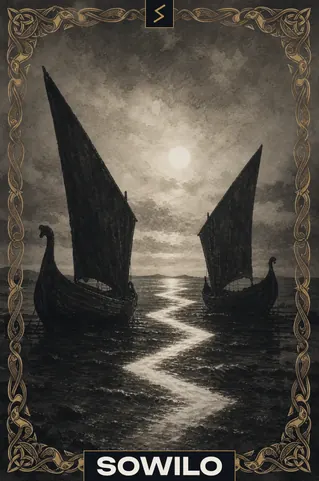
Algiz and Sowilo — protection that led to victory: danger has passed, a bright outcome lies ahead. One of the most reassuring combinations in the row.
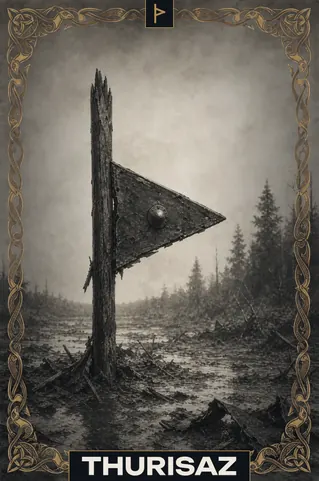
Algiz and Thurisaz — the difference between defense and attack: Algiz warns, Thurisaz strikes first. The pair often indicates that a conflict can still be stopped with caution, without escalating to confrontation.
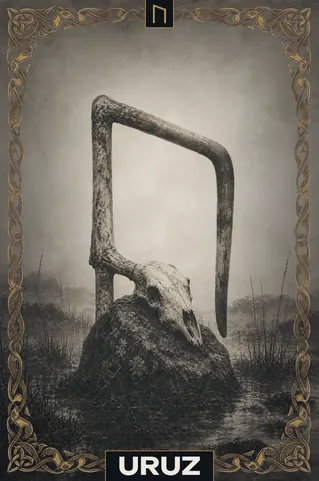
Algiz and Uruz — strength brought under control: the wild power of Uruz doesn't lash out aimlessly but stands guard. A good combination for those learning to protect themselves rather than attacking first.
Algiz and Teiwaz — protection backed by righteousness: if you have to defend your rights, the law and justice are on your side.
Algiz and Mannaz — a patron from within your own community: help will come not from outside, but from your close circle, kin, or collective.
Algiz and Hagalaz — protection under elemental attack: the threat is real and sudden, but the nearby rune reminds you that shelter exists.
Algiz and Perthro — hidden danger that won't be immediately apparent: it's worth looking closely at what seems like a coincidence at first glance.
Algiz as a symbol: talisman, tattoo, and amulet
Algiz is one of the most recognizable protective runes: the three rays pointing upwards were traditionally inscribed on weapons, doorposts, and drinking vessels — on anything that needed to be shielded from damage or ill intent. The shape of the symbol is convenient and clear, which is why it has survived centuries with almost no distortion.
As a personal symbol, Algiz is most often chosen by those seeking not luck, but protection: before a journey, a change, or an important conversation. Unlike runes of growth, it's not about acquisition but about preserving what you already have — health, family, reputation.
The symbol is usually applied strictly upright: reversed Algiz in tradition signifies removed protection, and this orientation is not used for amulets.
Like any runic symbol, Algiz is part of the cultural tradition of the Northern peoples, not a means to influence real events. It should be treated as a reminder to be more attentive to yourself, rather than as literal magical protection.
 Free to try · Try it
A funny caricature from a photo
AI will draw a friendly caricature — for a gift or an avatar
Free to try · Try it
A funny caricature from a photo
AI will draw a friendly caricature — for a gift or an avatar
Frequently asked questions about the Algiz rune
What does the Algiz rune mean in simple terms?
Protection and caution: the rune of the moose raising its horns in response to danger. It's not about attack or luck — it's about looking around and protecting what you already have before moving forward.
What does reversed Algiz mean?
Removed or weakened protection: support has waned, someone has lost vigilance, or trusted the wrong person. Sometimes the opposite: protection has become excessive and turned into isolation from everyone. In both cases, the rune advises figuring out where the vulnerability lies, rather than panicking.
Algiz — a money rune?
Not directly. It doesn't promise profit, but it suggests where an asset or contract is vulnerable and what needs protection — insurance, written terms, not revealing all your cards to a partner too early.
Is Algiz good in a relationship reading?
Yes, if it's about reliability: the rune indicates that the partner is protective and supportive. Reversed Algiz in this context often points to jealousy and control disguised as care, or to the loss of protection, leaving the person alone.
How to distinguish upright Algiz from reversed?
By the direction of the three rays from the stem. In the upright rune, they diverge upwards, like raised horns or spread arms. If the rays point downwards, the rune is reversed. Algiz is asymmetrical, so you can only confuse the positions if you don't look closely.
Algiz appeared first in the reading — what does that mean?
That the situation should begin with a warning: secure yourself first, check your rear, and only then act. It's not a prohibition from moving forward, but advice not to skip the preparation step.