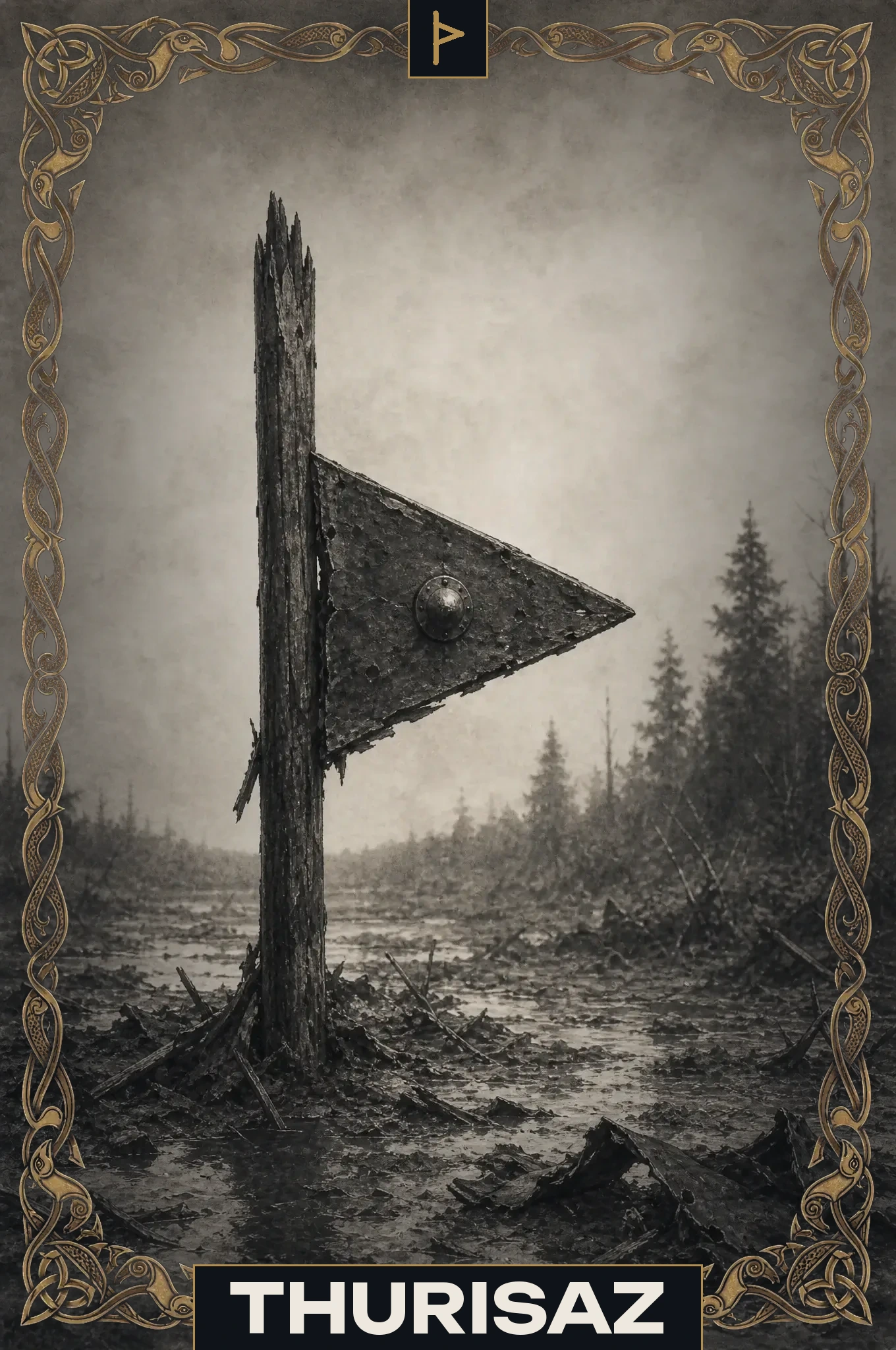
What Rune Thurisaz Means
Thurisaz is named after the Thurs — giants who in Norse mythology embodied the raw, irrational force of nature: cold, avalanches, storms. This force was not negotiated with; one either defended against it or perished. Hence, the first layer of the rune's meaning is danger that cannot be ignored.
The second layer is the thorn itself, a plant's defense. A thorn does not attack first; it only wounds those who touch it. Therefore, Thurisaz is rarely read as pure aggression: it is more often a force placed to guard a boundary, not a force for attack.
The third knot of meaning is the hammer used to control this elemental power. The rune answers the question, "Do you have the resolve to face what is coming?" and warns: softness will not help here; resistance is precisely what is needed.
 Free to try · Rune tattoo
A tattoo sketch with the Thurisaz rune
AI will draw a tattoo sketch with this rune in the style you pick
Free to try · Rune tattoo
A tattoo sketch with the Thurisaz rune
AI will draw a tattoo sketch with this rune in the style you pick
How Thurisaz Looks and How to Draw It Correctly
The inscription of Thurisaz is ᚦ: a vertical trunk and a triangular thorn attached to it on the right, approximately halfway up, with the point facing outwards. The shape resembles a spearhead attached to a shaft, or a prickle on a stem.
Write from top to bottom: first the trunk, then the triangle on the right, from the top of the trunk to its middle and back to the base. The thorn points strictly to the right — this is the check for correct writing. If the triangle is turned to the left or down, the symbol is read as reversed.
On our card, Thurisaz is depicted as a broken spear stuck in the ground — the vertical trunk — and a triangular shield fragment leaning against it, which forms the thorn. The setting is the edge of a forest after a skirmish: the scene shows that the defense has already taken place, not just brewing.
Thurisaz Upright
Upright Thurisaz says: a confrontation is ahead, and you cannot buy your way out of it with concessions. This is the rune of the border — the place where you need to say "no," defend your territory, and respond to pressure with equal pressure. It's not about war for war's sake, but about necessary toughness where softness will be misinterpreted as weakness.
It often appears as a warning: danger is near, and it's visible if you don't close your eyes. In this sense, Thurisaz is more honest than many runes — it doesn't promise an easy path, but it gives you time to prepare.
There is also a narrower meaning — a test. The situation checks if a person has the will to go all the way. Upright Thurisaz usually answers that the will is there, but it will require focus, not the usual reaction.
Thurisaz Reversed
Reversed Thurisaz is a thorn turned inward. The force that was supposed to protect begins to wound its own owner: a conflict is initiated without cause, irritation is vented not at the one who caused it, and defense turns into an attack out of nowhere.
A second common reading is a trap or vulnerability. Danger that a person did not notice in time: deception, a setup, a situation where resistance was no longer possible. Here, reversed Thurisaz acts as a belated warning: the blow has been missed, now it's important not to make it worse.
A third option is paralysis of will before a conflict. Instead of holding the line or retreating consciously, a person gets stuck between two decisions and endures both. Reversed Thurisaz in such a position advises not to be a hero, but to withdraw from a fight that cannot be won.
Thurisaz in Relationships and Feelings
In a relationship reading, upright Thurisaz indicates tension that doesn't necessarily destroy: a quarrel after which it becomes clearer whose boundaries are whose, attraction with friction, an argument backed by real passion. This rune is rarely about a calm, smooth connection — rather, it's about two people having to defend their space from each other.
When asked about a person's feelings, upright Thurisaz can also signify a protective instinct: they are not letting you get too close too quickly because they are protecting themselves — this is not always indifference.
Reversed Thurisaz in a couple is much more alarming: a scandal that hurts rather than clarifies, an attempt to control through pressure, a relationship as a battlefield with no winner. Sometimes it speaks of self-protection taken to the point of isolation: a person has fenced themselves off with thorns from everyone, including those who are sincerely close.
Thurisaz in Work and Money
In a business context, upright Thurisaz is almost always about competition: to maintain your position, project, or client, you'll have to defend them explicitly, not expect everything to resolve itself. It fits well with questions about negotiations requiring firmness, and about defending your terms against someone trying to push theirs.
This is the rune of justified risk: you can act, but be prepared for resistance, not expecting an easy victory. For hiring, it often signifies a trial interview or a competition where the toughest candidate wins.
Reversed Thurisaz in financial matters warns of a conflict that will cost more than a compromise would: a lawsuit, a scandal with a partner, an ill-considered decision under pressure of the moment. It can also mean sabotage from within – it's worth checking who in the project is against you.
Thurisaz – Yes or No
Thurisaz doesn't give a simple answer – it replies 'Yes, but only if you're ready to defend it.' If the question is about decisive action, a dispute, refusal, or competition – yes, act, but be collected and without illusions of an easy victory.
Reversed Thurisaz is closer to 'No': not now, not in this configuration, the risk of being hit first is too great. Especially if the question concerns a conflict you are initiating yourself – the rune advises to cool down.
In readings about love and gentle topics, Thurisaz is almost always a signal to slow down: it indicates hidden tension that should be clarified before saying a final 'yes'.
If Thurisaz Appears in a Reading
In the past position, Thurisaz speaks of an old clash that still affects the present: a long-held grievance, a struggle from which a person emerged wary. In the present position – that tension is active right now, and you can't afford to ignore it. In the future position, it warns of an impending clash: there's time to prepare, but usually no time to avoid it.
Thurisaz first in a reading sets the tone for the entire reading: be alert from the very beginning, the situation will require firmness. Thurisaz last in a reading means the outcome will have to be defended, not just received.
If the rune appears for a neutral question, interpret it as advice: there's a boundary nearby that you haven't tested in a long time. Perhaps now is the time to do it.
Combinations of Thurisaz with Other Runes
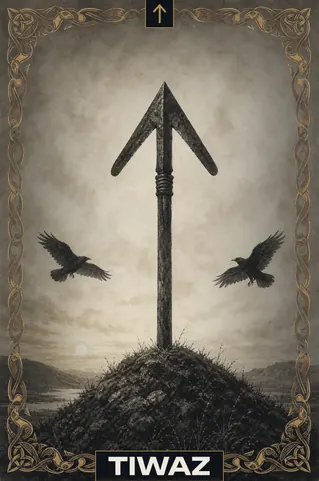
Thurisaz and Teyvaz – a conflict resolved fairly: a court case, an honest duel, a dispute where righteousness matters more than strength.
Thurisaz and Uruz – raw, tested strength: physical confrontation, working at the limit of capabilities, a clash that tempers.
Thurisaz and Nauthiz – a forced struggle: fighting not by choice, but because there's no other way, circumstances leave no options.
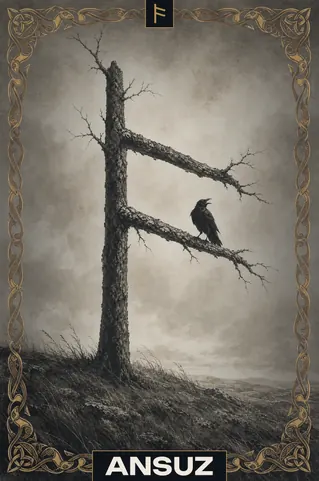
Thurisaz and Ansuz – a conflict resolved by words: negotiations instead of a fight, wise advice defuses an argument.
Thurisaz and Hagalaz – an unexpected blow: an accident, a scandal, a natural disaster on top of existing tension.
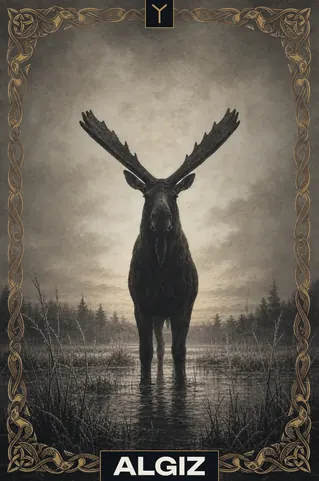
Thurisaz and Algiz – a repelled attack: the counterattack was timely and the defense worked, the danger has passed.
Thurisaz and Gebo – a dispute over division or agreement: conflict over who gets what.
Thurisaz as a Symbol: Talisman, Tattoo, and Amulet
Thurisaz has long been worn as an amulet on weapons and gates – places where border protection was needed, not just decoration. The meaning of the symbol in tradition is not to attract luck, but to set a boundary: to show that there is someone here to fight back.
It's important to remember the rune's dual nature: the same thorn that protects the owner also wounds the one who handles it carelessly. Therefore, Thurisaz as a personal symbol is traditionally chosen not for attack, but for strengthening one's own boundaries – in business, relationships, and decisions that are frightening to defend.
In modern practice, the symbol appears on rings, replica weapons, and military-themed tattoos. It is always inscribed upright: the inverted form changes its meaning to the opposite.
All of this is part of cultural tradition, not a way to harm anyone or force circumstances to turn out differently. The runic symbol here is a reminder of one's readiness to defend what is important, not a tool to influence others.
 Free to try · Try it
A funny caricature from a photo
AI will draw a friendly caricature — for a gift or an avatar
Free to try · Try it
A funny caricature from a photo
AI will draw a friendly caricature — for a gift or an avatar
Frequently Asked Questions About the Rune Thurisaz
What does the rune Thurisaz mean in simple terms?
Resistance and a boundary that needs to be protected. The easiest way to remember it: Thurisaz isn't 'there will be a fight,' but 'there's a border nearby, and it's up to you whether to hold it or give it up.'
Is Thurisaz Thor's Rune?
The rune is directly named after the Thurs giants, not the god Thor, but in folk tradition, they are often linked: Thor was precisely the one who held the Thurs back with his hammer. Therefore, the symbolism of strength that curbs chaos is justly applied to Thurisaz.
What does reversed Thurisaz mean?
Strength directed the wrong way: unprovoked aggression, a trap not seen in time, or paralysis of will before a conflict. It's not always an external danger – sometimes the thorn wounds its own master.
Is Thurisaz in a relationship reading bad?
Not necessarily. It more often speaks of tension that clarifies boundaries than of a breakup. But reversed Thurisaz in a pair is an alarming sign: a conflict that wounds rather than resolves the issue.
How to distinguish upright Thurisaz from reversed?
By the direction of the triangular thorn. For the upright rune, it points to the right of the shaft, like a spearhead attached to a shaft. If the triangle points left or down – the rune is reversed.
Thurisaz appeared first in the reading – what does that mean?
That the situation from the very beginning requires firmness and readiness to defend oneself. In the first position, this rune sets the tone: be alert, the rest of the reading will be interpreted through the prism of this warning.