What the Dagaz Rune Means
Dagaz is named after the day, but it would be more accurate to say—after the dawn. For the Nordic peoples, a day was divided not by a smooth scale, but by two states: darkness and light, and the transition between them took mere minutes. Dagaz describes not the day as twelve hours, but this very moment of transition—when one state sharply changes into another.
Hence its main difference from runes of growth like Jera or Ingwaz: those speak of gradual maturation, Dagaz—of a leap. It's not about a matter slowly moving towards resolution, but about the resolution arriving suddenly, without warning. Yesterday was unclear, today it's clear; yesterday was a dead end, today a door has opened.
Dagaz stands second-to-last in the sequence, before Othala—the ancestral home. This makes sense: before returning to one's roots, one must live to see the dawn, see the path clearly. In a spread, it almost always answers the question "when will this change?”—and its answer is always one: it has already begun.
 Free to try · Rune tattoo
A tattoo sketch with the Dagaz rune
AI will draw a tattoo sketch with this rune in the style you pick
Free to try · Rune tattoo
A tattoo sketch with the Dagaz rune
AI will draw a tattoo sketch with this rune in the style you pick
How Dagaz Looks and How to Draw It Correctly
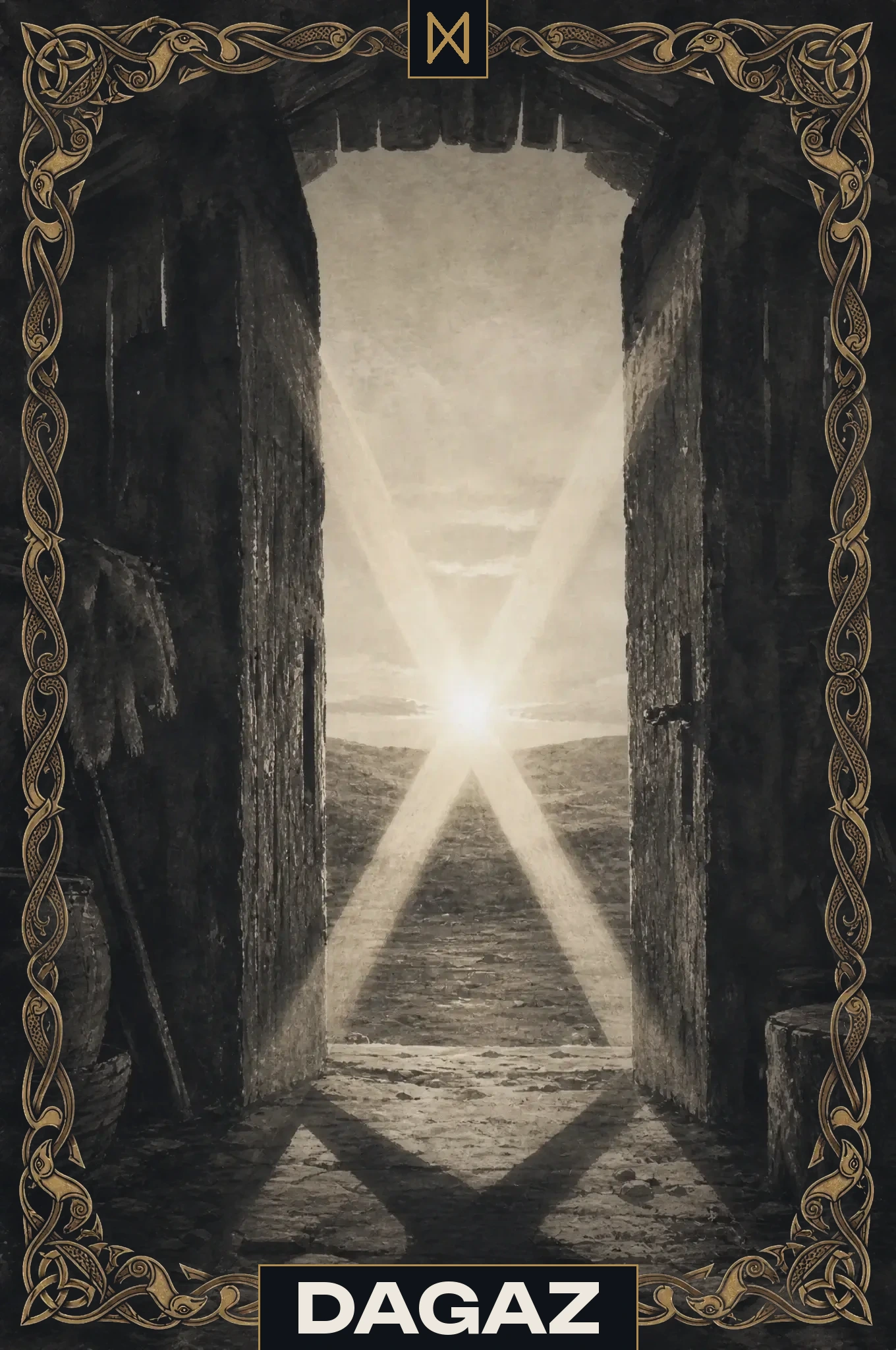
The inscription of Dagaz is ᛞ: two equal triangles converging at their vertices at one point in the center, like an hourglass or a butterfly with spread wings. No trunk, no obvious branches—only two wedges, mirror images of each other.
Dagaz is written with four short strokes from the center outwards: first the upper stroke to the left and the upper stroke to the right, then the lower stroke to the left and the lower stroke to the right, so that two equal triangles are formed. The order of strokes doesn't matter—what's important is that the wedges are of equal size: a skewed Dagaz ceases to be read as the sign of day.
On our card, the rune is formed by the doorway of a long house at dawn: the jambs form the vertical boundaries, and the two rays of the first sun, falling crosswise over the threshold, form the wedges of the symbol itself. This is not decoration—this is how Dagaz works: light enters precisely where there is a threshold that can be crossed. The symbol is so symmetrical that it cannot be drawn "the wrong way"—turn it at any angle, and you will see the same rune.
Dagaz in the Upright Position
In a spread, Dagaz is one of the most hopeful signs in the entire Futhark. It says: what was dragging on and not moving has started to move. A situation that seemed hopeless suddenly becomes clear—not because someone worked hard for a long time, but because the time came, and the light broke through on its own.
This is the rune of awakening, not the result of someone else's effort. It often appears to those who have been doubting, procrastinating, or afraid to start: Dagaz says that the hesitation is over and the path is finally visible. Unlike Isa, which asks you to wait, Dagaz answers the same question in the exact opposite way—the time has come, act now while the light is still on.
An important feature of Dagaz is that it almost never predicts gradual changes. If the rune appears in a spread for a long-term outcome, read it as a point, not a segment: a specific day, conversation, or decision after which everything will be different than it was.
Why Dagaz Has No Inverted Position
Dagaz has no inverted form: its symbol is two equal triangles converging at one point, and no matter how you turn it, you get the same drawing. In this sense, Dagaz is even more symmetrical than most other runes without an inverted position—not only does the top match the bottom, but the left half matches the right half.
Many interpreters do not find a dark side to Dagaz at all—it is considered one of the few runes that remains favorable almost always. However, it is not read without nuance. The place of the inverted meaning is taken by light that one is not ready for: a change that occurred too abruptly and is therefore frightening; clarity that a person refuses to notice because it is more convenient to remain in twilight; a decision made in haste simply because "it's finally possible."
This shadow is read through the neighboring runes in the spread. Next to heavy runes like Hagalaz or Nauthiz, Dagaz's dawn becomes harsh: the change will come whether you want it to or not, and it's better to prepare in advance. Next to runes of growth and joy, it remains what it seems at first glance—a pure, unreserved promise that the darkness is behind.
Dagaz in Relationships and Feelings
In a relationship spread, Dagaz almost always signifies a moment of clarity. Long-term uncertainty—"love or not," "is it worth continuing"—ends: the answer becomes obvious to both, and there's no need to guess anymore. It often appears before reconciliation after a quarrel, before a confession, before a decision to move in together or break up—it doesn't matter what the outcome will be, what matters is that the doubts have ended.
To the question about another person's feelings, Dagaz answers: they have understood—what was vague before has become clear to them. This could mean "understood that they love" or "understood that it's time to let go"; the rune is about the moment of insight itself, not its content, so it's important to look at the neighboring cards.
If the spread was about stagnation, Dagaz is the best possible rune: it promises an end to a prolonged pause. The only caution is not to confuse sudden clarity with haste: a decision made at dawn should be reviewed when the day has fully dawned.
Dagaz in Work and Money
In business, Dagaz signifies a turning point for the better that arrives sharply: a deal that has been stalled for months suddenly closes in one conversation; a project that was stuck in place gets a boost; a person who couldn't find a job suddenly receives an offer. It is one of the few runes that promises not gradual growth, but a leap.
To the question "when," Dagaz almost always answers "soon, and you will feel it immediately"—not after months of preparation, but as a turning point within a single day. Therefore, it fits well with questions about negotiations, interviews, and launches: if something has been in limbo for a long time, this rune indicates that the wait is almost over.
There is also practical advice within its meaning. Since the turning point comes suddenly, one should be prepared for it in advance: don't postpone your resume, don't delay with an offer, keep your affairs in a state from which they can be quickly brought to completion. Dagaz rarely gives time to ramp up after the door has opened.
Dagaz—Yes or No
Dagaz is a firm yes, and perhaps one of the most unequivocally positive runes in the Futhark when answering a direct question. It doesn't just agree; it clarifies: yes, precisely now, the moment is right, there's no need to delay.
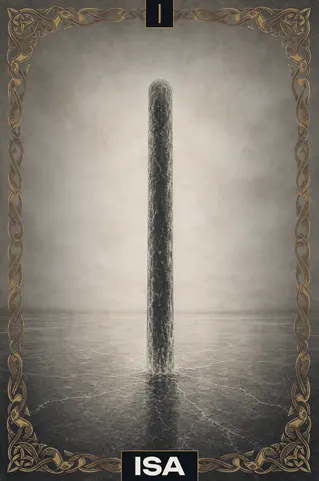
It is the direct opposite of Isa: where Isa asks you to wait until the appointed time, Dagaz answers that the time has already come. If both runes appear together in one spread, it means that the long pause has finally ended and it's time to act.
The only caveat concerns long-term questions—"will it work out in a year." Dagaz answers well about the moment, but poorly describes the process afterward: yes, it will start successfully, but what happens next will be shown by the neighboring runes.
If Dagaz Appears in a Spread
In the past position, Dagaz indicates that the current situation has already experienced its turning point—a sharp event after which everything changed, and you are still living in its aftermath. In the present position, it means literally the same as its name: the turning point is happening right now, you are standing on the threshold and see it more clearly than a week ago. In the future position, Dagaz promises not gradual improvement, but a specific moment that will put everything in its place.
Dagaz, appearing first in a spread, sets the tone for the entire reading: the topic will unfold through sudden clarity, not through long work. Dagaz, appearing last, is one of the best possible endings: the question concludes not with doubt, but with a bright, clear answer.
If heavy runes like Hagalaz, Nauthiz, or Isa lie next to Dagaz, the turning point will still occur, but read it as liberation after a difficult period, not as an easy victory. Next to Sol or Jera, Dagaz is strengthened: the change will come quickly and bring exactly what was expected.
Dagaz Combinations with Other Runes
Dagaz and Fehu — a breakthrough to prosperity: the streak of no money has ended, and profit comes suddenly, not gradually.
Dagaz and Isa — dawn after a long freeze: what has stood still for months suddenly moves in one day.
Dagaz and Eihwaz — long patience is finally rewarded with a breakthrough: the transition that endurance has prepared comes all at once.
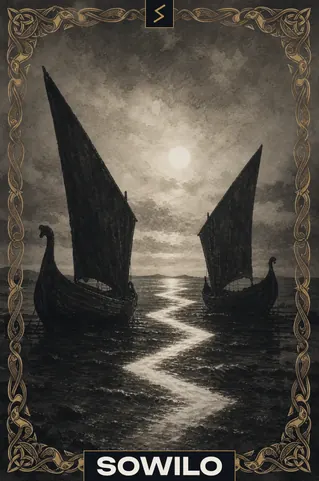
Dagaz and Sowilo — double light: success that is visible to all and comes quickly, without a prolonged struggle for it.
Dagaz and Hagalaz — relief immediately after the shock: the storm has subsided, and the first clear day comes without delay.
Dagaz and Nauthiz — the end of forced waiting: the need that kept you in place finally lets go.
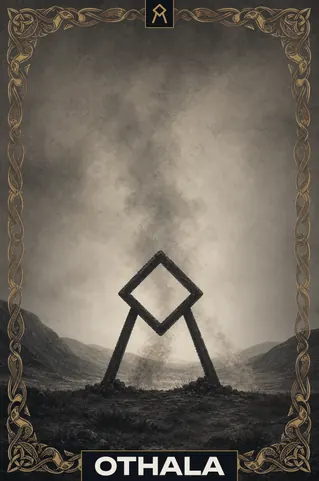
Dagaz and Othala — a new day for home and kin: moving, starting life in a new place, or returning to roots that has been brewing for a long time.
Dagaz as a sign: talisman, tattoo, and amulet
Dagaz is one of the most frequently chosen runes as a personal sign: its shape is intuitively understood even without explanation, as a symbol of hope and a new beginning. In tradition, the sign was applied to the lintels and thresholds of houses — not by chance, because it is the threshold that first meets the light of the coming day.
The symmetry of Dagaz makes it a convenient talisman in the literal sense: the sign cannot be applied "the wrong way," it is the same at any turn. Therefore, it is often chosen by those who are going through a difficult period and want a reminder that a breakthrough will come, even if it is not visible now.
All this is part of cultural tradition, not a way to speed up events or guarantee a change for the better. The sign of Dagaz should be understood as a reminder: dawn comes by itself, regardless of whether you are ready for it or not — and the best thing you can do is meet it with open eyes.
 Free to try · Try it
A funny caricature from a photo
AI will draw a friendly caricature — for a gift or an avatar
Free to try · Try it
A funny caricature from a photo
AI will draw a friendly caricature — for a gift or an avatar
Frequently asked questions about the rune Dagaz
What does the rune Dagaz mean in simple terms?
A sharp breakthrough for the better: a moment when uncertainty suddenly gives way to clarity, and stagnation to movement. The easiest way to remember it is: Dagaz is not "it will gradually get better," but "it will change right now."
Does the rune Dagaz have an inverted position?
No. The Dagaz sign is two equal triangles converging at one point and is symmetrical at any turn. It has almost no dark shade: even in a difficult environment, Dagaz promises change, only more abrupt and requiring preparation.
Is Dagaz a good rune?
Yes, one of the most favorable in the Futhark. It signifies the end of prolonged waiting and the onset of clarity, not loss or destruction — the outcome is almost always positive.
Dagaz in a relationship reading — what does it mean?
A moment when doubts end and the answer becomes obvious to both. It could be reconciliation, confession, or a decision to part ways — the rune speaks of clarity itself, not its content.
How is Dagaz different from Isa?
These are almost opposite runes. Isa asks to wait because the moment has not yet come; Dagaz says that the moment has already come and action is needed now, without delay.
Dagaz fell last in the spread — what does it mean?
One of the best possible outcomes: the issue will be resolved not by doubt, but by a clear, bright answer. Prolonged uncertainty is coming to an end.