What the Rune Isa Means
Isa is the rune of ice, and its entire meaning is encoded in this name. For the northern peoples, ice was not a decoration of winter, but a boundary of the possible: rivers froze, fjords iced over, trade and travel between farms stopped. The world did not disappear — it froze until the time came, and it is this state that Isa describes most accurately.
It is important to distinguish Isa's pause from destruction. Ice does not burn or destroy — it holds things as they are until the thaw comes. A frozen river will flow again in the spring, and what was frozen — a plan, a feeling, a business — may return in its original form.
In the Futhark sequence, Isa stands apart: after the turbulent Hagalaz and Nauthiz, it interrupts movement with a sharp, silent line. In a spread, it almost always signifies a pause, not an end — the only question is how long this pause will last and what you are doing while you wait.
 Free to try · Rune tattoo
A tattoo sketch with the Isa rune
AI will draw a tattoo sketch with this rune in the style you pick
Free to try · Rune tattoo
A tattoo sketch with the Isa rune
AI will draw a tattoo sketch with this rune in the style you pick
How Isa Looks and How to Draw It Correctly
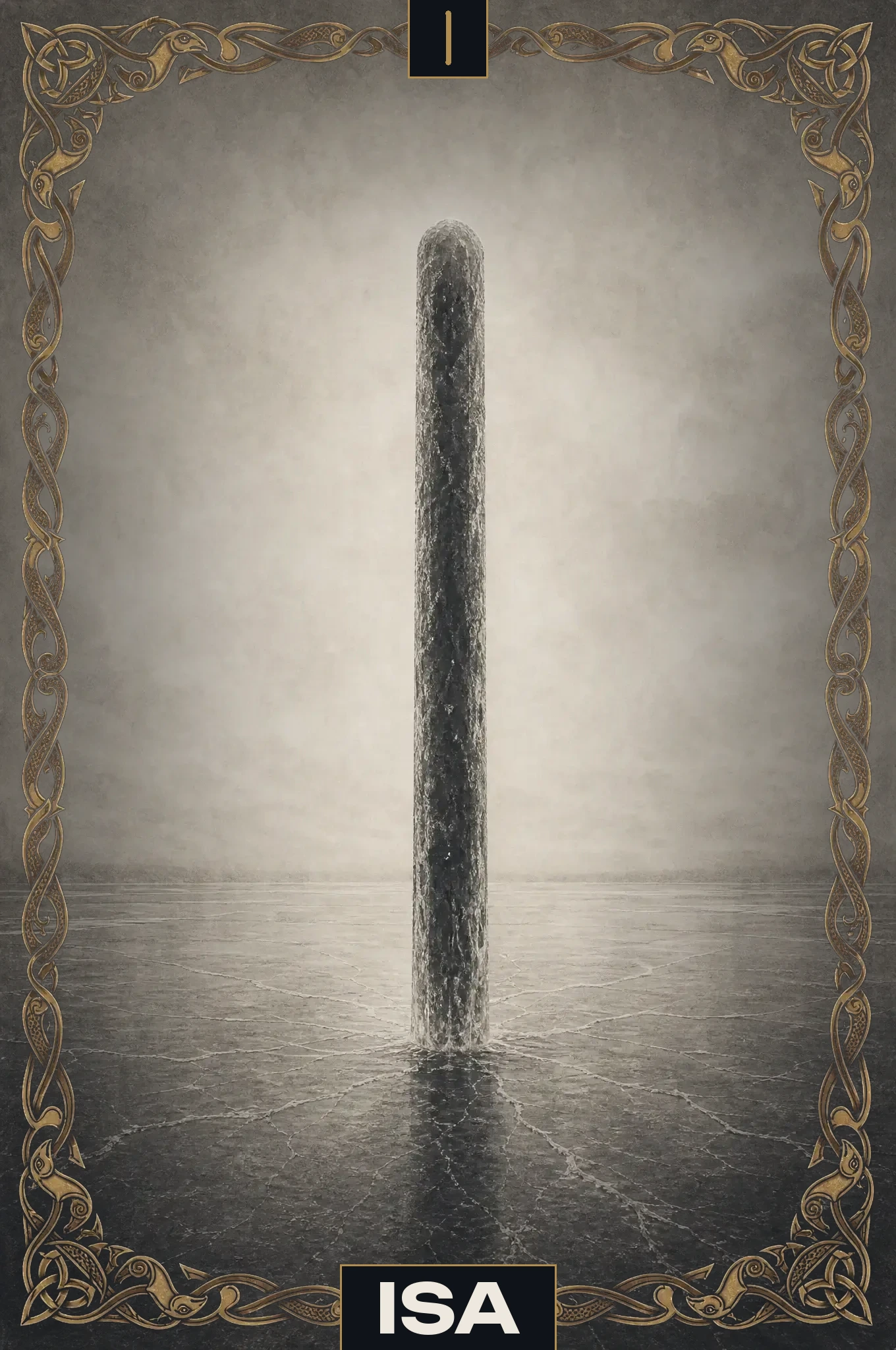
The inscription of Isa is ᛁ: a single vertical line without a single branch. This is the simplest sign in the entire Futhark, and there is meaning in this: ice does not create patterns, it covers the surface with a smooth canvas.
Isa is written in one movement from top to bottom, without lifting the pen. There is no technique here — the difficulty lies elsewhere: the line has no top or bottom that are different from each other. Rotate it one hundred and eighty degrees — and you get the same line.
On our card, Isa is carved as a pillar of ice frozen into a lake: cracks spread from it to the sides, and the sky above it is white and flat, like frozen water. The symmetry of the sign here is not an artist's whim, but a property of ice itself — it freezes evenly, without top or bottom, and therefore this rune, unlike most others, never had a reversed form.
Isa in the Upright Position
Since Isa has no reversed form, its only position is its full meaning. An upright Isa says: now is the time to stand, not to walk. Not because the path is closed forever, but because the ice has not yet melted — acting prematurely means breaking through and losing strength.
This is not a passive rune in the sense of complete inaction. Isa is about conscious stopping: it asks you to assess the situation, gather strength, and wait for the right moment. A frozen river still carries water under the ice — movement continues, it is just hidden from view.
Often, Isa appears when a person is rushing things. It answers not "no," but "not now": the contract will be signed, but not this week; the relationship will become clear, but not in this conversation. To ignore its advice is to waste energy on ice that will not move ahead of time anyway.
Why Isa Has No Reversed Position
Nine runes of the Futhark do not have a reversed inscription, and Isa is the most illustrative case: it is a straight line, and a straight line cannot be turned to get a different sign. Rotate it however you want — it will be the same line. Tradition does not write a reversed meaning for Isa precisely for this reason: there is physically nothing to flip.
But this does not mean that ice has only one shade. Where other runes have a reversed position for a difficult meaning, Isa takes on this role through neighboring runes and its place in the spread. The same pause next to runes of growth is read as a well-deserved rest before a new step. The same pause next to Hagalaz, Nauthiz, or another Isa is no longer a pause, but getting stuck: the ice does not melt for too long, and the business, relationship, or project freezes seriously.
Therefore, when working with Isa, one looks not at the position of the line, but at the context: what surrounds the ice and in what position in the spread it lies. This is the "shadow" side of Isa — not a reversed sign, but a prolonged winter.
Isa in Relationships and Feelings
In a relationship spread, Isa almost always indicates a cooling off — not necessarily a breakup, but a pause in warmth. Communication has become less frequent, conversations shorter, feelings seem to have receded into the background. This is not a verdict, but a state to be endured, not immediately fixed.
Often, Isa indicates that one of the two has consciously taken a break: tired, wants to think, afraid to take a step. Rushing at this moment is pointless — ice thaws on its own when its time comes, not when you start poking it.
To the question "have feelings cooled down," Isa does not give a definitive "yes" or "no." It says: there is less movement between you now than before, and this is noticeable to both. What happens next is decided by neighboring runes and whether both are investing in the pause or have already gone their separate ways.
Isa in Work and Money
In business, Isa reads straightforwardly: the project is stalled. Negotiations are delayed, there is no response from the client, payment is late, the launch is postponed — all this is its domain. The reason is usually not you: something in the system has frozen on its own, and rushing it means wasting energy in vain.
There is only one tactic with Isa — not to force it, but to use the pause. While the deal is not moving, there is time to recalculate the budget, refine the plan, and gather patience before the next step. Ice holds, but also protects: nothing spoils underneath it, money and agreements are simply waiting for their time.
Fussing works worst with Isa. Pressuring the client, calling every day, changing the plan on the fly — the surest way to prolong the freeze. The rune advises what is most difficult in business: to wait, without losing sight of the matter, but also without pressuring it.
Isa — Yes or No
Isa is no, but more precisely "not now." It almost never answers a question with a final refusal: it says that the moment for action has not yet come, and asks you to wait for a more favorable time.
If the question is "should I act right now," Isa answers a firm "no" — and in this sense, it is one of the most unambiguous runes of the Futhark. But if you ask "will it work in principle," the answer shifts: yes, but later and without haste.
In spreads where speed is important — a quick deal, an urgent conversation — Isa reads almost as a warning: not now, postpone. In long-term spreads, it is softer: a pause that simply needs to be endured without losing anything.
If Isa Falls in a Spread
The position of Isa in a spread almost entirely determines how to read it. In the past position, it says that the situation has already gone through stagnation — and what is happening now is largely a consequence of that pause. In the present position, Isa describes the literal state of affairs: movement is stopped right now. In the future position, it warns: do not expect quick results, a pause awaits, not the finale.
Isa appearing first in a spread is a signal to slow down from the very beginning: before taking any action, it is worth assessing the situation and waiting for a clearer moment. Isa appearing last is a sign that the issue will end not with a solution, but with a state of waiting that will last for some time.
If runes of growth — Yera, Soulou, Wunjo — lie next to Isa, the pause is read as temporary and beneficial. If Hagalaz, Nauthiz, or another Isa is nearby, the stagnation may drag on, and then the rune advises not just to wait, but to figure out what exactly is keeping the matter frozen.
Combinations of Isa with Other Runes
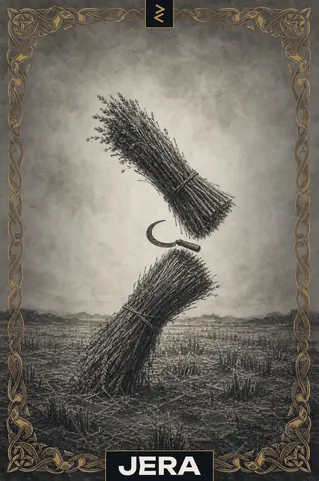
Isa and Jera — stagnation before harvest: a pause, which is inevitably followed by reward if endured to the end.
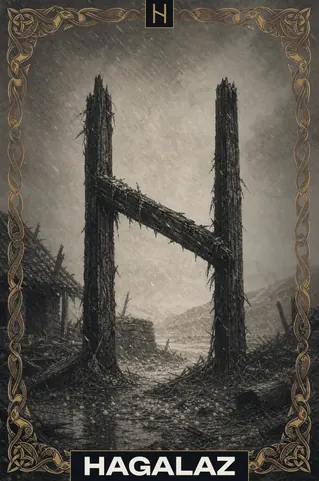
Isa and Hagalaz — double stop: not just a pause, but a destructive stagnation that needs to be dealt with, not waited out.
Isa and Nauthiz — forced waiting: circumstances hold tighter than desired, and it's pointless to rush them.
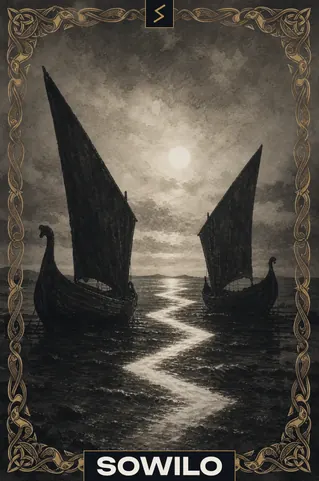
Isa and Sowilo — ice about to break: after a pause comes noticeable, warm success.
Isa and Dagaz — a sharp turn after a long freeze: what has been stagnant for months suddenly moves in one day.
Isa and Ansuz — news will come, but not now: a temporary silence in correspondence or conversation, not a break in connection.
Isa and Raidho — a road or matter stuck on the way: the path is not lost, but temporarily impassable.
Isa as a symbol: amulet, tattoo, and charm
Isa is less often chosen than other runes as a personal talisman for luck — and this is logical: it's not about acquisition, but about pause. However, it is worn as a sign of patience — by those who need not to rush in life or in business right now, but to wait.
In tradition, the sign was applied to things that were meant to be preserved untouched: to pantries, to supplies, to property boundaries. The meaning was not to "stop time," but to "protect what already exists until the right moment" — just as ice covers a river in winter.
It's almost impossible to draw Isa incorrectly: it has no top or bottom, so you can't make a mistake in the direction of the line, unlike most other runes in the row.
All of this is part of cultural tradition, not a way to influence events. The sign of Isa should be perceived as a reminder: not every stop needs to be overcome immediately, sometimes it's better to let it run its course.
 Free to try · Try it
A funny caricature from a photo
AI will draw a friendly caricature — for a gift or an avatar
Free to try · Try it
A funny caricature from a photo
AI will draw a friendly caricature — for a gift or an avatar
Frequently asked questions about the rune Isa
What does the rune Isa mean in simple terms?
Stoppage and waiting: movement has frozen, like a river under ice, and it's pointless to rush it before its time. The easiest way to remember it is: Isa doesn't mean "nothing will work out," but "it's not time yet."
Does the rune Isa have an inverted position?
No. The inscription of Isa is a single straight vertical line, it has no top or bottom, so it is physically impossible to invert it to get a different sign. The heavy, "stagnant" shade of meaning is read not by its position, but by the neighboring runes.
Is Isa a bad rune?
No, it is a neutral rune of pause. It does not promise loss by itself — it says that now is not the time to act, and asks you to wait. This interpretation only becomes difficult if runes of destruction like Hagalaz or Nauthiz are nearby.
Is Isa in a relationship reading bad?
Not necessarily. Most often it indicates a cooling off and a pause in communication, not a breakup. One of the two has taken time to think — rushing them at this moment will only prolong the freeze.
How to distinguish a direct Isa from an inverted one?
No way — and there's no mistake in that. Isa has no reverse inscription: the single vertical line looks the same at any turn. Its meaning is always the same, and the context of the spread sets the shade.
Isa came up first in the spread — what does that mean?
That you should slow down from the very beginning. The first position with Isa advises to first assess the situation and wait for a clearer moment, rather than rushing into action immediately.