What Rune Nauthiz Means
Nauthiz is a rune of lack, and this is what distinguishes it from most others: it's not about what you have, but about what you lack. The word "naud" in Northern languages meant hunger, hardship, necessity — a state where choice is narrowed down to one option, and that option is to endure.
But need in the Northern tradition also had an opposite meaning: it makes a person more mature. One who obtained fire by friction on a hungry night knows things about themselves that a well-fed person wouldn't. Nauthiz is not a curse, but a trial, and the difference between them is whether a person heard the lesson in time or missed it.
In a reading, Nauthiz rarely brings easy news. It warns: resources are less than desired, and you'll have to cope with what you have. It's the most honest rune of the row — it doesn't promise relief, it promises that resilience will pay off.
How Nauthiz Looks and How to Draw It Correctly
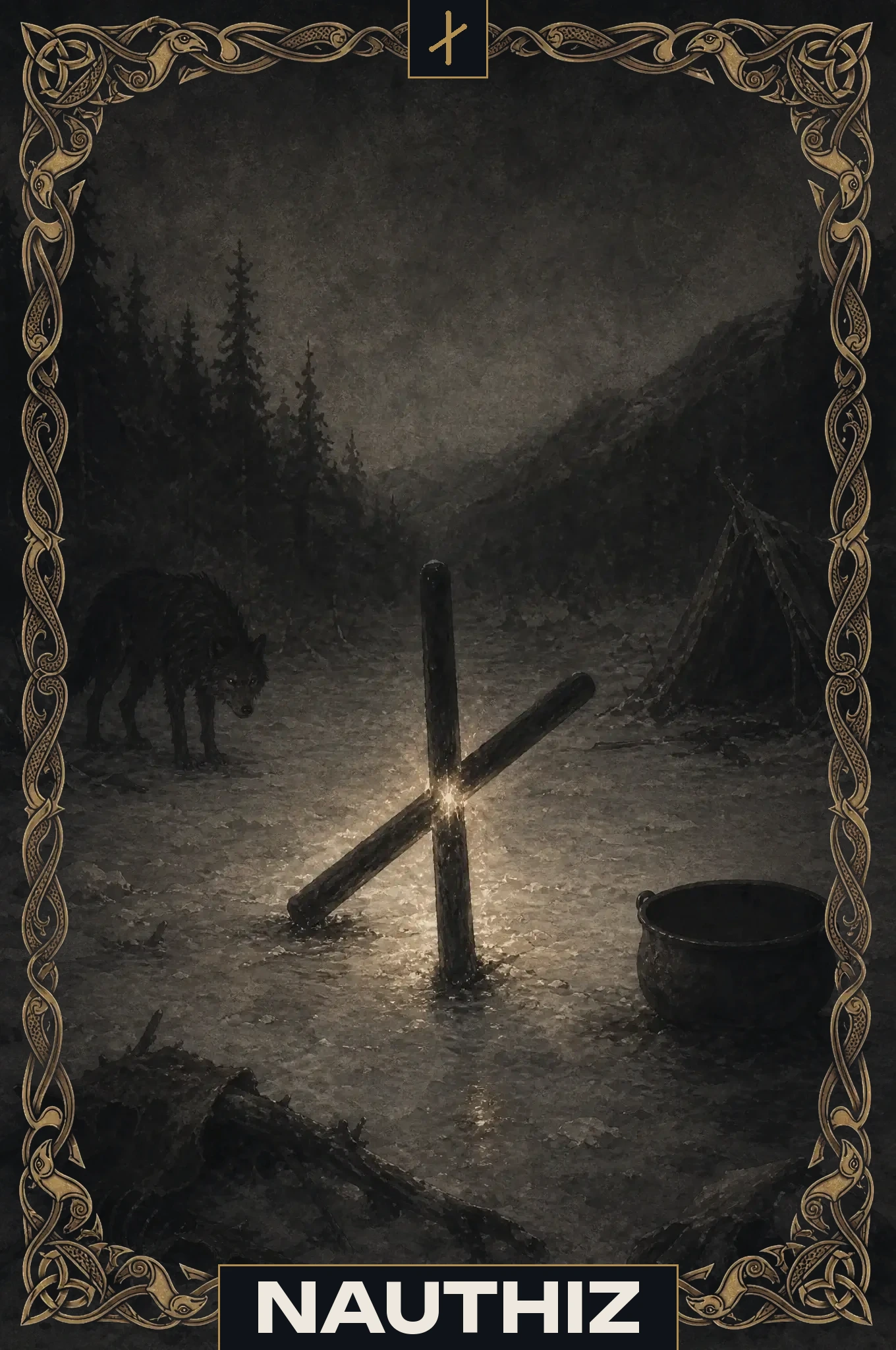
The inscription of Nauthiz is ᚾ: a vertical trunk with a short stick leaning diagonally from bottom left to top right. It's not an abstract cross, but a recognizable image: two sticks rubbed together to create fire — the bottom one lies still, the top one rests against it at an angle.
Nauthiz is written from top to bottom: first the trunk, then the diagonal, always rising from left to right, like a stick that has been pressed and is ready to be rotated. If the direction of the diagonal is reversed, the rune is read upside down — relaxed, slipped, without the necessary tension.
On our card, Nauthiz is formed from two such sticks over an extinguished fire: next to it is an empty cauldron and a wolf at the edge of the forest. The scene holds the meaning of the rune without a single word — need, demanding effort here and now.
Nauthiz in Upright Position
Upright Nauthiz describes a lack that forces action. Money, time, support are less than desired, and this is not a coincidence — the rune indicates precisely such a period. But its meaning is not in deprivation itself, but in the fact that it forces discipline, which is unnecessary in times of plenty.
This is the rune of delayed reward. It rarely says "you'll get it now" — it says "be patient, and it will pay off." It often appears when a person is looking for a shortcut, and there isn't one: the only way is through restriction, which must be endured in full, without shortening.
There is also a protective meaning. Upright Nauthiz can be the very "no" that protects from the worst — an unmade purchase, an unmade deal, which will later be remembered with gratitude. The rune doesn't punish with lack — it warns with it.
Nauthiz in Reversed Position
Reversed Nauthiz is the same lack, but without a lesson. The upright rune teaches, the reversed one simply exhausts: deprivation lasts longer than necessary, and its cause is no longer in circumstances, but in the refusal to change something. If you turn the glyph on the card, the diagonal slips down-right, as if the fire-starting stick has fallen, not holding the necessary tension — there will be no more sparks until it's put back in place.
Most often, this position indicates one of two traps. The first is impatience: a person wants to rush through a difficult stage ahead of time and thereby only prolongs it. The second is the habit of enduring silently where it's long overdue to ask for help or change strategy; deprivation turns from a trial into self-sabotage.
Reversed Nauthiz doesn't say "give up." It says: the method by which you are enduring need right now isn't working, and a different one is needed — not easier, but more correct.
Nauthiz in Relationships and Feelings
In a relationship reading, Nauthiz almost always indicates a bond tested by circumstances: separation, lack of money for two, illness, long-term work apart. It's not about ease — it's about whether the feeling will endure if all comfort is removed.
Upright Nauthiz is encouraging in this sense: if two people have gone through hardship together and haven't broken up, the bond has become stronger than it would have been without the trial. It's a rune of relationships proven by deprivation, not by gifts.
Reversed Nauthiz reads more alarmingly: people stay together not out of affection, but out of need — fear of being alone, financial dependence, the habit of enduring bad treatment because leaving is harder than staying. Here it's important to distinguish: a trial that brings people closer, and a cage that is mistakenly taken for closeness.
Nauthiz in Work and Money
In matters of work and money, Nauthiz is almost literal: it's about the economy mode, about working not by calling, but by necessity, about income that has to be stretched. The upright rune does not promise quick relief, but it does promise that discipline, fully observed, will pay off when the period of need ends.
To answer the question "should I take on a difficult project?", Nauthiz answers honestly: if you take it on, it will be hard, but it is this hardship that will give you a skill that will later sustain you. It is good where the question is not about easy earnings, but about whether it is worth going through a difficult stage for the sake of the result.
Reversed Nauthiz in terms of money means a crisis that does not resolve itself: expenses are cut, but the reason for the shortage is not eliminated because it is feared to be acknowledged. This is a signal not to endure a little longer, but to re-examine the budget and find the real hole, not the habitual one.
Nauthiz — yes or no
Nauthiz in any position is more of a no, but with a different continuation. The upright rune answers "no, not now": the resource or readiness is not yet sufficient, and the answer will change if you wait and make the effort that the rune directly demands.
The reversed Nauthiz is stricter: "no, and trying to bypass this limitation by force will make things worse." It warns not to argue with circumstances, but to acknowledge them and change your approach.
The only exception is questions about readiness to endure and work for a goal. Here, the upright Nauthiz answers "yes": you will have enough resilience to get through a difficult period if you have already decided that it is worth it.
If Nauthiz falls in a spread
The position significantly changes the reading of Nauthiz. In the past, it speaks of deprivation that forged resilience: a person's current stability grew precisely from that difficult time. In the present, it means the period of need is happening right now, and the only question is whether the person will learn a lesson from it. In the future, Nauthiz warns in advance: a trial lies ahead, and it is worth conserving resources in advance, not spending them to the limit.
Nauthiz as the first rune in a spread sets the tone for the entire theme — the issue is rooted in the lack of something important from the very beginning. Nauthiz as the last rune means the outcome will come not from luck, but from how well the person endured the previous runes of the spread.
If runes of growth lie nearby, the need is temporary and already waning. If runes of loss lie nearby, the trial has not yet reached its bottom, and there is no need to rush it.
Combinations of Nauthiz with other runes
Nauthiz and Fehu — need alongside abundance: there is just enough money or resource for the necessary, without surplus. Often indicates living paycheck to paycheck or being in debt.
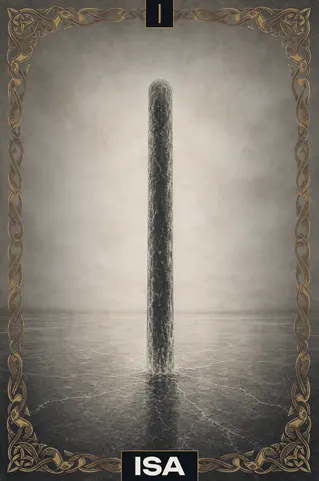
Nauthiz and Isa — frozen need: the period is not just difficult, but stagnant, when no action moves things forward.
Nauthiz and Hagalaz — trial after a sudden blow: a crisis caused not by gradual shortage, but by a sharp event that could not have been foreseen.
Nauthiz and Teyvaz — conscious sacrifice: deprivation accepted voluntarily for a goal or justice, not imposed by circumstances.
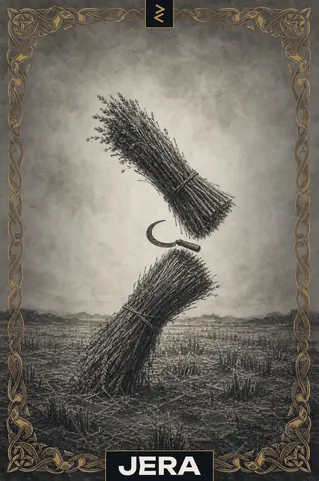
Nauthiz and Jera — a limitation with a deadline: what seems like endless endurance actually leads to a harvest if you complete the cycle.
Nauthiz and Algiz — need requiring vigilance: not a time to take risks, better to conserve what little you have and not expose yourself.
Nauthiz and Uruz — strength born from deprivation: it is in difficult times that a person finds endurance they did not suspect they possessed.
Nauthiz as a symbol: talisman, tattoo, and amulet
Nauthiz is chosen as decoration less often than other runes — its meaning is not flattering. In tradition, the symbol was applied not to something one is proud of, but to something that requires resilience: a tool, a staff on a journey, an item that must withstand a difficult season.
It is important to understand what this symbol represents. Nauthiz is not asked to "rid me of need" — the rune does not work that way, it is not a spell against hardship. It is taken as a reminder of a different kind: of one's own ability to endure, not of the desire for difficulties to disappear on their own.
In modern practice, Nauthiz is more often chosen by people who have gone through a difficult period — as a mark of a trial passed, not a plea to fate. Such a symbol should be applied upright: reversed Nauthiz carries the meaning of unfinished, slipped effort, and for a commemorative mark, this is an unsuitable interpretation.
All of this is part of cultural tradition, not a way to influence events. The runic symbol here does not protect from need or attract hardship — it only reminds of the choice a person has already made.
Frequently asked questions about the Nauthiz rune
What does the Nauthiz rune mean in simple terms?
Need that forces action, and patience that makes this need meaningful. The easiest way to remember it is: Nauthiz is not "it will be hard," but "it is hard now — and it is temporary if you endure it correctly."
Is Nauthiz a bad rune?
It is uncomfortable, but not bad. Nauthiz honestly warns of a lack of resources or strength, instead of promising an ease that will not come. Upright Nauthiz almost always indicates a trial from which one can emerge stronger.
What does reversed Nauthiz mean?
Deprivation without a lesson: the period drags on longer than necessary because the person either rushes events or endures silently where it is long overdue to change something. It is a signal to change the way of coping, not to endure in the same way even longer.
Is Nauthiz in a relationship spread good or bad?
It depends on the position. Upright Nauthiz speaks of a bond tested by difficulties and strengthened by it. Reversed Nauthiz warns: perhaps the connection is maintained not out of affection, but out of need or fear of being alone.
How to distinguish upright Nauthiz from reversed?
By the direction of the short diagonal. In the upright rune, it rises from the bottom left upwards to the right, like a stick used to start a fire. In the reversed rune, the diagonal slides down-right — the effort seems to have weakened.
Nauthiz fell first in the spread — what does that mean?
That the entire situation from the very beginning is hampered by a lack of something important — time, money, support. This sets the tone for the rest of the runes in the spread: one should look not for a quick solution, but for a way to get through the limitation.