What Rune Hagalaz Means
Hagalaz is named after hail – icy rain that falls suddenly and hits every field equally, regardless of what is sown. For a northern farmer, hail was one of the few misfortunes that could not be predicted by omens or averted by labor: it either passed by or it didn't. Hence the meaning of the rune – a force that comes from outside and does not ask for consent.
However, hail is not fire or a storm that destroys irrevocably. It is frozen water, and after ruining the harvest, it melts and goes into the soil. Hagalaz's destruction is temporary, even if it doesn't seem so at the moment of impact. The rune does not describe punishment for something done – it describes weather that happens on its own.
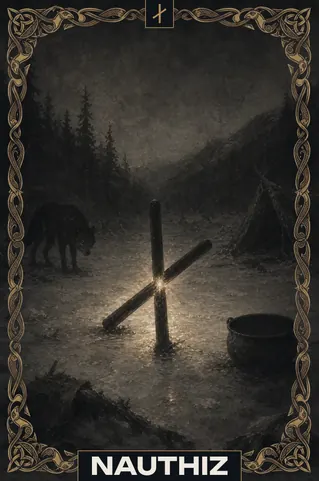
Hagalaz opens the second aettir, the row of Heimdall's runes, and this is no accident: after eight runes of growth and abundance in the first row, the conversation turns to what is not in your power. Hagalaz, Nauthiz, and Isa are traditionally read as a trio of trials – breakdown, need, stagnation – and Hagalaz is the first in it, because the blow always comes before realization.
 Free to try · Try it
You as a cartoon character
Upload a photo — AI will draw you as a cartoon hero
Free to try · Try it
You as a cartoon character
Upload a photo — AI will draw you as a cartoon hero
How Hagalaz Looks and How to Draw it Correctly
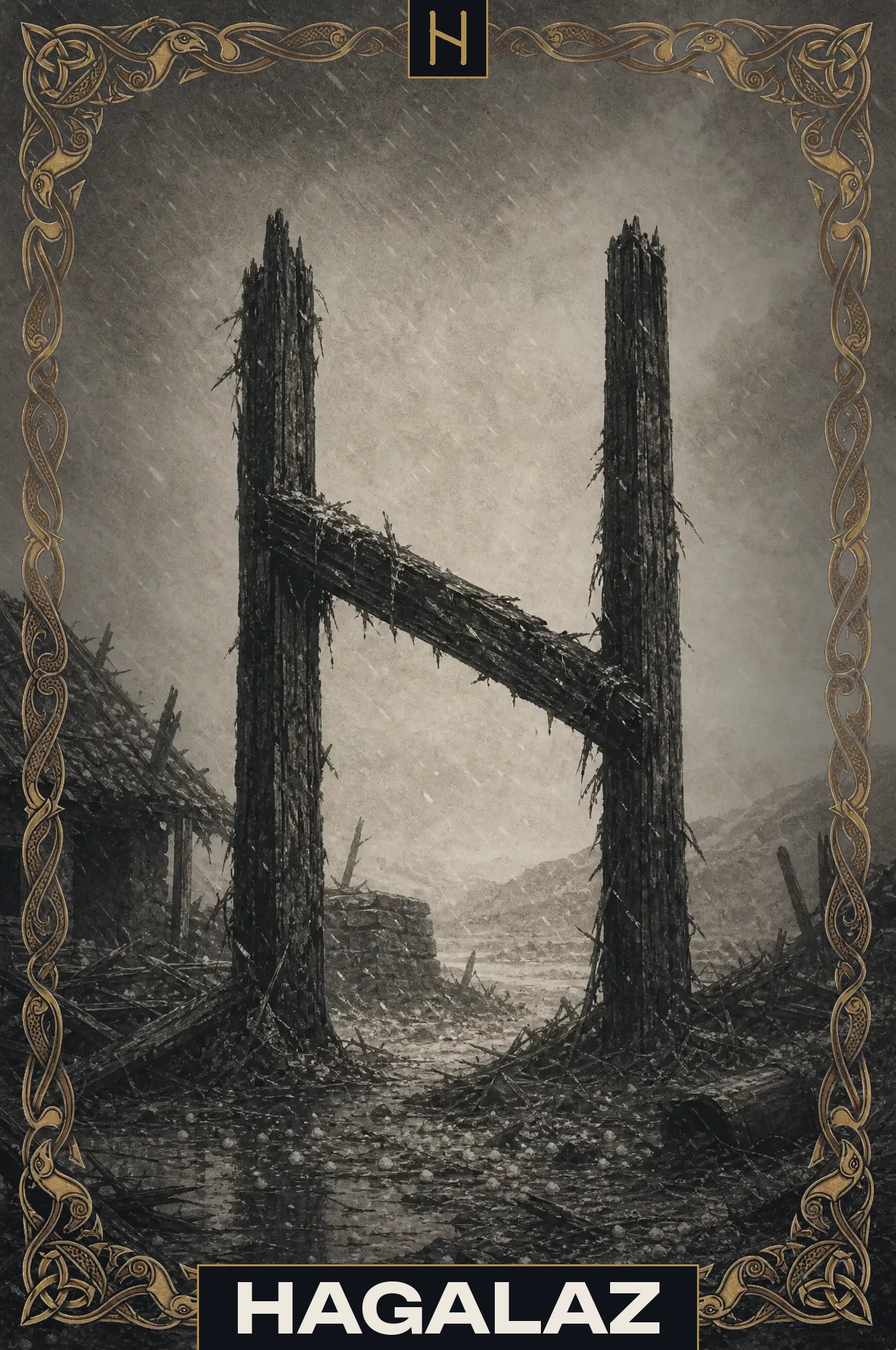
The inscription of Hagalaz is ᚺ: two vertical shafts at the same height, connected in the middle by a slanted crossbar. In silhouette, the rune resembles a slanted letter H – hence its sound remained in Latin as H.
Hagalaz is written in three movements: first the left shaft, then the right, then the diagonal between them, from the top point of one to the bottom point of the other. It is important that both shafts are strictly vertical and of the same length – otherwise the rune loses its recognizability.
It is this construction that makes Hagalaz symmetrical: rotate it 180 degrees – and it will lie on itself, the slanted crossbar does not change direction. On our map, this symmetry is read literally: two collapsed rafters of a farmstead, crushed by hail, lie vertically, and the torn crossbeam – as a slanted line between them. A ruined yard under an icy rain is a scene where the sign is formed from debris, not carved on them.
Hagalaz in Upright Position
Hagalaz has no second reading option, so its only meaning is an external event that breaks the usual course of affairs without warning. This could be illness, an accident, someone else's decision, force majeure at work – anything that happened not by your will and cannot be prevented.
The rune does not blame the one to whom it falls. It describes the weather, not an action: the blow came from outside, and the only question is how to get through it. In a spread, Hagalaz almost always advises not to be a hero or look for a culprit, but to save strength for what is truly in your hands.
There is another side. Hail ends faster than it seems at the moment of impact, and the meltwater goes into the ground and feeds the next harvest. Hagalaz rarely describes the end of a story – more often a sharp turn, after which another segment of the path begins, and what it will be like depends on the neighboring runes of the spread.
Why Hagalaz Has No Reversed Position
Hagalaz has no reversed position physically: its inscription, as described above, is symmetrical with respect to the center – turn the rune over, and it will lie on itself. Runologists consider this not a coincidence, but part of the meaning: the impact of the elements is the same, no matter which side you look at it from, hail is never "slightly softer" if you turn it over.
Tradition reads this not as a disappearance of nuances, but as a shift of focus from the rune's position to its surroundings. Instead of upright and reversed readings, the runologist looks at the neighbors: Hagalaz next to heavy runes – Nauthiz, Isa, Thurisaz – is read more harshly, as a prolonged, destructive crisis with no quick exit. Hagalaz next to runes of growth – Jera, Sowilo, Fehu – is softened to a "necessary shake-up" after which one will feel freer.
The second tool is the position in the spread. As the first rune, Hagalaz almost always sounds like a warning: prepare in advance while the storm has not yet arrived. In the last position, it is more often read as the result of what has already been experienced – a trial that a person has gone through and that has changed them more than they expected.
Hagalaz in Relationships and Feelings
In a relationship spread, Hagalaz almost never indicates a partner's fault. It speaks of external pressure: distance, interference from relatives, illness of one of the partners, circumstances that test the couple's strength, rather than someone falling out of love or cheating.
To the question about a person's feelings, Hagalaz answers evasively: now is not the time to judge by actions, because both or one of them are going through their own storm. Decisions made under hail are rarely final – it is worth waiting out the acute phase before drawing conclusions about the relationship.
For a couple already in crisis, Hagalaz can also mean a resolution: if heavy runes lie nearby, the breakup will be the very breakdown after which a new segment of life begins alone. If the neighbors are softer, it is more likely about a quarrel or a difficult period that the relationship will survive, becoming stronger.
Hagalaz in Work and Money
When asked about business, Hagalaz almost always indicates a disruption not through your fault: a canceled contract, a client's refusal, a technical failure, an inspection, a change in rules that affected the business. The rune is not about bad strategy – it's about a circumstance that could not have been foreseen.
This rune's practical advice is one: have a reserve for bad weather. Those who have a reserve – financial, time, or personnel – experience Hagalaz's blow with almost no losses. Those who worked to the limit lose more than the situation itself was worth.
In terms of money, Hagalaz reads similarly to reversed Fehu, but without its hint of carelessness: an unplanned repair, a fine, theft, a large one-time expense that you would have preferred not to incur. After it, as a rule, a more sober calculation follows – many reconsider their budget precisely after such an incident, and this is the only benefit that can be derived from the blow.
Hagalaz – Yes or No
Hagalaz's direct answer is rather no, not now: not because the intended plan is bad in itself, but because the decision depends on a circumstance that has not yet become clear. No runic tradition advises starting an important matter under hail.
If the question is "will I survive this," the answer is softer: yes, but with losses, and the outcome will differ from what was originally intended. Hagalaz honestly warns about the price, rather than forbidding action.
Neighboring runes strongly influence the answer. Next to Jera or Sowilo, Hagalaz reads as "difficult, but it will pass"; next to Nauthiz or Isa – as "wait for a calmer moment," and in this spread, it is definitely not worth rushing.
If Hagalaz Appears in a Spread
In the past position, Hagalaz says that the current situation grew out of a past shock: it was that breakdown that determined where you are now. In the present position – that the storm is happening right now, and the best tactic is to wait it out, not to force decisions. In the future position, it warns: prepare, the trial is ahead, but it will not be the end of the story.
Hagalaz as the first rune in a spread is read as a signal to prepare in advance: strengthen what can be strengthened, postpone what can be postponed. Hagalaz as the last rune in a spread is the result: the trial has been passed, and the question is closed not with the answer expected at the beginning, but with what remains afterward.
If several heavy runes lie next to Hagalaz in a row, the spread should be perceived as advice not to rush events. If there is only one heavy rune, and the rest are neutral or favorable – Hagalaz is most likely about one sharp but localized episode, not a prolonged period.
Combinations of Hagalaz with Other Runes
Hagalaz and Nauthiz — a trial that doesn't end quickly: breakdown leads to prolonged need, and the spread calls for patience.
Hagalaz and Isa — the storm has subsided, but movement hasn't resumed: the situation is frozen in uncertainty, and time is needed, not action.
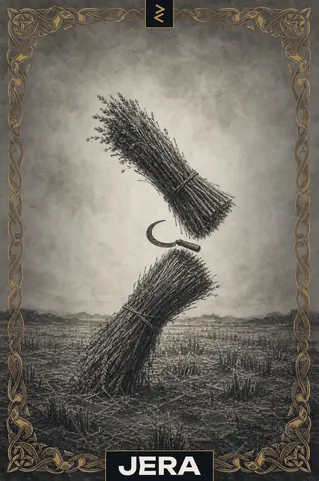
Hagalaz and Jera — a difficult year that still ends with a harvest: losses in the first half are compensated in the second.
Hagalaz and Fehu — sudden loss: breakdown, fine, circumstance that hit the wallet without warning.
Hagalaz and Sowilo — the thunderstorm disperses quickly: sharp shock is followed by equally sharp relief.
Hagalaz and Thurisaz — an external blow meets resistance: conflict or self-defense against someone else's pressure.
Hagalaz and Algiz — a trial that is endured under protection: there is support nearby — a person, home, reserve — and it takes the blow.
Hagalaz as a symbol: amulet, tattoo, and charm
Hagalaz is less common than other runes as personal adornment — by meaning, it's more of a warning sign than a wish for luck. In tradition, such runes were carved not on rings, but on doorposts and supports: not to ask for protection, but to mark a past misfortune and remind of readiness for the next.
The symmetrical shape of Hagalaz has a practical advantage for tattoos and carvings: it cannot be carved "backwards" — the rune is the same from any side, and it's physically impossible to make a directional mistake, unlike with asymmetrical signs.
The meaning invested in it today is not a charm against misfortune, but a reminder of resilience: that which has already been endured and did not break. This tradition should be understood precisely this way: part of cultural heritage, not a tool capable of averting real misfortune or changing the course of events.
 Free to try · Rune tattoo
A tattoo sketch with the Hagalaz rune
AI will draw a tattoo sketch with this rune in the style you pick
Free to try · Rune tattoo
A tattoo sketch with the Hagalaz rune
AI will draw a tattoo sketch with this rune in the style you pick
Frequently asked questions about the rune Hagalaz
What does the rune Hagalaz mean in simple terms?
A sudden trial that came through no fault of yours and cannot be prevented — like hail that beats down on a field regardless of what was sown. The destruction is temporary: the storm ends, and life goes on afterward, but differently.
Is it true that Hagalaz has no inverted position?
Yes, the rune's inscription is symmetrical: two vertical lines and a diagonal crossbar lie on themselves when rotated 180 degrees. Instead of direct and inverted readings, runologists look at the runes next to Hagalaz in a spread — they indicate whether the выпадение (reading) is heavier or softer.
Is Hagalaz a bad rune?
Not bad, but a warning one. It's not about punishment for an action, but about a circumstance that happens on its own, and that it is temporary: like hail that melts and seeps into the soil.
What to do if Hagalaz appears in a spread?
Do not force decisions and do not look for someone to blame for what happened. The best tactic is to have a reserve of time, money, or energy and wait out the acute phase before drawing conclusions or starting a new endeavor.
What does Hagalaz mean in a relationship spread?
Usually external pressure, not the partner's fault: distance, interference from loved ones, difficult circumstances that test the couple, not their feelings for each other. Decisions made in the midst of such a trial should be reconsidered later, in a calm environment.
Can the Hagalaz symbol be worn as a charm?
As part of cultural tradition — yes, but not as a way to prevent misfortune. Historically, such a symbol was carved not to ask for protection, but to mark a past trial; modern wear should be perceived the same way — as a reminder of resilience, not a magical shield.