What Rune Fehu Means
Fehu is the rune of property that a person has acquired themselves. In ancient Norse economy, cattle were the measure of all things: a herd could be counted, divided, given as wergild or dowry. Therefore, Fehu speaks not of wealth in general, but of concrete, countable prosperity—of what is already in hand.
The second half of its meaning is more important than the first. Cattle are fed, herded, treated, and hay is stored for them in winter. The wealth that Fehu describes does not lie idle but lives: it either grows or perishes, and everything depends on whether the owner invests in it. Hence, this rune's constant warning—what has been received must be maintained, otherwise it will leave as easily as it came.
Fehu stands first in the row, and this is no accident: everything else begins with a material foundation. Until there is a roof over one's head and food, talk of destiny, lineage, and spirit does not begin. In a reading, it often answers the simplest question—whether there are enough resources for what you have planned.
How Fehu Looks and How to Draw It Correctly
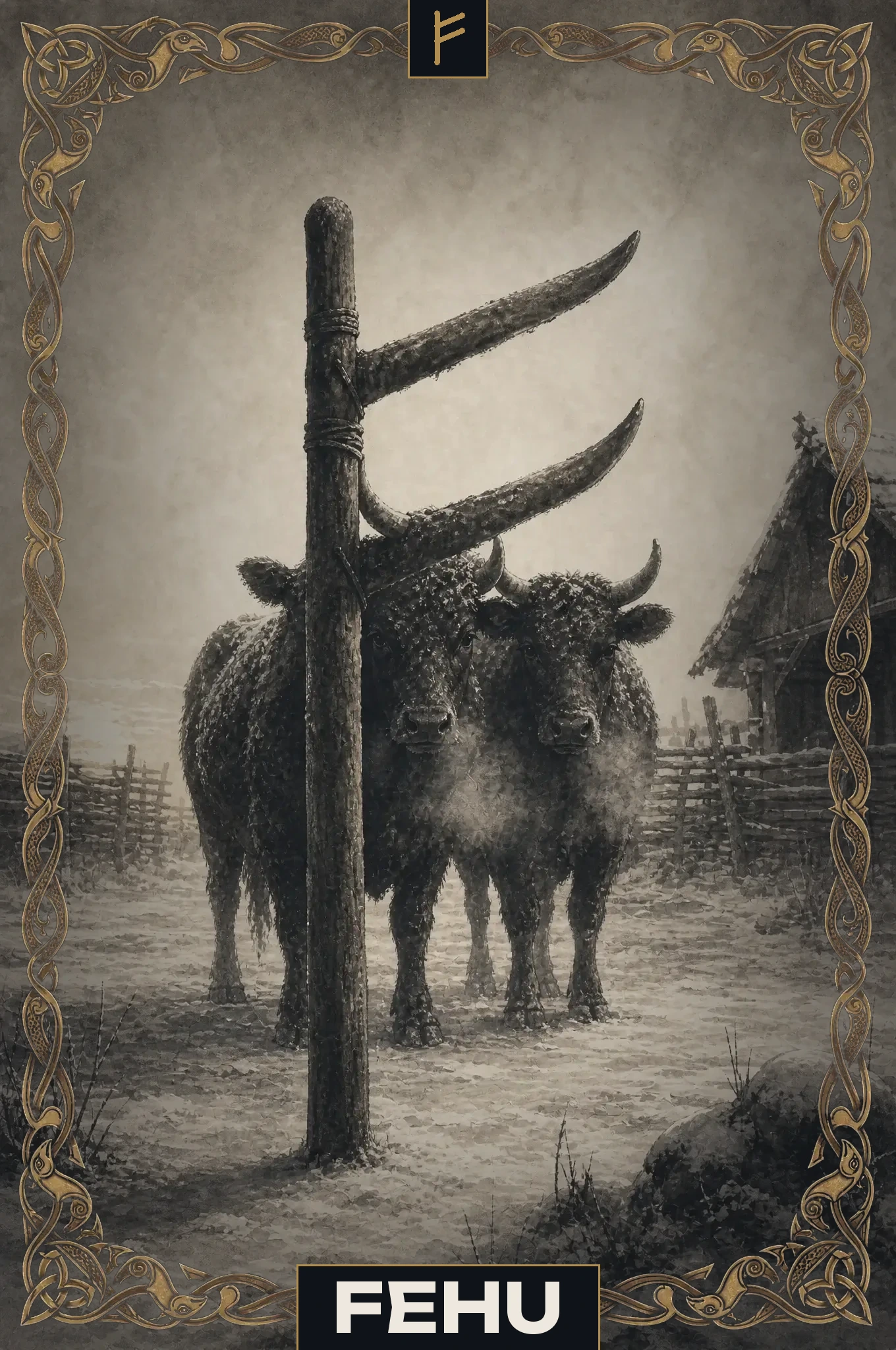
The inscription of Fehu is ᚠ: a vertical trunk and two short branches extending upwards and to the right. The upper one extends from the very top, the second—about a third of the way up. Both point upwards at the same angle, like animal horns raised to the sky.
Fehu is written from top to bottom: first the trunk, then the upper branch, then the lower one. The branches go only to the right—this is the check for correctness. If you turn them to the left, you get a different symbol; if you lower them down, the rune is read as reversed.
On our card, Fehu is carved on a horn from which grain spills—this is how the rune works: the vessel is full but tilted, and the contents do not stand still. It is impossible to mistake the position of Fehu: it is asymmetrical, it clearly has a top and bottom, and the direction of the branches always shows whether it is upright or reversed.
Fehu Upright
Upright Fehu is a good answer to almost any question about business and money. It says: there are resources, movement has begun, what you invested will return. It is the rune of the first profit, a salary after a long break, debt repayment, inheritance, a successful deal—everything that adds, not subtracts.
Its second meaning is energy, not just property. A person to whom upright Fehu appears usually has the strength for what they have planned: they are not burned out or exhausted. Therefore, the rune often answers "start now" when asked about timing.
There is a caveat. Upright Fehu promises an arrival but does not promise that it will stay. In long-term readings, it is read as a start, not an outcome: what has arrived will have to be reinvested, otherwise the next rune in the spread will show a decline.
Fehu Reversed
Reversed Fehu is a drain. Not a catastrophe or ruin, but a slow loss: money is spent on trifles, energy is wasted, investments do not return. The horn has tipped over, the grain has spilled out.
Most often, it indicates one of three situations. The first is unrewarding work: a person invests, but there is no result, and continuing in the same mode is pointless. The second is greed and hoarding: clinging to what has been acquired so tightly that it stops working. The third is other people's hands in your pocket: a contract signed without looking, a promised share, an unreturned debt.
Unlike many other runes, reversed Fehu does not forbid action—it requires recalculation. It is a rune of revision: look at where exactly the resource is going and close the leak. If loss runes appear nearby in the spread, it is worth postponing major expenses; if growth runes are nearby, it is about a temporary dip.
Fehu in Relationships and Feelings
In a relationship reading, Fehu speaks of investment. It describes a connection in which both partners invest—with time, care, daily life, money—and therefore this connection grows. Fehu is rarely about passion; it is about two people building a common household and finding joy in it.
To a question about a person's feelings, upright Fehu answers: you are valuable to them. They see in you not something fleeting, but something they want to preserve and multiply. This is a warm, reliable feeling of ownership in a good sense—"mine, I protect it."
Reversed Fehu in relationships reads differently: one gives, the second takes. A literal meaning is also possible—money as a cause of quarrels, disputes over property, a feeling of being used. Sometimes it indicates that the relationship is based on benefit and will fall apart without it. For women asking about a partner, reversed Fehu often points to stinginess—not only financial but also emotional.
Fehu in Work and Money
This is Fehu's specialized area: out of all twenty-four runes, it directly corresponds to money. In a work reading, a direct Fehu signifies a raise, bonus, promotion, successful launch, first client, or recouped investment.
For business, it's one of the best runes: it indicates that the venture is alive and profitable. For hiring – that you are valued and paid accordingly. For the question "should I take on this project" – yes, take it on, the return will be there.
An inverted Fehu regarding money is straightforward: expenses outpace income. A project consumes more than it yields; a client doesn't pay; a loan turns out to be more expensive than anticipated. It doesn't advise quitting everything – it advises sitting down and calculating. Very often, the deficit is immediately apparent once a person stops calculating "roughly".
A special case is Fehu next to runes of learning and growth. Then it's about money invested in oneself: a course, a tool, equipment. Fehu approves of such an investment even in its inverted form, because it's not going into a void.
Fehu – yes or no
A direct Fehu is a confident yes. Especially if the question concerns money, work, a purchase, or starting a business: the rune indicates that the resources are available and will be returned.
An inverted Fehu is a no, but with a clarification: not "never," but "not in this form and not now." It almost always points to a miscalculation in expenses. Recalculate – and the answer may change.
If the question is not about material matters, Fehu answers more weakly: to "does he love me," it will say "values" rather than "loves." In such readings, it's better to interpret it as a condition rather than an answer: yes, if both are investing.
If Fehu appears in a reading
The position where the rune falls changes its meaning more than you might think. In the past position, Fehu indicates that the situation had a strong material foundation – starting capital, family support, accumulated experience. In the present position – that resources are available right now, and the only question is how to manage them. In the future position, it promises an arrival: money, an item, an opportunity.
Fehu first in a reading means "begin." Fehu last means "you will receive, but you'll have to maintain it."
If the rune appears for a question where there's no money involved, interpret it more broadly: Fehu represents any resource you already possess. Health, time, connections, reputation – all fall within its domain. Often, it answers not "you will be given," but "you already have it, look more closely."
Combinations of Fehu with other runes
Fehu and Sowilo – profit that is visible to all: success, recognition, money combined with fame. One of the most favorable combinations in a business reading.
Fehu and Dagaz – a turning point towards prosperity. Dagaz signifies dawn and a sharp change, so the pair is interpreted as "the period of lack of money has ended."
Fehu and Wunjo – joy from what has been acquired: a dreamed-of purchase, a wedding, a celebration with your own money.
Fehu and Othala – money and family: inheritance, family business, help from parents, an apartment from a grandmother. A pair where you should clarify what is yours and what is shared.
Fehu and Nauthiz – need alongside abundance: just enough money for necessities. Often indicates debts.
Fehu and Hagalaz – sudden loss: breakdown, fine, an unforeseen circumstance.
Fehu and Gebo – money as a gift or joint investment: partnership, a gift, a joint contribution to a venture.
Fehu as a symbol: talisman, tattoo, and amulet
Fehu is one of the most common runes in jewelry and tattoos, and it's easy to see why: it's invoked for prosperity. Traditionally, the symbol was applied to property-related items – on a chest, on harness, on a boundary stone.
It's worth remembering that the rune's meaning is two-sided. Fehu doesn't bring money out of nowhere; it enhances what is already being done: for a working business, it increases turnover; for a stagnant one, it does nothing. Therefore, as a personal symbol, it's usually chosen by those who are starting their own ventures, not by those waiting for luck.
In modern practice, Fehu is most often found on bracelets, rings, and as a symbol on phone wallpapers. It is applied strictly upright: the inverted form of Fehu has its own meaning, and an error in the direction of the branches reverses the meaning.
All of this is part of cultural tradition, not a way to influence events. The runic symbol should be treated as a reminder of your own choices: it's about paying attention to what you already have.
Frequently asked questions about the rune Fehu
What does the rune Fehu mean in simple terms?
Property acquired by one's own hands and the energy needed to maintain it. The simplest way to remember it: Fehu doesn't mean "money will come," but "money works while you work."
Is Fehu a money rune?
Yes, out of all twenty-four runes of the Futhark, it directly corresponds to material wealth. But it describes income from business and labor, not winnings or a stroke of luck – other runes are more often responsible for unexpected external income.
What does an inverted Fehu mean?
Resource leakage: expenses outpace income, investment is not returned, energy is spent in vain. This is not a prohibition on acting, but a requirement to recalculate – most often, the budget deficit is immediately visible once you stop calculating "roughly."
Is Fehu in a relationship reading a good sign?
Yes, if the question is about the strength of the connection: the rune indicates that both parties are investing and the relationship is growing. However, it says little about passion – Fehu is about reliability and shared daily life, not about infatuation.
How to distinguish a direct Fehu from an inverted one?
By the direction of the branches. In the direct form, both short lines extend upwards and to the right from the trunk, like raised horns. If they point downwards – the rune is inverted. Fehu is asymmetrical, so it's impossible to confuse the orientation.
Fehu appeared first – what does that mean?
That the situation has a material foundation and you can begin. In the first position of a reading, this rune almost always means "you have the resources for this."