What the Gebo Rune Means
Gebo is a rune of gift, but not charity. In Germanic languages, the word that gave it its name means "to give" and "to receive" simultaneously: a gift among the northern peoples was an act that bound two people with an obligation to reciprocate. Exchanged rings — entered into a union; shared bread — took each other under protection.
Therefore, Gebo is not about generosity for its own sake, but about balance: as much as is given, so much should return, even if not immediately and not in the same way. It is responsible for deals, unions, partnerships, marriages — everything that is built on reciprocity, not on one-sided effort.
This is one of the few runes without an explicit warning: its very shape — a cross of two equal lines — already says that a tilt in such a connection is impossible by definition. If Gebo appears, the question is usually not "will they give?", but "is it in equal measure?"
 Free to try · Try it
You as a cartoon character
Upload a photo — AI will draw you as a cartoon hero
Free to try · Try it
You as a cartoon character
Upload a photo — AI will draw you as a cartoon hero
How Gebo Looks and How to Draw It Correctly
The inscription of Gebo is ᚷ: two straight strokes of equal length, intersecting exactly in the middle, like a Roman X. The rune has no trunk or branches — only two equal rays, and this is what distinguishes it from all its neighbors in the row.
Gebo is written in two movements: first a stroke from bottom-left to top-right, then from bottom-right to top-left, crossing each other. The order of strokes does not matter, but the result is always the same: no matter how you turn the finished sign, it looks the same — it has no top or bottom.
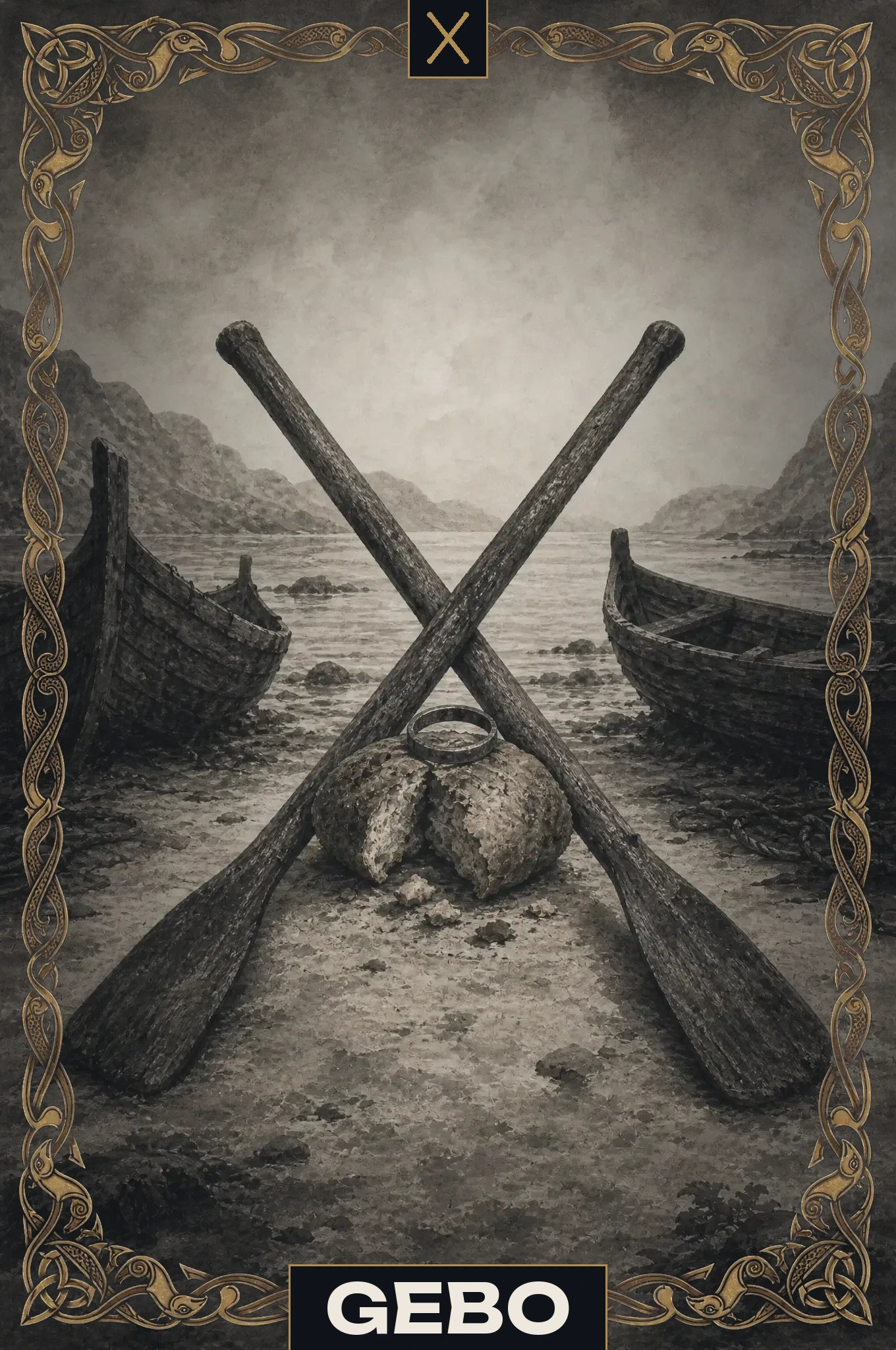
On our map, Gebo is formed from two oars crossed on the sand at the moment when the boats are approaching each other: between the oars lie broken bread and a ring — signs of the gift exchanged upon meeting. The cross of oars is the rune: the same geometry as in the sign itself, only assembled from objects of a coastal scene.
Gebo in the Upright Position
Gebo in a spread always concerns two people. It speaks of a union formed on equal terms: a partnership in business, an engagement, a contract where the terms are fair to both parties. If the question concerns a deal or relationship, Gebo is one of the most reliable signs that the parties are not deceiving each other.
Its second meaning is generosity without calculation. Sometimes the rune describes a gesture that does not require immediate return: a gift, help, hospitality. But even here, Gebo reminds us that a gift creates a bond — the recipient of help will somehow become involved in a relationship with the giver.
In a decision spread, Gebo often advises not to pull in one direction: to offer a counter-step, not just to ask or only to give.
Why Gebo Has No Reversed Position
Gebo has no physical top or bottom: its sign is a cross of two equal strokes, and no matter how you turn it, it remains the same sign. Unlike Fehu or Ansuz, whose branches clearly point in one direction, Gebo is symmetrical — therefore, tradition has never interpreted it reversed.
But this does not mean that a gift has a dark side. The place of the reversed position is taken by reversed interpretation: the same meaning of exchange, only distorted by context. A gift given not out of goodwill, but out of fear or calculation. A service for which disproportionately much is expected. A contract signed without looking.
This is read not by Gebo itself, but by its neighbors in the spread. Next to runes of need and destruction, it indicates that there is an exchange, but it is unequal, and someone pays more than they receive. Next to runes of growth and joy — on the contrary, it confirms that the balance is maintained.
Gebo in Relationships and Feelings
In a relationship spread, Gebo is one of the most favorable runes: it describes a connection where both invest equally. Not "who loves more", but an honest exchange of attention, time, care. It often appears when asking about engagement or proposal — historically, a ring was the very gift that sealed a union.
If the question is about the feelings of another person, Gebo answers: they are ready to reciprocate, but they also expect it from you. This is not a rune of unrequited love — its meaning falls apart where only one gives.
In the company of difficult runes, Gebo warns of an unequal exchange: one in the couple gives too much, and the other takes it for granted. Then you should ask not "do I love?", but "am I being reciprocated?"
Gebo in Work and Money
For business matters, Gebo is a rune of honest deals. It answers well questions about partnerships, joint projects, contracts: if the terms are fair to both parties, the deal will work out. It is not a rune of individual success, but of results achieved together or as a team.
It is also relevant for questions about gifts and bonuses: a bonus for work, a fee, a paid service — Gebo describes money received as an honest exchange, not as luck.
Its warning is also about balance. Next to Nauthiz or Hagalaz, Gebo indicates a deal where one party contributes a disproportionately larger share than the other — an unfavorable partnership, not fraud as such. It is worth reconsidering the terms before signing.
Gebo — Yes or No
Gebo almost always answers yes if the question concerns a union, a deal, or an exchange on equal terms. It is never sharply negative — the very nature of the rune is about balance, not prohibition.
But its "yes" has a condition: it is valid only if both parties contribute equally. If the question is "will I receive without giving anything in return?", Gebo answers with a soft "no" — not because they will refuse, but because one-sided calculation is alien to this rune.
In the company of difficult neighbors, the answer shifts to a cautious "yes, but check the terms" — the exchange will take place, but it is not certain that it will be equal.
If Gebo Appears in a Spread
In the past position, Gebo indicates that the current situation grew out of an honest deal or an equal union — an obligation that is still valid. In the present position — that an exchange is currently taking place: you are either giving or receiving, and it is worth checking if the balance is maintained. In the future position, Gebo promises a new union or offer that is worth accepting if the terms are fair.
Gebo sets the tone for the entire spread: the issue will be resolved through agreement, not through one-sided effort. Gebo concludes the spread — what you invested will be returned proportionally.
If the rune appears for a question without a second party — for example, about a personal decision — interpret it as advice: seek a partner or advisor, do not decide alone.
Combinations of Gebo with Other Runes
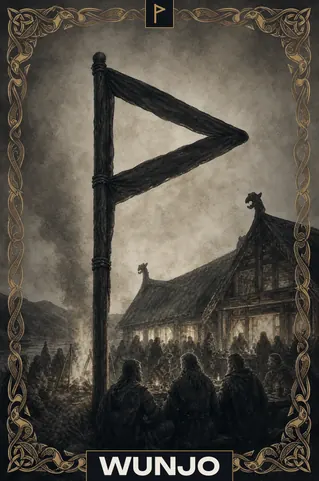
Gebo and Wunjo — a joyful, light union: a partnership or relationship where both sides feel good effortlessly.
Gebo and Fehu — a deal that brings mutual profit: a fair division of money or a stake in a business.
Gebo and Ansuz — a contract sealed with a word: an oral agreement that both parties uphold more strongly than paper.
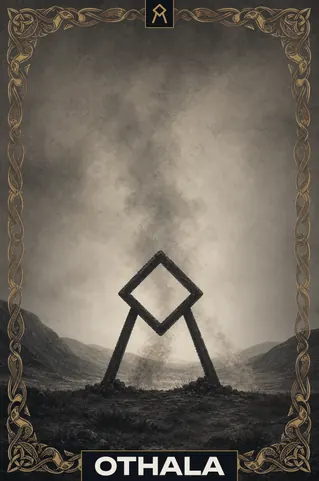
Gebo and Othala — a gift received by inheritance: an exchange within the family, help from parents, a family business for two.
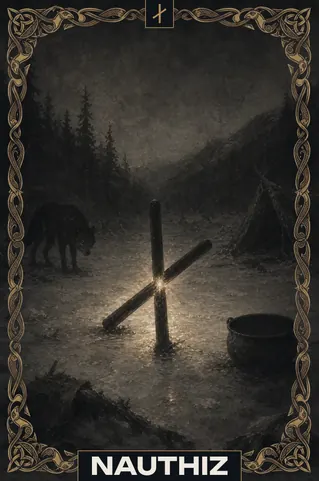
Gebo and Nauthiz — an exchange dictated by need, not desire: a favor done unwillingly.
Gebo and Hagalaz — a broken agreement: a deal ruined by external circumstances.
Gebo and Mannaz — a union important not only for two, but for the entire community: a partnership that others will notice and acknowledge.
Gebo as a symbol: a talisman, tattoo, and amulet
Gebo is often chosen for matching jewelry — pendants for two, wedding engravings, friendship symbols: a cross of two equal lines is read as a sign of an honest union even without explanation. In tradition, the symbol was applied to items of exchange — on dishes for a feast, on ceremonial weapons, on wedding rings.
Gebo has no reversed aspect, so it's impossible to misinterpret its position — a rare practical convenience among runes. This also makes it a symbol of stability: the connection it protects is not overturned by circumstances.
All of this is part of cultural tradition, not a way to force someone to love you back or ensure a profitable deal. A Gebo amulet should be understood as a reminder to keep your word, not as a guarantee that it will be kept for you.
 Free to try · Rune tattoo
A tattoo sketch with the Gebo rune
AI will draw a tattoo sketch with this rune in the style you pick
Free to try · Rune tattoo
A tattoo sketch with the Gebo rune
AI will draw a tattoo sketch with this rune in the style you pick
Frequently asked questions about the Gebo rune
What does the Gebo rune mean in simple terms?
A gift and equal exchange: a connection where both parties give and both receive. The easiest way to remember it: Gebo is not 'I was given,' but 'we exchanged.'
Why doesn't Gebo have a reversed position?
Because its symbol is a cross of two equal strokes, symmetrical at any rotation: a reversed Gebo is indistinguishable from a direct one. Tradition interprets the dark side of a gift not through reversal, but through neighboring runes in a spread.
Is Gebo a rune of love or money?
Both, if it's about honest exchange: engagement, marriage, business partnership, a fair deal. It poorly describes one-sided love or income without contribution — where only one gives, the meaning of Gebo doesn't apply.
How to distinguish Gebo from other runes?
By its symmetrical cross: two equal strokes intersecting at an angle, with no distinct top or bottom. It's the only rune in the first aett with this shape — it's difficult to confuse it with its neighbors in the row.
Gebo came up first in the spread — what does it mean?
That the situation is based on an agreement or an equal union, and the entire spread should be read through the prism of balance — who invests how much and whether they receive the same in return.
Is Gebo in a spread a good sign?
Almost always yes, if the terms of the exchange are fair for both parties. Caution is needed only when difficult runes are nearby — then the gift may turn out to be imposed rather than freely given.