What the Four of Cups means in Tarot
The upright Four of Cups describes a state where everything seems sufficient, but there is no joy. Before the hero of the card stand three cups — what is already there and working: relationships, work, the usual routine. But the gaze is directed not at them, but inward, and he simply turns away from the offered fourth cup.
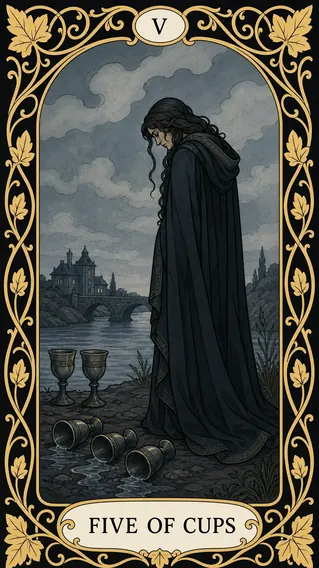
An important nuance that is lost in retellings: the card is not about the absence of opportunities, but about the inability to notice them. A hand from a cloud reaches out a cup — meaning the chance is already there, it's just not being looked at. This is how the Four differs from cards of true lack like the Five of Cups: there, there is truly nothing to take; here, one does not want to reach out.
It is worth noting the scale immediately: this is a Minor Arcana, and it describes not fate or character for years to come, but a specific segment — a week, a conversation, a period when interest in what previously brought joy disappears. A Major Arcana like the Moon speaks of prolonged self-deception; the Four of Cups is about a specific episode of fatigue, from which one usually emerges on their own, without a major breakdown.
Reversed Four of Cups: meaning
The reversed Four of Cups is read in one of two directions, and the context of the spread helps to distinguish them.
- Apathy begins to fade. The person finally lifts their head and notices what they were offered long ago: interest, an invitation, an option that was previously overlooked.
- Apathy has hardened. Instead of a temporary slump, it becomes a habit of not reacting to anything at all; the state drags on for months, and the person no longer notices that nothing brings them joy.
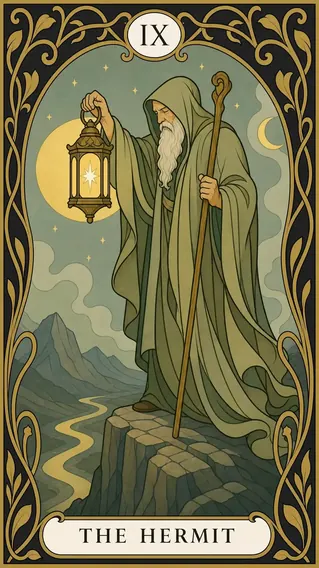
The difference is usually visible in neighboring cards: next to active Wands or Swords — it is more likely an awakening; next to the Moon, the Hermit, or other cards of stagnation — it is more likely the second option. If the same meaning of "I am indifferent to everything" repeats in consecutive spreads, this is a reason not for a new spread, but for self-reflection outside of the cards: prolonged indifference to everything is treated not by divination, but by talking to a specialist.
The Four of Cups in a "yes or no" spread
In "yes/no" spreads, the Four of Cups leans towards no — not because the event is impossible, but because the person being asked will likely not notice the moment and will not react in time. The card describes not an external obstacle, but an internal lack of engagement.
The answer becomes more definite if the question is about an initiative or a conversation that needs to be started by oneself: here the card directly answers "not now," until the indifference passes. If the question concerns an offer made by someone else, the answer is more likely "yes, the offer will come," it's just not a fact that it will be accepted.
The reversed position shifts the answer to a more favorable one: since the apathy is fading, the chance of noticing the offer and reacting is higher.
The Four of Cups in relationships and feelings
In relationships, the upright Four of Cups is not about a breakup or betrayal, but about emotional numbness within generally normal relationships. One of the partners (or both) stops reacting to what previously touched them: words, attempts to get closer, signs of attention are perceived with indifference not because they have become bad, but because perception has temporarily dulled.
For single people, the card in this position often describes fatigue from dating: offers exist, but there is no desire to respond to them, and the person is more likely to close off than to respond to affection.
In the position of feelings, the Four of Cups is precisely indifference, not cooled-down love: the feeling has not gone anywhere, it is obscured by fatigue or resentment that has not been talked about. The difference is important: cooled-down feelings require a decision, dulled ones require a pause and self-care.
The reversed card in a couple is the moment when one of the partners begins to notice the other again: writes first, suggests a meeting, returns to conversation after a lull.
The Four of Cups in work and money
In a career spread, the Four of Cups is burnout out of nowhere: the work hasn't changed, the tasks are the same, but the interest is gone. Often the card appears for those who are formally satisfied with everything but cannot explain where the irritation with routine tasks came from.
A separate plot is a missed offer: a career chance, an offer, an interesting project arrive exactly at the moment when one doesn't want to change anything, and the person refuses or delays the answer, even though the offer is objectively good.
In money, the card does not speak of a lack — rather of inertia: income is stable, but there is neither pleasure from spending nor a desire to deal with finances. The Five of Cups nearby intensifies this to regret over what was missed; the Nine or Ten of Cups nearby is a sign that the fatigue is against a background of abundance, not poverty.
The reversed Four of Cups in work is the moment when the offer is finally accepted, albeit with a delay.
The Four of Cups as a person: man and woman
In the "what kind of person" position, the Four of Cups describes someone who is currently closed off and not reacting to external signals — not out of spite, but out of fatigue. Such a person may not respond to invitations for months, not because they don't value the company, but because it is difficult for them to want anything at all.
The Four of Cups man in a spread is thoughtful, withdrawn, often literally with arms crossed: it is difficult to start a conversation with him not because he is dissatisfied with the interlocutor, but because he has nothing to say right now.
The Four of Cups woman is someone who is tired of responding to others' expectations and has temporarily switched off from paying attention to others, including those who are sincerely offering her something.
This is a description of a temporary state, not a character: the same person in another spread can easily appear as an active Three or Six of Cups.
The Four of Cups in the position of thoughts
Sa posisyon ng mga kaisipan, ipinapakita ng card ang mental na pag-ikot sa iisang bagay: ang tao ay paulit-ulit na iniisip ang mga bagay na hindi niya ikinatuwa, ngunit hindi lumalampas sa pagrereklamo sa kanyang sarili. Hindi ito pagkabalisa gaya ng sa Swords, at hindi rin plano gaya ng sa Pentacles — ito ay ang pagkakadikit sa iisang lugar.
Kadalasan, nasa likod nito ang isang hindi nasabing pagkadismaya: may inaasahan, ngunit nakakuha ng resulta na gumagana naman pero walang gana, at sa halip na tanggapin ito, patuloy na iniisip na "may mali," nang hindi tinutukoy kung ano mismo.
Isang kapaki-pakinabang na tanong sa sarili sa posisyong ito: ano ba talaga ang kulang — hindi sa abstrakto, kundi sa kongkretong paraan. Hangga't walang sagot, ang mga kaisipan ay patuloy na iikot sa bilog.
Ano ang gagawin kung lumabas ang Four of Cups
Ang payo ng card ay simple at hindi masyadong kaaya-aya: mapansin ang ikaapat na tasa. Halos palaging may alok, opsyon, o tao na sa tabi na hindi lang pinapansin dahil ang tingin ay nakatuon sa loob, sa sariling pagkadismaya.
Ano ang dapat gawin nang konkreto:
- Tukuyin kung ano ang eksaktong hindi ikinatuwa. Ang "pagod na ako sa lahat" ay hindi diagnosis, kundi paraan para hindi harapin ang problema. Halos palaging may konkretong dahilan.
- Suriin kung may napalampas na totoong alok. Imbitasyon, usapan, o opsyon na iniiwasan — minsan ang kawalan ng gana ay nagsisilbing dahilan para hindi tumugon.
- Huwag ipagpalit ang pahinga sa desisyon. Hindi dapat magbitiw sa trabaho, makipaghiwalay, o tumanggi sa mahahalagang bagay habang nasa ganitong estado: ang mga desisyong ginawa dahil sa pagod ay madalas na pinagsisisihan.
- Bigyan ang sarili ng oras para maka-recover, huwag patagalin ang pagbagsak. Ang pahinga, pagtulog, o pagbabago ng kapaligiran sa loob ng ilang araw ay mas epektibo kaysa sa pilitin ang sarili na maging masaya.
At bukod pa rito: kung ang kawalan ng pakialam ay hindi lang isang yugto kundi isang matagal na estado — kung saan walang nagpapasaya sa loob ng ilang linggo o buwan at nawala ang interes sa lahat ng bagay — hindi ito dahilan para sa bagong reading, kundi dahilan para kumunsulta sa isang eksperto. Ang card ay mahusay na naglalarawan ng pansamantalang pagkapagod; ang matagal na kawalan ng interes sa lahat ay maaaring sintomas na dapat tugunan ng mga psychologist at doktor, hindi ng panghuhula.
Ano ang nakaguhit sa card
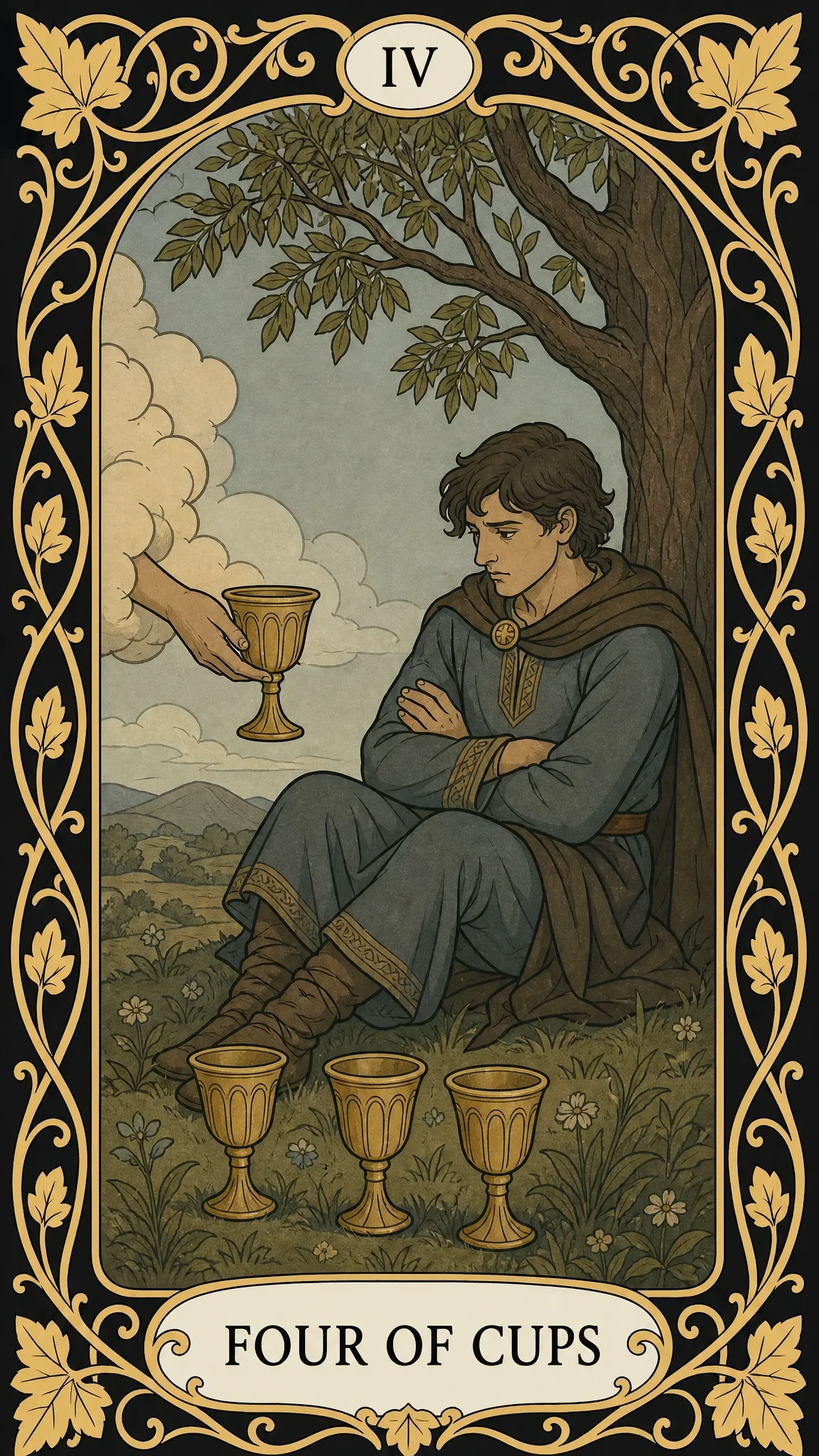
Sa ating Four of Cups, isang binata na nakasuot ng kulay abong-asul na damit ang nakaupo sa damuhan sa ilalim ng malaking puno, na nakapamewang ang mga braso. Nakayuko ang kanyang tingin, ang mukha ay seryoso at nakasimangot: hindi siya nakatingin sa labas, kundi tila sa loob ng kanyang sarili.
Ganito binabasa ang eksena:
- Tatlong tasa sa lupa sa harap niya — ang mga bagay na mayroon na at nakuha na: nakatayo ang mga ito nang maayos, walang kumukuha. Ang kalmadong "mayroon na" na ito ang lumilikha ng pakiramdam ng pagkabusog, kung saan nagtatago ang pagkabagot.
- Ang ikaapat na tasa mula sa kamay sa ulap — isang bagong oportunidad, na inaalok na parang galing kung saan, nang walang pagsisikap mula sa kanya.
- Nakapamewang na mga braso at nakayukong tingin — ang bida ay pisikal na sarado sa alok: hindi man lang tumitingin sa direksyon ng tasa, kahit na malapit lang ito.
- Puno sa itaas ng ulo — silungan at bitag din: ang lilim ay komportable, ngunit ito mismo ang humahadlang para makita ang nangyayari sa liwanag.
- Kalmadong tanawin sa malayo — mga burol, bulaklak, walang panganib; ang kawalan ng gana rito ay hindi dahil sa mabibigat na pangyayari, kundi sa kabila ng kawalan nito.
Sa itaas ng card ay ang Roman numeral na IV, sa ibaba ay ang pangalang Ingles na FOUR OF CUPS: ang ating deck ay iginuhit sa tradisyon ng Rider-Waite, kung saan ganito ang label sa ikaapat na numerong card ng suit ng Cups.
Four of Cups bilang card of the day
Bilang card of the day, ang Four of Cups ay hindi nagbabala tungkol sa masasamang pangyayari, kundi tungkol sa panganib na hindi mapansin ang mga ito. Malamang, sa loob ng araw ay magkakaroon ng kahit isang maliit na alok — makipagkita, sumubok, sumagot sa mensahe — na gugustuhin mong awtomatikong palampasin.
Kapaki-pakinabang na mindset: ngayong araw, dapat mong sadyang tingnan ang mga inaalok bago tumanggi nang awtomatiko. At huwag pilitin ang sarili na maging masaya — kung ang araw ay nararamdaman mong walang gana, ito ay normal na pansamantalang estado, hindi dahilan para mabahala.
Mga madalas itanong tungkol sa Four of Cups
Ito ba ay Major o Minor Arcana?
Minor Arcana ng suit ng Cups, elementong Tubig. May kabuuang 56 na Minor Arcana — 14 sa bawat apat na suit, dagdagan pa ng 22 Major Arcana, kaya may kabuuang 78 na card sa deck.
Ano ang pagkakaiba ng Four of Cups sa Four of Swords?
Ang Four of Swords ay isang malay na pahinga: ang tao ay sadyang nagpapahinga pagkatapos ng pagsisikap upang maka-recover, at ito ay kanyang pinili. Ang Four of Cups ay hindi piniling pahinga, kundi kawalan ng gana: kawalan ng pakialam sa mga inaalok, nang walang pakiramdam na nagpapahinga ka nang sadya.
Ang Four of Cups ba ay masamang card?
Hindi. Inilalarawan nito ang pansamantalang estado ng pagkapagod at kawalan ng pokus, hindi parusa o katangian ng isang tao. Mas masama kung hindi napapansin ang estadong ito at patuloy na nabubuhay nang ganito sa loob ng maraming buwan — doon dapat pagtuunan ng pansin ang sarili, hindi ang mga card.
Ano ang ibig sabihin ng baligtad na Four of Cups?
Kadalasan — na ang kawalan ng gana ay nagsisimula nang mawala: napapansin na muli ng tao ang mga alok at interes sa buhay. Bihira — na ang kawalan ng pakialam, sa kabaligtaran, ay naging nakasanayang estado na, hindi pansamantalang pagbagsak. Nakakatulong ang mga katabing card sa reading para makilala ang pagkakaiba.
Ang Four of Cups ba ay "oo" o "hindi"?
Malamang na "hindi," at hindi dahil sa panlabas na hadlang: ipinapakita ng card na maaaring hindi mapansin ng tao ang pagkakataon o hindi makatugon sa tamang oras. Kung ang tanong ay tungkol sa inisyatibo o alok ng ibang tao — ang sagot ay malamang na positibo, ngunit walang garantiya na tatanggapin ito.