What the Four of Swords means in Tarot
Swords in Tarot are the suit of mind and conflict: arguments, decisions, difficult conversations, sharp thoughts. Almost all cards of this suit are about movement and tension, and against this background, the Four stands out sharply — it is the only sword card where a person does not act or argue, but lies motionless.
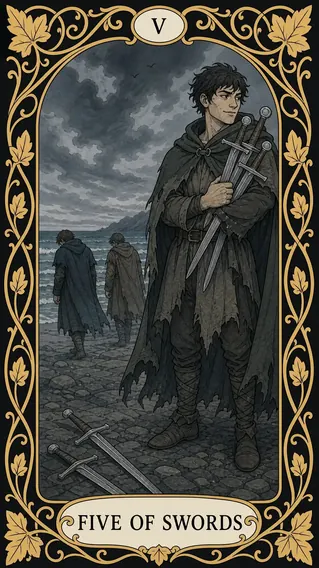
An important nuance that must be stated immediately: the minor arcana describes an episode, not a destiny. If the major Death card is about a large, irreversible transition, then the Four of Swords is about a specific week or month when, after a blow, one needs to lie down, not about the end of a story. In the sequence of the suit, the card stands after the Three of Swords — sharp pain and rupture — and before the Five of Swords, where the conflict resumes with new strength. The Four is exactly what happens between them: the body and psyche take a break because they cannot endure further without it.
The number four in Tarot is about structure and stability, like the Emperor among the major arcana. In the fiery suit of wands, it means celebration and a completed stage, and in the airy suit of swords, it means stability of a different kind: the ability to endure a pause without falling apart or pretending that everything is fine. The upright position is read unambiguously as a well-deserved, not forced, rest — the case when stopping means acting reasonably, not giving up.
Reversed Four of Swords: meaning
The reversed Four of Swords is the same need for a pause, but without the pause itself. Usually, the spread implies one of three options, and the question provides the hint.
- Returning to work sooner than one should. The rest was interrupted by someone else's demand, circumstances, or one's own guilt for "just lying there."
- Exhaustion that is not acknowledged. The person continues to work and solve problems to the limit, even though the resource has long been depleted — and this most often looks not like laziness, but like a stubborn urge to hold on until the end.
- There is rest, but no peace. Formally, a pause has been taken: vacation, sick leave, weekends — but the head still replays the same thoughts, and recovery does not happen.
There is also a softer reading: sometimes the reversed card means the end of a prolonged stagnation — the person is finally ready to get up and return to business after a long downtime. The difference is visible from the context: if the spread previously spoke of forced immobility, the reversed Four of Swords can be a relief, not an alarming sign.
Four of Swords in a "yes or no" spread
In "yes/no" spreads, the Four of Swords is usually read as not now: the card does not deny the event, but asks not to rush into it until strength is restored. If a decision is made under pressure — tired, sleep-deprived, still angry after an argument — the card directly advises postponing it until a pause, rather than acting immediately.
If the question sounds like "do I need a rest now" or "should I take a pause" — the answer is a confident yes, and often faster and more obvious than it seems to a person who is used to not stopping.
The reversed position in this spread is a warning: a decision made without rest will likely have to be reconsidered. It is worth rephrasing the question not as "should I," but as "what will change if I rest first."
Four of Swords in relationships and feelings
In a relationship spread, the upright Four of Swords most often means not a breakup, but a necessary distance: one or both partners take a pause after an argument or a difficult conversation so as not to say too much in the heat of the moment. This is a timeout card, not a breakup card — and this is its fundamental difference from much sharper cards of the suit, like the Three of Swords.
In the position of feelings, the card describes a state where there are temporarily no strong emotions at all — not because they have passed, but because the psyche has taken a break from experiencing them. For a person who has recently come out of a difficult relationship, the Four of Swords can mean a conscious pause in new acquaintances: not a rejection of feelings altogether, but time to recover before the next step.
Reversed Four of Swords in relationships — the couple is forced to reconcile or talk before either of them is ready, or one partner silently continues to experience the conflict while the other is already demanding to move on.
Four of Swords in work and money
In career spreads, the Four of Swords is sick leave, vacation, a conscious pause in a project or negotiations after an intense push. This is a recovery card after a rush, not about being fired or failing: the break is taken precisely because the matter was important and required effort.
In money, the card advises not about earnings, but about preservation: do not make financial decisions in a state of exhaustion, postpone large expenses and contracts until the moment when the head is clear again. This is not about lack of money — it is about the fact that a tired mind easily makes mistakes in calculations and deal terms.
Reversed Four of Swords in work — overwork from which one is not allowed to exit: vacation is postponed, one is returned to work before recovery, rest is perceived by the team as weakness. The result is usually the same — the body or psyche takes a pause on its own, already in the form of illness or a breakdown, if it is not given in time.
Four of Swords as a person: man and woman
When the Four of Swords appears in the "what kind of person" position, it describes not the character as a whole, but a state: someone who has closed off to recover and is not ready to argue, decide, or explain. This is not coldness or indifference — rather, it is a protective silence after overload.
A Four of Swords man is someone who withdraws into himself after a conflict or heavy load and is unavailable even to loved ones for a while, not because he is offended, but because he has run out of energy to talk. A Four of Swords woman is someone who honestly takes a pause instead of proving involvement through force, and drops out of the usual circle of affairs for a while.
It is important not to confuse this state with a permanent character trait: the card is about the current moment. As soon as the resource is restored, the person will most likely return to their usual pace — the only question is whether they will be given time for it.
Four of Swords sa posisyon ng pag-iisip
Sa posisyon ng pag-iisip, ang Four of Swords ay isang malay na pagtatangka na patahimikin ang panloob na diyalogo: masyadong maraming iniisip, masyadong matagal na nasa limitasyon, at sa wakas ay humihingi ng katahimikan ang isip sa halip na mga bagong solusyon. Hindi ito kalituhan o kawalan, kundi isang pangangailangan para sa pahinga upang maproseso ang mga naipon na.
Kung may iba pang baraha ng Swords sa tabi nito sa pagbasa — malamang na ang mga iniisip ay nababalisa pa rin at hindi pa makapagpahinga; kung katabi ng Cups o Pentacles — ang estado ay mas malapit sa mahinahon at nakapagpapanumbalik na pahinga, kung saan ang isip ay tunay na nagpapahinga at hindi lang nagkukunwari.
Ano ang gagawin kung lumabas ang Four of Swords
Ang payo ng baraha ay simple, ngunit mahirap para sa mga sanay na gawin ang lahat nang mag-isa at agad-agad: huminto sa itinakdang panahon, at hindi hanggang sa kawalan. Ang Four of Swords ay hindi tungkol sa pagtalikod sa mga gawain, kundi tungkol sa isang pahinga na may malinaw na katapusan, pagkatapos nito ay babalik ka nang may malinaw na pag-iisip.
Ano ang dapat gawin:
- Magtakda ng hangganan sa pahinga. Hindi "magpapahinga hanggang sa gumaan ang pakiramdam," kundi isang tiyak na araw o linggo — ito ang naghihiwalay sa pagbawi mula sa walang katapusang paghinto.
- Iwasan ang paggawa ng desisyon sa panahong ito. Ang mga malalaking usapan, kontrata, at pagbili ay maaaring ipagpaliban nang walang mawawala — ang pakiramdam ng pagmamadali ay karaniwang senyales lamang ng pagkapagod.
- Huwag ituring na pagkatalo ang pahinga. Ang pagpapahinga pagkatapos ng tensyon ay bahagi ng trabaho, hindi ang kabaligtaran nito; ganito rin ang pagbasa sa baraha at sa mga katabi nitong suit.
- Suriin kung ito ay tunay na pahinga o pagtakas. Kung ang pahinga ay hindi nagbibigay ng ginhawa pagkatapos ng makatwirang panahon, maaaring hindi ito pagkapagod, kundi pagkaubos (burnout) na nangangailangan ng tulong ng eksperto, hindi lang ng isa pang weekend.
Kung ang dahilan ng pagbasa ay hindi pagkapagod, kundi isang mas mabigat na sitwasyon sa kalusugan o mental, ang baraha ay hindi kapalit ng pagbisita sa doktor: ipinapakita lamang nito na humihingi ng pahinga ang katawan, hindi kung ano ang dapat gawin pagkatapos.
Ano ang nakaguhit sa baraha
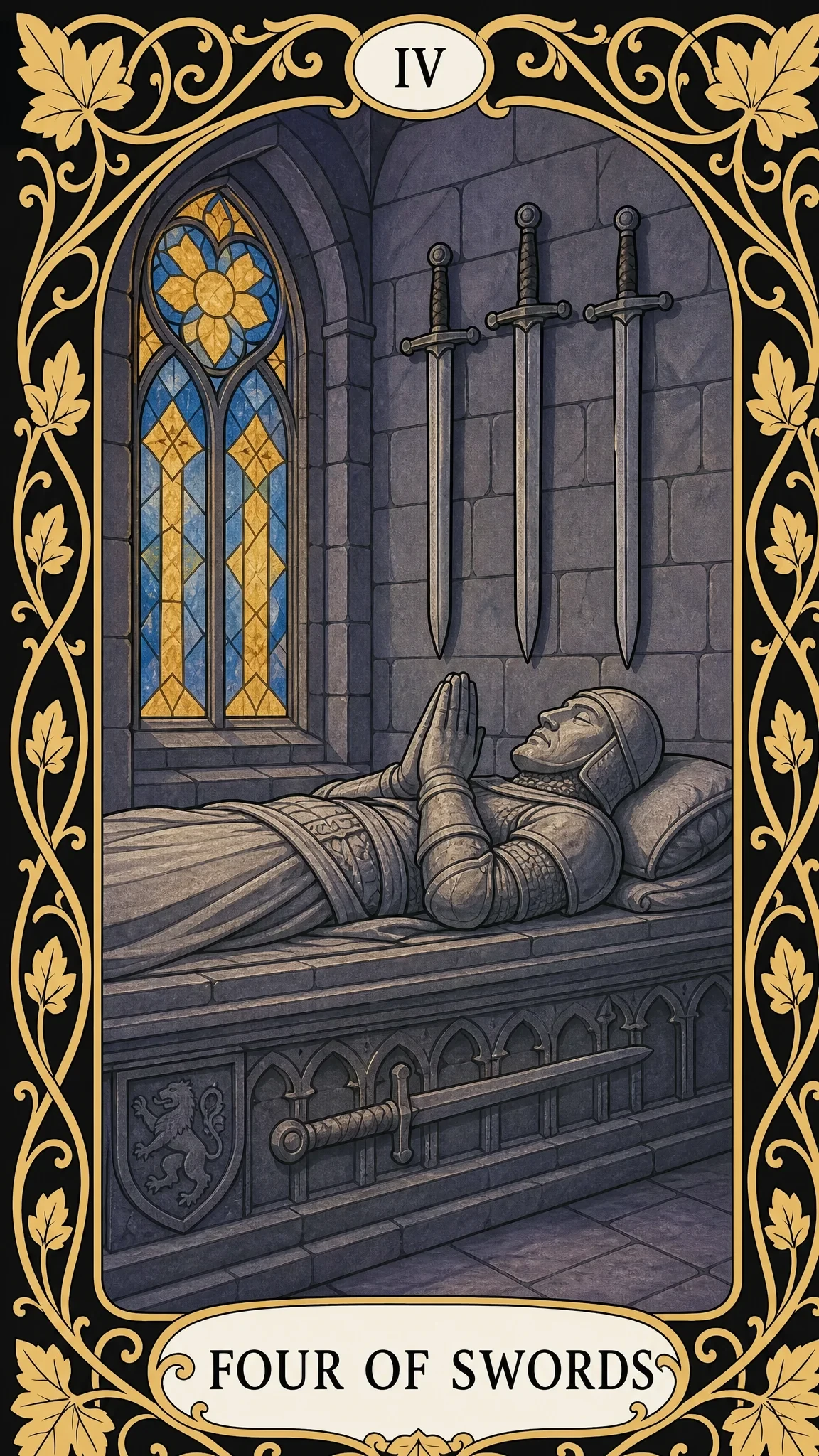
Sa ating baraha ay may estatwa ng isang knight na nakasuot ng armor at chainmail hood: nakahiga siya sa isang pedestal, ang mga kamay ay nakatiklop sa dibdib sa isang panalangin, ang ulo ay nakapatong sa unan. Sa itaas niya, sa dingding ng kapilya, tatlong espada ang nakabitin nang patayo na nakaturo pababa; ang ikaapat na espada ay nakahiga nang pahiga sa gilid ng pedestal, sa ilalim ng pigura. Sa kaliwa ay isang makitid na bintanang may makulay na stained glass sa dilaw at asul na tono, sa kanan sa pedestal ay makikita ang isang heraldic shield na may leon.
Mahalagang sabihin nang direkta: ang eksenang ito ay hindi tungkol sa kamatayan, bagaman mukhang libingan sa panlabas. Sa klasikong iconograpiya ng Tarot, ang estatwa sa ibabaw ng libingan ay isang matatag na simbolo ng pansamantala, hindi pangwakas na kapahingahan: ang mga eskulturang ganito ay naglalarawan ng mga taong "natutulog" sa bato, hindi mga namatay. Ang mga kamay na nakatiklop sa panalangin ay hindi posisyon ng paglilibing, kundi ng nakatuon at meditatibong katahimikan.
Ganito binabasa ang eksena:
- Tatlong espada sa dingding — ang mga tunggalian at desisyon ay hindi nawala, pansamantala lamang silang inilagay sa tabi kung saan hindi sila makakaabala sa pahinga.
- Ikaapat na espada sa ilalim ng pigura — ang tensyon na hindi pa ginigising ng knight: malapit lang ito, ngunit wala sa kamay, at maaari mo itong balikan anumang oras kapag tapos na ang pahinga.
- Stained glass na may malambot na liwanag — isang tahimik at sagradong kapaligiran kung saan sadya ang pagpunta ng tao, hindi aksidente.
- Posisyon ng nakatiklop na mga kamay — hindi pagsuko, kundi pagiging handa: ang katawan ay hindi gumagalaw, ngunit hindi walang lakas.
Sa itaas ng baraha ay ang Roman numeral na IV, sa ibaba ay isang plake na may pangalang FOUR OF SWORDS.
Four of Swords bilang baraha ng araw
Ang Four of Swords bilang baraha ng araw ay isang direktang pahiwatig na magbagal: ipagpaliban ang mga hindi importanteng pagpupulong, iwasan ang mga hindi kailangang usapan, bigyan ang sarili ng kahit ilang tahimik na oras na walang screen at argumento. Ang araw ay mas angkop para sa pagbawi kaysa sa mga bagong desisyon.
Kung ang baraha ay lumabas nang pabaligtad — ang araw ay patuloy na hihingi ng parehong pahinga na matagal mo nang ipinagpapaliban. Ang kapaki-pakinabang na mindset ay huwag hintayin ang tuluyang pagkaubos ng lakas bago huminto, kundi kumuha ng maikling pahinga nang maaga habang ito ay pagpipilian pa, hindi pangangailangan.
Mga madalas itanong tungkol sa Four of Swords
Ito ba ay Major o Minor Arcana?
Minor Arcana, suit ng Swords, elementong Hangin. May kabuuang 56 na Minor Arcana sa Tarot deck — 14 na baraha bawat isa sa apat na suit, at ang Four of Swords ay hindi naglalarawan ng pagbabago ng tadhana, kundi isang tiyak na panahon ng pahinga at pagbawi pagkatapos ng tensyon.
Ano ang pagkakaiba ng Four of Swords sa Four of Pentacles?
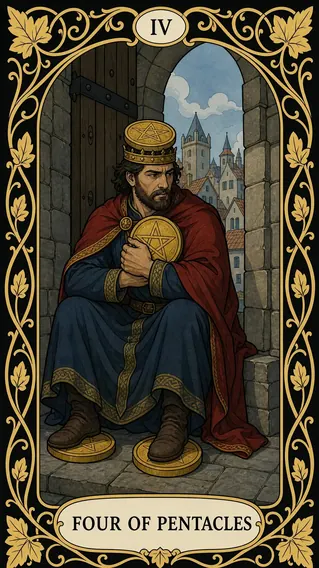
Parehong tungkol sa numerong apat ang mga barahang ito — katatagan, ngunit nakabatay sa magkaibang elemento. Ang Four of Swords (Hangin) ay tungkol sa pahinga ng isip at katawan, boluntaryong pagpapahinga pagkatapos ng tunggalian o pagod. Ang Four of Pentacles (Lupa) ay tungkol sa paghawak sa materyal: pera, ari-arian, kontrol, madalas dahil sa takot na mawala ang mga ito. Kung ang pagbasa ay tungkol sa pagkapagod at pagbawi — ito ay tungkol sa Swords; kung tungkol sa mahigpit na pagkapit sa mga resources — tungkol sa Pentacles.
Ang estatwa sa lapida sa baraha — ito ba ay tungkol sa kamatayan?
Hindi. Ito ay isang klasikong imahe sa Tarot ng isang batong eskultura ng "natutulog" na pigura, hindi patay — simbolo ng pansamantala, malalim na kapahingahan, hindi katapusan. Ang tatlong espada ay nakatabi sa dingding, hindi bali, ang ikaapat ay nakahiga sa tabi na handa: ang tunggalian ay ipinagpaliban, hindi natapos nang tuluyan. Ang baraha ay tungkol sa pahinga at pagbawi ng lakas, hindi tungkol sa wakas.
Four of Swords — oo o hindi?
Mas malamang na "hindi ngayon": ang baraha ay hindi tumatanggi sa pangyayari, ngunit nagpapayo na huwag magmadali hangga't hindi pa nakakabawi ng lakas. Kung ang tanong ay tungkol sa mismong pahinga — ang sagot ay tiyak na oo.
Ano ang ibig sabihin ng pabaligtad na Four of Swords?
Ang parehong kinakailangang pahinga, ngunit wala ito: ang pahinga ay naputol nang masyadong maaga, patuloy na binabalewala ang pagkaubos, o ang pormal na pahinga ay hindi nagbibigay ng kapayapaan dahil sa mga balisang iniisip. Bihira — katapusan ng matagal na paghinto at kahandaang bumalik sa mga gawain.