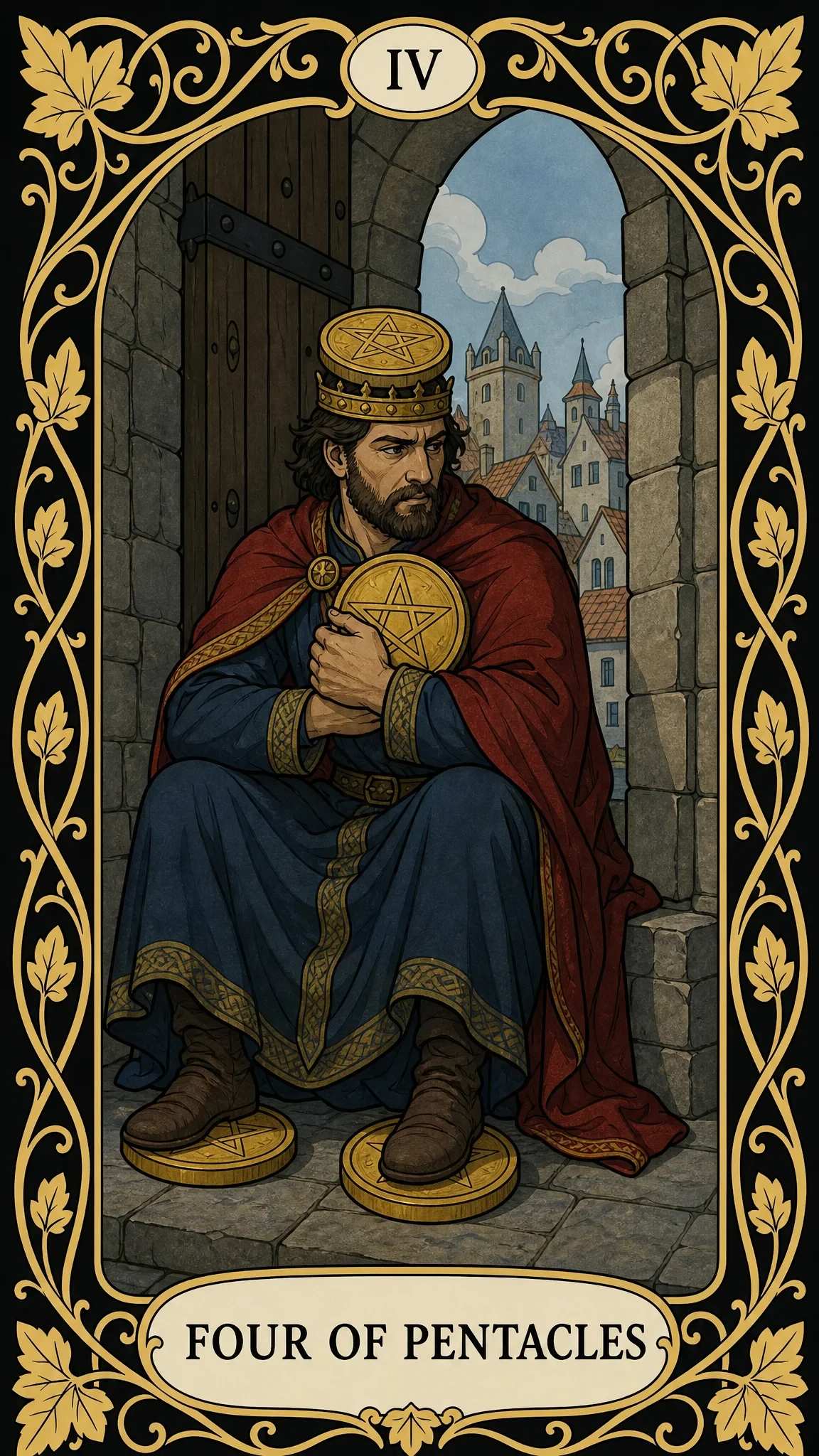
What the Four of Pentacles means in Tarot
Fours in Tarot are cards about structure and what happens to what has been achieved when it needs to be secured: the Four of Wands celebrates success, the Four of Cups describes emotional satiety, and the Four of Swords describes a forced pause. The Four of Pentacles secures what has been achieved in the most tangible sense: money, property, status, the habitual order of life — and it does so more firmly than any other four.
An important nuance often lost in retellings: frugality and greed are not the same thing, although the card is almost always interpreted as greed. The difference lies in the motive. A frugal person saves because they remember what it is like to be without a reserve; a greedy person wants more even when they have enough. The Four of Pentacles more often describes the former: not an appetite for more, but a fear of being left without support again. In itself, this is not a vice — the question is whether caution turns into a prison from which one does not want to leave, even when the threat is long gone.
And, like any minor arcana, this is not about fate as a whole, but about a specific segment: a week when you don't want to spend extra, a conversation about a budget, a decision not to share what has been hard-earned. Neighboring cards will show whether this caution is justified by circumstances or is already hindering life.
Reversed Four of Pentacles: meaning
The reversed Four of Pentacles loosens the grip, but not always voluntarily and not always for the better. The meaning is chosen by the question of the spread.
- The grip loosened against one's will. Money or things leave against one's desire: unplanned spending, a forced change in the budget, what was saved suddenly needs to be given away or spent.
- Caution taken to the limit. The reverse option: control does not let go, but intensifies — saving becomes not reasonable, but anxious; a person is afraid to spend even on necessities.
- The grip is released consciously. The rarest but occurring reading: a decision to stop keeping everything to oneself — to share, invest, trust, and for the first time in a long time, not count every penny.
Neighboring cards help distinguish these options: next to anxious Swords — more likely an intensification of control; next to the Star or the Ten of Cups — more likely a conscious release.
The Four of Pentacles in a "yes or no" spread
In "yes/no" spreads, the Four of Pentacles is more often read as no — but specifically as "not now and not through movement": the card describes retention, not action, so it answers with a restrained refusal to questions about change, risk, or new investments.
The answer changes if the question is phrased differently. "Will what I have be preserved?" — here the Four answers yes, and more confidently than many other cards: it is specifically about preservation, not growth.
The reversed position in this spread is read as "no, and it will become harder to hold on": either the resource will have to be given away against one's will, or the efforts to keep everything as it is will become noticeably harder.
The Four of Pentacles in relationships and feelings
In a relationship spread, the upright Four of Pentacles describes not emotional coldness, but a reluctance to risk what is already there. A person holds onto the relationship firmly, sometimes too firmly: they are afraid to open up first, to share vulnerabilities, to let in changes that might shake the habitual order.
In the position of feelings, the card often points to caution instead of warmth: feelings exist, but there is a fear of showing them to their full extent — what if it is used or devalued? Here again, it is important not to confuse this with stinginess of character: more often it is a consequence of past experience where openness was costly.
For one person in a couple, the Four of Pentacles can mean a desire to control the dynamics: who invests how much, who makes concessions first. This is not a love of power, but an attempt not to end up without support again if something goes wrong.
The reversed position — either the grip loosens and a readiness to trust appears, or, conversely, control turns into jealousy and a reluctance to let the partner go even in small things.
The Four of Pentacles in work and money
In career spreads, the Four of Pentacles is a stable but inflexible position: holding onto the current job, not agreeing to the risk of changing jobs, avoiding projects with uncertain results. Often this is a justified strategy in an unstable period, but sometimes it is a missed opportunity because any movement begins to seem like a threat.
In money, the card speaks of accumulation and control of expenses, not about a specific amount or term: the desire to save, not to spend extra, to have a reserve for a rainy day. This is a state, not a forecast — the Four of Pentacles does not show how much will be accumulated and when, only the mode of frugality itself.
The advice of the card in money and work is one: it is useful to ask yourself, is saving now a reasonable preparation or already a way not to look into the eyes of a larger decision that has long been overdue?
The Four of Pentacles as a person: man and woman
When the Four of Pentacles appears in the "what kind of person" position, it describes someone who keeps resources to themselves: not necessarily stingy, but cautious to the limit — they count carefully, do not like to share what was earned with difficulty, and are wary of others' requests for help.
The Four of Pentacles man is reliable but closed off: he keeps his word and money under control, does not like spontaneous spending or risky partnerships. The Four of Pentacles woman is someone who has built her own stability and protects it, sometimes too zealously.
This is not a description of a greedy person, but rather someone who was once left without support and has not wanted a repeat since. Neighboring cards will show whether this person is ultimately ready to trust and share, or if the grip will remain their main trait.
The Four of Pentacles in the position of thoughts
In the position of thoughts, the Four of Pentacles is an obsessive focus on preservation: thoughts revolve around the budget, property, and how not to lose what has already been achieved. This is a state of anxious bookkeeping, not calm planning.
Next to Pentacles, it is more likely sober calculation; next to Swords, it is anxiety that inflates the risk of loss more than it actually is.
Ano ang dapat gawin kung lumabas ang Four of Pentacles
Ang payo ng Four of Pentacles ay hindi "bitawan ang lahat" o "hawakan nang mahigpit" — mas tiyak ito: suriin kung saan nanggaling ang pagkapit bago ito luwagan o higpitan.
Ano ang dapat gawin:
- Pag-ibahin ang makatwirang pagtitipid sa pagkabalisa. Ang una ay nagbibigay ng kapayapaan, ang pangalawa ay patuloy na tensyon kahit may sapat na pera.
- Tukuyin ang kinatatakutan ng pagkapit. Kadalasan, hindi ito kasakiman kundi isang tiyak na takot: ang mawalan muli ng pera, suporta, o kontrol sa sitwasyon.
- Suriin ang isang bagay na kinatatakutan mong bitawan. Hindi mo kailangang bitawan ito ngayon — sapat na ang tapat na tingnan kung tunay nga ba itong nasa panganib.
- Huwag ipagkamali ang pagiging matipid sa pagpaparusa sa sarili. Ang pagtitipid ay may saysay kung ito ay para sa isang layunin, hindi kung ito ay nagiging pagkakait sa sarili.
Kung ang card ay lumabas sa konteksto ng tunay na kakulangan sa pera, utang, o pagkabalisa na nakakaabala sa buhay, ang reading ay hindi kapalit ng konsultasyon sa isang financial expert o psychologist: inilalarawan ng card ang estado, hindi nito nilulutas ang mga materyal na problema.
Ano ang nakaguhit sa card
Sa ating card — isang lalaking nakasuot ng madilim na asul na damit at pulang kapa ang nakaupo sa pintuan ng isang kuta. May korona siya sa ulo na may gintong pentacle sa halip na mamahaling bato, isa pang pentacle ang mahigpit niyang niyayakap sa kanyang dibdib, at dalawa ang nasa ilalim ng kanyang mga paa — na literal niyang tinatapakan.
Sa kanyang likuran ay isang nakasarang pinto na may mabibigat na itim na bisagra, at sa labas ng pintuan ay makikita ang isang lungsod: mga bubong na tisa, mga toreng bato, at ang buhay sa labas. Ang lalaki mismo ay hindi nakatingin sa lungsod o sa tumitingin, kundi sa malayo, nang may tensyon at pag-iingat.
Ganito binabasa ang eksena:
- Ang pinto sa likuran ay nakakandado — humiwalay ang tao sa mundong nasa labas; hawak niya ang lahat ng kailangan niya sa loob.
- Pentacle sa korona — ang kontrol ay naging bahagi ng kanyang pagkatao: hindi lang "may pera ako," kundi "ako ang may hawak ng kontrol."
- Pentacle sa dibdib — ang pinakapersonal at bulnerableng bahagi ng kanyang naipon, ang bagay na ayaw niyang isapalaran.
- Dalawang pentacle sa ilalim ng paa — ang pundasyon kung saan siya nakatayo; literal na hindi aalis ang tao sa kanyang kinatatayuan para hindi ito magalaw.
Ang tanawin ng lungsod sa malayo ay ang buhay na nagpapatuloy sa labas, habang ang bida sa card ay nananatili sa pagitan ng bahay at kalye, hindi makapagdesisyong magpasok ng bago o lumabas mismo.
Four of Pentacles bilang card of the day
Ang Four of Pentacles bilang card of the day ay hudyat na magdahan-dahan sa malalaking gastos at huwag padala sa bugso ng damdamin na baguhin ang sitwasyon sa pananalapi o ari-arian. Mas angkop ang araw na ito para ayusin ang mga mayroon na kaysa sumugal sa bago.
Kung ang araw ay nararamdamang puno ng pagkabalisa dahil sa pera, makabubuting pag-ibahin ang makatwirang pag-iingat sa panic: makakatulong na tingnan nang tapat ang mga numero sa halip na iwasan ang mga ito. Inilalarawan ng Four of Pentacles ang pagnanais na mapanatili ang kontrol, hindi nito ipinapakita kung may basehan ang pagkabalisa — dapat itong suriin gamit ang mga katotohanan, hindi base sa nararamdaman.
Mga madalas itanong tungkol sa Four of Pentacles
Ito ba ay Major o Minor Arcana?
Minor Arcana, suit ng Pentacles, elementong Lupa. May kabuuang 56 na Minor Arcana sa Tarot deck — 14 na card bawat suit, at ang Four of Pentacles ang ikaapat na card ng Pentacles.
Ano ang pagkakaiba ng Four of Pentacles sa Four of Wands?
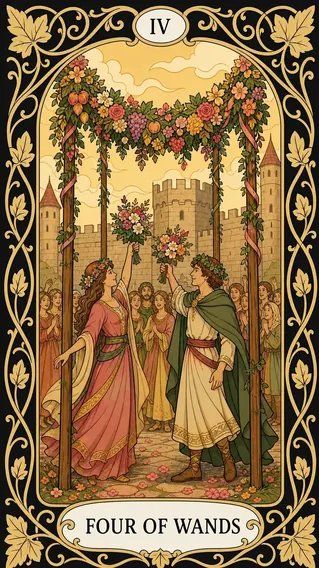
Parehong tungkol sa katatagan ang mga card na ito, pero magkaiba ang uri. Wands — elementong apoy: ang Four of Wands ay tungkol sa kagalakan sa nakamit, katatagang gustong ipagdiwang kasama ang iba. Pentacles — elementong lupa: ang Four of Pentacles ay tungkol sa pagpapanatili ng nakamit nang mag-isa, walang selebrasyon at walang pagnanais na magbahagi. Kung ang kagalakan sa resulta ang mahalaga sa reading — mas patungkol ito sa Wands; kung pagkabalisa sa seguridad — patungkol ito sa Pentacles.
Four of Pentacles — oo o hindi?
Kadalasan ay hindi: ang card ay tungkol sa pagpapanatili ng kasalukuyang posisyon, hindi sa pag-abante. Kung ang tanong ay "mananatili ba ang mayroon na" — oo ang sagot; kung ang tanong ay tungkol sa pagbabago o bagong investment — malamang na hindi.
Ano ang ibig sabihin ng baligtad (reversed) na Four of Pentacles?
Nagbabago ang pagkapit: maaaring lumuluwag ito nang hindi sinasadya — nawawala ang pera o resources — o kaya naman ay humihigpit ito hanggang sa maging labis na kontrol. Bihira itong maging malay na desisyon na magbitaw at magtiwala sa iba. Nakakatulong ang mga katabing card para mas maunawaan ito.
Four of Pentacles — tungkol ba ito sa kasakiman?
Hindi masyado. Kadalasan, ang card ay nagsasalita tungkol sa takot na mawalan muli ng pundasyon, hindi sa pagnanais na makakuha ng higit pa habang may sapat na. Ang pagtitipid dahil sa pag-iingat at kasakiman dahil sa kasibaan ay mukhang magkatulad sa labas, pero magkaibang estado ito, at ang pagkakaibang ito ay dapat isaalang-alang sa interpretasyon.