What the Five of Pentacles means in Tarot
Fives in Tarot are always a point of tension within a suit: unlike the calm fours, they describe a moment when the previous balance breaks and one must adapt. Pentacles are the most earthly, material suit: money, body, work, home, everything that can be touched and counted. The Five of Pentacles is the moment when this very support is suddenly lacking.
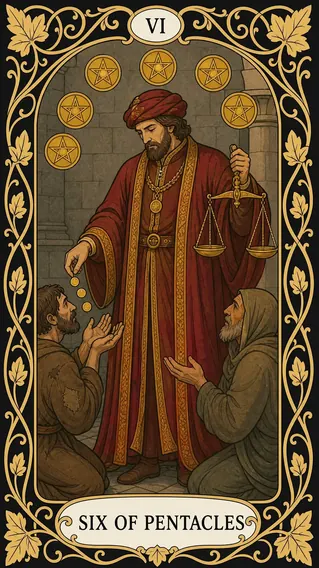
An important nuance often lost in retellings: the minor arcana describes an episode, not destiny. The card does not say that a person is doomed to poverty or loneliness — it is about a specific difficult period: a month without money, the time after being fired, the feeling that you were not invited or considered. This state passes, and in the deck, the Six of Pentacles stands nearby — a card about help eventually arriving or being given.
The second layer of meaning is not so much poverty as exclusion. The classic plot of the card: a person walks past warmth and light that do not belong to them and does not dare to knock. This can be literally about money, or about the feeling that you were bypassed: not invited, not chosen, not noticed. The upright position says that this feeling is sharp and real right now, not imagined.
Reversed Five of Pentacles: meaning
The reversed Five of Pentacles is the same need, but at a different stage. Usually, the spread implies one of three options, and the question itself provides the hint.
- Difficulties are beginning to recede. The most frequent and pleasant reading: help has arrived, work has been found, the acute phase is behind, but strength has not yet fully recovered.
- Help is available, but not taken. Pride or distrust prevent accepting a helping hand — and then the difficulties drag on longer than they should.
- Material matters have improved, but the feeling of poverty remains. Externally, everything is fine: there is money, there is a roof over one's head — but inside, the anxiety of lack and the fear that the warmth will be taken away again still lives.
The reversed position is almost always softer than the upright: the acute phase of need has already passed or is passing, the question is what to do with its aftermath.
Five of Pentacles in a "yes or no" spread
In "yes/no" spreads, the Five of Pentacles is usually read as no — but with a caveat that is more important than the answer itself. It is not about everything being bad forever, but about the fact that now is not the time to count on an easy or quick solution: money will not come by itself, the situation will not resolve without effort and without someone else's help.
The answer flips if the question itself is about difficulty: "will it be hard?", "will I have to save money?", "will I be left without support?" — here the card answers more like yes, and usually sooner than one would like.
The reversed Five of Pentacles in this spread is read as "yes, but with someone else's help": resolution is possible if you don't try to find it alone. The worst version of the spread is not the need itself, but the habit of refusing a helping hand out of pride.
Five of Pentacles in relationships and feelings
In a relationship spread, the upright Five of Pentacles describes a period when a couple or a person lacks support: money, attention from loved ones, the feeling that you will be taken care of. This is not necessarily about the union itself — often external difficulties hit the couple from the outside, and it is important whether the two endure this together or if each experiences the need alone.
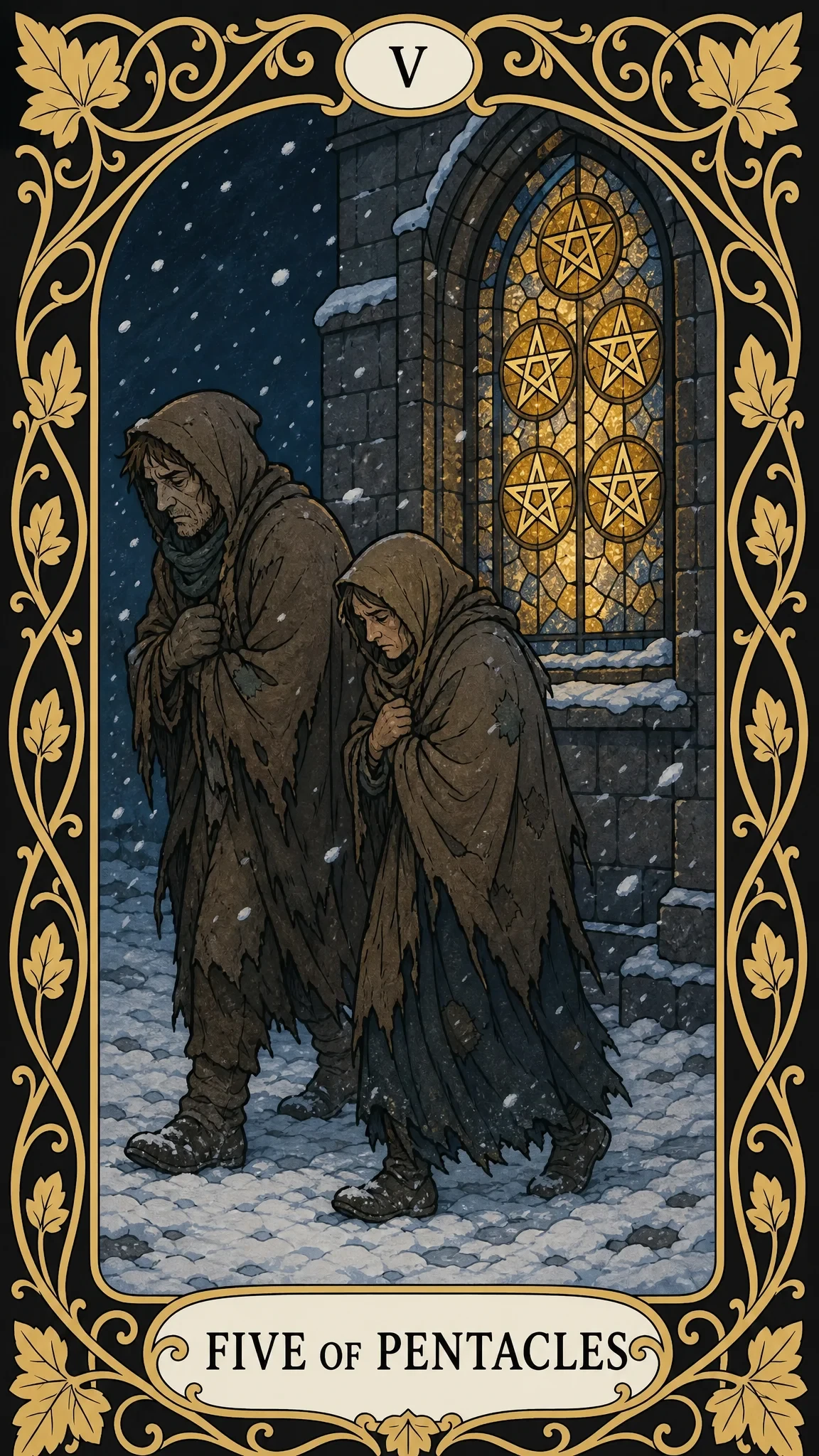
An important detail: on the card, two people are walking side by side, not separately — the difficulty does not negate the fact that the person is not alone. The problem in this card is often not the absence of people nearby, but that each is so busy with their own cold that they don't immediately notice that someone is walking nearby in the same situation, and support can be found right there, not just from the outside.
In the position of feelings, the card often speaks of the feeling that you were not chosen or were overlooked: not invited, not put first, not noticed for your efforts. This is painful, but concrete — and is usually resolved by conversation, not by waiting for the partner to guess on their own.
The reversed Five of Pentacles in relationships is a period when the couple begins to get out of a difficult streak: a conversation has finally happened, help has been accepted, and warmth is available again.
Five of Pentacles in work and money
In career spreads, the Five of Pentacles means job loss, reduced income, the feeling that you were bypassed for a promotion or not invited to an important project. The card describes the feeling of exclusion from the work circle well, not just the amount in the account.
In money, the upright position speaks of a real shortage: expenses exceed what was expected, reserves are gone or running out. The card does not name a deadline or an amount — specifics are provided by neighboring cards and real circumstances, not the spread itself.
What the Five of Pentacles really advises in a work spread: do not solve the problem silently and alone. There is almost always a resource nearby — an acquaintance, a support service, an assistance program — which on the card looks like a glowing window nearby that simply hasn't been approached. It is worth checking what is actually available before considering the situation hopeless.
Five of Pentacles as a person: man and woman
When the Five of Pentacles appears in the "what kind of person" position, it describes not a character, but a role: someone who is currently going through a difficult period and holding on with their last strength, often without showing it directly. Such a person is not necessarily poor in the literal sense — it is more important that they feel abandoned or undervalued.
A Five of Pentacles man in a spread is someone who is not used to asking and prefers to cope silently, even when it is exhausting. A Five of Pentacles woman is someone who is near the difficulties of others, but her own need remains unnoticed because she is the first to take care of those around her.
This is a description of a person's temporary state, not a verdict on their destiny. If the card is important as a characteristic for the future — it is worth looking at neighboring cards: next to the Six of Pentacles, this role will soon change to that of someone who receives or gives support.
Five of Pentacles sa posisyon ng pag-iisip
Sa posisyon ng pag-iisip, ang Five of Pentacles ay pagkabalisa tungkol sa kakulangan na paulit-ulit sa isip: sapat ba ang pera, mapapansin ba ang mga pagsisikap, at maiiwan ba ang tao nang walang suporta sa oras na kailangan niya ito. Ang estadong ito ay nagpapanatili sa iyo sa patuloy na tensyon at humahadlang sa pagkakita ng mga opsyon na malapit na.
Minsan ang pagkabalisa ay may basehan — ang mga paghihirap ay totoo at dapat magplano nang maaga. Minsan ito ay isang panloob na pakiramdam ng kakulangan na hindi tumutugma sa aktwal na sitwasyon. Ang mga katabing baraha ay nakakatulong upang makilala ito: sa tabi ng makatotohanang Pentacles — ito ay malamang na isang matino na pagtatasa, sa tabi ng nakakabalisang Swords — ito ay malamang na isang kaisipan na nagpalaki sa problema nang higit sa nararapat.
Ano ang gagawin kung lumabas ang Five of Pentacles
Ang payo ng baraha ay simple, ngunit hindi madaling gawin: mapansin ang tulong na malapit na, at magpasyang tanggapin ito. Sa baraha, ang liwanag mula sa bintana ay malinaw na nakikita — ang paghihirap ay kadalasang hindi dahil sa kawalan nito, kundi dahil sa ugali na lampasan ito.
Ano ang dapat gawin sa esensya:
- Tukuyin ang problema nang tiyak. Hindi "masama ang lahat," kundi: kulang ang pera para sa ano, sino ang hindi nakapansin sa mga pagsisikap, saan talaga nanggagaling ang lamig.
- Suriin kung anong tulong ang talagang magagamit. Kadalasan ay mas malapit ito kaysa sa iniisip sa sandali ng kawalan ng pag-asa — kailangan lang na huwag manahimik tungkol sa pangangailangan.
- Huwag ipagpalit ang pagmamalaki sa lakas. Ang pagtanggi sa suporta ay hindi nagpapaikli sa mahirap na yugto.
- Mapansin ang mga kasama sa paglalakad. Dalawa ang nasa baraha, hindi isa — minsan ang suporta ay hindi matatagpuan sa labas, kundi sa taong nakakaranas ng katulad na sitwasyon.
At hiwalay, isang mahalagang paalala: kung ang paksa ng pagbabasa ay tunay na kahirapan, sakit, o adiksyon, ang baraha ay hindi kapalit ng tulong ng mga espesyalista at serbisyong panlipunan. Ang pagbabasa ay maaaring magpangalan sa nararamdaman, ngunit hindi ito malulutas — para sa tiyak na suporta, dapat lumapit sa mga tao at organisasyong tunay na makakatulong, sa halip na maghanap ng sagot sa mga baraha.
Ano ang nakaguhit sa baraha
Sa ating Five of Pentacles — dalawang tao sa madilim at punit-punit na mga balabal ang naglalakad sa maniyebeng kalsada sa gabi, lampas sa isang batong pader na may mataas na arched stained-glass window. Ang mga salamin ng bintana ay nagniningning sa mainit na ginto, at sa mga pattern ng stained glass ay malinaw na makikita ang limang pentacles — ang mismong limang barya ng baraha, ngunit hindi hawak ng mga bida, kundi hindi maabot na malapit, sa likod ng salamin.
Ang eksenang ito ay binabasa nang ganito:
- Mga punit-punit na balabal — makikita sa tela ang mas madidilim na tagpi: ang damit ay inayos nang higit sa isang beses, ito ay isang nakasanayan at matagal na pangangailangan, hindi isang masamang linggo.
- Niyebe at madilim na langit — mga panlabas na pangyayari na parehong nagpapahirap sa dalawa: ang lamig dito ay hindi metapora, kundi isang literal na detalye, ang pisikal na kakulangan sa ginhawa ay nagpapalala sa emosyonal.
- Nagniningning na bintana na may limang pentacles — ang init at yaman ay umiiral nang malapit, isang hakbang lang, ngunit sa panig na ito ng salamin ay hindi sila makukuha; ang bintana ay hindi sadyang naka-lock laban sa mga bida, pagmamay-ari lang ito ng ibang espasyo.
- Dalawang naglalakad nang magkasama — sa ating bersyon ng baraha ay walang saklay o kapansanan, tulad ng sa klasikong iconograpiya: parehong nakatayo, may buong sapatos, pagod lang at abala sa sariling lamig. Inililipat nito ang pokus mula sa pisikal na sakuna patungo sa mas malapit sa katotohanan ng karamihan ng mga manonood: pagkapagod at pakiramdam na ikaw ay nalampasan, hindi isang sakuna.
Sa itaas ng baraha ay ang Roman numeral na V, sa ibaba — isang plake na may Ingles na pangalan na FIVE OF PENTACLES: ang ating deck ay iginuhit sa tradisyon ng Rider-Waite, kung saan ang Five of Pentacles ay pang-lima sa suit.
Five of Pentacles bilang baraha ng araw
Ang Five of Pentacles bilang baraha ng araw ay bihirang magsalita tungkol sa sakuna — kadalasan ito ay isang araw kung saan may kulang: pera hanggang sa susunod na suweldo, atensyon, pakiramdam na ikaw ay isinaalang-alang. Kapaki-pakinabang na huwag palakihin ang pakiramdam na ito at huwag subukan kung "gaano kasama ang lahat," kundi tanungin ang sarili nang direkta: ano ang eksaktong kailangan at kanino ito maaaring hingin.
Kung ang baraha ay lumabas na baligtad — ang araw ay mas tungkol sa katotohanan na ang tulong ay sa wakas ay malapit na o nagsisimula nang gumana, at dapat mong payagan ang iyong sarili na tanggapin ito, sa halip na tumanggi dahil sa nakasanayan.
Mga madalas itanong tungkol sa Five of Pentacles
Ito ba ay Major o Minor Arcana?
Minor Arcana, suit ng Pentacles, elementong Lupa. May kabuuang 56 na Minor Arcana sa Tarot deck — 14 na baraha para sa bawat isa sa apat na suit, at ang Five of Pentacles ay naglalarawan ng isang mahirap na pagliko sa mismong ito, ang pinaka-materyal na suit.
Ano ang pagkakaiba ng Five of Pentacles sa Five of Wands?
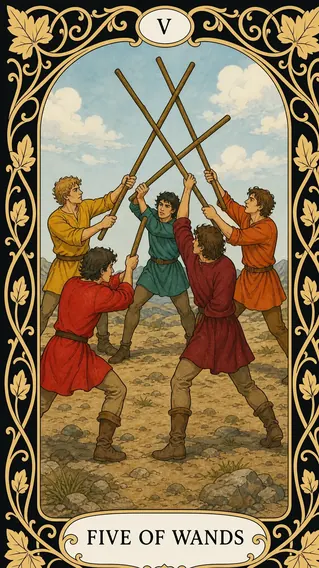
Ang parehong lima ay tungkol sa tensyon sa loob ng suit, ngunit may magkaibang kalikasan. Ang Pentacles ay elementong lupa, materyal na mundo: ang Five of Pentacles ay tungkol sa kakulangan ng yaman at pakiramdam ng pagiging excluded. Ang Wands ay elementong apoy, kalooban at kompetisyon: ang Five of Wands ay tungkol sa tunggalian at kompetisyon, hindi tungkol sa pangangailangan. Kung ang pagbabasa ay tungkol sa pera, suporta, o pakiramdam na hindi ka napansin — ito ay tungkol sa pentacles; kung tungkol sa pagtatalo o pakikipaglaban para sa pangunguna — tungkol sa wands.
Five of Pentacles — oo o hindi?
Kadalasan ay hindi: sinasabi ng baraha na huwag umasa ng mabilis at madaling solusyon. Kung ang tanong ay tungkol sa mismong paghihirap — kung magiging mahirap ba, kung kailangang magtipid — ang sagot ay malamang na oo. Ang baligtad na posisyon ay binabasa nang mas malambot: "oo, ngunit may tulong mula sa iba."
Ano ang ibig sabihin ng baligtad na Five of Pentacles?
Karaniwan — na ang matinding yugto ng mga paghihirap ay tapos na: ang tulong ay dumating na o tinanggap na, ang lakas ay unti-unting bumabalik. Bihira — na may suporta, ngunit hindi ito tinatanggap dahil sa pagmamalaki, o na ang materyal na aspeto ay maayos na, ngunit ang pagkabalisa sa kakulangan ay nananatili.
Ang Five of Pentacles ba ay naghuhula ng kahirapan o sakit?
Hindi. Inilalarawan ng baraha ang pakiramdam ng kakulangan at pagiging excluded sa isang tiyak na panahon, hindi isang diagnosis o hatol para sa hinaharap. Kung ang paksa ng pagbabasa ay tunay na kahirapan, kalusugan, o adiksyon, dapat lumapit sa mga mahal sa buhay at mga espesyalistang serbisyo para sa tulong, sa halip na maghanap ng solusyon sa pagbabasa.