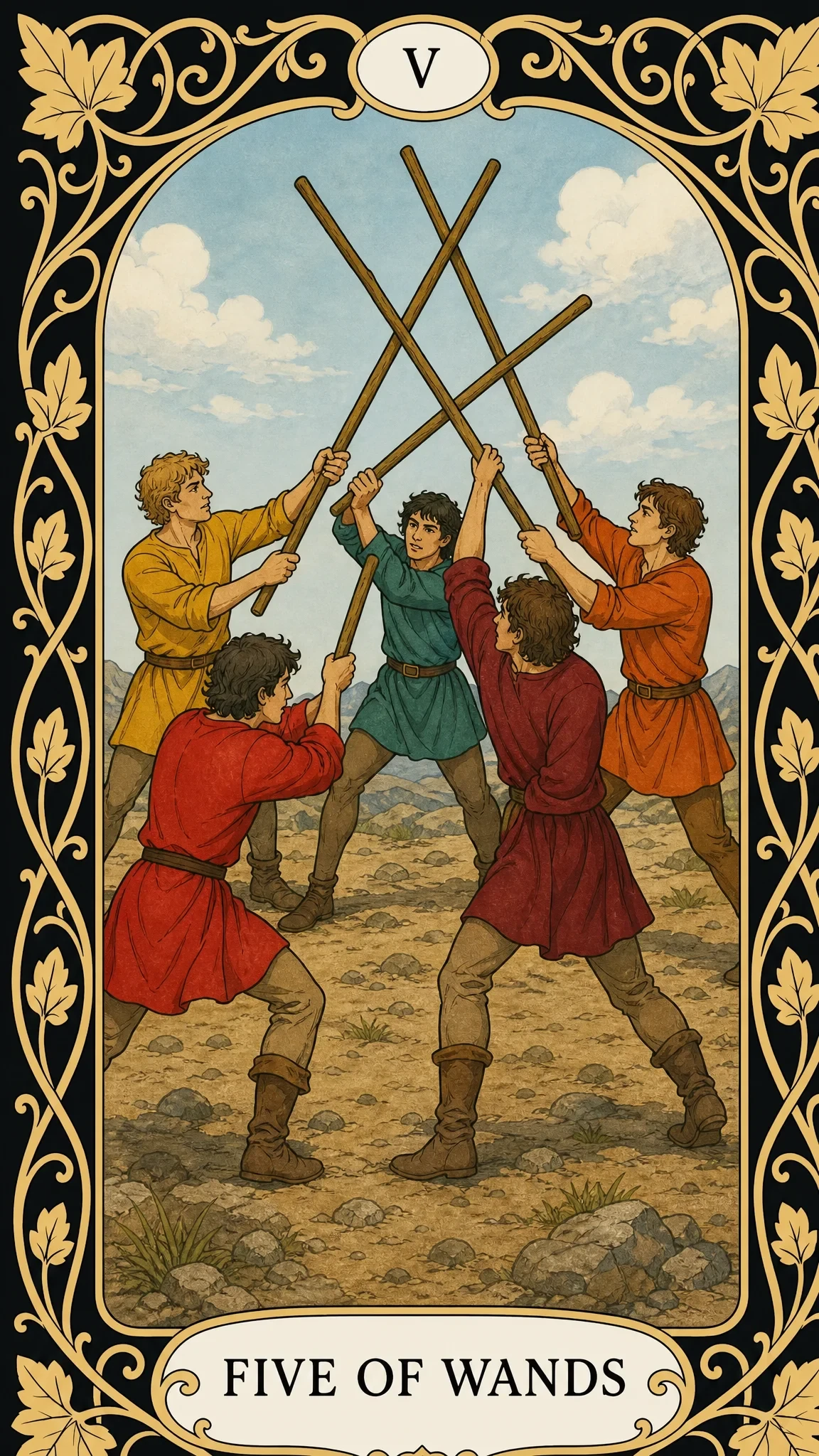
What the Five of Wands Means in Tarot
The Five of Wands is a card of noisy but not fatal confrontation. Five people cross staffs, each pulling in their own direction, with no one having a clear advantage – and this is the essence of the card: it's not a war to the death, but a skirmish for a place, for precedence, for whose version will be heard first.
It's important to immediately separate this card from the Major Arcana. The Tower or The Devil describe major themes for years to come; the Five of Wands is much more modest in scale. It's a specific argument on a conference call, a spat in a chat, a competition for attention in a group, not a fateful turning point. Reading it as 'chaos will begin in life' is to inflate the card beyond its station: the Minor Arcana are about episodes, not destiny.
The element of Fire and the suit of Wands set the tone: there is a lot of energy, it bursts outward, but it's misdirected – everyone is pushing, no one has agreed on the rules beforehand. Hence the classic meaning: rivalry, friction, minor conflicts, scattered efforts. The card often appears where several people are right in their own way at the same time and no one is willing to yield first.
Reversed Five of Wands: Meaning
The reversed Five of Wands is the same jostling, only suppressed. Three common interpretations, chosen based on the question of the reading:
- The dispute has ended – not because someone convinced someone else, but because everyone got tired. A formal truce without real agreement.
- The conflict has gone internal. It's quiet on the outside, but the irritation and rivalry haven't disappeared – they're just no longer being shown.
- The skirmish is unfair. One voice drowns out the others, and the appearance of an "equal" struggle from the upright position disappears – someone is pushing their own agenda.
The reversed position is a signal that the open confrontation described by the upright card has not happened or is being consciously avoided. Sometimes this is for the best, sometimes it's just the same conversation postponed for later.
Five of Wands in a "Yes or No" Reading
In a "yes or no" reading, the Five of Wands is usually interpreted as yes, but not without a fight. A question like "Will it work out?" is answered affirmatively – only the result will have to be defended, not received immediately and without resistance.
If the question is about peace – "Will it pass without argument?" "Will they agree without objection?" – the card is more likely to answer no: there will be friction, someone will definitely speak out against it.
The reversed version softens the answer to "the conflict hasn't ripened" or "the parties are already tired of arguing": the practical meaning is that open struggle, which the upright position promises, is not expected in the near future.
Five of Wands in Relationships and Feelings
In relationships, the upright Five of Wands represents partners who are constantly competing a little: who invested more, who is right in a domestic dispute, whose opinion is more important in decision-making. This in itself is not a death sentence for a couple – many couples live like this for years, and the friction even keeps the interest alive.
Often the card appears where several parties are vying for one person's attention: a direct rival for attention or simply competing obligations – family, work, old relationships – that pull in different directions. This card does not describe a calm, stable feeling, neither upright nor reversed.
In the position of feelings, it's more about excitement than tenderness: the desire to prove oneself, to be heard, not to back down in an argument that is actually not worth such intensity.
The reversed Five of Wands in relationships means either a dispute that has been suppressed and not discussed, or, conversely, a short truce after a quarrel that did not resolve the underlying cause.
Five of Wands in Work and Money
In work readings, this is open competition: several people are vying for one project, a budget is divided with a fight, a meeting turns into shouting instead of discussion. Often it's a team where roles are not clearly defined, and everyone pulls the blanket to themselves not out of malice, but because otherwise no one will hear their contribution.
In terms of money, the card signifies a dispute over an amount: who owes how much, who pays for what, haggling over the division of property or expenses. The card does not promise direct loss – it promises a struggle over how what exists will be distributed.
What the Five of Wands advises in essence: before arguing further, agree on the rules of the argument – who speaks first, what is being divided and into how many parts. The chaos on the card is not a lack of resources, but a lack of regulation.
Five of Wands as a Person: Man and Woman
When the Five of Wands appears as a description of a person, it represents someone who argues about anything – not necessarily out of spite, but because it's important for them to voice their position. It's rarely quiet around such a person: they test the strength of others' arguments and expect the same in return.
A Five of Wands man is a passionate debater, enjoys competitive situations, easily gets into an argument and just as easily gets out of it without offense. A Five of Wands woman is someone who doesn't back down or stay silent, even if the argument is inconvenient or disadvantageous in terms of status.
This is not a description of a conflict-prone or angry person – rather, someone who wants to be heard in the general noise and is willing to fight for it.
Five of Wands in the position of thoughts
In the position of thoughts, the Five of Wands is the head, where several inner voices argue simultaneously: one insists on its own version, another objects, a third doubts everything at once. It is difficult to concentrate precisely because thoughts compete with each other, rather than lining up in order.
This is often a state before an important conversation or decision: a person mentally rehearses arguments that have not yet happened, preparing arguments for all sides at once. Neighboring cards will suggest whether this internal struggle is productive or just exhausting in vain.
What to do if the Five of Wands appears
The card's advice is simple, though not the most pleasant: don't disengage from the argument, but don't turn it into a war of annihilation. The Five of Wands is about energy scattered on trifles, and the first task is to gather it back.
What is worth doing in essence:
- Name what the argument is really about. Often, behind a squabble over trifles lies one unresolved, more serious issue.
- Agree on the rules, not just the content. Who speaks, in what order, by what deadline is the result needed.
- Don't confuse competition with personal offense. The excitement of an argument does not mean that the opponent is an enemy.
- Leave room for a draw. Not every clash must have a clear winner.
If a protracted exhausting conflict stands behind the card, not a domestic squabble, the spread describes the dynamics, but does not solve it; in such cases, direct conversation or a mediator helps, not another card in the deck.
What is drawn on the card
On our Five of Wands, there are five young men in a rocky wasteland, and each holds his own single staff: no one grips two at once, nor shares one staff with a neighbor. All five stand at full height in a loose circle, simultaneously raising their staffs above their heads, so that the staffs converge in the sky in a sweeping cross. The poses show that this is a brawl, not a one-on-one duel: someone pulls the staff towards them, someone pushes it away, and the young man in the turquoise tunic in the center holds his with both hands, squeezed by the other staffs from both sides.
The scene is read as follows:
- Five tunics — five equal positions. Golden-yellow, red, turquoise-green, dark red, and orange. The colors are deliberately mismatched. This is a dispute among equals, not a hierarchy where one is clearly in charge.
- Each has exactly one staff. No staff has to be shared by two, and none are left over: neither on the ground nor in a free hand are there any extra staffs — the balance of power in the skirmish is fair, without tilting to anyone's side.
- The staffs are crossed high above the heads — no blow has been fully delivered, no one is injured or defeated: it looks more like an excited scuffle than a real fight.
- Rocky dry land and bare hills in the background — the setting is poor in resources, and the clash is partly about who gets the little that is available.
- Light sky with clouds — unlike cards of real misfortune, the background here is calm: the storm is only between people, not around them.
At the top of the card is the Roman numeral V, and at the bottom is the English name FIVE OF WANDS: our deck is drawn in the Rider-Waite tradition, where this card is the fifth in the suit of Wands.
Five of Wands as the card of the day
The Five of Wands as the card of the day means a day with increased background friction: someone will definitely argue on a call, in a chat, in line, or at home over trifles. This in itself is not a bad sign — rather, it's a signal to prepare for having to defend your point of view more often than usual.
A useful attitude for such a day: do not perceive every objection as an attack and do not get involved in other people's arguments that do not directly concern you. The excitement of this day quickly burns out on its own if you don't add fuel to the fire.
Frequently asked questions about the Five of Wands card
Is it a Major or Minor Arcana?
The Five of Wands is a Minor Arcana, suit of Wands, element of Fire. There are 56 Minor Arcana in the Tarot deck — 14 in each of the four suits, and the Five of Wands is one of them.
How does the Five of Wands differ from the Five of Swords?
Both cards are about conflict, but in different ways. The Five of Swords is about a dispute with a clear loser and a lingering feeling after a victory at any cost. The Five of Wands is softer: it's a noisy competition without a single winner and without real enmity — the parties let off steam, rather than destroying each other.
Does the Five of Wands mean a fight?
Not literally. The card describes the energy of rivalry and friction — argument, competition, struggle for attention, not physical violence. The five characters on the card are waving staffs, but none of them are injured: the meaning is in the scuffle itself, not in its outcome.
What does the reversed Five of Wands mean?
Usually one of three options: the conflict has been exhausted out of fatigue, not by agreement of the parties; the dispute has gone internal and has not been voiced; or, conversely, one person is pushing their agenda, and the appearance of a fair fight from the upright position is lost.
Is the Five of Wands a bad card?
No, rather neutral. It describes an energy-consuming but not destructive period: competition, arguments, scattered efforts. The card does not bring real misfortune or loss — what a person does with this friction is more important than the fact of its existence.