What the Eight of Cups means in Tarot
Cups in Tarot are responsible for feelings and satisfaction, not for will or material results: if Wands ask "did you start" and Pentacles ask "did you receive," then Cups ask "does what you have fulfill you." The Eight of Cups is a card where the answer is honest and uncomfortable: no, it does not fulfill, even if everything is formally done correctly.
An important nuance that is lost in retellings: the minor arcana describes an episode, not the entire destiny. The Eight of Cups is not a diagnosis that "life is empty," but a specific evening when a person admits to themselves that they no longer want to drag on the familiar, even though from the outside there seem to be no reasons to leave.
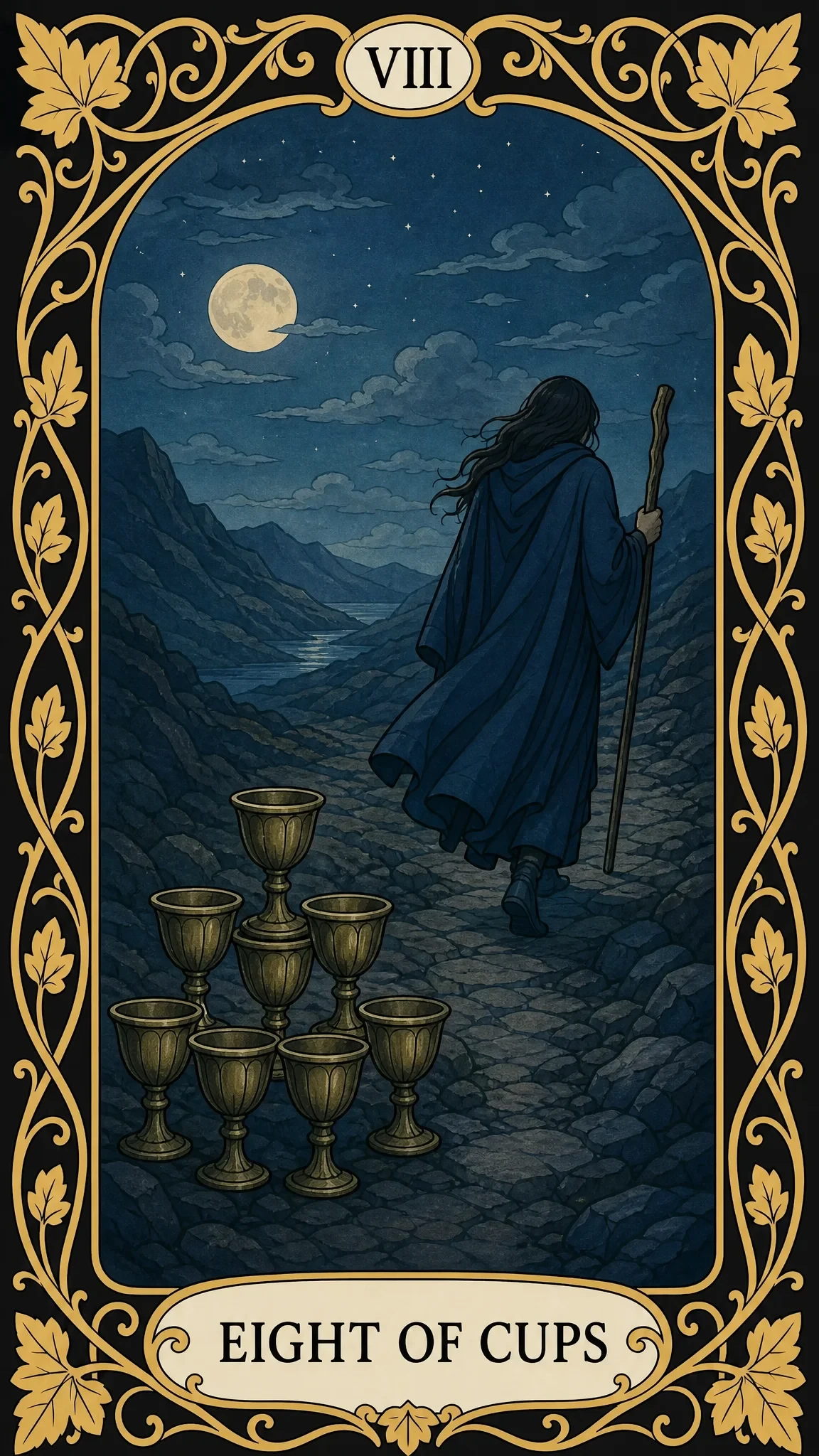
On the card, there are eight full cups — not broken or overturned — and a figure that turns and walks away from them into the darkness, toward distant mountains. This fundamentally distinguishes the Eight of Cups from the Five of the same suit: there, one mourns a loss; here, one consciously leaves what is still whole because it has ceased to be enough.
Reversed Eight of Cups: meaning
The reversed Eight of Cups is the same impulse to leave, but stuck halfway. Usually, the spread refers to one of three options, and the question itself helps to figure it out.
- The decision is made internally, but the step is not taken. The person has already mentally said goodbye to the situation but continues to remain in it — out of fear, habit, or a sense of duty.
- Leaving without direction. They have already left the old, but haven't decided where to go; hence the feeling of rushing between options instead of moving.
- Returning to what is no longer liked. After an unsuccessful attempt to start over, the person returns to the old way of life — not because it has become better there, but because it is familiar.
There is also a softer reading: sometimes the reversed card is not being stuck, but a pause before finally deciding, and it is no worse than the upright position if the person uses it to weigh things rather than to hide.
Eight of Cups in a "yes or no" spread
In "yes/no" spreads, the Eight of Cups is more often read as no — but no specifically to the question "is it worth staying, continuing, keeping as is." If the question is "is it worth leaving," "is it time to change something" — the card, on the contrary, is confirming, and often with a hint of "it's high time."
If the question is about a specific outcome ("will they return," "will it work out if I stay") — the Eight of Cups does not answer it: it is about the decision to leave, not about what will happen after. For this, other cards are needed in the spread.
The reversed position in this spread is "not yet, but internally yes": the person is already ready for change but does not give themselves permission to act. The question should be reformulated not as "will it happen," but "what is holding me back from the step."
Eight of Cups in relationships and feelings
In a relationship spread, the upright Eight of Cups almost always describes emotional cooling despite external well-being: the relationship looks stable, the partner has done nothing wrong, but there is no warmth or response inside anymore. This is not a card of betrayal or scandal, but of a quiet admission that feelings have changed.
In the position of feelings, the card shows not the absence of love in general, but its shift: the person is looking not for less caring relationships, but for deeper ones — where they are seen and heard in a way that is no longer possible here. For a single person's spread, the upright Eight of Cups often means a conscious refusal of light, non-binding connections for the sake of finding something real.
The reversed Eight of Cups in relationships — the person stays, even though everything is decided inside: they keep the usual routine, fearing loneliness more than they fear unhappiness. Or, conversely, they have already left emotionally but cannot close the topic formally.
Eight of Cups in work and money
In career spreads, the Eight of Cups is leaving a stable place for a cause that does not yet bring money or recognition, but resonates in meaning. The card well describes the moment when a successful project suddenly stops bringing joy: the goal is achieved, but there is no satisfaction, and this is more disturbing than failure.
In money, the upright position is not a loss of income, but a voluntary refusal of part of the earnings in exchange for meaning: changing fields, leaving a profitable but draining business. This distinguishes the card from, for example, the Five of Pentacles, where money is lost against one's will.
The reversed Eight of Cups in work — holding onto a position or business that has long ceased to bring joy because it is scary to start over without guarantees. The advice here is simple: before throwing everything away, it is worth honestly understanding if there is a resource for a transition period, rather than acting only out of fatigue.
Eight of Cups as a person: man and woman
When the Eight of Cups appears in the "what kind of person" position, it describes not the character as a whole, but the role of the seeker: someone who has outgrown circumstances and is not ready to pretend that everything is fine just to avoid changing the familiar. Usually, this is a person who is calm on the outside, but with an internal compass that pulls them beyond what has been established.
The Eight of Cups man is someone who can leave a seemingly successful life without scandal or explanation because internal response is more important to him than status. The Eight of Cups woman is someone who is the first to admit to herself that what has been achieved no longer fulfills her, and is not afraid to start the search anew.
The flip side for both is the same: it is difficult to count on constancy next to such a person if they have not yet found what they are looking for. If stability is important in the spread, it is worth looking to see if there are other cards nearby that speak of a completed cycle, for example, the Ten of the same suit.
Eight of Cups sa posisyon ng kaisipan
Sa posisyon ng kaisipan, ang Eight of Cups ay isang tahimik ngunit matatag na pakiramdam na "hindi na ito tama." Umiikot ang mga iniisip sa tanong kung bakit pa ginawa ang lahat kung hindi naman masaya ang resulta; iniisip na ng tao ang pag-alis bago pa man niya ito gawin sa katotohanan.
Ang kalagayang ito ay hindi nakakabahala, kundi mapagnilay-nilay at nakatuon sa loob. Kung may mga Swords sa tabi sa pagbasa, ang mga pagdududa ay maaaring maging nakakapagod na pagsusuri sa sarili; kung may Pentacles naman, ang mga iniisip ay mas malamang na maging konkretong plano kung saan at paano aalis.
Ano ang gagawin kung lumabas ang Eight of Cups
Simple lang ang payo ng card: pahintulutan ang sarili na aminin na hindi sapat ang nakamit, nang hindi naghihintay ng panlabas na dahilan para umalis. Hindi hinihingi ng Eight of Cups ang biglaang paghihiwalay sa lahat — hinihingi nito ang katapatan sa sarili tungkol sa kung ano ang hindi na nagbibigay ng kasiyahan.
Ano ang dapat gawin:
- Tukuyin nang tiyak kung ano ang kulang. Hindi "masama ang lahat," kundi kung ano ang hindi na tumutugma — kung hindi, ang paghahanap ng bago ay hahantong lang sa parehong resulta.
- Huwag ipagpalit ang pagkapagod sa kawalan ng saysay ng layunin. Minsan, hindi ito tungkol sa pag-alis, kundi tungkol sa paghinto at pagpapahinga — dapat itong suriin bago gumawa ng padalos-dalos na desisyon.
- Gawing unti-unti ang pag-alis kung maaari. Hindi hinihingi ng Eight of Cups na sunugin ang mga tulay — maaari kang maghanda habang wala pa ang bago.
- Suriin kung ano ang pumipigil sa iyo — takot, obligasyon sa iba, o tunay na kakulangan ng resources para sa paglipat.
Kung ang pag-alis ay hindi dahil sa paghahanap ng kahulugan, kundi dahil sa matagal na kawalan ng gana, pagkawala ng interes sa lahat, o depresyon na hindi nawawala sa loob ng ilang linggo — ang pagbasa ay hindi kapalit ng pakikipag-usap sa isang eksperto: ipinapakita ng card ang paggalaw ng damdamin, hindi diagnosis o solusyon sa isang komplikadong kondisyon.
Ano ang nakaguhit sa card
Sa ating card ay isang eksena sa gabi: isang nag-iisang pigura na nakasuot ng madilim na asul na kapa na may mahabang buhok ang naglalakad palayo sa tumitingin sa isang mabatong landas, habang nakasandal sa isang kahoy na tungkod. Sa likuran, malapit sa mga paa, ay may walong gintong tasa na nakasalansan sa lupa — lahat ay buo, walang natumba o nabasag. Sa unahan ay isang lambak sa bundok na may ilog, at mataas sa mabituing langit ay nakasilip ang kabilugan ng buwan.
Ganito binabasa ang eksena:
- Ang mga tasa ay naiwan nang buo — ang pag-alis ay hindi konektado sa pagkawala o parusa: iniiwan ng tao ang eksaktong mayroon siya, naubos lang ang silbi nito.
- Gabi at mabituing langit sa halip na karaniwang dapit-hapon — binibigyang-diin ng ating bersyon ng card na ang desisyon ay hindi ginawa sa gulat, kundi sa katahimikan, mag-isa, nang walang saksi o tagapayo.
- Tungkod sa kamay — ang suporta na dala ng tao: hindi siya tumatakbo nang walang dala sa desperasyon, kundi sadyang naghahanda sa paglalakbay.
- Ilog at mga bundok sa unahan — hindi pa ipinapakita ang buong landas, hindi pa nakikita ang layunin, ngunit napili na ang daan.
Eight of Cups bilang card of the day
Ang Eight of Cups bilang card of the day ay isang pagkakataon para tapat na tanungin ang sarili kung nagbibigay pa ba ng kasiyahan ang mga ginagawa mo ngayon, o ginagawa na lang ito dahil sa nakasanayan. Ang araw na ito ay hindi para sa biglaang paghihiwalay, kundi para sa matino na pagsusuri: ano ang dapat iwanan at ano ang masyado pang maaga para bitawan.
Kung ang card ay lumabas na baligtad — ang araw ay tungkol sa desisyong hinog na sa loob, ngunit natatakot pang sabihin. Isang kapaki-pakinabang na mindset — huwag pilitin ang sarili na gumawa agad ng hakbang, kundi kahit aminin lang nang tapat sa sarili kung ano ang kulang.
Mga madalas itanong tungkol sa Eight of Cups
Ito ba ay Major o Minor Arcana?
Minor Arcana, suit ng Cups, elementong Tubig. May kabuuang 56 na Minor Arcana sa Tarot deck — 14 na card bawat suit, at ang Eight of Cups ang nagpapatuloy sa paglalakbay sa loob ng suit ng damdamin.
Ano ang pagkakaiba ng Eight of Cups sa Eight of Swords?
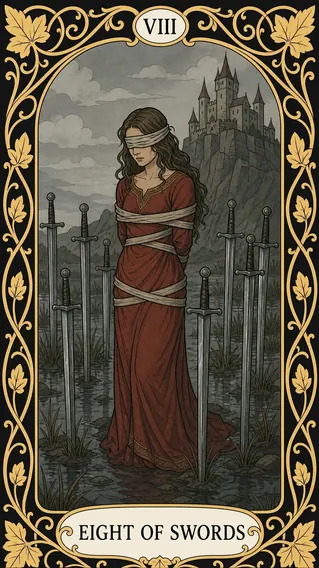
Parehong card ay tungkol sa pakiramdam ng pagkakulong, ngunit magkaiba ang pinagmulan. Ang Cups ay elementong tubig, damdamin: ang Eight of Cups ay tungkol sa kusang-loob na pag-alis kapag napagdesisyunan na at malaya na ang landas. Ang Swords ay elementong hangin, isipan: ang Eight of Swords ay tungkol sa pakiramdam ng bitag, kung saan nararamdaman ng tao na nakagapos siya ng sarili niyang mga iniisip, kahit na sa katotohanan ay maaari siyang umalis. Kung sa pagbasa ay mahalaga ang malay na pagpili na iwanan ang nakamit — ito ay tungkol sa Cups; kung mahalaga ang pakiramdam ng pagkakulong at panloob na pagbabawal na kumilos — tungkol ito sa Swords.
Ang Eight of Cups ba ay oo o hindi?
Malamang na hindi, kung ang tanong ay kung dapat bang manatili at magpatuloy gaya ng dati. Kung ang tanong ay kung dapat bang umalis o magbago ng isang bagay, ang sagot ay positibo — ang card ay tungkol sa tamang panahon ng pag-alis, hindi tungkol sa pagpapanatili ng status quo.
Ano ang ibig sabihin ng baligtad na Eight of Cups?
Parehong bugso ng damdamin na umalis, ngunit walang natapos na hakbang: ang desisyon ay hinog na sa loob, ngunit natatakot kumilos, o kaya naman ay nakaalis na pero walang malinaw na direksyon. Minsan ito ay paghinto lang bago ang pinal na desisyon, hindi pagtalikod dito.
Ang Eight of Cups ba ay nangangahulugan ng paghihiwalay?
Hindi kinakailangang isang madramang paghihiwalay — mas madalas itong pag-amin na nagbago na ang damdamin sa isang relasyong mukhang maayos naman sa labas. Maaari itong humantong sa paghihiwalay, o sa isang tapat na usapan na nagpapabuti sa relasyon. Ipinapakita ng card ang sandali ng pagkamulat, hindi ang tapos na resulta.