What the Eight of Swords means in Tarot
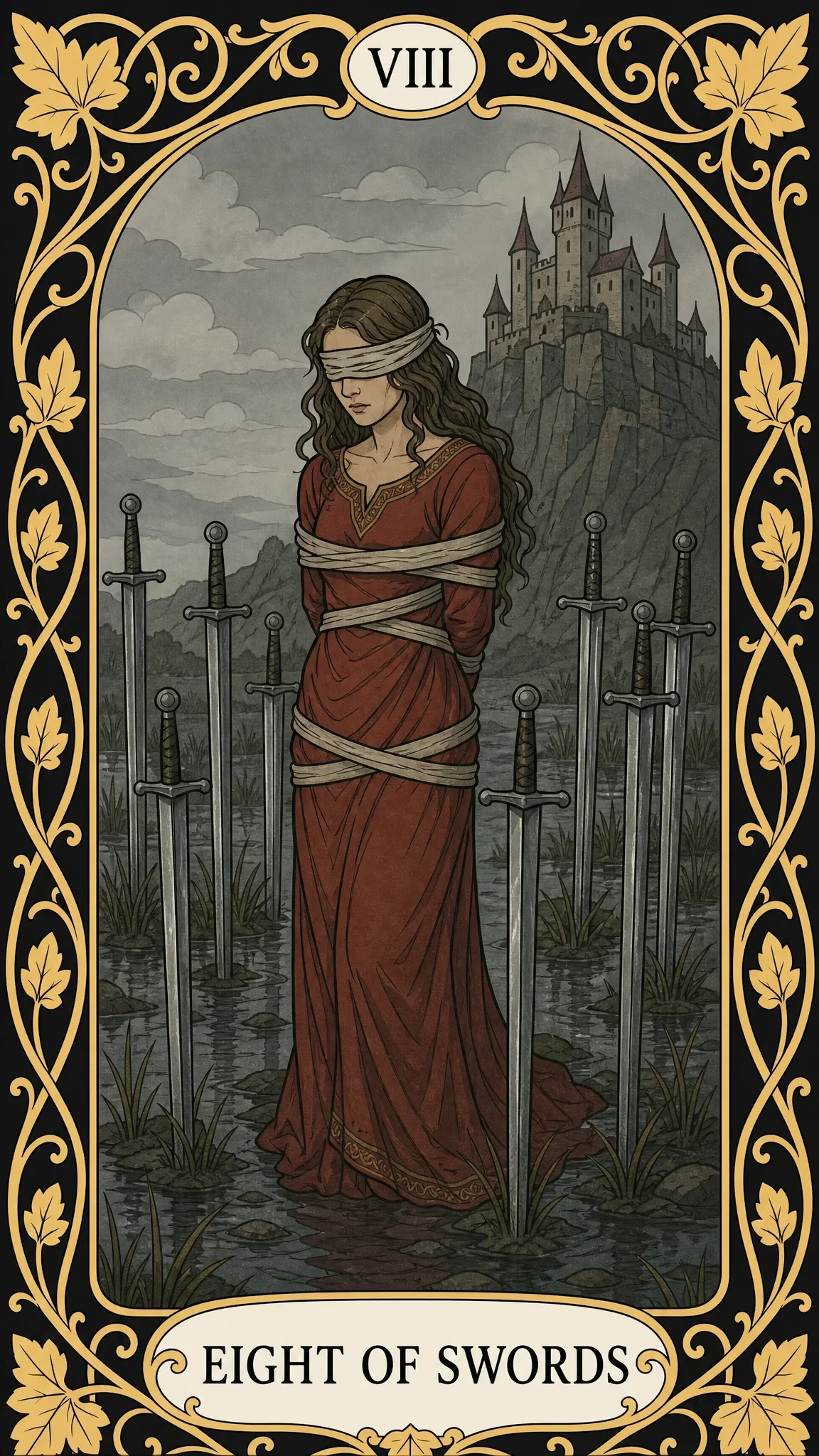
The Eight of Swords is one of the most recognizable images of the minor arcana: a woman with a blindfold, her hands tied with cloth, and blades stuck into the ground around her. The first thing to say right away: the trap on this card is almost always set from the inside, not the outside. The swords are not placed close together; there is enough space between them to pass through, but the person does not see this because they have blindfolded themselves.
An important nuance that gets lost in retellings: the minor arcana describes an episode, not destiny. The Eight of Swords is not about a person's whole life being a prison, but about a specific situation in the coming days or weeks where it seems there is no choice: a job that has become stifling, a conversation one is afraid to start, a decision being postponed because only bad options are visible. The element of swords is air, and air here is thoughts: the card is precisely about how the mind itself has narrowed the picture of what is happening to a single hopeless scenario.
The upright position reads this situation honestly: the feeling of helplessness is real, but there are usually fewer objective obstacles than it seems. It is important to immediately separate this state from literal lack of freedom — if the question is not about a metaphor, but about a real situation, more details on this are in the section "What to do if the Eight of Swords appears".
Reversed Eight of Swords: meaning
The reversed Eight of Swords is a moment when the blindfold is removed, even if not completely. Usually, the spread refers to one of three options, and the question itself helps to choose.
- The first step has already been taken. The person has finally seen the way out and is starting to act, albeit slowly and uncertainly.
- Acknowledging your role in the trap. There is an understanding that the dead end is partly created by one's own avoidance, and not just by external circumstances.
- Liberation after long tension. A situation that was holding one in a vice is finally resolving — not always beautifully, but with palpable relief.
There is also a heavy reading that should not be ignored: sometimes the reversed card shows not a solved problem, but only the beginning of realizing its scale — for example, addiction or an unhealthy relationship. Here, working with the card ends where working with a specialist begins.
Eight of Swords in a "yes or no" spread
In "yes/no" spreads, the Eight of Swords leans towards a cautious no — but not because the road is objectively closed, but because the person is not yet ready to see the way out. If the question sounds like "will it work out," the upright card answers: for now, it feels like it won't, although there may be significantly fewer real obstacles.
If the question is phrased differently — "is there a way out at all" — the answer is more affirmative, it's just that the way out is not where one is looking. Here it is useful to rephrase the question itself: not "will it resolve itself," but "what is preventing me from seeing the solution."
The reversed position in this spread is read more gently: yes, the situation is starting to shift, the first step towards the exit has already been taken or is about to be taken.
Eight of Swords in relationships and feelings
In a relationship spread, the upright Eight of Swords often describes the feeling that a person is stuck in a couple or in a situation from which they see no way out: it is scary to leave, scary to stay, scary to start a conversation about the problem. Sometimes this feeling is amplified by one's own assumptions — the partner never said what they are being accused of, but the assumption holds tighter than any real words.
For single people, the card can mean a fear of trusting again after a painful experience: the connection is not forbidden by anyone, but the person themselves does not let anyone close, fearing a repetition of old pain.
The reversed position is the removal of this fear: the conversation has finally taken place, a decision has been made, the view of the situation has become clearer. A direct disclaimer is needed here: if behind the words "stuck in a relationship" there is not anxiety, but a real threat, control, or violence from a partner — the spread is not the place to solve this issue. Such a situation is a reason to contact a specialist or a help service, not to read cards.
Eight of Swords in work and money
In career spreads, the Eight of Swords is a job that seems like a dead end: rigid frameworks, a boss with whom it is scary to argue, obligations that are difficult to break. Often, in reality, there are more options than are visible from within the position — change departments, talk directly, look for another place — they just aren't considered, as one has become accustomed to considering the situation hopeless.
In money, the upright position is the feeling that expenses or debts have cornered one so much that it seems like nothing can be changed. This is more of a psychological dead end than a mathematical one: there are often steps that reduce tension — review the budget, talk to a creditor, ask for an installment plan — one just doesn't think about them in a state of panic.
The reversed card is the beginning of movement: the first call, the first edit of a resume, the first conversation about revising terms.
Eight of Swords as a person: man and woman
When the Eight of Swords appears in the "what kind of person" position, it describes the role of someone who has driven themselves into a corner: they exaggerate risks, are afraid to act, and see fewer exits than there actually are.
A woman-Eight of Swords is someone who keeps anxiety to herself and does not ask for help, even though there is someone nearby who can help. A man-Eight of Swords is someone who gets stuck in analysis and self-criticism instead of action, even though the way out is likely simple.
It is useful to remember: this is not about a weakness of character, but about a temporary state. Nearby in the spread, it is worth looking at cards that speak of support and a sober view from the outside — often they turn out to be the missing piece of the puzzle.
Eight of Swords sa posisyon ng pag-iisip
Sa posisyon ng pag-iisip, ang Eight of Swords ay ang paulit-ulit na pag-iisip sa iisang senaryo: ang isip ay nakatuon lamang sa kaisipang "walang labasan," at ang anumang alternatibo ay itinatapon bago pa man mapag-isipan.
Ito ay isang estado ng tunnel vision, na katangian ng mga espada bilang elemento ng hangin: masyadong maraming iniisip tungkol sa isang dead-end at masyadong maliit na atensyon sa mga totoong katotohanan sa paligid. Kung ang Pentacles ay nasa tabi sa pagbasa, ang pagkabalisa ay mas praktikal, tungkol sa pera o obligasyon; kung ang Cups ay nasa tabi, ang pagkabalisa ay mas emosyonal, tungkol sa kung ano ang iisipin o kung paano tutugon ang iba.
Ano ang gagawin kung lumabas ang Eight of Swords
Ang payo ng baraha ay simple, bagaman hindi madali: tanggalin ang piring nang mag-isa, dahil walang ibang gagawa nito para sa iyo. Ang Eight of Swords ay tungkol sa isang bitag na maaari mong lisanin kung titigilan mo ang pag-iisip ng mga hadlang na hindi naman totoo.
Ano ang dapat gawin:
- Ihiwalay ang mga katotohanan sa haka-haka. Isulat kung ano ang tunay na nakakahadlang, at kung ano ang takot lamang o opinyon ng iba.
- Humanap ng isang puwang sa pagitan ng mga "espada". Huwag agad maghanap ng kumpletong plano para makalabas — sapat na ang isang konkretong hakbang na magpapaliit sa dead-end.
- Magtanong sa ibang tao. Ang tunnel vision ay karaniwang nawawala sa pananaw ng taong hindi nakulong sa parehong sitwasyon.
- Huwag ipagkamali ang sikolohikal na bitag sa totoong kawalan ng kalayaan.
Kung ang tanong ay hindi metapora kundi isang totoong sitwasyon — kung saan ang isang tao ay pinipigilan laban sa kanyang kalooban, tinatakot, o nililimitahan ang paggalaw o komunikasyon — ang Tarot reading ay hindi lugar para sa solusyon. Ito ay usapin para sa mga eksperto: psychologist, abogado, support services, at kung may agarang panganib, sa mga emergency services. Ang baraha ay maaaring magpakita ng estado ng pagkabalisa, ngunit hindi nito pinapalitan ang totoong tulong at hindi dapat itong ipagpaliban.
Ano ang nakaguhit sa baraha
Sa ating baraha, isang babaeng nakasuot ng madilim na pulang damit ang nakatayo sa maputik na lupa sa gitna ng mababang damo. Ang kanyang mga mata ay nakapiring, at ang kanyang mga kamay ay nakatali sa kanyang katawan gamit ang malapad na tela. Sa paligid, kalahating nakabaon sa tubig, ay may walong espada — hindi nakapulupot nang mahigpit sa katawan, kundi may sapat na distansya sa isa't isa, na nag-iiwan ng malinaw na daanan. Sa malayo, sa isang mabatong burol, ay isang maliwanag na kastilyo na may ilang tore, na maaari mong marating kung gugustuhin.
Ganito binabasa ang eksena:
- Piring sa mga mata — hindi ang mga espada ang nagkukulong sa babae, kundi ang sarili niyang kawalan ng alam sa nangyayari sa paligid.
- Nakahiwalay na mga espada — ang daan palabas ay pisikal na umiiral, hindi lang ito nakikita dahil sa piring.
- Kastilyo sa background — ang layunin o normal na buhay ay maaari pa ring maabot, hindi ito nawasak o kinuha, pansamantala lang itong natatakpan ng hamog ng pagkabalisa.
Ang pagkakaiba sa karaniwang iconograpiya ay dapat sabihin nang direkta: sa klasikong deck, ang mga kamay ay madalas na nakatali sa likod, at ang mga espada ay mas dikit-dikit, halos parang hawla sa paligid ng mga paa. Sa atin, ang mga kamay ay nakatali sa harap, at may malinaw na puwang sa pagitan ng mga espada: ang diin dito ay mas matindi sa katotohanang ang dead-end ay gawa-gawa lamang at hindi literal na hindi malalagpasan.
Eight of Swords bilang baraha ng araw
Ang Eight of Swords bilang baraha ng araw ay isang senyales na huminto at suriin kung ang sitwasyon ay talagang walang labasan gaya ng iniisip mo sa umaga. Ang araw ay angkop para ihiwalay ang mga totoong hadlang sa mga haka-haka, at hindi para sa mga padalos-dalos na desisyon.
Kung ang baraha ay lumabas na baligtad (reversed) — ang araw ay malamang na magdadala ng ginhawa: ang usapang ipinagpapaliban ay mangyayari nang kusa, o ang solusyon ay darating nang mas madali kaysa sa inaasahan.
Mga madalas itanong tungkol sa Eight of Swords
Ito ba ay Major o Minor Arcana?
Minor Arcana, suit ng Swords, elementong Hangin. May kabuuang 56 na Minor Arcana sa Tarot deck — 14 na baraha bawat suit, at ang Eight of Swords ang ikawalong baraha ng suit ng Swords.
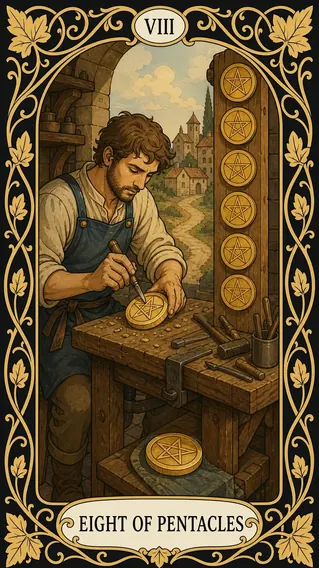
Ano ang pagkakaiba ng Eight of Swords sa Eight of Pentacles?
Parehong baraha ang tungkol sa ikawalong antas ng suit, ngunit magkaiba ang kalikasan. Ang Swords ay elementong hangin, pag-iisip: ang Eight of Swords ay tungkol sa pakiramdam ng pagkakulong na dulot ng sariling takot at maling persepsyon. Ang Pentacles ay elementong lupa, paggawa: ang Eight of Pentacles ay tungkol sa nakatuong pagsasanay at paghasa ng kasanayan, nang walang bitag o pagkabalisa. Kung ang interes sa pagbasa ay ang pakiramdam ng pagkakulong at takot — ito ay para sa Swords; kung sipag at kahusayan — para sa Pentacles.
Ang Eight of Swords ba ay oo o hindi?
Malamang na hindi: sinasabi ng baraha na hindi pa nakikita ng tao ang labasan, hindi sa ibig sabihin na walang labasan. Kung ang tanong ay tungkol sa "magtatagumpay ba," ang sagot ay maingat na negatibo. Kung ang tanong ay kung may solusyon ba, ang sagot ay malamang na oo — hindi lang ito nakikita sa ngayon.
Ano ang ibig sabihin ng baligtad na Eight of Swords?
Pag-alis ng piring: unang hakbang palabas ng dead-end, pagkilala sa sariling papel sa sitwasyon, o ginhawa pagkatapos ng mahabang tensyon. Minsan — simula pa lang ng pag-unawa sa seryosong problema, at hindi pa ang solusyon nito, kaya dapat itong sundan ng tulong mula sa isang eksperto.
Ang Eight of Swords ba ay nangangahulugan ng totoong panganib o pagkakulong?
Ang baraha mismo ay tungkol sa sikolohikal at self-limiting na pakiramdam ng pagkakulong, hindi sa literal na kawalan ng kalayaan. Ngunit kung ang tanong ay tungkol sa totoong sitwasyon kung saan ang isang tao ay pinipigilan laban sa kanyang kalooban, nililimitahan ang paggalaw o komunikasyon — ito ay dahilan para humingi ng tulong sa eksperto, support service, o emergency services, sa halip na maghanap ng sagot sa pagbasa.