What the Seven of Swords means in Tarot
Swords in Tarot represent the mind, words, and strategy, not brute force, and their element is air: fast, cold, and calculating. The Seven of Swords is a card about the moment when the direct path seems too long, too risky, or too public, and a person chooses to bypass it.
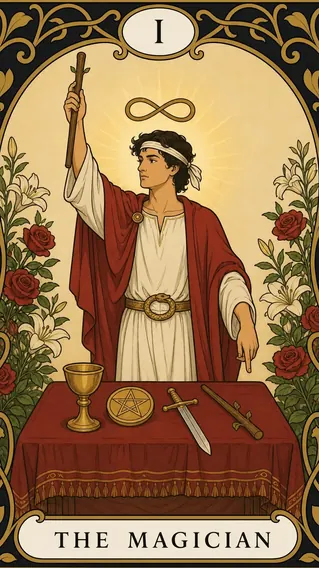
An important nuance often lost in retellings: the minor arcana describes a specific maneuver, not a person's entire character. While the Magician speaks of dexterity and mastery of tools in general, the Seven of Swords is about one single move: solving a problem quietly, without approvals, and without attracting unnecessary attention. This can be resourcefulness — bypassing bureaucracy, getting out of a dead end without a scandal, or handling things yourself while others argue. Or it can be corner-cutting — taking what isn't yours or staying silent when you should have spoken up.
The card does not pass moral judgment on its own: it shows a maneuver, and its nature — whether it is honest or not — is determined by neighboring cards and the situation itself. The upright position is read unambiguously as acting indirectly, rather than head-on. How justified this is, the Seven of Swords does not judge — for that, one should look at the cards nearby in the spread, primarily at who bears the cost of this maneuver.
Reversed Seven of Swords: meaning
The reversed Seven of Swords is the same maneuver, but at a stage where it is either revealed or stops satisfying the person themselves. Usually, the spread refers to one of three options, and the question helps to choose.
- The hidden has become obvious. What was done quietly has come to light — not necessarily with a catastrophe, but explanations will be necessary.
- The person is tired of playing a double game. Keeping track of who was told what and what was left unsaid turned out to be harder than taking one direct step.
- The maneuver didn't work. The detour led to the same place a direct path would have, only with a loss of time and trust.
There is also a calmer reading: the reversed card often signifies a decision to return to honesty — not because they were forced to, but because it became easier to live that way. The difference is whether this decision came on its own or was forced by circumstances.
Seven of Swords in a "yes or no" spread
In "yes/no" spreads, the Seven of Swords answers yes, but not in the way you have in mind. The direct path is likely closed or too expensive, but a detour is quite viable: negotiate on the side, approach from a different angle, or do it yourself instead of waiting for permission.
If the question is "will it be possible to negotiate openly" or "will everything be resolved honestly and immediately" — the answer is likely negative. If the question is broader, "will it work out at all" — the answer is affirmative, it's just that the path to it won't be the most direct.
The reversed position in this spread is "not yet": the maneuver is either already revealed, or it is safer to abandon it and look for an honest option, even if it is slower.
Seven of Swords in relationships and feelings
In a relationship spread, the Seven of Swords most often speaks of omission rather than infidelity — and this is an important distinction: the card describes silence, not a specific event. Someone in this story decides not to resolve the relationship directly, but to bypass an uncomfortable conversation. This could be a partner, but it could just as easily be the person pulling the spread — the card alone does not allow you to assume who exactly.
In the position of feelings, the Seven of Swords is caution, a reluctance to open up completely, and a habit of keeping something to oneself "just in case." This is not necessarily a warning sign: sometimes this is what a person looks like who has already been burned by complete honesty and is now consciously rationing it.
If the spread directly asks about trust, it is more honest to ask the person in question rather than the card: the Seven of Swords shows a tendency toward maneuvering, but not the fact of specific deception.
The reversed card in relationships is the moment when the unsaid surfaces or when one of the two finally decides to say what they were silent about.
Seven of Swords in work and money
In career spreads, the Seven of Swords is solving a problem by bypassing the usual order: without a meeting, without a manager's permission, without disclosure to the team. Sometimes this is resourcefulness that saves everyone's nerves, sometimes it is a risk if bypassing the rules is discovered at the wrong time.
In money, the upright position often points to an expense or a deal that not all interested parties know about: a hidden purchase, an agreement bypassing an intermediary, or income that one is in no hurry to report. The card does not say whether it is legal or not — only that the operation was carried out quietly.
The reversed Seven of Swords in work is a detour that didn't work: the plan was exposed, colleagues found out ahead of time, or the person themselves decided against risking their reputation for a shortcut. The reasonable conclusion from this card is one: before acting indirectly, it is worth estimating the cost of exposure, not just the benefit of the maneuver.
Seven of Swords as a person: man and woman
When the Seven of Swords appears in the "what kind of person" position, it does not describe the entire character, but the manner of acting: someone who prefers to solve a problem themselves, without consulting or explaining in advance, and who does not like it when their plan is discussed before it has worked.
A Seven of Swords man is reserved, keeps to himself, acts quickly and without demonstration; his plans are usually found out after the fact. A Seven of Swords woman is someone who knows how to resolve an uncomfortable issue quietly, bypassing conflict rather than engaging in it.
This is not a description of a dishonest person by default — rather a person who does not consider it necessary to report every step. You should judge their reliability by the neighboring cards: next to cards of trust, like the Ace of Swords, the maneuver is likely direct and justified; next to heavy cards of the same suit, it is worth being more careful.
Seven of Swords in the position of thoughts
In the position of thoughts, the Seven of Swords is calculating a move ahead: how to bypass an obstacle without attracting attention, whether it is worth explaining one's actions or if it is easier to do it and then tell if asked. This is not necessarily anxiety — sometimes it is just the cold calculation of a person who does not like to ask for permission.
If other Swords appear nearby in the spread, the calculation can grow into excessive suspicion and sleepless thoughts of "what if they find out." Next to warmer suits, it is more likely calm planning rather than hidden anxiety.
Ano ang dapat gawin kung lumabas ang Seven of Swords
Ang payo ng card ay hindi ang talikuran ang anumang diskarte—minsan, ang pag-iwas ay mas tapat at matalino kaysa sa direktang pagharap. Ang payo ay suriin ang halaga ng maniobra para sa iba bago ito ituloy.
Ano ang dapat gawin:
- Tanungin ang sarili kung bakit kailangan ng pag-iwas sa halip na pag-uusap. Ang pagtitipid ng oras at lakas ay isang dahilan, ngunit ang ayaw marinig ang "hindi" ay iba.
- Tantyahin ang halaga ng pagbubunyag. Kung malalaman ang plano bukas, mahihiya ka ba sa mismong ginawa o maiilang lang sa usapan—magkaibang sitwasyon ito.
- Huwag ibatay ang buong estratehiya sa pananahimik. Ang isang tahimik na hakbang ay isang tool, ngunit ang patuloy na paglilihim ay nakakapagod.
- Kung ang maniobra ay direktang nakakaapekto sa ibang tao, suriin kung mas madali bang sabihin ang totoo—hindi dahil sa prinsipyo, kundi dahil mas mababa ang panganib.
Kung ang tanong ay tungkol sa seryosong hidwaan o tiwalang nasira, ang reading ay hindi kapalit ng direktang pag-uusap sa tao o, kung mabigat ang sitwasyon, sa isang psychologist: ipinapakita ng card ang hilig sa maniobra, hindi ang solusyon para sa iyo.
Ano ang nakaguhit sa card
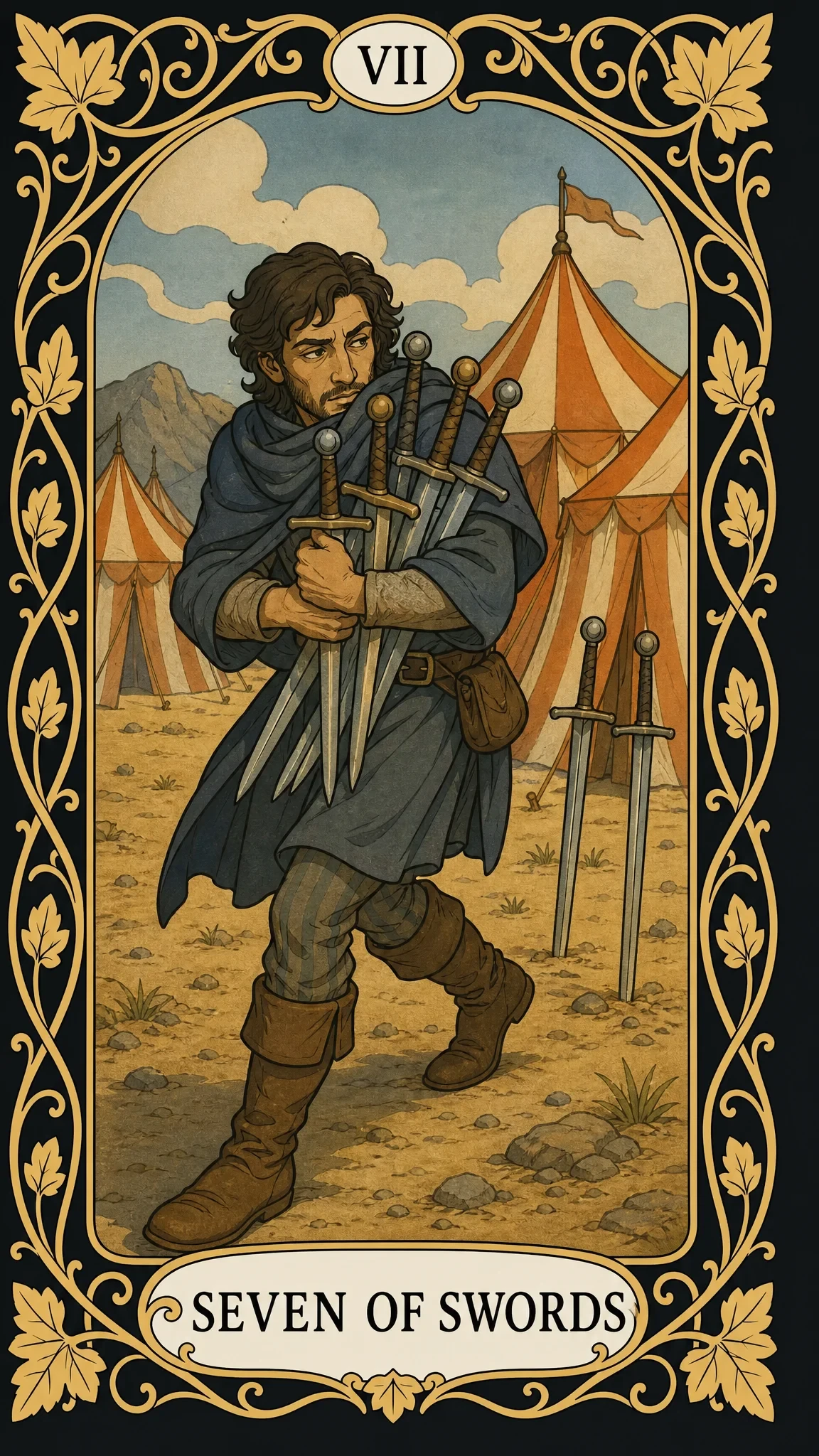
Sa ating card ay isang binatang may kulot na kayumangging buhok at maikling balbas, nakabalot sa asul na kapa na nakapulupot sa magkabilang balikat; sa ilalim ng kapa ay makikita ang mapusyaw na quilted na tela ng kanyang suot. Ang kanyang pantalon na may asul-abo at olive na guhit ay nakapasok sa matataas na brown na bota, at sa kanyang baywang ay isang leather belt na may maliit na pitaka. Naglalakad siya nang mabilis at palihim, mahigpit na hawak ang limang espada—makikita ang limang bilog na hawakan sa ibabaw ng kanyang mga palad. Ang kanyang ulo ay nakalingon sa gilid: ang tingin ay mapagmatyag, hindi gaanong natatakot kundi maingat, na parang tinitingnan kung may nakapansin sa kanya. Sa likod, sa mabuhanging lupa malapit sa mga guhit-guhit na orange at puting tolda na may bandila sa tuktok, ay may dalawa pang espada na nakabaon sa lupa—kasama ang mga hawak niya, eksaktong pito, gaya ng nararapat sa card. Sa paligid ay tuyong mabatong lupa na may ilang maliliit na palumpong, at sa abot-tanaw sa kaliwa ay makikita ang mababang hanay ng mga bundok.
Ganito binabasa ang eksena:
- Mapagmatyag na tingin sa gilid — ang sentrong detalye ng card: ang tao ay hindi tumatakbo sa takot, kinokontrol niya ang sitwasyon, sinusuri ang paligid at tinitingnan kung may nakapansin sa kanya. Higit itong pagiging kalmado kaysa takot.
- Limang espada sa kamay laban sa dalawa sa lupa — ang maniobra ay kalahating tapos na: ang bahagi ng nakuha ay nasa kanya na, ang iba ay naiwan dahil hindi nadala lahat nang sabay-sabay.
- Mga guhit-guhit na tolda sa background — teritoryo ng iba, mga panuntunan ng iba, kung saan umaalis ang tao nang walang pahintulot at walang paalam.
- Bukas na lupain sa unahan — malaya ang daan, ngunit hindi magtatagal: ang eksena ay nahuli sa sandaling maaari pang mabigo ang maniobra.
Sa itaas ng card ay ang Roman numeral na VII, sa ibaba ay ang label na SEVEN OF SWORDS: ang deck ay iginuhit sa tradisyon ng Rider-Waite, kung saan ang Seven of Swords ang ikapito sa suit na ito.
Seven of Swords bilang card of the day
Ang Seven of Swords bilang card of the day ay magandang araw para magdesisyon nang mag-isa at mabilis, nang hindi naghihintay ng pagsang-ayon ng lahat: tapusin ang usaping matatagalan sa diskusyon, ayusin ang gawain nang mag-isa habang ang iba ay nagpupulong pa.
Ang kabaligtaran nito ay ang tuksong gawin ito nang masyadong tahimik kung saan dapat ay nagbabala ka. Kapaki-pakinabang na paalala: bago kumilos nang walang paalam, isipin sandali kung kailangan mo bang magpaliwanag pagkatapos—at kung oo, mas mabuting sabihin na nang maaga kaysa sa huli.
Mga madalas itanong tungkol sa Seven of Swords
Ito ba ay Major o Minor Arcana?
Minor Arcana, suit ng Swords, elementong Hangin. May kabuuang 56 na Minor Arcana sa Tarot deck—14 na card bawat isa sa apat na suit, at ang Seven of Swords ang ikapito sa suit ng mga espada.
Ano ang pagkakaiba ng Seven of Swords sa Seven of Pentacles?
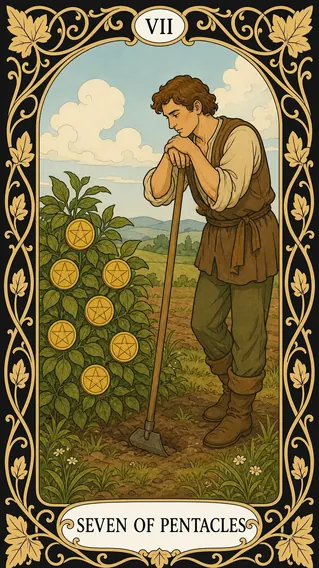
Parehong tungkol sa pansamantalang resulta ang mga card na ito, ngunit magkaiba ang kalikasan. Ang Swords ay elementong hangin, isip at estratehiya: ang Seven of Swords ay tungkol sa maniobra, pag-iwas sa mga panuntunan, at pagpapasya nang palihim. Ang Pentacles ay elementong lupa, paggawa at resources: ang Seven of Pentacles ay tungkol sa paghinto at pagtatasa ng mga pinaghirapan, hindi tungkol sa panlilinlang. Kung ang paraan ng pagkilos ang mahalaga sa reading—tingnan ang Swords, kung ang resulta ng matagal na pagtatrabaho—tingnan ang Pentacles.
Ang Seven of Swords ba ay laging tungkol sa panlilinlang?
Hindi. Ipinapakita ng card ang maniobra sa halip na direktang landas, hindi isang tiyak na katotohanan ng panlilinlang at tiyak na hindi kasalanan ng isang partikular na tao. Minsan ito ay pagiging mapamaraan: lutasin ang isyu nang tahimik at walang gulo. Ang pagtatasa kung tapat ang maniobra o hindi ay dapat ibatay sa sitwasyon at sa mga katabing card, hindi sa card na ito lamang.
Ang Seven of Swords ba ay oo o hindi?
Malamang na oo, ngunit hindi sa paraang inaasahan ng tanong: ang direktang landas ay sarado o hindi kapaki-pakinabang, ngunit ang pag-iwas ay gumagana. Kung ang tanong ay tungkol sa tapat at bukas na solusyon, ang sagot ay malamang na hindi.
Ano ang ibig sabihin ng baligtad na Seven of Swords?
Ang parehong maniobra, ngunit sa yugto ng pagbubunyag o pagtalikod dito: ang sikreto ay lumalabas, ang pag-iwas ay hindi gumagana, o ang tao mismo ang nagpapasya na huminto sa paglilihim at maging tapat. Ang pagkakaiba sa tuwid na posisyon ay hindi na posible o hindi na gustong maglihim pa.