Present Continuous — nastoyashchee dlitel'noe vremya v angliyskom yazyke: im opisyvayut deystvie, kotoroe proiskhodit pryamo seychas (I am reading — ya chitayu) ili dlitsya v nyneshniy period. Obrazuetsya ono po formule am / is / are + glagol s -ing. Na etoy stranitse — pravilo s tablitsami, napisanie okonchaniya -ing, otritsanie i vopros, markery vremeni, glagoly sostoyaniya, raznitsa mezhdu Present Simple i Present Continuous i trenazhyor iz 10 variantov, chtoby zakrepit' temu.
Prover' sebya: 10 variantov po 12 predlozheniy, razbor posle kazhdogo otveta.
Odpri vadnicoChto takoe Present Continuous
Present Continuous (ego eshche nazyvayut Present Progressive) — nastoyashchee dlitel'noe vremya angliyskogo yazyka. Ono pokazyvaet deystvie v protsesse: ono uzhe nachalos', eshche ne zakonchilos' i proiskhodit pryamo seychas ili v nyneshniy period.
V russkom yazyke otdel'nogo «dlitel'nogo» vremeni net: i «ya chitayu kazhdyy vecher», i «ya chitayu pryamo seychas» zvuchat odinakovo. V angliyskom eto dva raznykh vremeni — Present Simple i Present Continuous. Poetomu glavnyy vopros, kotoryy nuzhno zadavat' sebe: eto privychka ili protsess, kotoryy idyot seychas?
- Look! It is raining. — Smotri! Idyot dozhd'. (pryamo seychas)
- I am talking on the phone right now. — Ya seychas razgovarivayu po telefonu.
- She is studying for her exams this week. — Na etoy nedele ona gotovitsya k ekzamenam. (vremenno)
Present Continuous: obrazovanie — am, is, are + -ing
Present Continuous stroitsya iz dvukh chastey: vspomogatel'nogo glagola to be v nastoyashchem vremeni (am, is ili are) i osnovnogo glagola s okonchaniem -ing. Kakuyu formu be vybrat', zavisit ot podlezhashchego. V razgovornoy rechi i v pis'me drugu formy pochti vsegda sokrashchayut: I'm, she's, we're, they're.
Glagol s -ing bez am / is / are — ne skazuemoe. She playing tennis — oshibka: ne khvataet is.
| Kto | Primer |
|---|---|
I am · I'm | I am reading a book.Ya chitayu knigu. |
he / she / it is · she's | She is playing tennis.Ona igrayet v tennis. |
you / we / they are · they're | They are watching TV.Oni smotryat televizor. |
Pravila napisaniya okonchaniya -ing
V bol'shinstve sluchayev -ing prosto pribavlyaetsya k glagolu. No yest' tri sluchaya, v kotorykh menyayetsya napisanie osnovy — imenno na nikh chashche vsego teryayut bally v kontrol'nykh.
Otritsanie i vopros v Present Continuous
Vsya «grammaticheskaya rabota» v etom vremeni lezhit na am / is / are, a osnovnoy glagol s -ing ne menyayetsya. V otritsanii posle vspomogatel'nogo glagola stavitsya not, v voprose vspomogatel'nyy glagol vykhodit vperyod, pered podlezhashchim. Slova do i does zdes' ne nuzhny — oni otnosyatsya k Present Simple.
I 'm not working today.
What are you doing?
Kogda upotreblyayetsya Present Continuous
- Deystvie v moment rechi — to, chto proiskhodit pryamo seychas, poka my govorim.
Listen! Somebody is playing the piano. - Vremennaya situatsiya — deystvie dlitsya kakoy-to period (segodnya, na etoy nedele, v etom mesyatse), no ne postoyanno.
My dad is working from home this month. - Izmeneniya i tendentsii — to, chto postepenno menyayetsya.
The weather is changing. The days are becoming shorter. - Plany na blizhaishee budushchee, o kotorykh uzhe dogovorilis': kupleny bilety, naznachena vstrecha.
I am meeting John tomorrow. We are flying to Paris next week. - Razdrazhayushchaya privychka so slovami always, constantly — govoryashchiy nedovolen.
He is always complaining! — On vechno zhaluyetsya!
Markery Present Continuous: now, at the moment, Look!
Slova-markery podskazyvayut, kakoe vremya nuzhno. Vosklitsaniya Look!, Listen!, Be quiet! — tozhe markery: my prosim posmotret' ili prisлуshat'sya k tomu, chto proiskhodit pryamo seychas.
Glagoly sostoyaniya: kakiye glagoly ne upotreblyayutsya v Present Continuous
Nekotoryye glagoly oboznachayut ne deystvie, a sostoyanie — chuvstvo, mnenie, znanie, obladanie. U sostoyaniya net protsessa, poetomu takiye glagoly (stative verbs) obychno ne stavyat v Continuous, dazhe yesli rech' idyot o «seychas».
U chasti etikh glagolov yest' vtoroye znachenie — deystvie, i togda Continuous vozmozhen:
- I think this film is boring. — Ya schitayu (mneniye). / She is thinking about her answer. — Ona obdumyvayet otvet (protsess).
- He has a big family. — U nego bol'shaya sem'ya (obladanie). / He is having lunch. — On obedayet (deystvie).
- I see a bird on the roof. — Ya vizhu (vospriyatiye). / I am seeing the doctor tomorrow. — Ya idu k vrachu (dogovoryonnost').
| Gruppa | Glagoly |
|---|---|
| Chuvstva i zhelaniya | like, love, hate, want, need, prefer |
| Mysli i znaniya | know, understand, believe, remember, forget, mean |
| Vospriyatiye | see, hear, smell, taste |
| Obladanie | have (imet'), own, belong |
| Prochiye sostoyaniya | be, seem, cost, contain |
Present Simple ili Present Continuous: v chyom raznitsa
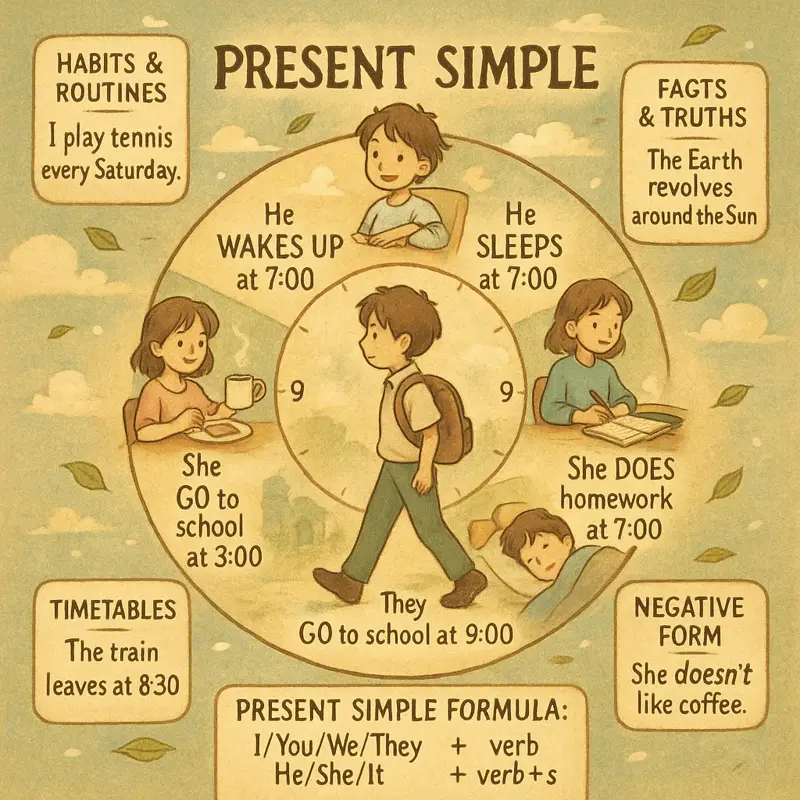
Present Simple rasskazyvayet o tom, chto byvayet voobshche: privychki, raspisanie, fakty. Present Continuous — o tom, chto proiskhodit seychas ili vryemennno. Sravni: I walk to school every day (privychka) i Today I am walking to school with my friend (segodnyashniy sluchay).
Chtoby vybrat' vremya, zaday tri voprosa po poryadku:
- Eto glagol sostoyaniya (know, like, want, have = imet')? → Present Simple.
- Yest' marker privychki (every day, usually, often, on Mondays) ili eto fakt? → Present Simple.
- Deystvie idyot seychas, vryemennno ili eto dogovoryonnost' (now, Look!, this week, tomorrow)? → Present Continuous.
| Present Simple | Present Continuous |
|---|---|
| Chto vyrazhayet | |
| Privychki, povtory, raspisanie, fakty | Deystvie v moment rechi, vremennuyu situatsiyu, izmeneniya, plany |
| Kak obrazuyetsya | |
| V / V‑s do / does | am / is / are + V‑ing |
| Markery | |
| every day, usually, often, always, never, on Mondays | now, at the moment, Look!, Listen!, today, this week |
| Primer | |
| He drinks coffee every morning. | Today he is drinking tea. |
| Otritsanie i vopros | |
| He doesn't drink milk. Does he drink milk? | He isn't drinking milk. Is he drinking milk? |

Primery s razborom: raskryvayem skobki
Primer 1. Marker Listen!
Zadanie: Listen! The neighbours ___ (argue) again.
Shag 1. «Listen!» — nas prosiat prisлуshat'sya k tomu, chto slyshno pryamo seychas. Znachit, Present Continuous.
Shag 2. Podlezhashchee the neighbours — vo mnozhestvennom chisle (oni) → are.
Shag 3. Argue okonchivayetsya na nemuyu -e: ona otpadayet → arguing.
Otvet: Listen! The neighbours are arguing again.
Primer 2. Privychka i okonchanie -es
Zadanie: Tim ___ (study) French twice a week.
Shag 1. Twice a week — regulyarnoye deystvie, privychka → Present Simple.
Shag 2. Podlezhashchee Tim — eto «on», znachit, nuzhno okonchanie -s.
Shag 3. Study okonchivayetsya na soglasnuyu + y: y menyayetsya na i, dobavlyayem -es.
Otvet: Tim studies French twice a week.
Primer 3. Glagol sostoyaniya v otritsanii
Zadanie: I ___ (not / know) where my bag is.
Shag 1. Kazhetsya, chto rech' o «seychas», i khochetsya napisat' am not knowing.
Shag 2. No know — glagol sostoyaniya (znanie), v Continuous ego ne stavyat.
Shag 3. Otritsanie Present Simple s I: do not → don't + glagol bez okonchaniy.
Otvet: I don't know where my bag is.
Primer 4. Vopros v Present Continuous
Zadanie: ___ (they / dance) now?
Shag 1. Now — deystvie v moment rechi → Present Continuous.
Shag 2. V voprose vspomogatel'nyy glagol stoit pered podlezhashchim; s they → are.
Shag 3. Dance → nemaya -e otpadayet → dancing.
Otvet: Are they dancing now? — Yes, they are. / No, they aren't.
Chastyye oshibki v Present Continuous
-
Propuskayut vspomogatel'nyy glagol: *She reading a book.*
Bez am / is / are skazuemogo net: She is reading a book.
-
Stavyat ne tu formu be: *They is singing.*
I — am, he / she / it — is, you / we / they — are: They are singing.
-
Oshibayutsya v napisanii -ing: *runing*, *writeing*, *lieing*.
Udvayivayem soglasnuyu posle kratkoy glasnoy (running), ubirayem nemuyu -e (writing), menyayem -ie na -y (lying).
-
Stavyat glagoly sostoyaniya v Continuous: *I am wanting a new bike.*
Want, know, like, need i drugiye glagoly sostoyaniya ostayutsya v Present Simple: I want a new bike.
-
Govoryat o privychke v Continuous: *I am going to school every day.*
Every day — marker Present Simple: I go to school every day.
-
Stroyat vopros i otritsanie s do / does: *Do you reading? She doesn't playing.*
V Continuous rabotayut tol'ko am / is / are: Are you reading? She isn't playing.
Voprosy i otvety o Present Continuous
Chto takoe Present Continuous prostymi slovami?
Eto nastoyashchee dlitel'noe vremya: im govoryat o deystvii, kotoroe proiskhodit pryamo seychas ili v nyneshniy period i eshche ne zakonchilos'. Naprimer: I am reading — ya chitayu (seychas, v protsesse).
Kak obrazuyetsya Present Continuous?
Po formule: podlezhashchee + am / is / are + glagol s okonchaniem -ing. Am — s I, is — s he, she, it, are — s you, we, they. V otritsanii posle am / is / are dobavlyayut not, v voprose stavят am / is / are pered podlezhashchim.
Kakiye slova-markery u Present Continuous?
Now, right now, at the moment, at present, today, this week, these days, a takzhe vosklitsaniya Look! i Listen!. Dlya planov na budushchee — tonight, tomorrow, next week.
V chyom raznitsa mezhdu Present Simple i Present Continuous?
Present Simple — o privychkakh, raspisanii i faktakh (every day, usually, often). Present Continuous — o tom, chto proiskhodit seychas ili vryemennno (now, at the moment, this week). She plays the piano — ona umeyet i igrayet regulyarno; She is playing the piano — igrayet pryamo seychas.
Kakiye glagoly ne upotreblyayutsya v Present Continuous?
Glagoly sostoyaniya: chuvstva (like, love, hate, want, need), mysli (know, understand, believe, remember), vospriyatiye (see, hear), obladanie (have v znachenii «imet'», own, belong), a takzhe seem, cost. Pravil'no I know, a ne I am knowing.
Mozhno li skazat' Present Continuous pro budushchee?
Da, yesli rech' o dogovoryonnosti na blizhaishee vremya: We are moving to a new flat next month. Obychno ryadom stoit ukazaniye na vremya — tonight, tomorrow, next week. Bez nego fraza budet ponyata kak «seychas».
V kakom klasse prokhodyat Present Continuous?
Obychno vpervyye — v 3–4 klasse, a sravneniye Present Simple i Present Continuous podrobno povtoryayut v 5–7 klassakh. Pravilo na etoy stranitse podkhodit dlya lyubogo goda obucheniya.