Simple Tenses in English
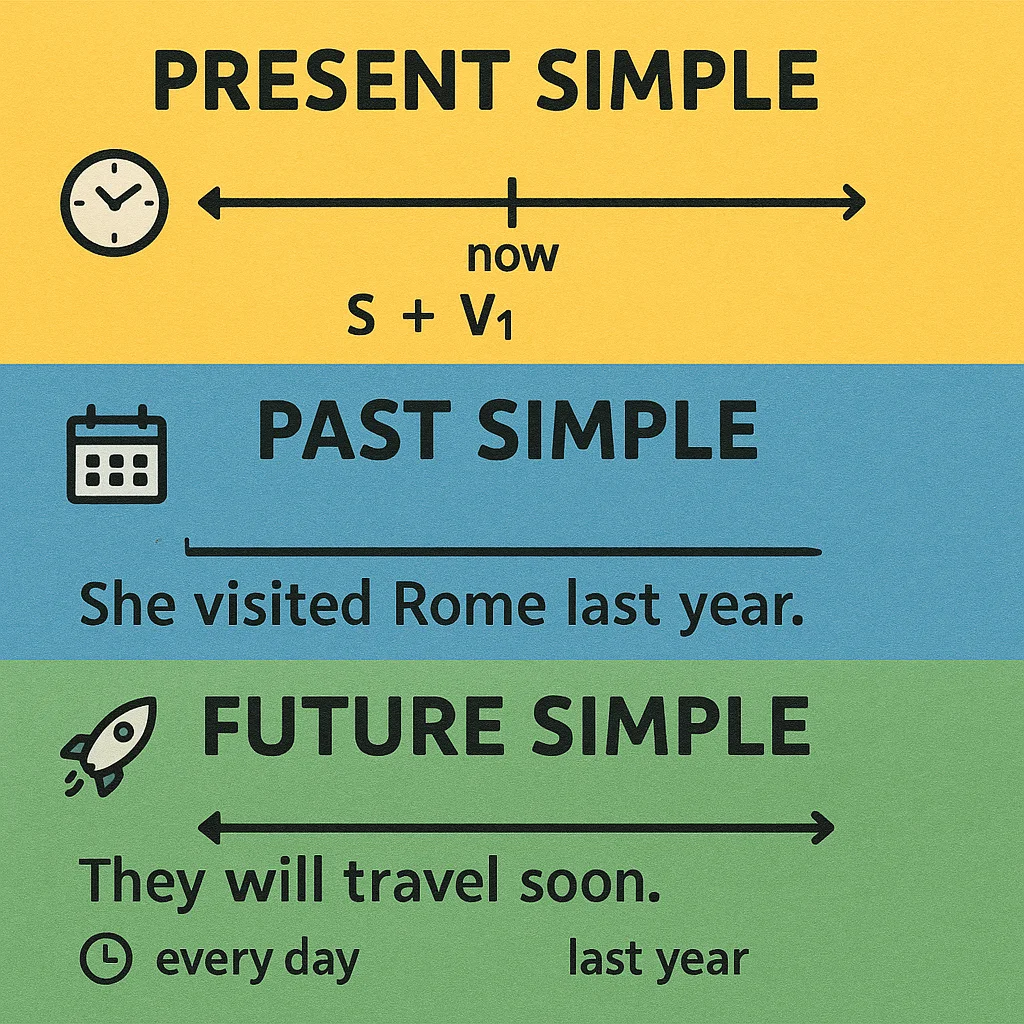
Simple tenses are fundamental building blocks of English grammar that express when actions happen without focusing on their duration or completion. Let's explore each of the three simple tenses: Present Simple, Past Simple, and Future Simple.
Present Simple
Usage:
- Regular or habitual actions: I walk to school every day.
- General truths and facts: The Earth revolves around the Sun.
- Scheduled events (especially in the future): The train leaves at 5 pm tomorrow.
- Giving instructions or directions: First, you turn right at the corner.
Formation:
- Affirmative: Subject + base form of verb (+ s/es for third person singular)
- I/You/We/They work
- He/She/It works
- Negative: Subject + do/does + not + base form of verb
- I/You/We/They do not (don't) work
- He/She/It does not (doesn't) work
- Questions: Do/Does + subject + base form of verb
- Do I/you/we/they work?
- Does he/she/it work?
Time expressions: always, usually, often, sometimes, rarely, never, every day/week/month/year, on Mondays, in the morning, etc.
Past Simple
Usage:
- Completed actions in the past: I visited Paris last summer.
- Series of completed actions: I woke up, brushed my teeth, and had breakfast.
- Past habits or states: I played tennis when I was younger.
- Narratives and storytelling: The princess lived in a castle.
Formation:
- Regular verbs: Subject + verb + ed
- I/You/He/She/It/We/They worked
- Irregular verbs: Subject + past form of verb (varies)
- I/You/He/She/It/We/They went
- Negative: Subject + did not + base form of verb
- I/You/He/She/It/We/They did not (didn't) work/go
- Questions: Did + subject + base form of verb
- Did I/you/he/she/it/we/they work/go?
Time expressions: yesterday, last night/week/month/year, in 2010, ago, when I was young, etc.
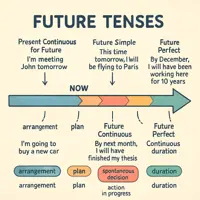
Future Simple
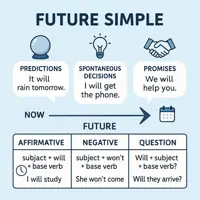
Usage:
- Predictions about the future: It will rain tomorrow.
- Spontaneous decisions: I'll help you with that.
- Promises: I will always love you.
- Offers and requests: Will you help me?
Formation:
- Affirmative: Subject + will + base form of verb
- I/You/He/She/It/We/They will work
- Negative: Subject + will not + base form of verb
- I/You/He/She/It/We/They will not (won't) work
- Questions: Will + subject + base form of verb
- Will I/you/he/she/it/we/they work?
Time expressions: tomorrow, next week/month/year, in the future, in 2030, etc.
Common Mistakes to Avoid
-
Adding -s/-es in the wrong places
- ❌ They works hard.
- ✅ They work hard. -
Using the wrong form in negatives and questions
- ❌ She doesn't works.
- ✅ She doesn't work. -
Forgetting to use auxiliary verbs in negatives and questions
- ❌ You work not here?
- ✅ Don't you work here? -
Using Present Simple instead of Future Simple for predictions
- ❌ It rains tomorrow.
- ✅ It will rain tomorrow. -
Using Past Simple form after did
- ❌ Did you went there?
- ✅ Did you go there?
Signal Words for Simple Tenses
Identifying the correct tense often depends on signal words or time expressions in the sentence:
- Present Simple: always, usually, often, sometimes, rarely, never, every day, generally
- Past Simple: yesterday, last week, in 1999, ago, when I was a child
- Future Simple: tomorrow, next week, in the future, soon
Remember that context is just as important as signal words when determining which tense to use.