What the Six of Pentacles means in Tarot
The Six of Pentacles is a card about one specific moment of transfer: someone gives, someone receives, and in the hand of the giver are scales. Pentacles are responsible for the material world, their element is earth, and this card is about the most practical type of relationship: the exchange of a resource that can be weighed and counted.
An important nuance that is lost in retellings: the minor arcana describes an episode, not a destiny. If the major arcana speaks of a change in luck in general, then the Six of Pentacles is about a specific week in which someone lent money, helped with payment, took someone under their care, or, conversely, received help themselves. The card does not promise either an amount or a deadline — only the fact of the exchange itself and that it is rarely completely equal.
The upright position is read as an honest calculation: help reaches those who really need it, debt is repaid, work is valued according to merit. But the card has a second side that is easy to miss: the one who distributes also makes the decision here — to whom, how much, and on what terms. The scales in the hand are not equality, they are an assessment, and it is the giver who is doing the assessing.
Reversed Six of Pentacles: meaning
The reversed Six of Pentacles is the same exchange, but with a bias. Usually, the spread refers to one of three options, and the question itself provides the hint.
- Conditional help. Formally it is a gift, but in fact it is a favor for which sooner or later you will be asked to return with a service, time, or gratitude greater than expected.
- An exchange where one is clearly on top. The one who gives uses this as a way to show their position, not as care — money or help becomes a tool of power.
- A debt that is not returned or acknowledged. They helped and forgot; they took and did not notice that the help remained one-sided.
There is also a softer reading: sometimes the reversed position is simply a signal to reconsider an established exchange that has ceased to be fair for one of the parties, rather than an accusation of someone specific.
Six of Pentacles in a "yes or no" spread
In "yes/no" spreads, the Six of Pentacles answers yes, but not unconditionally: the help, loan, or support being asked about will most likely appear — along with conditions that should be discussed in advance rather than figured out after the fact. If the question sounds like "will they lend me money" or "will they agree to help" — the answer is affirmative.
If the question is about whether the exchange will be fair and equal in itself, the card is rather cautious: it never promises complete equality, only the fact that the exchange will take place.
The reversed Six of Pentacles in this spread is read as "no, not on the terms you would like": help will either not come at all, or it will come at such a price that it is worth looking for another source.
Six of Pentacles in relationships and feelings
In a relationship spread, the upright Six of Pentacles describes a couple where care does not flow equally: one invests more — with time, attention, material support — and the other mainly receives. This is not always bad: sometimes one of the partners is indeed going through a difficult period, and it is reasonable that the one who is better off right now carries more.
In the position of feelings, the card shows care through action, not through words: helping, bailing out, taking on household or financial burdens — this is how this card expresses attachment. There is little romance in it, but a lot of practical support.
The difficulty begins when the balance freezes for a long time: the one who is always giving risks getting tired, and the one who is always receiving gets used to it as the norm. The reversed Six of Pentacles in relationships is exactly about such a frozen imbalance: care that has become a lever of pressure, or help that one partner uses to keep the other nearby.
Six of Pentacles in work and money
In career spreads, the Six of Pentacles is financial support from the outside: a loan, an investment, sponsorship, a promotion that depends on someone else's decision, and not just on one's own merits. The card well describes a situation where the result of work is evaluated by someone else — a boss, a client, a commission — and what you get and when depends on this evaluation.
In a money spread, the upright position speaks not about the size of the amount, but about the principle itself: the resource is distributed at someone's discretion, and it is useful to understand the rules of this distribution in advance, rather than relying on everything working out fairly on its own. If the spread asks about your own business — the card may point to the role of the one who decides for themselves who to pay and how much, and here it is important not to confuse generosity with obligation.
In work, the reversed Six of Pentacles is a distribution that feels unfair: a bonus is not given based on merit, a loan is issued on predatory terms, help is promised but not followed through. Here it is worth reading the terms more carefully, rather than just counting on the goodwill of the other party.
Six of Pentacles as a person: man and woman
When the Six of Pentacles appears in the "what kind of person" position, it does not describe the character as a whole, but the role of the one who distributes the resource: a patron, a sponsor, a boss, and sometimes just a generous person in the environment who decides who to help and how much. Such a person is usually solvent and willing to share — but does so on their own terms.
Six of Pentacles man — someone who helps with money or connections, but remembers who he gave to and how much; rarely reminds of this out loud, but keeps it in mind. Six of Pentacles woman — generous and practical, tends to support those she considers worthy, and is able to refuse someone who, in her feeling, is abusing her kindness.
This is not a description of a greedy or calculating person — rather, someone for whom care and justice go hand in hand: they want to help, but not blindly.
Six of Pentacles in the thoughts position
In the thoughts position, the Six of Pentacles represents a constant internal calculation: who owes what to whom, how much has already been invested, and whether it is time to ask for help or refuse support from others to avoid feeling obligated. Thoughts revolve around the fairness of the exchange, even if the terms haven't been spoken aloud.
Sometimes this is a sober assessment of the situation, and sometimes it is the anxiety of someone who feels awkward both asking for and receiving help. Next to Swords, the card likely points to obsessive comparisons of "who contributed more"; next to the Star or the Sun, it points to a calm, realistic decision to accept help without guilt.
What to do if you draw the Six of Pentacles
The advice of the Six of Pentacles is practical: state the terms of the exchange out loud instead of assuming them in your head. The card rarely describes malicious intent—more often it is about unspoken expectations: one side thinks they are helping as a friend, the other thinks they are now obligated, and no one discussed it beforehand.
What you should do in practice:
- Clarify the terms if you are receiving help. Whether it is a one-time favor or an expectation of repayment—it is better to ask directly than to guess later.
- Help consciously if you are the one giving. Understand why you are doing it and whether you are prepared for the help not to be returned in kind.
- Notice a stagnant imbalance. If in a relationship or friendship one person always gives and the other always takes—it is worth talking about it before resentment builds up.
- Do not confuse generosity with dependency. The difference lies in whether both parties have the choice to continue the exchange or not.
If the question concerns real debt, poverty, or dependency on someone else's money—the reading does not replace a consultation with a lawyer or financial professional, let alone an honest conversation with loved ones: the card shows the dynamics of the exchange itself, not a solution to financial difficulties.
What is depicted on the card
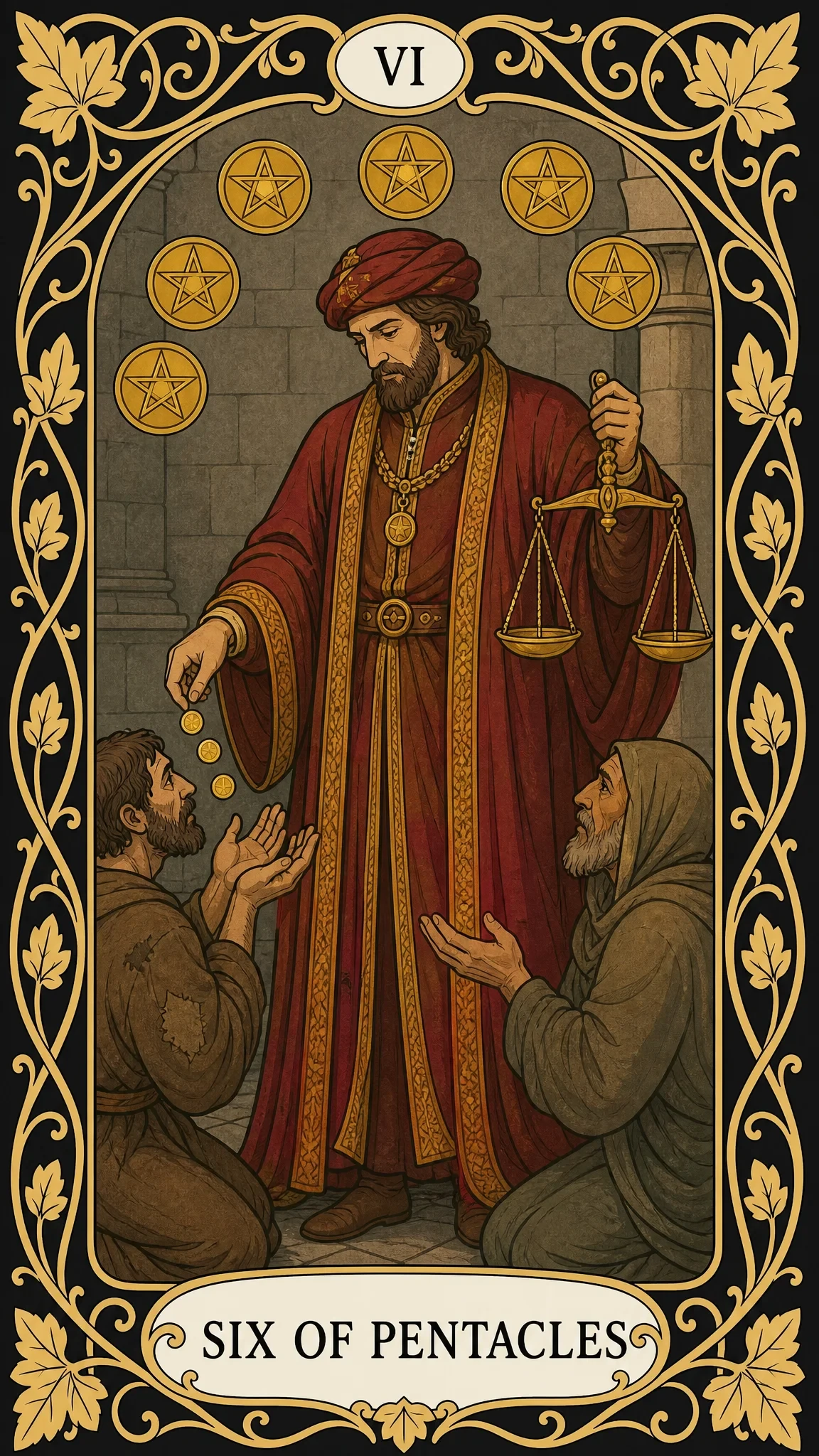
On our card, a wealthy man in a red and gold robe and a turban with a gemstone stands between two petitioners kneeling on the ground. In his left hand, he holds golden scales; in his right, three coins that are falling into the open palms of the person on the left, who is dressed in tattered clothing with a patch. To the right, kneeling, is an elderly man in a hood, also with his hands raised, but the coins have not reached him yet. Above the giver's head, six pentacles with an embossed star are arranged in a semicircle—matching the card's number. The scene takes place in a stone gallery with a column in the background.
The scene is interpreted as follows:
- Scales in one hand — an assessment of who to give to and how much; the distribution here is not random or equal, but weighed.
- Coins flying to only one of the petitioners — the card directly shows that an exchange is rarely equal for all parties at once, even if the giver is kind to both.
- Two petitioners in different poses — one is already receiving, the other is still waiting: the card marks the moment when a decision is still being made, rather than when it has already been finalized.
At the top of the card is the Roman numeral VI, and at the bottom is a plaque with the English name SIX OF PENTACLES: our deck is drawn in the Rider-Waite tradition, where the Six of Pentacles bears this number.
Six of Pentacles as the card of the day
The Six of Pentacles as the card of the day is a good reason to pay attention to the balance between what you give and what you receive. The day is suitable for asking for help without shame or offering it to someone who truly needs it—but not as a loan that you will later have to pay back with awkwardness.
If the card appears reversed—take a closer look to see if someone is trying to use care as leverage, and if you are doing the same yourself. A useful mindset for such a day is one honest conversation about terms instead of silent expectations on both sides.
Frequently asked questions about the Six of Pentacles card
Is it a Major or Minor Arcana?
Minor Arcana, suit of Pentacles, element of Earth. There are 56 Minor Arcana cards in a Tarot deck—14 cards for each of the four suits, and the Six of Pentacles is the sixth card in this sequence.
How does the Six of Pentacles differ from the Six of Wands?
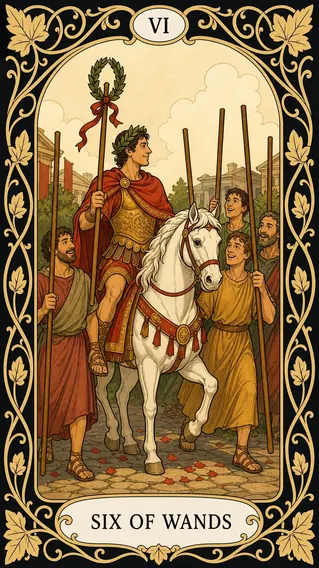
Both cards are about recognition from others, but of different kinds. Pentacles are the element of earth, the material world: the Six of Pentacles is about financial or practical support, an exchange of resources. Wands are the element of fire, will, and achievement: the Six of Wands is about public success, victory, and recognition of merit before everyone. If the reading is about money or help—it is about Pentacles; if it is about triumph and reputation—it is about Wands.
Is the Six of Pentacles a yes or no?
More likely yes: the help or support you are asking about will likely appear—but the card immediately specifies that it will come on someone's terms, not unconditionally. If equality between parties in the exchange is important to you, the answer is more cautious—the card does not guarantee that.
What does the reversed Six of Pentacles mean?
The same exchange, but skewed: help with a hidden condition, an exchange where one person is clearly on top, or a debt that is not acknowledged or repaid. Sometimes it is simply a reason to reconsider an established balance that has ceased to be fair for one of the parties.
Does the Six of Pentacles promise financial help?
The card describes the dynamics of the exchange itself—the fact that someone is distributing a resource at their own discretion—not a specific amount or deadline. It does not guarantee the size of the support or that an offer will even be made: for that, you should look at the surrounding cards in the reading.