What The Hanged Man means in Tarot
The upright Hanged Man is a situation where you cannot move and have to wait. The decision does not depend on you, there is no answer, and attempts to speed things up do not work. All that is available is to change your attitude toward what is happening.
An important nuance often lost in retellings: The Hanged Man is hanging voluntarily. The rope on the card holds him by the foot, but his hands are free — he could untangle himself if he wanted to. He does not untangle himself because he has realized: right now it is more important not to move, but to see what is not visible from a normal position.
The second side of the card is a trade-off. The Hanged Man often describes a conscious sacrifice: giving up something now to receive it later. This is not martyrdom; it is the price for something that cannot be obtained otherwise.
Reversed Hanged Man: meaning
The reversed Hanged Man is usually read in one of three ways:
- Meaningless sacrifice. A person gives up something important but receives nothing in return — and continues to do so. This is the most common scenario.
- Getting stuck. The pause has ceased to be productive: nothing is being rethought, time is simply passing.
- Finding a way out of a dead end. Less common, but it happens: the situation has finally moved, and the waiting is over.
Neighboring cards help to choose: next to the Eight of Swords — a feeling of being trapped, next to the Ten of Wands — a sacrifice that has turned into overload, next to Aces — movement that has already begun.
The Hanged Man in a "yes or no" spread
In "yes/no" spreads, The Hanged Man answers "not now". It is not a refusal, but a delay: the situation is in a state of suspension, and the answer will appear later.
To questions like "should I wait," the answer is affirmative. To questions like "will it be possible to speed it up" or "should I push," the answer is negative: any pressure with this card only extends the timeline.
The reversed Hanged Man in a yes/no spread is ambiguous: it is either "no, you are stuck" or "yes, the pause is ending." It is interpreted based on neighboring cards.
The Hanged Man in relationships and feelings
In a relationship spread, the upright Hanged Man means suspension. Relationships without certainty: not together and not apart, there is no answer, and neither of the two is ready to give one.
In the position of feelings, this is attachment in standby mode. A person is waiting, hoping, not letting go — and at the same time doing nothing.
A separate common plot is a relationship for which one person sacrifices a lot. As long as the trade-off is conscious and there is a goal, the card is neutral; when the sacrifice becomes a habit, it flips.
The Hanged Man in work and money
In career spreads, The Hanged Man is a freeze: a project is on pause, a decision on a vacancy is being postponed, approval is hung up. It often describes a job where a person has long outgrown their position but cannot leave yet.
In money, the card speaks of frozen assets: a delayed payment, money invested and not yet returned, income that "will come later." Neighboring cards will show how it ends: with the Ace of Pentacles, the wait will be justified; with the Five of Pentacles, it will drag on.
What The Hanged Man advises in a work spread: do not fuss and use the pause. His plots are won by those who studied during the downtime, not by those who demanded an answer every day.
The Hanged Man as a person: man and woman
In the "what kind of person" position, The Hanged Man describes someone who cannot or does not want to make a decision. They are not stalling on purpose — they are truly in a state of suspension and suffer from it themselves.
The Hanged Man in a spread is someone who postpones a decision and asks to wait; often sincerely. The Hanged Woman is someone who sacrifices their own interests for others and does not notice what it costs them.
Important: this is not a description of a manipulator. Someone who keeps another in uncertainty consciously and for profit is The Devil or the Seven of Swords, not The Hanged Man.
Повешенный в позиции мыслей
В позиции мыслей Повешенный — пересборка картины мира. Человек думает не о том, как поступить, а о том, правильно ли он вообще всё понимал: смотрит на свою историю с другой стороны и находит другое объяснение.
Сюда же относится состояние «всё замерло»: мысли есть, а решений из них не следует. Это нормальная фаза карты, и торопить её бесполезно. Соседи уточняют: рядом с Отшельником — продуктивное осмысление, рядом с Восьмёркой мечей — бесплодное прокручивание.
Что делать, если выпал Повешенный
Совет Повешенного неудобен деятельным людям: перестать дёргать ситуацию. Всё, что можно было сделать, сделано; остальное решается не вами и не сейчас.
Что стоит сделать по существу:
- Признать, что не в вашей власти. Это снимает половину напряжения.
- Посмотреть на ситуацию с чужой стороны. Буквально: как это выглядит для второго участника.
- Назначить срок ожидания. «Жду до конца месяца, потом действую иначе» — так пауза не превращается в застревание.
- Использовать простой. Учиться, лечиться, отдыхать — то, на что обычно нет времени.
И отдельно: если пауза тянется годами и держится на надежде, что другой человек однажды решится, — это уже перевёрнутое положение, и разбираться надо не со сроком, а с самой надеждой.
Что нарисовано на карте
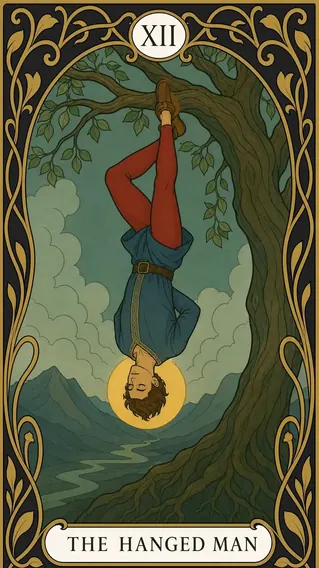
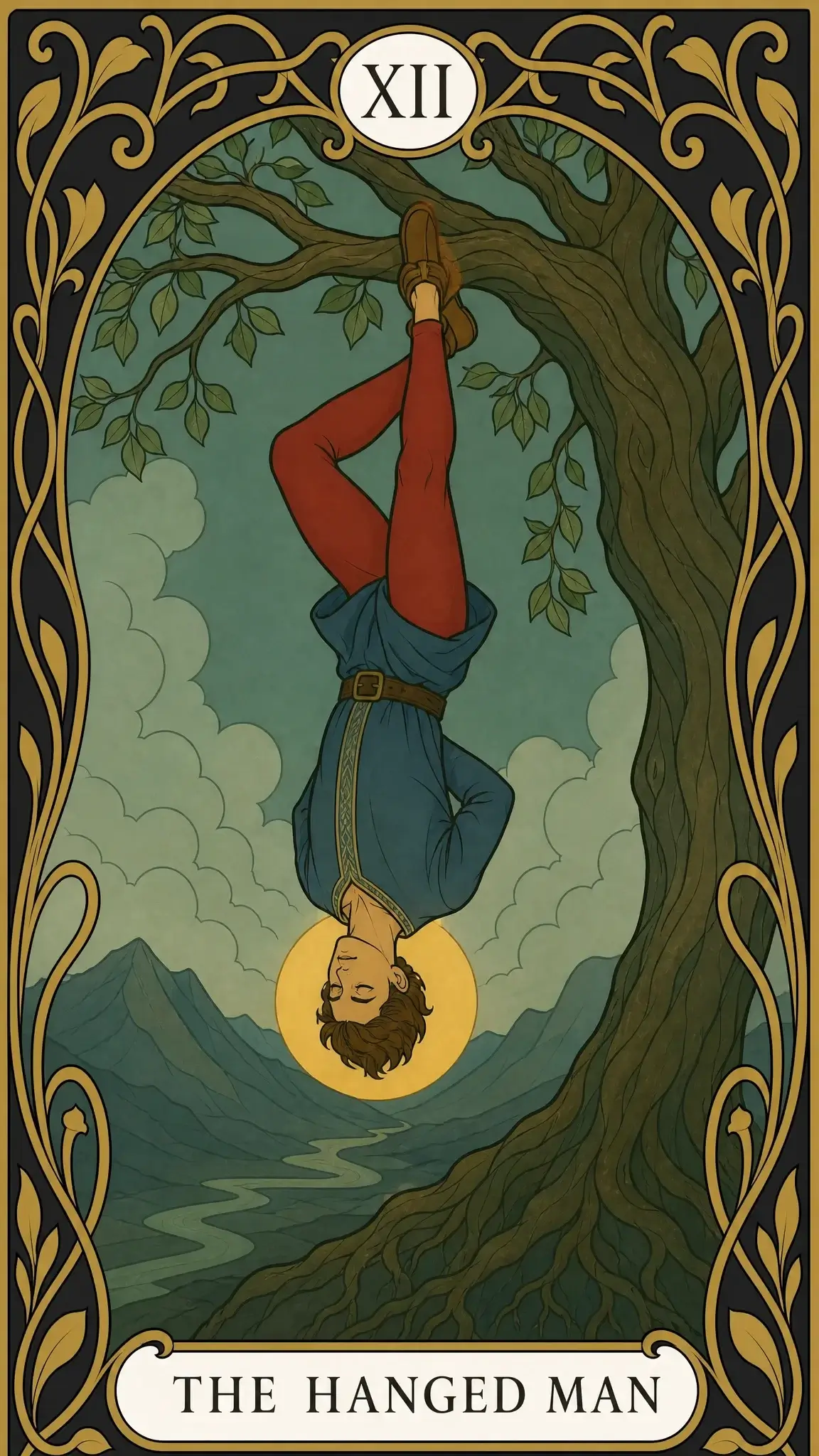
На нашем Повешенном — человек, подвешенный за одну ногу к ветке дерева; вторая нога согнута, руки убраны за спину, вокруг головы сияние, лицо спокойное.
Читается сцена так:
- Свободные руки — он может выпутаться и не делает этого. Вся карта держится на этой детали.
- Спокойное лицо — он не мучается. Страдание в этой карте появляется только в перевёрнутом положении.
- Сияние вокруг головы — то, ради чего висит: понимание, доступное только из этого положения.
- Дерево живое — пауза не мертва, она часть роста.
Сверху римская цифра XII, снизу английское название THE HANGED MAN: наша колода нарисована в традиции Райдера—Уэйта, где Повешенный идёт двенадцатым, прямо перед Смертью.
Повешенный как карта дня
Повешенный в качестве карты дня — день, когда ничего не сдвинется. Ответы не придут, дела не закроются, планы упрутся в чужие сроки.
Полезная установка: не воевать с расписанием и не выбивать ответы. Хороший день для того, чтобы разобраться в чём-то неспешно, посмотреть на давнюю проблему свежим взглядом или просто отдохнуть — сопротивление в этот день дороже, чем принятие.
Частые вопросы о карте Повешенный
Повешенный в Таро — плохая карта?
Она неприятная, но не разрушительная. Речь о вынужденной паузе и необходимости посмотреть на ситуацию иначе, а не о беде. Тяжело в ней в основном ожидание, а не то, что происходит.
Что означает перевёрнутый Повешенный?
Чаще всего бессмысленную жертву или застревание: пауза перестала быть продуктивной и превратилась в образ жизни. Реже — наоборот, окончание ожидания и выход из тупика. Смысл уточняют соседние карты.
Повешенный означает, что надо просто ждать?
Ждать и одновременно менять угол зрения. Пассивное ожидание — это уже перевёрнутое положение. Продуктивная пауза предполагает, что человек за это время что-то понял или чему-то научился.
Чем Повешенный отличается от Отшельника?
Отшельник уходит в паузу сам и может выйти из неё когда захочет. Повешенный в паузе не по своей воле: обстоятельства держат, и срок определяет не он.
Какой это по счёту аркан?
Двенадцатый старший аркан, на карте римская цифра XII. В колоде Райдера—Уэйта, по которой нарисована наша, Повешенный идёт после Справедливости (XI) и перед Смертью (XIII).