What the Five of Cups means in Tarot
The upright Five of Cups is not a great tragedy, but a specific disappointment: a plan that seemed reliable fell through, a relationship ended, or invested effort yielded no results. The three overturned cups on the card are what is truly lost, and the figure's gaze is directed exactly at them.
An important nuance often lost in retellings: there are two more cups on the card, whole and full, they are just standing behind the figure. The Five of Cups is not about everything being lost, but about a state in which it is physically impossible to see that. It describes a moment of grief, not its end: sooner or later, the gaze will lift, and what remains will become visible on its own.
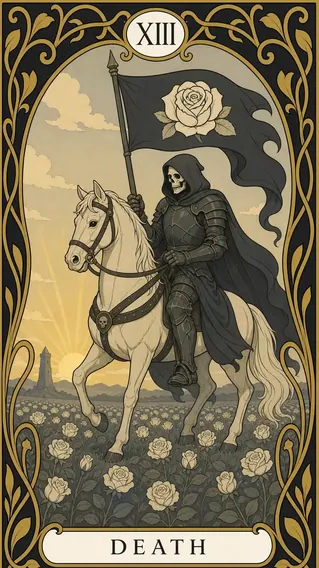
The suit of Cups and the element of Water set the tone: the card is not about facts of the external world, but about the feeling inside — about what happens to a person when something doesn't work out. As a Minor Arcana card, it does not inflate the loss to the scale of destiny (that would be closer to Death or the Tower): it is about a specific episode — one conversation, one missed chance, one mistake, not the whole life.
Reversed Five of Cups: meaning
The reversed Five of Cups is the moment when the gaze finally tears away from what has been spilled. Three common readings, chosen based on the spread's question:
- True acceptance. Grieving has run its natural course, and the strength has appeared to look at what remains: two whole cups, a bridge across the river, a house on the other bank.
- Hasty closure. The reversed position sometimes means not processed, but bypassed grief — a person is in a hurry to "move on" without allowing themselves to fully experience the loss.
- Return of old pain. Less often, a loss that was thought to be long overcome resurfaces unexpectedly.
It is impossible to distinguish these options by one card alone — look at the neighboring cards and give an honest answer to yourself: has the feeling really passed, or has it just been pushed aside?
The Five of Cups in a "yes or no" spread
In a "yes or no" spread, the Five of Cups is usually read as probably no, with a clarification that is more important than the answer itself: the refusal is temporary and heavily colored by the emotion of the moment, in which it is difficult to judge soberly.
If the question is "should I make a decision now" — the answer is negative: first you need to process the emotion, then decide. If the question is "will it work out in the end and will I see a way out" — the answer is likely positive, just not immediately.
The reversed position softens the answer to "yes, but not as quickly as you would like": there is a way forward, it just requires time to let go of what was lost, rather than skipping this step.
The Five of Cups in relationships and feelings
In a relationship spread, the upright Five of Cups is the pain of things not working out: a breakup, unfulfilled expectations, disappointment in a partner who did not live up to trust. The card does not name the reason for the breakup — it is about the focus on the loss, not its nature.
In the position of feelings, this is grief mixed with regret or guilt: "if only I had acted differently," "why didn't I notice sooner." The emotion is real, and it requires time, not a quick fix to the problem.
The reversed Five of Cups in relationships is the beginning of acceptance: the person still remembers the loss but is already capable of seeing those who are nearby now, rather than just mourning those who are gone. If the spread is about a new relationship after a breakup, it is a good sign — but not a reason to rush things.
The Five of Cups in work and money
In career spreads, the card represents a missed opportunity or a project that did not end as expected: the wrong contract, the wrong position, invested time that did not pay off. The three overturned cups here are specific losses: a client, a deal, a reputation in the moment.
In money, the Five of Cups points to an expense that is regretted, or lost income that cannot be recovered. The card's advice is pragmatic: calculate the real loss rather than catastrophizing it, and look at what resources — those very two whole cups — are still available for the next step.
The reversed position is a signal that it is time to exit the loss-counting mode and build a new plan based on what remains, not on what is no longer there.
The Five of Cups as a person: man and woman
When the Five of Cups appears in the "what kind of person" position, it does not describe the entire character, but a snapshot: someone currently going through a phase of disappointment or grief — over work, relationships, or plans. Such a person may seem detached, withdrawn, and not ready for new commitments.
A Five of Cups man is someone who keeps his feelings to himself and is in no hurry to discuss them, even if he is clearly upset. A Five of Cups woman is someone who honestly talks about the loss out loud but lingers in this state for a long time, returning to the conversation about it again and again.
This is not a description of a weak or passive person — it is a description of a specific phase that everyone goes through, and it does not last forever.
Five of Cups in the position of thoughts
In the position of thoughts, this card represents an obsessive return to what didn't work out: replaying a conversation that went wrong or a decision one regrets. Attention is focused on what has been spilled, rather than on what is still standing.
Sometimes this is an appropriate time to reflect on a mistake so as not to repeat it. But if the Five of Cups appears alongside Sword cards, it is more likely about a fixation that exhausts and hinders progress — in which case, it is worth consciously directing attention to what is still working.
What to do if the Five of Cups appears
The advice of the Five of Cups is simple to state but difficult to execute: allow yourself to grieve, and then turn to the two remaining cups. You cannot skip the first part — suppressed grief almost always returns later and stronger.
What you should do in practice:
- Name the loss precisely. Not "everything is bad," but specifically: what exactly didn't work out and why it matters.
- Give yourself a timeframe for grieving, without setting a date in advance for when it is "time to let go."
- Look back at what remains. Resources, people, options — they rarely disappear completely along with the loss.
- Do not make decisions at the peak of emotion — neither end relationships permanently nor quit a project while the grief is still sharp.
And separately, to be clear: a Tarot reading does not replace grief counseling and is not psychological help. The card describes the feeling well, but it does not heal it. If the state does not let go for weeks and interferes with eating, sleeping, and working, it is a reason to consult a psychologist or therapist, not to look for an answer in cards.
What is depicted on the card
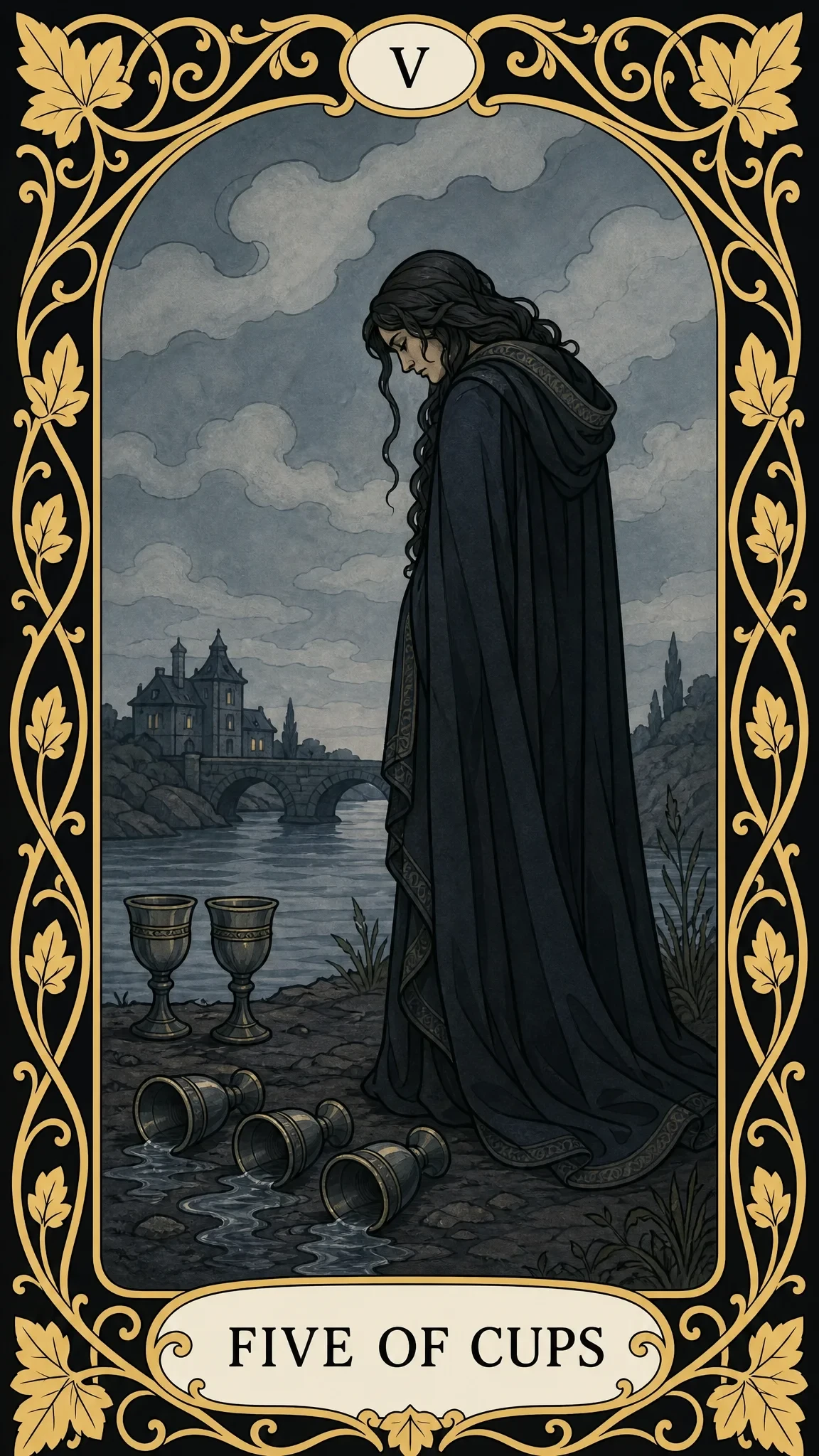
On our Five of Cups, there is a female figure in a dark, almost black cloak with a gold trim, standing on a rocky riverbank. Her head is lowered, long dark hair falls over her face — she is looking down, not around.
The scene is read as follows:
- Three overturned cups lie on the ground right in front of her, dark liquid spreading toward the water — this is what her gaze is focused on, and what cannot be returned.
- Two cups stand behind her, whole and full — she does not see them because she has her back to them. This is perhaps the most accurate detail of the entire card: what remains is physically behind her, and it is enough to simply turn around.
- A stone bridge across the river and a house with lit windows on the other bank — the path forward already exists, it does not need to be built from scratch, one only needs to walk along it.
- A gray, cloud-covered sky — the emotional background of the card: heavy, but not stormy, bad weather without a catastrophe.
At the top of the card is the Roman numeral V, at the bottom is the English name FIVE OF CUPS: our deck is drawn in the Rider-Waite tradition, where this card is the fifth in the suit of Cups.
Five of Cups as the card of the day
The Five of Cups as the card of the day is a warning not to get stuck. The day may start with a small disappointment: no reply, something didn't work out, not as planned. The danger is not in the event itself, but in spending the whole day replaying it in your head.
A useful mindset for such a day: notice the disappointment, do not deny it, but consciously shift your attention to what actually worked out or is available that day. The two whole cups on the card are a literal reminder to check what remains before mourning what has been spilled.
Frequently asked questions about the Five of Cups card
Is it a Major or Minor Arcana?
The Five of Cups is a Minor Arcana, suit of Cups, element of Water. There are 56 Minor Arcana in a Tarot deck in total — 14 in each of the four suits, and the Five of Cups is one of them.
How does the Five of Cups differ from the Five of Swords?
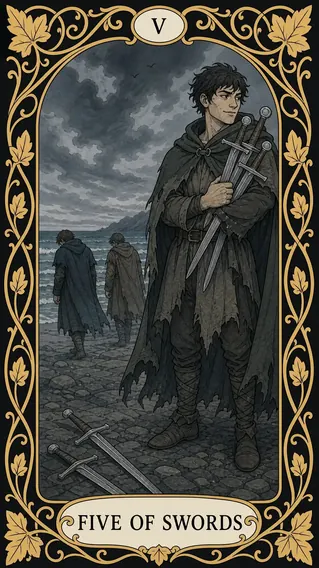
Both cards are about a heavy feeling, but of a different kind. The Five of Swords is about a conflict with a clear loser and a bitter aftertaste after a victory at any cost. The Five of Cups is not about a clash with others: it is grief and disappointment within one person, without someone else's fault and without a winner.
Does the Five of Cups mean depression?
The card describes grieving and disappointment as an emotion of the moment, not a medical diagnosis. A Tarot reading cannot diagnose or rule out depression. If a heavy state lasts for weeks and interferes with normal life, it is a reason to consult a specialist, not to look for an explanation in cards.
What does the reversed Five of Cups mean?
Usually one of three options: grieving has ended and true acceptance has come; grief was bypassed without being fully experienced; or pain that was thought to be long gone has unexpectedly returned. Neighboring cards help to distinguish them.
Is the Five of Cups a bad card?
No, rather heavy, but not destructive. It describes a specific disappointment and its first, most acute phase — not endless misery. On the card, next to the three spilled cups, there are two more whole ones: the card clearly shows that the loss is not the whole picture.