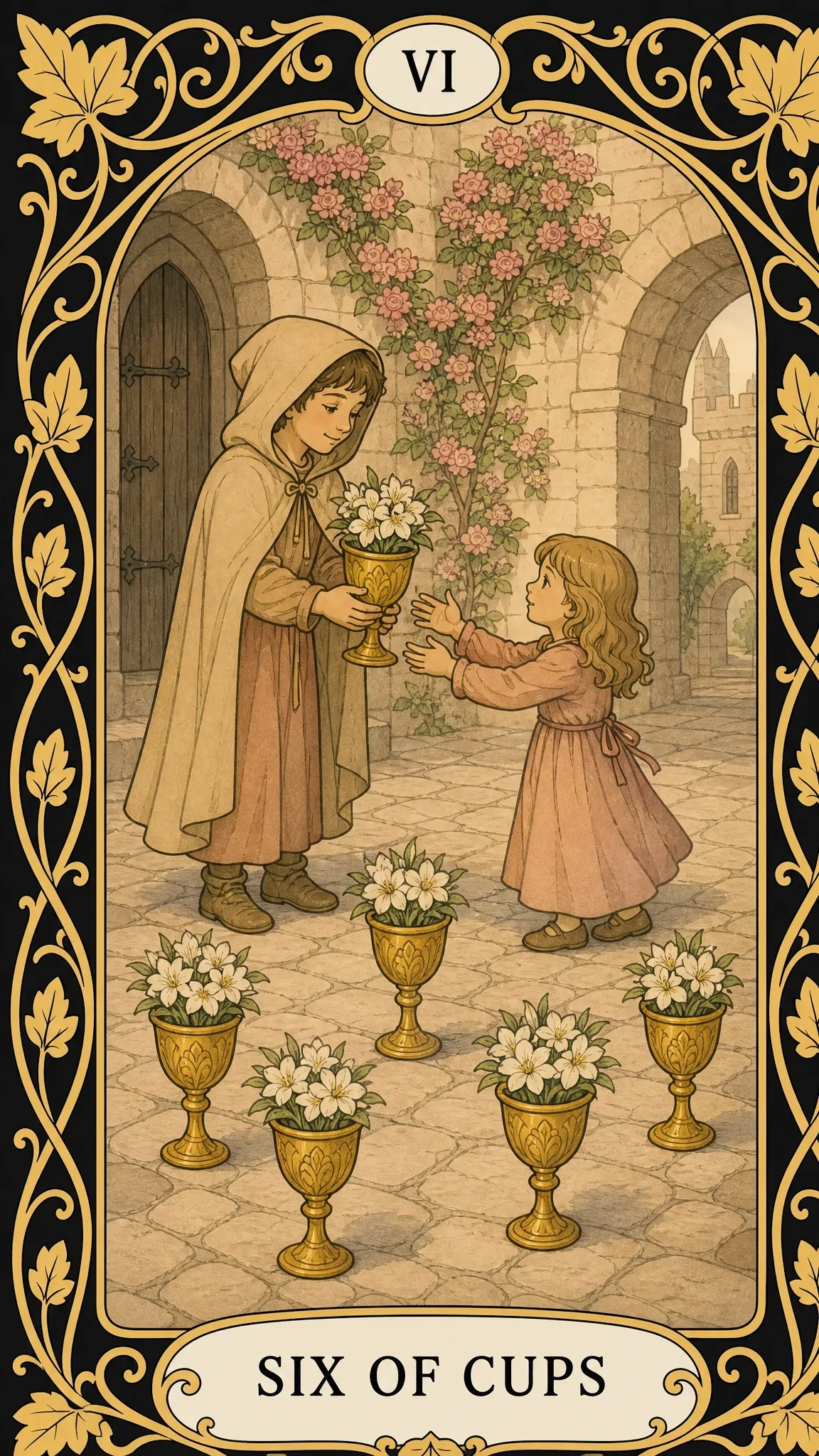
What the Six of Cups means in Tarot
The Six of Cups is a card of warmth that doesn't need to be earned: a gift, a memory, or a meeting that comes simply, without calculation or the need to prove anything in return. In the classic deck, there are two children in a courtyard with cups full of flowers — a scene so simple that it is easy to dismiss as childlike tenderness and forget.
An important nuance often lost in retellings: this is a card of a specific episode, not a card of destiny. It does not describe one's whole life as a return to origins — as a major arcana like the Wheel of Fortune might — but shows a single moment: a letter from an old friend, a randomly surfaced photograph, a conversation after which you no longer want to rush. The Six of Cups is about everyday life, not revelation.
The second part of the meaning is generosity without expectation of gratitude: giving because you want to, not because you have to.
Reversed Six of Cups: meaning
The reversed card is the same interest in the past, but stuck in it. Usually, the spread shows one of three options, and the clue is in the question itself.
- Nostalgia instead of action. A person reviews old messages and photos instead of dealing with the present day.
- The past returns with a burden. An old acquaintance or ex-partner appears not with warmth, but with a claim or a debt.
- Refusal to grow up. Decisions are postponed because it is more comfortable to remain in the role of someone being taken care of.
The reversed position almost always means that the card's warmth has been replaced by habit, not that the warmth is gone entirely.
Six of Cups in a 'yes or no' spread
In 'yes/no' spreads, the Six of Cups usually answers yes, but with a clarification: the answer will come not from a new person or circumstance, but from something already familiar. Someone who was already nearby will return; a method that has already been tested will work; what was agreed upon earlier will come true.
If the question is about starting something completely new, the card is rather cautious: it is worth closing or remembering the old before moving on.
The reversed position in this spread is read as 'yes, but not at the right time' — the answer is known, but the person is delaying accepting it.
Six of Cups in relationships and feelings
In a relationship spread, the upright Six of Cups often means a return: a partner from the past writes again, the couple remembers how it all began, or the relationship moves into a calm, almost family-like stage without the previous tension.
In the position of feelings, the card is tenderness without pressure: care that does not require an immediate response, affection without figuring out who owes whom more. If the spread is about a new acquaintance, the Six of Cups may point to a person who reminds you of someone from the past — by character, by manner, sometimes simply by the feeling of 'we have met somewhere before.'
There is also a downside: the card poorly describes passion and development. It is about comfort, not moving forward, and if there is nothing in the couple but familiar warmth for a long time, this is also its honest meaning.
Reversed Six of Cups in relationships is an attempt to hold on to what has already ended because the new seems scarier than the old, even if it is uncomfortable.
Six of Cups in work and money
In career spreads, the Six of Cups is a return to a previous job, colleague, or client: a former employer calls you back, an old project suddenly becomes relevant again, a mentor from the beginning of the journey helps now.
In money, the card speaks of a gift, a debt repayment, or a small sum that comes without pressure or obligations — not a big deal, but an honest, calm compensation for something done earlier.
The weak point of the card in a work context is that it is not good for ambition and growth. If the spread is about a promotion or scaling a business, the Six of Cups rather advises: close old agreements first, then take on the new.
Six of Cups as a person: man and woman
When the card appears in the 'what kind of person' position, it describes not so much character as a role — a person from the past or someone similar to someone from the past. They do not try to impress and do not build a strategy: it is comfortable and calm next to them, as if you have known each other for a long time, even if you met recently.
Man-Six of Cups — caring, not prone to arguments, sometimes slightly infantile: it is easier for him to give and help than to talk about serious things directly. Woman-Six of Cups — warm, home-oriented, often she is the one who keeps in touch with mutual friends and remembers important dates.
The flip side of the portrait is an unwillingness to grow up completely: such a person may avoid difficult conversations, preferring old, proven roles to new and uncomfortable ones.
Six of Cups in the thoughts position
In the thoughts position, the Six of Cups represents a mind occupied by the past: a person re-evaluating old decisions, recalling "how things used to be," and comparing the current situation with something familiar.
Sometimes this is a useful check: experience suggests a solution that has already worked. Sometimes it is an escape from the present into a simpler and more understandable past because there is less uncertainty there. Neighboring cards help distinguish this: next to Swords, it is more like anxious rumination; next to Pentacles, it is a practical reliance on proven experience.
What to do if the Six of Cups appears
The card's advice is simple: allow yourself warmth without abandoning the present. The mistake the Six of Cups describes most often is either a complete rejection of nostalgia as a weakness or, conversely, diving into it headfirst instead of solving current tasks.
What is worth doing in practice:
- Respond to an outstretched hand if you feel warmth, not just the convenience of silence.
- Separate memory from decision. It is pleasant to remember, but that does not mean you need to return to the same thing.
- Check who benefits from the return. If only one of the two, it is no longer about care.
- Allow yourself to accept a gift or help without a sense of obligation — that is exactly what this card is about.
And separately: if nostalgia is connected to a difficult topic — the loss of a loved one, a breakup, childhood trauma — the reading does not replace a conversation with a psychologist. Cards describe feelings well, but they do not help you process them.
What is depicted on the card
On our card, there is a paved courtyard of an old castle. A boy in a cream-colored hood offers a golden cup with white flowers to a little girl in a pink dress; she reaches for it with both hands. Around them on the stones stand five more such cups with flowers, and at the wall between two arches, a pink flowering bush rises directly from the stone.
The scene is read as follows:
- A cup with flowers, not water — the gift here is not a fleeting emotion, but something grown and prepared with care in advance.
- The difference in the children's height — the older one gives, the younger one receives; in a reading, this is not always literally about age, but about who is caring and who is receiving at the moment.
- An open arch with a view of a distant castle tower — there is a path out in the frame, but the meeting happens deep in the courtyard, by the wall with roses: the card is about what happens at home, not about the path beyond the gates.
- Five cups on the ground, not yet given — there is more warmth in this scene than is required for one gesture: the card is about an excess of care, not a lack of it.
At the top of the card is the Roman numeral VI, at the bottom is the English name SIX OF CUPS: our deck is drawn in the Rider-Waite tradition, where the Six of Cups occupies the sixth place in the suit.
The Six of Cups as the card of the day
The Six of Cups as the card of the day is usually about a small joy from the past: a chance encounter with an old acquaintance, a song that brings back childhood memories, or a call from parents.
A useful mindset for such a day: do not try to speed up or structure this warmth — just notice it and, if possible, respond in kind. It is a good time to write to someone you haven't spoken to in a long time or to sort through an old box of photographs — without haste and without a goal, just because it is pleasant.
Frequently asked questions about the Six of Cups card
Is this a Major or Minor Arcana?
A Minor Arcana of the Cups suit, element Water. There are 56 Minor Arcana in the Tarot deck in total — 14 cards in each of the four suits, and the Six occupies the sixth place in the suit of Cups.
How does the Six of Cups differ from the Six of Swords?
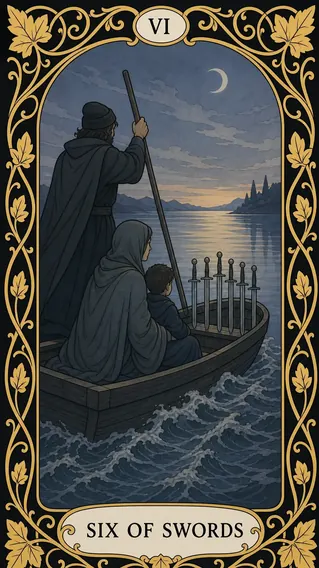
Both cards are about transition, but of different kinds. The Six of Swords is moving away from difficulties forward, toward peace through distance. The Six of Cups is moving backward, toward the warm and familiar, without the need to go anywhere.
Does the Six of Cups mean an ex-partner will return?
It is often read this way, but not as a promise, rather as a likely theme of the reading: contact from the past, less often — the relationship itself. Neighboring cards will show whether it will be a warm meeting or an unresolved issue without development.
Is the Six of Cups a card about children?
The picture shows children, but the card is not only about them and not about the birth of a child as a prediction. The children here are a symbol of simplicity and generosity without calculation, not a literal prediction about a family.
Is the Six of Cups in a reading a "yes" or "no"?
More often "yes," but the answer is connected to something already familiar: a person will return, a proven method will work, an old agreement will be fulfilled. If the question is about a completely new endeavor, the card advises closing the past first.