What the Five of Swords means in Tarot
In all four suits, the fives represent the point of the first real tension: after the confident four, reality intervenes, and the ease is gone. In Swords, the element of words, intellect, and conflict, this tension takes the form of an argument that is won — but in such a way that there is nothing to rejoice about.
An important nuance often lost in retellings: the Minor Arcana describes an episode, not a person's lifelong character. If the Five of Swords appears in a spread, it is almost always about a specific skirmish — a work dispute, a family quarrel, or a correspondence where someone insisted on their way. The card does not say that a person always acts this way; it names one moment when victory was bought at the cost of relationships or trust.
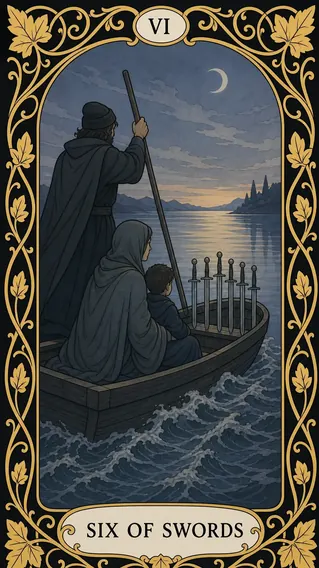
The upright position is read directly: yes, the victory took place, but the costs are higher than the gain. In the classic sequence of Swords, the Six follows the Five — a card of departure, moving away from the place of conflict to calmer waters, and this is no coincidence: the logical continuation of a hollow victory is to leave the place where it was won.
Reversed Five of Swords: meaning
The reversed Five of Swords is the same conflict, but in a different phase. There are three common readings, and the question of the spread helps choose between them.
- Hostility has already exhausted both sides. The argument continues by inertia, but there is no spark of interest in winning left — only fatigue.
- Someone is ready to take the first step toward reconciliation. The realization that the victory was hollow comes late, but it comes — and with it, the desire to reconcile after all.
- Old resentment rises again. The conflict seems closed, but reminds of itself at the first similar opportunity.
There is also a sharper reading: sometimes the reversed card means not softening, but the opposite — open, no longer hidden hostility, when a previous cold argument turns into a direct confrontation. The difference is usually clear from the context: if there are peaceful cards nearby in the spread, reconciliation is more likely; if there are more Swords, the conflict is more likely to escalate.
Five of Swords in a "yes or no" spread
In "yes/no" spreads, the Five of Swords in the upright position is read as no — not because nothing will work out, but because the price of success will be unacceptably high. If the question is "should I enter into a conflict" or "should I insist on my way," the card answers: technically you can win, but it is better not to.
If the question is phrased differently — "will there be a conflict" or "will I face an argument" — the answer is more likely yes, and quite soon.
The reversed position softens the forecast: the acute phase of the conflict is behind you or has not yet arrived; there is room to avoid leading to an open skirmish. Here, it is worth rephrasing the question not as "will I win," but "what will I lose if I win."
Five of Swords in relationships and feelings
In a relationship spread, the upright Five of Swords almost always describes an argument in which someone insisted on their way — and won the conversation, but not the relationship. This is a card about the moment when being right becomes more important than intimacy: one person proves their point, while the other internally withdraws.
Often, the card points specifically to the position of the "winner": they got what they were striving for in the argument, but the loneliness afterward is felt more acutely than the satisfaction of victory. Less often, it points to the position of the one who left, like the two figures on the card walking away: this is also a fair reading if the question is asked by the one who retreated.
The reversed Five of Swords in relationships means fatigue from recurring quarrels or, conversely, a readiness to admit: even if formally right, continuing the argument makes no sense. Sometimes it is a signal that someone is ready to apologize first.
Five of Swords in work and money
In career spreads, the Five of Swords is a conflict in which someone gets their way at the expense of colleagues: pushing through a decision at a meeting, taking credit, winning an argument about being right, but ruining relationships with the team. The card well describes a victory in the moment that creates a problem for the future.
In money, the upright position can mean a won but unscrupulous bargain: a deal where one side pressured the other, or a situation where formal correctness was obtained at the cost of a partner's trust. Such a victory rarely brings long-term profit.
The reversed Five of Swords at work is a time to admit that the old tactic of "pushing at any cost" no longer works, and to try to negotiate instead of winning. The card's advice in this sphere: before insisting on your way, ask what is more important for the business — being right or maintaining working relationships.
Five of Swords as a person: man and woman
When the Five of Swords appears in the "what kind of person" position, it describes not a stable character, but a role in a specific conflict: the one who must win the argument at any cost, even if no one is left by their side afterward.
A Five of Swords man is someone who knows how to find the weak spot in another's position and strikes it without hesitation, and then sincerely does not understand why everyone is offended. A Five of Swords woman is someone who gets her way in an argument calculatingly and cold-bloodedly, leaving a noticeable distance between herself and those she out-argued.
This is a state of behavior, not a permanent portrait: the person described by this card is likely going through a "win at all costs" phase, rather than living that way always. If it is important to understand how this will end, look at the neighboring cards — the Six of Swords nearby usually means that the person is ready to walk away from the conflict rather than fuel it further.
Five of Swords in the thoughts position
In the thoughts position, the Five of Swords represents obsessive replaying of an argument: searching for new arguments, rehearsing lines, and the desire to prove one's point even long after the conversation has ended. The thoughts are competitive, sharp, and aimed at winning, even in hindsight.
Sometimes this is an early signal that a person is preparing for a real confrontation that hasn't happened yet. If the Tower is nearby in the spread, thoughts of conflict are linked to something about to change abruptly; next to the Six of Swords, the person is already mentally ready to let go of the argument and move on.
What to do if the Five of Swords appears
The card's advice is not the most pleasant: before getting into an argument, ask yourself what is more valuable — winning it or the relationships it will destroy. The Five of Swords does not forbid standing your ground; it warns of the price that is easy to overlook in the heat of a conflict.
What to do in practice:
- Assess the scale of the conflict soberly. An argument about principles and an argument about trifles require different approaches — not everything is worth "standing your ground" until the end.
- Separate being right from relationships. You can be right and still lose what was more important than being right.
- If the victory is already won — don't celebrate alone. It is more useful to ask yourself what to do now with the people who ended up on the other side of the argument.
- Consider a step toward reconciliation, even if you are not formally obligated: sometimes refusing to continue an argument is not a defeat, but a sober choice.
If the conflict is related to something serious — threats, violence, systematic pressure — the spread does not replace professional help or reaching out to those who can protect you in reality, not just in the cards.
What is depicted on the card
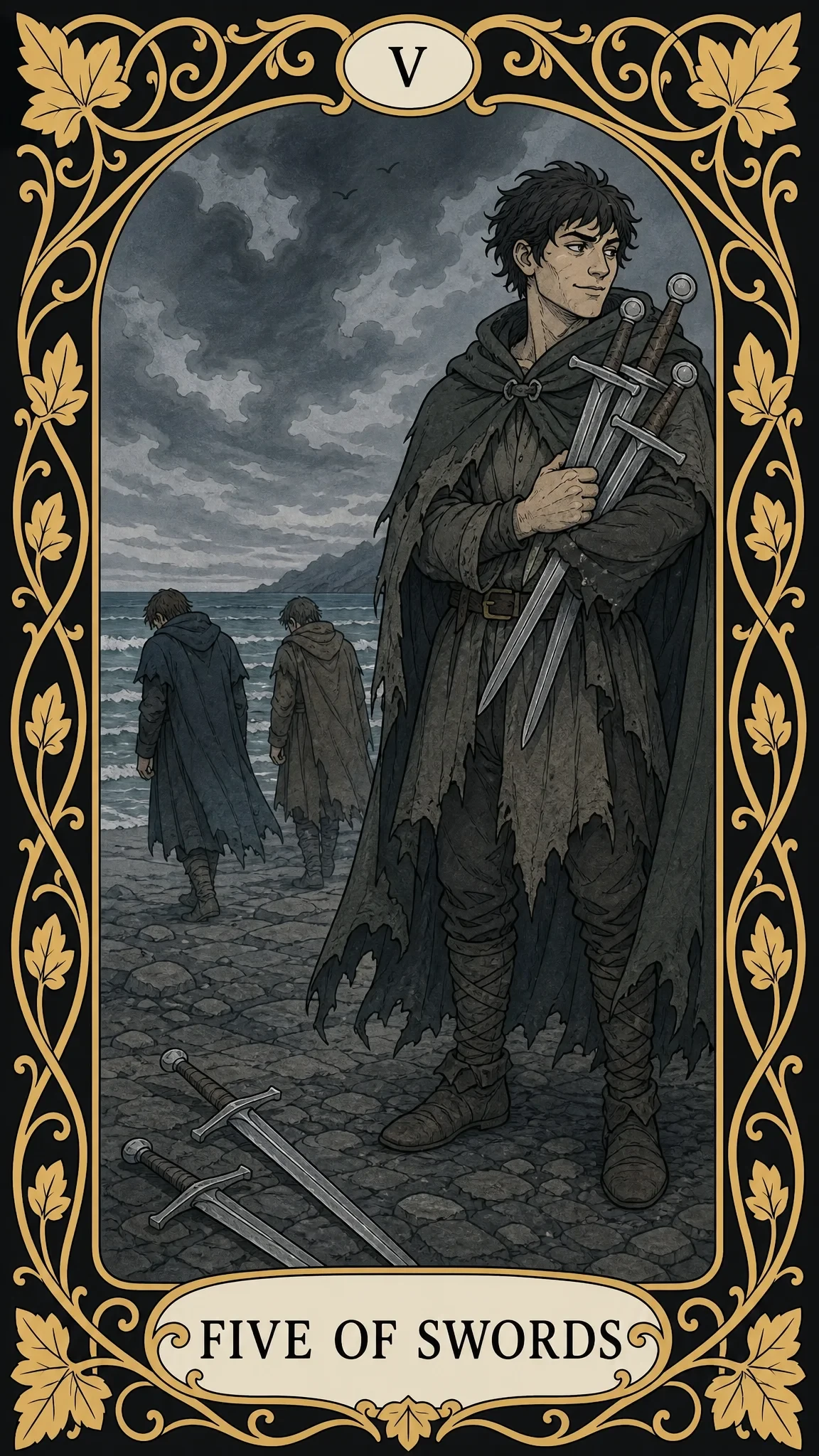
On our card, a young dark-haired man in a tattered, dark green cloak with ragged, charred-looking edges stands on a rocky shore, holding three swords to his chest: the hilts are gripped in his fist, and the blades are raised to his shoulder. The cloak is fastened at the throat with a round metal fibula, there is a heavy buckle on his belt, and his shins are wrapped in fabric — this is the clothing of a wanderer, not a parade victor. Two more swords are thrown directly on the wet stones at his feet, crossed blade against blade — as if they were not considered worth picking up.
On his face is not open malice, but a slight, slightly crooked half-smile: he is looking not at the viewer, but somewhere to the side, following those who are leaving, and there is more calculation than triumph in this gaze. In the distance, at the very edge of the sea, two figures in cloaks are walking away with their backs to us — those who lost this argument and are not looking back.
The scene is read as follows:
- Three swords in hand, not all that were in the argument — the winner took exactly as much as needed to prove his superiority without disarming the opponent to the last blade.
- Two swords thrown on the ground at his feet — not forgotten trophies, but what the winner found unnecessary: the argument was not about weapons, but about insisting on his own way.
- A half-smile, not laughter — this is not joy, but the cold satisfaction of a person who knows the price of his victory and accepted it anyway.
- Figures walking toward the sea — the sea here does not mean a journey, but disappearing from the life of the winner: they will not return to argue again.
- Ragged, torn sky with slanted streaks of clouds and birds — the conflict was not quiet, but noisy, and its echoes still hang in the air.
At the top of the card is the Roman numeral V, at the bottom is a plaque with the English name FIVE OF SWORDS: the card is drawn in the Rider-Waite tradition, where the Five of Swords is the fifth in the suit of swords.
The Five of Swords as the card of the day
The Five of Swords as the card of the day is a warning that the day may push you toward an argument where it will be easiest to force your way. It is worth deciding in advance whether a specific issue is really worth ruining your relationship with the person opposite you.
If the card appears reversed, the day is more suitable for reconciliation than for a new skirmish: an old conflict can be closed if you take the first step yourself, without waiting for someone else to do it.
Frequently asked questions about the Five of Swords card
Is it a Major or Minor Arcana?
Minor Arcana, suit of Swords, element of Air. There are 56 Minor Arcana cards in the Tarot deck in total — 14 cards for each of the four suits, and the Five of Swords is the fifth card in the suit of swords.
How does the Five of Swords differ from the Five of Pentacles?
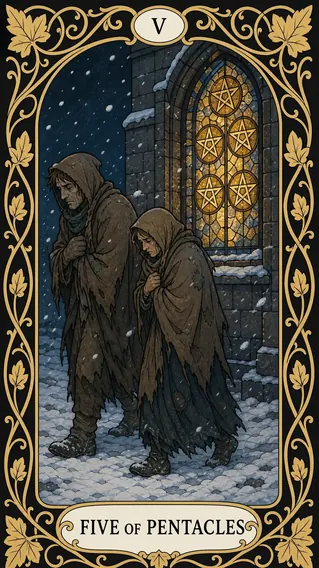
Both cards are the fifth, crisis step of their suit, but the crisis is of a different nature. Pentacles are the element of earth, about lack and exclusion: being left without money, support, or a place among one's own. Swords are the element of air, about conflict and words: a victory in an argument that costs more than it was worth. If the Five of Pentacles is about what was taken away or what was denied, then the Five of Swords is about what was won, but something important was lost in return.
Is the Five of Swords a yes or a no?
Probably no, if the question is whether it is worth getting into a conflict or insisting on your own way: formally you can win, but the price will turn out to be higher than the win. If the question is whether the argument itself will happen, the answer is likely yes, and quite soon.
What does the reversed Five of Swords mean?
Most often, it means fatigue from a prolonged feud or a readiness to reconcile after the emptiness of victory has become obvious. Less often, it refers to an old grudge that has reminded of itself, or a conflict that has shifted from a cold standoff to an open one. Neighboring cards in the spread help to distinguish between these.
Does the Five of Swords always mean I will lose?
No, the card can equally describe the position of the one who won the argument and the position of the one who walked away from it, like the figures in the background of the card. It is not about the outcome in terms of "win-loss," but about the price paid by the winning side — loneliness and undermined trust.