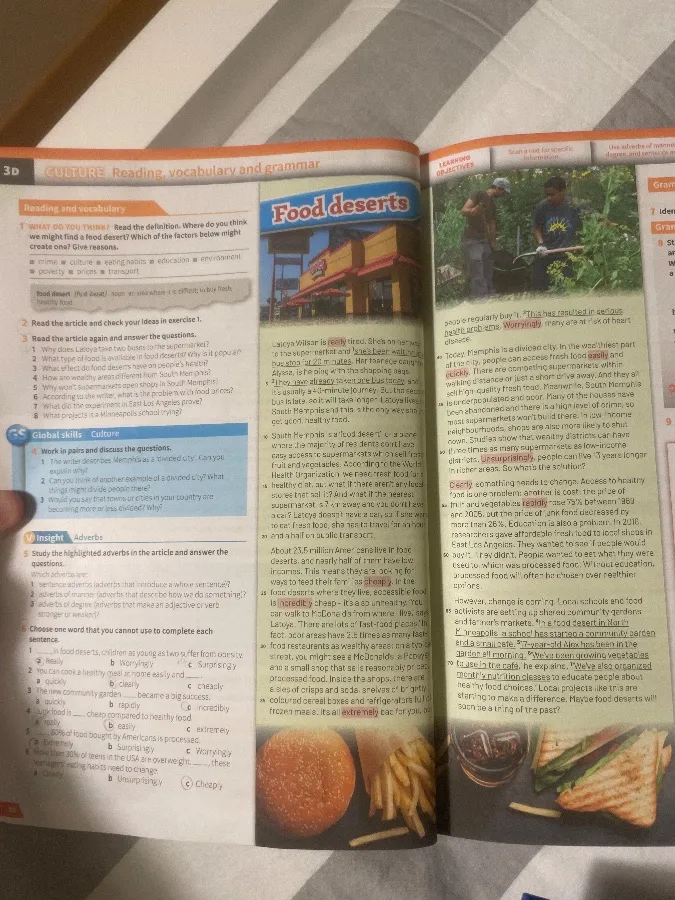
Certamente! Continuiamo con gli esercizi 4, 5 e 6, e poi traduciamo tutto in inglese.
Задание 4
Domanda: In che modo le aree benestanti sono diverse da South Memphis?
Risposta:
Le aree benestanti sono diverse da South Memphis perché hanno un facile accesso a supermercati che vendono frutta e verdura fresca. Inoltre, ci sono meno case abbandonate e un livello di criminalità inferiore, il che incoraggia i supermercati a operare in queste aree.
Задание 5
Domanda: Perché i supermercati non aprono negozi a South Memphis?
Risposta:
I supermercati non aprono negozi a South Memphis a causa dell'alto livello di criminalità e del fatto che molte case sono abbandonate. Questo rende meno attraente investire in queste aree.
Задание 6
Domanda: Secondo lo scrittore, qual è il problema con l'accesso al cibo?
Risposta:
Secondo lo scrittore, il problema con l'accesso al cibo è che nelle aree povere, il cibo sano è meno accessibile e più costoso, mentre il cibo spazzatura è economico e facilmente disponibile. Inoltre, la mancanza di educazione porta le persone a scegliere cibi trasformati invece di opzioni più sane.
Ora, traduciamo tutto in inglese:
Task 1
Question: Where do you think we might find a food desert? Which of the factors below might create one? Give reasons.
Answer:
A food desert is an area where it is difficult to access healthy and nutritious food. I think we might find a food desert in:
- Low-income areas: where people have fewer resources to buy healthy food or to travel to stores that sell it.
- Isolated rural areas: where grocery stores are far away and public transportation is limited.
- Urban neighborhoods with high crime rates: where supermarkets may not want to operate for safety reasons.
Factors that could create a food desert include:
- Poverty: People with less money may not be able to afford healthy food.
- Transportation: Lack of access to a car or reliable public transportation can make it difficult to reach grocery stores.
- Education: Lack of awareness about the importance of a healthy diet can lead to less healthy food choices.
- Culture: Eating habits and cultural preferences can influence the demand for healthy food.
- Prices: High prices of healthy foods compared to processed foods can make it difficult to access a nutritious diet.
Task 2
Question: Read the article and check your ideas in exercise 1.
Answer:
After reading the article "Food Deserts", my ideas in exercise 1 were confirmed. The article highlights how food deserts are often located in low-income areas, where access to healthy food is limited due to the lack of supermarkets and the high costs of nutritious foods. The article also mentions how the lack of education and eating habits influence people's choices in these areas.
Task 3
Question: Why does Latoya take two buses to go to the supermarket?
Answer:
Latoya takes two buses to go to the supermarket because she doesn't have a car and lives in an area where the supermarket is far away. This makes it difficult to access healthy and nutritious food.
Task 4
Question: How are wealthy areas different from South Memphis?
Answer:
Wealthy areas are different from South Memphis because they have easy access to supermarkets that sell fresh fruits and vegetables. In addition, there are fewer abandoned houses and a lower crime rate, which encourages supermarkets to operate in these areas.
Task 5
Question: Why won't supermarkets open shops in South Memphis?
Answer:
Supermarkets won't open shops in South Memphis because of the high crime rate and the fact that many houses are abandoned. This makes it less attractive to invest in these areas.
Task 6
Question: According to the writer, what is the problem with food access?
Answer:
According to the writer, the problem with food access is that in poor areas, healthy food is less accessible and more expensive, while junk food is cheap and readily available. Additionally, the lack of education leads people to choose processed foods instead of healthier options.