English Grammar Exercises: Present Simple and Present Continuous
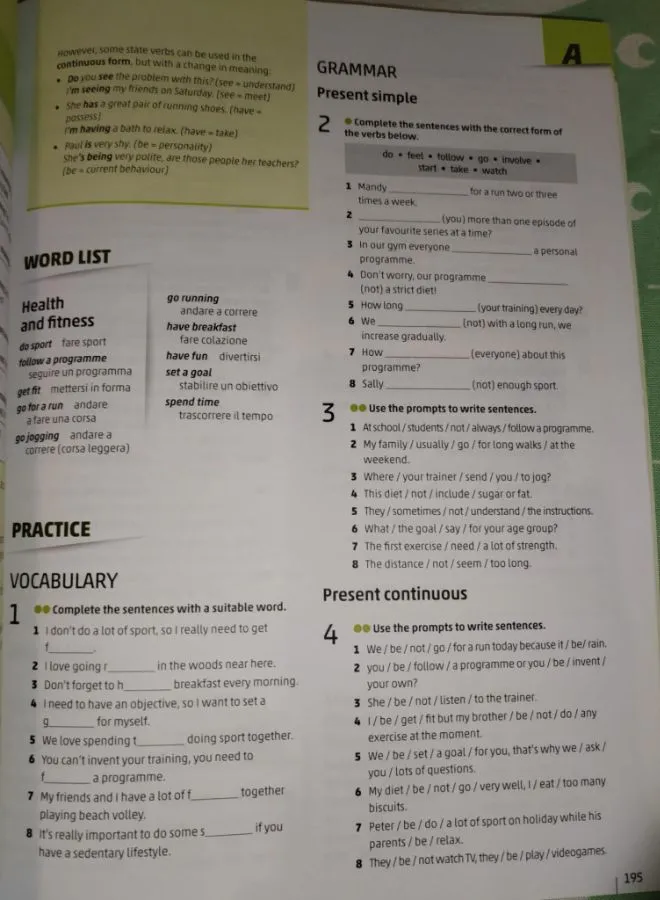
Ciao! Analizziamo e risolviamo insieme questi esercizi di inglese.
Задание 1
Completa le frasi con la parola adatta.
- I don't do a lot of sport, so I really need to get fitter. (Ho bisogno di rimettermi in forma.)
- I love going running in the woods near here. (Amo andare a correre nei boschi qui vicino.)
- Don't forget to have breakfast every morning. (Non dimenticare di fare colazione ogni mattina.)
- I need to have an objective, so I want to set a goal for myself. (Ho bisogno di avere un obiettivo, quindi voglio fissare un traguardo per me stesso.)
- We love spending time doing sport together. (Amiamo passare del tempo facendo sport insieme.)
- You can't invent your training, you need to follow a programme. (Non puoi inventare il tuo allenamento, devi seguire un programma.)
- My friends and I have a lot of fun together playing beach volley. (Io e i miei amici ci divertiamo molto a giocare a beach volley insieme.)
- It's really important to do some sport if you have a sedentary lifestyle. (È molto importante fare sport se hai uno stile di vita sedentario.)
Задание 2
Completa le frasi con la forma corretta dei verbi dati.
- Mandy goes for a run two or three times a week. (Mandy va a correre due o tre volte a settimana.)
- Do you watch (you) more than one episode of your favourite series at a time? (Guardi più di un episodio della tua serie preferita alla volta?)
- In our gym everyone follows a personal programme. (Nella nostra palestra tutti seguono un programma personalizzato.)
- Don't worry, our programme doesn't involve a strict diet! (Non preoccuparti, il nostro programma non prevede una dieta rigida!)
- How long does your training take every day? (Quanto tempo richiede il tuo allenamento ogni giorno?)
- We feel good if we increase gradually. (Ci sentiamo bene se aumentiamo gradualmente.)
- How does Sally feel (everyone) about this programme? (Come si sente Sally riguardo a questo programma?)
- Sally doesn't do enough sport. (Sally non fa abbastanza sport.)
Задание 3
Usa le indicazioni per scrivere le frasi.
- At school students don't always follow a programme. (A scuola gli studenti non seguono sempre un programma.)
- My family usually goes for long walks at the weekend. (La mia famiglia di solito fa lunghe passeggiate nel fine settimana.)
- Where does your trainer send you to jog? (Dove ti manda il tuo allenatore a fare jogging?)
- This diet doesn't include sugar or fat. (Questa dieta non include zucchero o grassi.)
- They sometimes don't understand the instructions. (A volte non capiscono le istruzioni.)
- What does the goal say for your age group? (Cosa dice l'obiettivo per la tua fascia d'età?)
- The first exercise needs a lot of strength. (Il primo esercizio richiede molta forza.)
- The distance doesn't seem too long. (La distanza non sembra troppo lunga.)
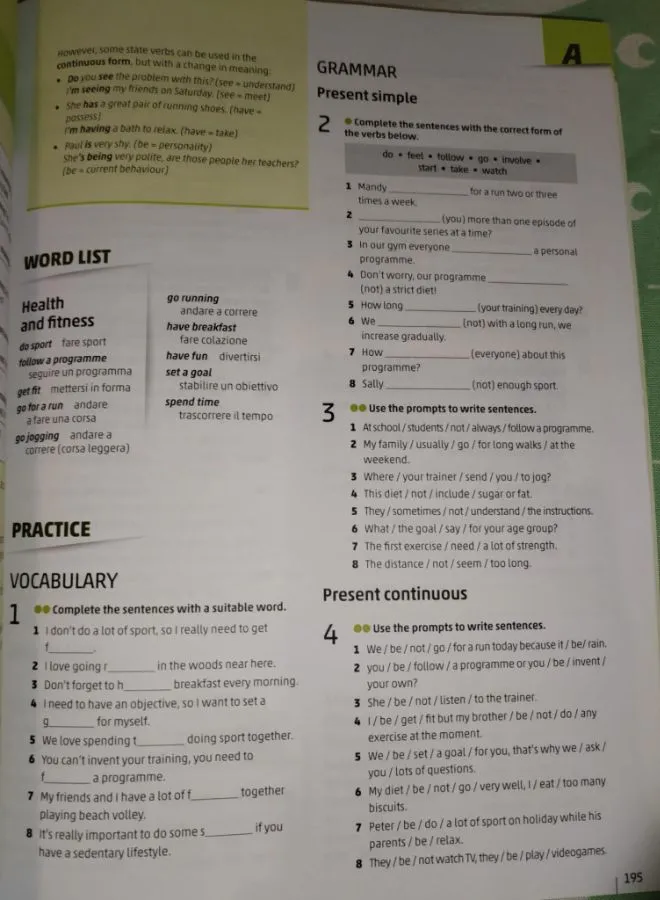
Ciao! Certo, analizziamo e risolviamo insieme questi esercizi di inglese.
Задание 1
Completa le frasi con la parola adatta.
- I don't do a lot of sport, so I really need to get fitter. (Ho bisogno di rimettermi in forma.)
- I love going running in the woods near here. (Amo andare a correre nei boschi qui vicino.)
- Don't forget to have breakfast every morning. (Non dimenticare di fare colazione ogni mattina.)
- I need to have an objective, so I want to set a goal for myself. (Ho bisogno di avere un obiettivo, quindi voglio fissare un traguardo per me stesso.)
- We love spending time doing sport together. (Amiamo passare del tempo facendo sport insieme.)
- You can't invent your training, you need to follow a programme. (Non puoi inventare il tuo allenamento, devi seguire un programma.)
- My friends and I have a lot of fun together playing beach volley. (Io e i miei amici ci divertiamo molto a giocare a beach volley insieme.)
- It's really important to do some sport if you have a sedentary lifestyle. (È molto importante fare sport se hai uno stile di vita sedentario.)
Задание 2
Completa le frasi con la forma corretta dei verbi dati.
- Mandy goes for a run two or three times a week. (Mandy va a correre due o tre volte a settimana.)
- Qui usiamo la terza persona singolare del verbo "go" (andare) al Present Simple, perché si parla di un'azione abituale di Mandy.
- Do you watch (you) more than one episode of your favourite series at a time? (Guardi più di un episodio della tua serie preferita alla volta?)
- Si tratta di una domanda al Present Simple. Per formare la domanda con "you", usiamo l'ausiliare "do" prima del soggetto e il verbo alla forma base.
- In our gym everyone follows a personal programme. (Nella nostra palestra tutti seguono un programma personalizzato.)
- "Everyone" è considerato singolare in inglese, quindi il verbo "follow" (seguire) prende la forma della terza persona singolare al Present Simple.
- Don't worry, our programme doesn't involve a strict diet! (Non preoccuparti, il nostro programma non prevede una dieta rigida!)
- Per formare la negazione al Present Simple con "programme" (che è singolare), usiamo "doesn't" seguito dal verbo alla forma base "involve" (prevedere).
- How long does your training take every day? (Quanto tempo richiede il tuo allenamento ogni giorno?)
- Domanda al Present Simple. Usiamo "does" perché "your training" è considerato singolare, e il verbo "take" (richiedere) rimane alla forma base.
- We feel good if we increase gradually. (Ci sentiamo bene se aumentiamo gradualmente.)
- Usiamo la forma base del verbo "feel" (sentire) perché il soggetto è "we" (noi).
- How does Sally feel (everyone) about this programme? (Come si sente Sally riguardo a questo programma?)
- Domanda al Present Simple. Usiamo "does" perché ci riferiamo a Sally (terza persona singolare), e il verbo "feel" (sentire) rimane alla forma base.
- Sally doesn't do enough sport. (Sally non fa abbastanza sport.)
- Negazione al Present Simple. Usiamo "doesn't" perché ci riferiamo a Sally (terza persona singolare), e il verbo "do" (fare) rimane alla forma base.
Задание 3
Usa le indicazioni per scrivere le frasi.
- At school students don't always follow a programme. (A scuola gli studenti non seguono sempre un programma.)
- Negazione con "don't" perché il soggetto è "students" (plurale).
- My family usually goes for long walks at the weekend. (La mia famiglia di solito fa lunghe passeggiate nel fine settimana.)
- "My family" è considerato singolare in questo contesto, quindi usiamo "goes".
- Where does your trainer send you to jog? (Dove ti manda il tuo allenatore a fare jogging?)
- Domanda con "does" perché "your trainer" è singolare.
- This diet doesn't include sugar or fat. (Questa dieta non include zucchero o grassi.)
- Negazione con "doesn't" perché "this diet" è singolare.
- They sometimes don't understand the instructions. (A volte non capiscono le istruzioni.)
- Negazione con "don't" perché il soggetto è "they" (plurale).
- What does the goal say for your age group? (Cosa dice l'obiettivo per la tua fascia d'età?)
- Domanda con "does" perché "the goal" è singolare.
- The first exercise needs a lot of strength. (Il primo esercizio richiede molta forza.)
- "The first exercise" è singolare, quindi usiamo "needs".
- The distance doesn't seem too long. (La distanza non sembra troppo lunga.)
- Negazione con "doesn't" perché "the distance" è singolare.
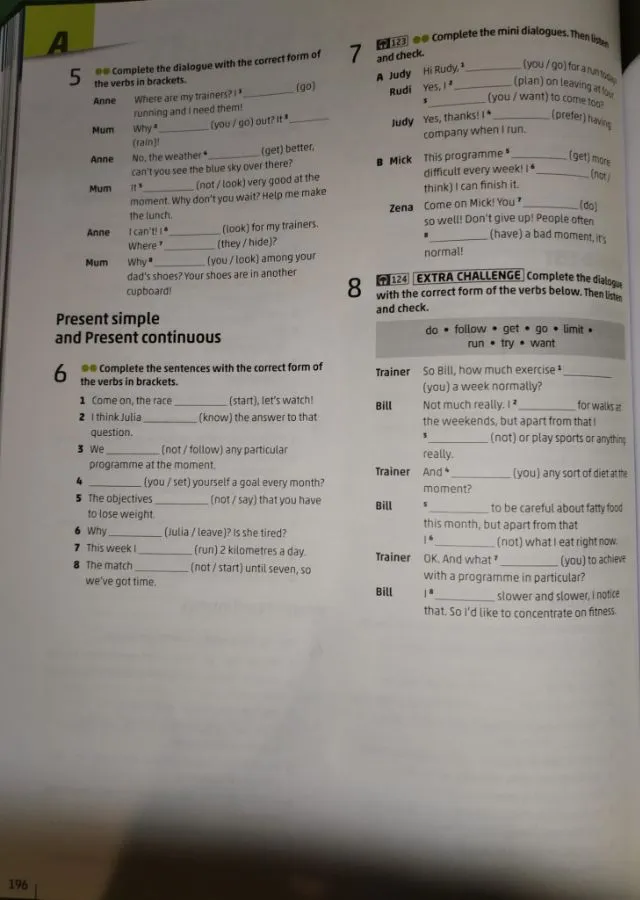
Perfetto! Continuiamo con gli esercizi successivi.
Задание 4
Usa le indicazioni per scrivere le frasi.
- We / be / not / go / for a run today because it / be / rain.
- We aren't going for a run today because it is raining. (Non andiamo a correre oggi perché sta piovendo.)
- Qui usiamo il Present Continuous per esprimere un'azione che sta accadendo ora ("it is raining") e un'intenzione per il futuro immediato ("We aren't going").
- You / be / follow / a programme or you / be / invent / your own?
- Are you following a programme or are you inventing your own? (Stai seguendo un programma o stai inventando il tuo?)
- Usiamo il Present Continuous per chiedere se l'azione di seguire o inventare è in corso.
- She / be / not / listen / to the trainer.
- She isn't listening to the trainer. (Lei non sta ascoltando l'allenatore.)
- Il Present Continuous indica che l'azione di non ascoltare è in corso in questo momento.
- I / be / get / fit but my brother / be / not / do / any exercise at the moment.
- I am getting fit but my brother isn't doing any exercise at the moment. (Mi sto rimettendo in forma ma mio fratello non sta facendo alcun esercizio al momento.)
- Usiamo il Present Continuous per descrivere un'azione in corso ("I am getting") e una che non sta accadendo ("my brother isn't doing").
- We / be / set / a goal / for you, that's why we / ask / you / lots of questions.
- We are setting a goal for you, that's why we are asking you lots of questions. (Stiamo fissando un obiettivo per te, ecco perché ti stiamo facendo molte domande.)
- Il Present Continuous indica che entrambe le azioni (fissare e chiedere) sono in corso.
- My diet / be / not / go / very well, I / eat / too many biscuits.
- My diet isn't going very well, I am eating too many biscuits. (La mia dieta non sta andando molto bene, sto mangiando troppi biscotti.)
- Usiamo il Present Continuous per descrivere un'azione in corso ("My diet isn't going") e una cattiva abitudine temporanea ("I am eating").
- Peter / be / do / a lot of sport on holiday while his parents / be / relax.
- Peter is doing a lot of sport on holiday while his parents are relaxing. (Peter sta facendo molto sport in vacanza mentre i suoi genitori si stanno rilassando.)
- Il Present Continuous indica che entrambe le azioni sono in corso contemporaneamente.
- They / be / not / watch TV, they / be / play / videogames.
- They aren't watching TV, they are playing videogames. (Non stanno guardando la TV, stanno giocando ai videogiochi.)
- Usiamo il Present Continuous per descrivere un'azione che non sta accadendo ("They aren't watching") e una che sta accadendo ("they are playing").
Задание 5
Completa il dialogo con la forma corretta dei verbi tra parentesi.
Anne: Where are my trainers? (go)
Mum: Are they running and I need them? Why?
Anne: Is it raining? (rain)
Mum: No, the weather is getting better, can't you see the blue sky over there? It doesn't look very good at the moment. Why don't you just help me make the lunch.
Anne: I can't! I am looking for my trainers.
Mum: Where are they? (they / hide)
Anne: Where are you looking among your bad shoes? Your shoes are in another cupboard!
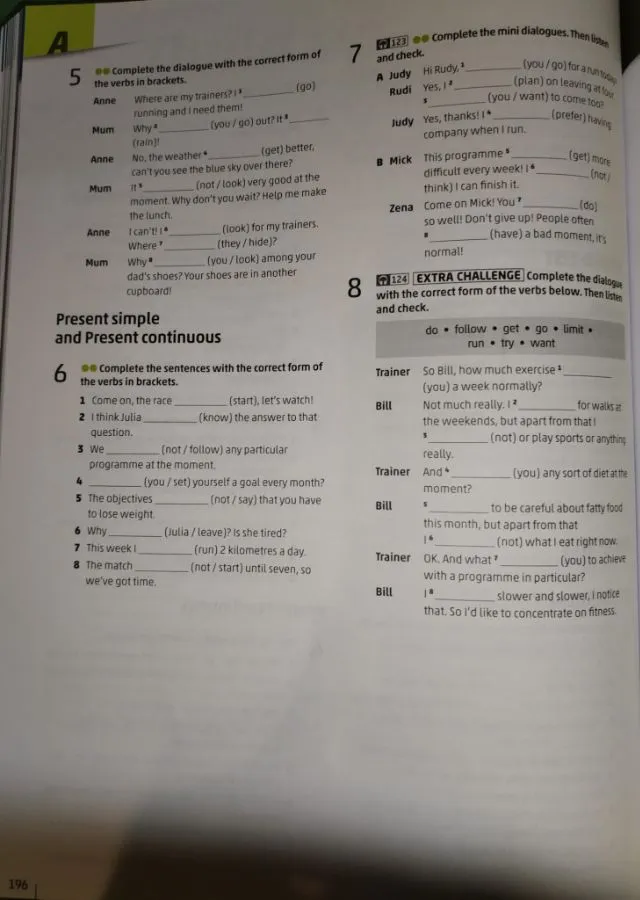
Ассистент: Ottimo! Continuiamo con gli esercizi.
Задание 6
Completa le frasi con la forma corretta dei verbi tra parentesi.
- Come on, the race starts! (Forza, la gara inizia!)
- Usiamo il Present Simple per indicare un evento programmato.
- I think Julia knows the answer to that question. (Penso che Julia sappia la risposta a questa domanda.)
- Usiamo il Present Simple per esprimere un'opinione o una credenza.
- We aren't following any particular programme at the moment. (Non stiamo seguendo alcun programma particolare al momento.)
- Usiamo il Present Continuous per indicare un'azione che non è in corso.
- Are you setting yourself a goal every month? (Ti stai fissando un obiettivo ogni mese?)
- Usiamo il Present Continuous per chiedere se un'azione è in corso.
- The objectives are not / don't say that you have to lose weight. (Gli obiettivi non dicono che devi perdere peso.)
- Usiamo il Present Simple per indicare una verità generale.
- Why is Julia tired? (Perché Julia è stanca?)
- Usiamo il verbo "to be" al Present Simple per descrivere uno stato.
- This week I am running 2 kilometres a day. (Questa settimana sto correndo 2 chilometri al giorno.)
- Usiamo il Present Continuous per indicare un'azione temporanea.
- The match doesn't start until seven, so we've got time. (La partita non inizia fino alle sette, quindi abbiamo tempo.)
- Usiamo il Present Simple per indicare un evento programmato.
Задание 7
Completa i mini dialoghi.
A. Judy: Hi Rudy, are you going (you/go) for a run today?
Rudy: Yes, I want (want) to come too.
Judy: Yes, thanks! I prefer having company when I run.
B. Mick: This programme gets more difficult every week!
Zena: Come on Mick! You can do so well! Don't give up! People often have a bad moment, it's normal!