Ejercicios de gramática inglesa: to be vs have got, formación de oraciones
¡Hola! Veo varios ejercicios de gramática en la imagen. Vamos a resolverlos paso a paso.
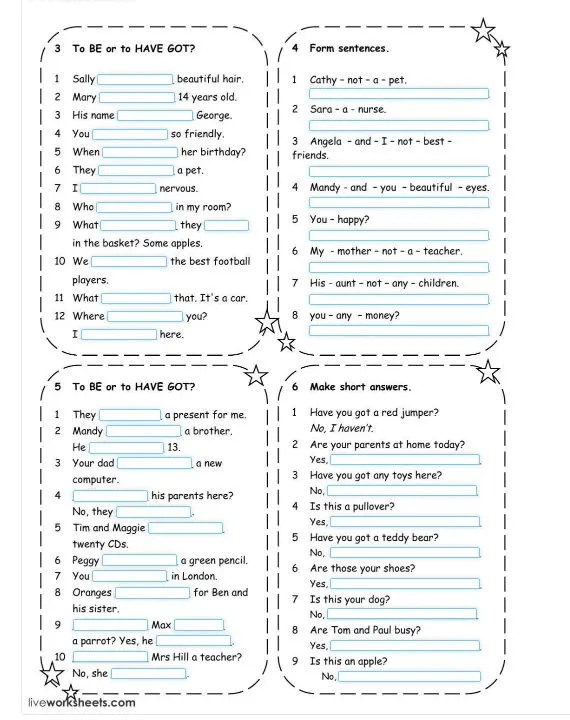
Задание 3: To BE or to HAVE GOT?
В этом задании нужно выбрать правильную форму глагола to be (am, is, are) или have got (have/has got).
- Sally has got beautiful hair. (Sally tiene un cabello hermoso.)
- Mary is 14 years old. (Mary tiene 14 años.)
- His name is George. (Su nombre es George.)
- You are so friendly. (Eres tan amigable.)
- When is her birthday? (¿Cuándo es su cumpleaños?)
- They have got a pet. (Ellos tienen una mascota.)
- I am nervous. (Estoy nervioso.)
- Who is in my room? (¿Quién está en mi habitación?)
- What are they in the basket? Some apples. (¿Qué son ellos en la canasta? Algunas manzanas.)
- We are the best football players. (Somos los mejores jugadores de fútbol.)
- What is that? It's a car. (¿Qué es eso? Es un coche.)
- Where are you? (¿Dónde estás?)
- I am here. (Estoy aquí.)
Задание 4: Form sentences.
В этом задании нужно составить предложения, используя предложенные слова.
- Cathy is not a pet. (Cathy no es una mascota.)
- Sara is a nurse. (Sara es enfermera.)
- Angela and I are not best friends. (Angela y yo no somos mejores amigas.)
- Mandy and you have beautiful eyes. (Mandy y tú tienen ojos hermosos.)
- Are you happy? (¿Eres feliz?)
- My mother is not a teacher. (Mi madre no es profesora.)
- His aunt doesn't have any children. (Su tía no tiene hijos.)
- Do you have any money? (¿Tienes algo de dinero?)
Задание 5: To BE or to HAVE GOT?
В этом задании, как и в первом, нужно выбрать правильную форму глагола to be или have got.
- They have got a present for me. (Ellos tienen un regalo para mí.)
- Mandy has got a brother. (Mandy tiene un hermano.)
- He is 13. (Él tiene 13 años.)
- Your dad has got a new computer. (Tu padre tiene una computadora nueva.)
- Are his parents here? (¿Están sus padres aquí?)
- No, they haven't. (No, no tienen.)
- Tim and Maggie have got twenty CDs. (Tim y Maggie tienen veinte CDs.)
- Peggy has got a green pencil. (Peggy tiene un lápiz verde.)
- You are in London. (Estás en Londres.)
- Oranges are for Ben and his sister. (Las naranjas son para Ben y su hermana.)
- Has Max got a parrot? Yes, he has. (¿Max tiene un loro? Sí, él tiene.)
- Is Mrs Hill a teacher? No, she isn't. (¿Es la Sra. Hill una profesora? No, ella no lo es.)
¡Hola! He analizado la imagen y veo que hay varios ejercicios de gramática. Vamos a resolverlos paso a paso.
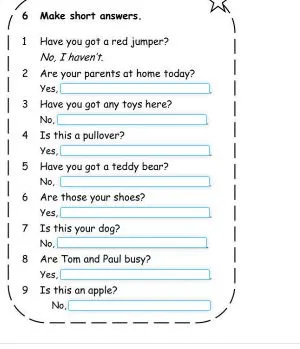
Задание 6: Make short answers.
В этом задании нужно дать краткие ответы на вопросы, используя Yes или No.
- Have you got a red jumper? No, I haven't. (¿Tienes un jersey rojo? No, no tengo.)
- Are your parents at home today? Yes, they are. (¿Están tus padres en casa hoy? Sí, lo están.)
- Have you got any toys here? No, I haven't. (¿Tienes algún juguete aquí? No, no tengo.)
- Is this a pullover? Yes, it is. (¿Es esto un jersey? Sí, lo es.)
- Have you got a teddy bear? No, I haven't. (¿Tienes un oso de peluche? No, no tengo.)
- Are those your shoes? Yes, they are. (¿Son esos tus zapatos? Sí, lo son.)
- Is this your dog? No, it isn't. (¿Es este tu perro? No, no lo es.)
- Are Tom and Paul busy? Yes, they are. (¿Están Tom y Paul ocupados? Sí, lo están.)
- Is this an apple? No, it isn't. (¿Es esto una manzana? No, no lo es.)
¡Hola! Veo varios ejercicios de gramática en la imagen. Vamos a resolverlos paso a paso.
Задание 3: To BE or to HAVE GOT?
В этом задании нужно выбрать правильную форму глагола to be (am, is, are) или have got (have/has got).
- Sally has got beautiful hair. (Sally tiene un cabello hermoso.)
- Mary is 14 years old. (Mary tiene 14 años.)
- His name is George. (Su nombre es George.)
- You are so friendly. (Eres tan amigable.)
- When is her birthday? (¿Cuándo es su cumpleaños?)
- They have got a pet. (Ellos tienen una mascota.)
- I am nervous. (Estoy nervioso.)
- Who is in my room? (¿Quién está en mi habitación?)
- What are they in the basket? Some apples. (¿Qué son ellos en la canasta? Algunas manzanas.)
- We are the best football players. (Somos los mejores jugadores de fútbol.)
- What is that? It's a car. (¿Qué es eso? Es un coche.)
- Where are you? (¿Dónde estás?)
- I am here. (Estoy aquí.)
Задание 4: Form sentences.
В этом задании нужно составить предложения, используя предложенные слова.
- Cathy is not a pet. (Cathy no es una mascota.)
- Sara is a nurse. (Sara es enfermera.)
- Angela and I are not best friends. (Angela y yo no somos mejores amigas.)
- Mandy and you have beautiful eyes. (Mandy y tú tienen ojos hermosos.)
- Are you happy? (¿Eres feliz?)
- My mother is not a teacher. (Mi madre no es profesora.)
- His aunt doesn't have any children. (Su tía no tiene hijos.)
- Do you have any money? (¿Tienes algo de dinero?)
Задание 5: To BE or to HAVE GOT?
В этом задании, как и в первом, нужно выбрать правильную форму глагола to be или have got.
- They have got a present for me. (Ellos tienen un regalo para mí.)
- Mandy has got a brother. (Mandy tiene un hermano.)
- He is 13. (Él tiene 13 años.)
- Your dad has got a new computer. (Tu padre tiene una computadora nueva.)
- Are his parents here? (¿Están sus padres aquí?)
- No, they aren't. (No, no están.)
- Tim and Maggie have got twenty CDs. (Tim y Maggie tienen veinte CDs.)
- Peggy has got a green pencil. (Peggy tiene un lápiz verde.)
- You are in London. (Estás en Londres.)
- Oranges are for Ben and his sister. (Las naranjas son para Ben y su hermana.)
- Has Max got a parrot? Yes, he has. (¿Max tiene un loro? Sí, él tiene.)
- Is Mrs Hill a teacher? No, she isn't. (¿Es la Sra. Hill una profesora? No, ella no lo es.)
¡Hola! He analizado la imagen y veo que hay varios ejercicios de gramática. Vamos a resolverlos paso a paso.
Задание 6: Make short answers.
В этом задании нужно дать краткие ответы на вопросы, используя Yes или No.
- Have you got a red jumper? No, I haven't. (¿Tienes un jersey rojo? No, no tengo.)
- Are your parents at home today? Yes, they are. (¿Están tus padres en casa hoy? Sí, lo están.)
- Have you got any toys here? No, I haven't. (¿Tienes algún juguete aquí? No, no tengo.)
- Is this a pullover? Yes, it is. (¿Es esto un jersey? Sí, lo es.)
- Have you got a teddy bear? No, I haven't. (¿Tienes un oso de peluche? No, no tengo.)
- Are those your shoes? Yes, they are. (¿Son esos tus zapatos? Sí, lo son.)
- Is this your dog? No, it isn't. (¿Es este tu perro? No, no lo es.)
- Are Tom and Paul busy? Yes, they are. (¿Están Tom y Paul ocupados? Sí, lo están.)
- Is this an apple? No, it isn't. (¿Es esto una manzana? No, no lo es.)
¡Hola! Claro, vamos a revisar la teoría de los verbos to be y have got en detalle.
Глагол TO BE (SER/ESTAR)
Формы глагола TO BE
Глагол to be имеет три формы в настоящем времени:
- am - используется с местоимением I (yo)
- is - используется с местоимениями he, she, it (él, ella, ello) и существительными в единственном числе
- are - используется с местоимениями you, we, they (tú, nosotros, ellos) и существительными во множественном числе
Утвердительные предложения
- I am a student. (Yo soy un estudiante.)
- He is a doctor. (Él es un doctor.)
- She is happy. (Ella está feliz.)
- It is a cat. (Es un gato.)
- You are my friend. (Tú eres mi amigo.)
- We are a team. (Nosotros somos un equipo.)
- They are teachers. (Ellos son profesores.)
Отрицательные предложения
Для образования отрицательной формы добавляем not после глагола to be.
- I am not a teacher. (Yo no soy un profesor.)
- He is not (isn't) at home. (Él no está en casa.)
- She is not (isn't) sad. (Ella no está triste.)
- It is not (isn't) a dog. (No es un perro.)
- You are not (aren't) late. (No llegas tarde.)
- We are not (aren't) ready. (No estamos listos.)
- They are not (aren't) from Spain. (Ellos no son de España.)
Вопросительные предложения
Для образования вопросительной формы ставим глагол to be перед подлежащим.
- Am I right? (¿Tengo razón?)
- Is he your brother? (¿Es él tu hermano?)
- Is she a student? (¿Es ella una estudiante?)
- Is it a bird? (¿Es un pájaro?)
- Are you tired? (¿Estás cansado?)
- Are we late? (¿Llegamos tarde?)
- Are they happy? (¿Están felices?)
Краткие ответы
- Are you ready? Yes, I am. / No, I am not.
- Is he a doctor? Yes, he is. / No, he isn't.
- Are they students? Yes, they are. / No, they aren't.
Глагол HAVE GOT (TENER)
Формы глагола HAVE GOT
Глагол have got используется для выражения обладания, наличия чего-либо.
- have got - используется с местоимениями I, you, we, they (yo, tú, nosotros, ellos)
- has got - используется с местоимениями he, she, it (él, ella, ello) и существительными в единственном числе
Утвердительные предложения
- I have got a car. (Yo tengo un coche.)
- He has got a bike. (Él tiene una bicicleta.)
- She has got a book. (Ella tiene un libro.)
- It has got a tail. (Tiene una cola.)
- You have got a dog. (Tú tienes un perro.)
- We have got a house. (Nosotros tenemos una casa.)
- They have got children. (Ellos tienen hijos.)
Отрицательные предложения
Для образования отрицательной формы используем have not got или has not got. Часто используются сокращения haven't got и hasn't got.
- I haven't got a car. (Yo no tengo un coche.)
- He hasn't got a bike. (Él no tiene una bicicleta.)
- She hasn't got a book. (Ella no tiene un libro.)
- It hasn't got a tail. (No tiene una cola.)
- You haven't got a dog. (Tú no tienes un perro.)
- We haven't got a house. (Nosotros no tenemos una casa.)
- They haven't got children. (Ellos no tienen hijos.)
Вопросительные предложения
Для образования вопросительной формы ставим Have или Has перед подлежащим.
- Have I got a car? (¿Tengo yo un coche?)
- Has he got a bike? (¿Tiene él una bicicleta?)
- Has she got a book? (¿Tiene ella un libro?)
- Has it got a tail? (¿Tiene una cola?)
- Have you got a dog? (¿Tienes tú un perro?)
- Have we got a house? (¿Tenemos nosotros una casa?)
- Have they got children? (¿Tienen ellos hijos?)
Краткие ответы
- Have you got a car? Yes, I have. / No, I haven't.
- Has he got a bike? Yes, he has. / No, he hasn't.
- Have they got children? Yes, they have. / No, they haven't.