English Grammar: A Comprehensive Guide
Introduction
English grammar forms the foundation of effective communication in English. Whether you're a beginner or looking to refine your skills, understanding grammar principles will help you express yourself clearly and confidently.
Parts of Speech
Nouns
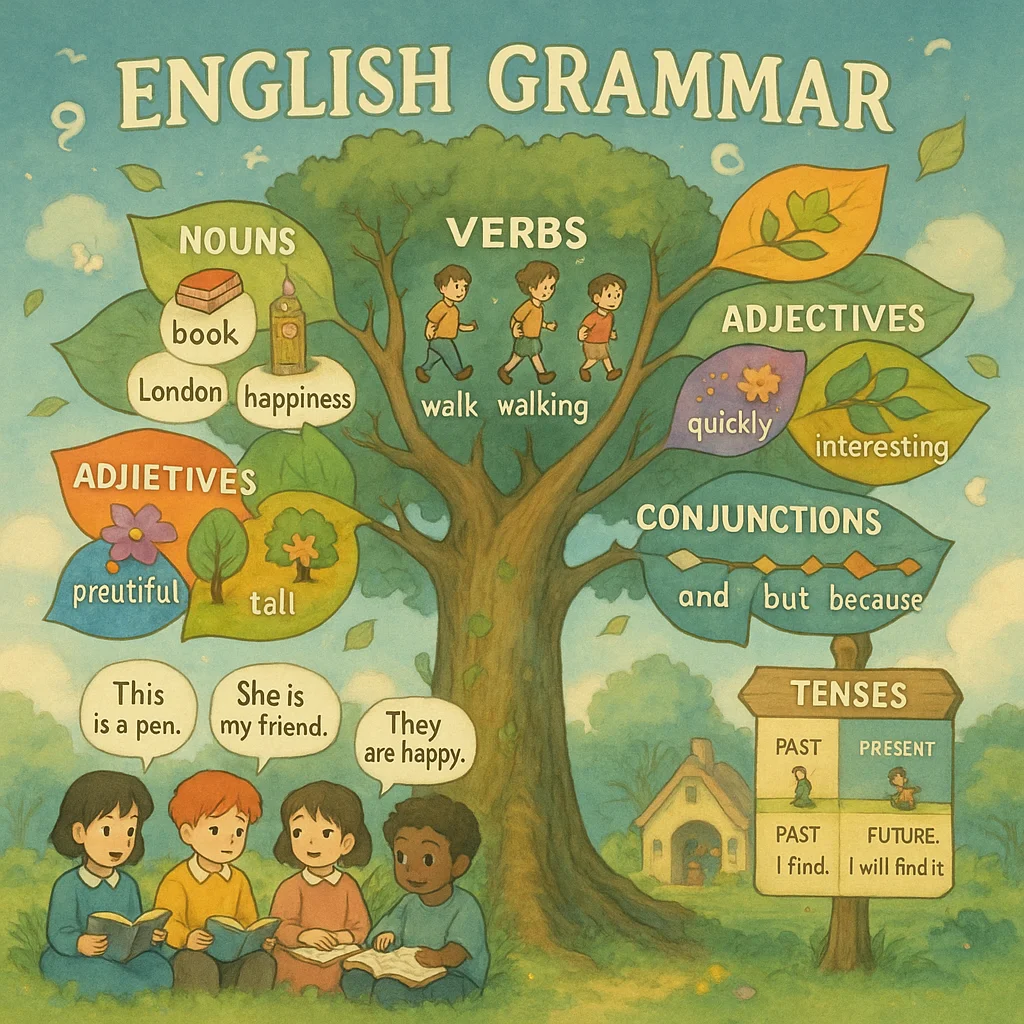
Nouns name people, places, things, or ideas.
- Common nouns: general names (book, city, teacher)
- Proper nouns: specific names (London, Shakespeare, Monday)
- Countable nouns: can be counted (book, apple, student)
- Uncountable nouns: cannot be counted (water, music, information)
Articles
- Definite article (the): refers to specific nouns
- Indefinite articles (a/an): refer to non-specific nouns
- Use "a" before consonant sounds
- Use "an" before vowel sounds
Pronouns
- Personal: I, you, he, she, it, we, they
- Possessive: my, your, his, her, its, our, their
- Reflexive: myself, yourself, himself, herself, itself, ourselves, yourselves, themselves
- Relative: who, whom, whose, which, that
Verbs
Verbs express actions, states, or occurrences.
- Action verbs: run, jump, speak
- Linking verbs: be, seem, become
- Auxiliary verbs: be, do, have
- Modal verbs: can, could, may, might, shall, should, will, would, must
Adjectives
Adjectives describe or modify nouns.
- Descriptive: beautiful, tall, interesting
- Quantitative: many, few, several
- Demonstrative: this, that, these, those
Adverbs
Adverbs modify verbs, adjectives, or other adverbs.
- Manner: quickly, carefully, well
- Time: now, yesterday, soon
- Place: here, there, everywhere
- Frequency: always, often, never
- Degree: very, too, extremely
Prepositions
Prepositions show relationships between words.
- Time: at, on, in, during, before, after
- Place: at, on, in, under, above, between
- Direction: to, from, toward, across
Conjunctions
Conjunctions connect words, phrases, or clauses.
- Coordinating: and, but, or, nor, for, yet, so
- Subordinating: because, although, if, when, while
- Correlative: either...or, neither...nor, both...and
Tenses
Present Tenses
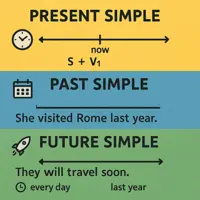
- Present Simple: I work (habits, facts, routines)
- Form: subject + base verb (+ s/es for third person singular)
-
Example: She works in London.
-
Present Continuous: I am working (actions happening now)
- Form: subject + am/is/are + verb-ing
-
Example: They are studying for their exam.
-
Present Perfect: I have worked (past actions with present relevance)
- Form: subject + have/has + past participle
-
Example: I have visited Paris twice.
-
Present Perfect Continuous: I have been working (ongoing actions that started in the past)
- Form: subject + have/has been + verb-ing
- Example: She has been working here for five years.
Past Tenses
- Past Simple: I worked (completed actions in the past)
- Form: subject + past tense verb
-
Example: We visited Rome last summer.
-
Past Continuous: I was working (actions in progress at a specific time in the past)
- Form: subject + was/were + verb-ing
-
Example: I was reading when you called.
-
Past Perfect: I had worked (actions completed before another past action)
- Form: subject + had + past participle
-
Example: By the time we arrived, the movie had started.
-
Past Perfect Continuous: I had been working (ongoing actions before another past action)
- Form: subject + had been + verb-ing
- Example: She had been studying for three hours before she took a break.
Future Tenses
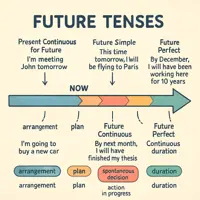
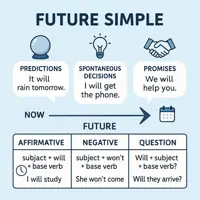
- Future Simple: I will work (predictions, spontaneous decisions)
- Form: subject + will + base verb
-
Example: I will help you tomorrow.
-
Future Continuous: I will be working (actions in progress at a future time)
- Form: subject + will be + verb-ing
-
Example: This time next week, I will be flying to New York.
-
Future Perfect: I will have worked (actions that will be completed by a future time)
- Form: subject + will have + past participle
-
Example: By next month, I will have finished my project.
-
Future Perfect Continuous: I will have been working (ongoing actions up to a future time)
- Form: subject + will have been + verb-ing
- Example: By December, I will have been working here for ten years.
Sentence Structure
Basic Sentence Patterns
- Subject + Verb: Birds fly.
- Subject + Verb + Object: She reads books.
- Subject + Verb + Indirect Object + Direct Object: He gave me a gift.
- Subject + Verb + Complement: She is a doctor.
Types of Sentences
- Simple: contains one independent clause
- Compound: contains two or more independent clauses
- Complex: contains one independent clause and one or more dependent clauses
- Compound-Complex: contains two or more independent clauses and one or more dependent clauses
Comparatives and Superlatives
One-syllable adjectives
- Comparative: add -er (tall → taller)
- Superlative: add -est (tall → tallest)
Two-syllable adjectives ending in -y
- Comparative: change y to i and add -er (happy → happier)
- Superlative: change y to i and add -est (happy → happiest)
Most adjectives with two or more syllables
- Comparative: more + adjective (beautiful → more beautiful)
- Superlative: most + adjective (beautiful → most beautiful)
Irregular forms
- good → better → best
- bad → worse → worst
- far → farther/further → farthest/furthest
- many/much → more → most
- little → less → least
Quantifiers
With countable nouns
- many, few, a few, several, a couple of, a number of
With uncountable nouns
- much, little, a little, a bit of, a great deal of
With both countable and uncountable nouns
- some, any, no, all, enough, a lot of, lots of, plenty of
Common Grammar Mistakes to Avoid
- Subject-verb agreement: The team is (not are) playing well.
- Pronoun-antecedent agreement: Everyone should bring his or her (not their) book.
- Misplaced modifiers: I only want one cookie (vs. I want only one cookie).
- Dangling modifiers: Walking down the street, the building came into view (incorrect)
- Double negatives: I don't want nothing (incorrect) → I don't want anything (correct)
- Incorrect verb forms: She has went (incorrect) → She has gone (correct)
Tips for Improving Grammar
- Read extensively in English to internalize correct grammar patterns
- Practice writing regularly and seek feedback
- Learn from mistakes by keeping a grammar journal
- Use grammar resources like books, websites, and apps
- Apply new grammar rules in real conversations
Remember that mastering grammar takes time and practice. Focus on applying one rule at a time in your everyday communication until it becomes second nature.