Future Tenses in English
English has several ways to express future actions, each with specific uses and nuances. Understanding when to use each future tense will help you communicate more precisely and naturally.
1. Future Simple (will + infinitive)
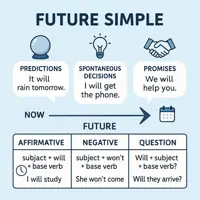
Form:
- Affirmative: Subject + will + verb
- Negative: Subject + will not (won't) + verb
- Question: Will + subject + verb?
Uses:
- Spontaneous decisions made at the moment of speaking
I'll help you with that bag.
- Predictions about the future
I think it will rain tomorrow.
- Promises, offers, threats, requests
I'll call you tomorrow.
Will you help me with this?
- Facts and certainties about the future
The sun will rise at 6:30 tomorrow.
Time expressions: tomorrow, next week/month/year, in 2030, the day after tomorrow
2. Be Going To (be + going to + infinitive)
Form:
- Affirmative: Subject + am/is/are + going to + verb
- Negative: Subject + am/is/are + not + going to + verb
- Question: Am/Is/Are + subject + going to + verb?
Uses:
- Plans and intentions decided before the moment of speaking
I'm going to study medicine next year.
- Predictions based on present evidence
Look at those clouds! It's going to rain.
Time expressions: tomorrow, next week, soon, in the future
3. Present Continuous for Future (be + verb-ing)
Form:
- Affirmative: Subject + am/is/are + verb-ing
- Negative: Subject + am/is/are + not + verb-ing
- Question: Am/Is/Are + subject + verb-ing?
Uses:
- Fixed arrangements in the near future
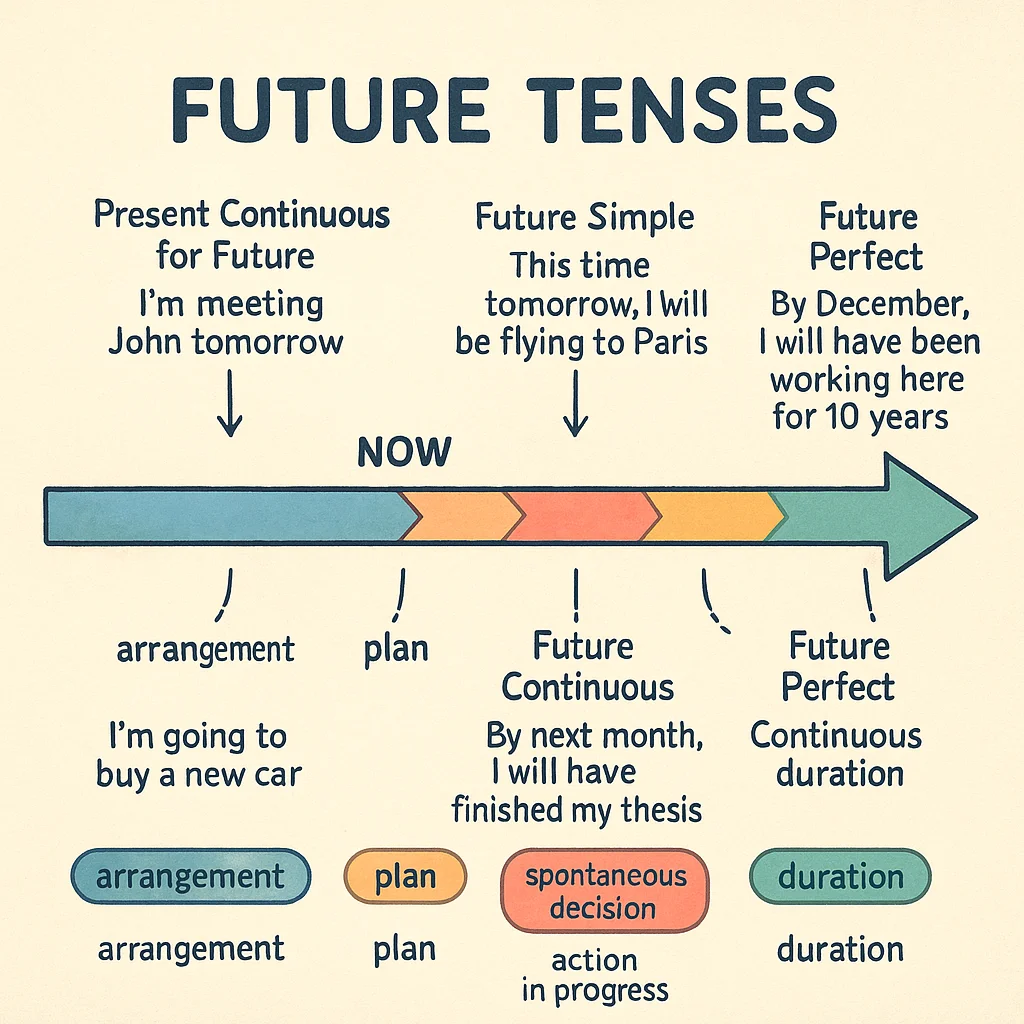
I'm meeting John at 6 pm.
- Personal plans that are already arranged
We're flying to Paris next month.
Time expressions: tonight, tomorrow, next week, on Monday
4. Future Continuous (will be + verb-ing)
Form:
- Affirmative: Subject + will be + verb-ing
- Negative: Subject + will not (won't) be + verb-ing
- Question: Will + subject + be + verb-ing?
Uses:
- Actions in progress at a specific time in the future
This time tomorrow, I'll be flying to New York.
- Planned future actions
I'll be working all day tomorrow.
- Polite enquiries about someone's plans
Will you be using the car tonight?
Time expressions: at this time tomorrow, all day tomorrow, when you arrive
5. Future Perfect (will have + past participle)
Form:
- Affirmative: Subject + will have + past participle
- Negative: Subject + will not (won't) have + past participle
- Question: Will + subject + have + past participle?
Uses:
- Actions that will be completed before a certain time in the future
By next month, I will have finished my thesis.
Time expressions: by tomorrow, by next week, by the time, by then, before
6. Future Perfect Continuous (will have been + verb-ing)
Form:
- Affirmative: Subject + will have been + verb-ing
- Negative: Subject + will not (won't) have been + verb-ing
- Question: Will + subject + have been + verb-ing?
Uses:
- To emphasize the duration of an action up to a specific point in the future
By December, I will have been working here for ten years.
Time expressions: by... for, by... since
Common Mistakes and How to Avoid Them
-
Confusing "will" and "going to"
- Remember: "will" is often for spontaneous decisions; "going to" is for pre-planned intentions
- Incorrect: I will visit my parents this weekend. (if already planned)
- Correct: I'm going to visit my parents this weekend. -
Using Future tense after time conjunctions
- After when, while, before, after, as soon as, until, by the time → use Present Simple, not Future
- Incorrect: When I will arrive, I'll call you.
- Correct: When I arrive, I'll call you. -
Using Present Simple instead of Present Continuous for arrangements
- Incorrect: I go to the dentist tomorrow.
- Correct: I'm going to the dentist tomorrow.
How to Choose the Right Future Tense
Ask yourself these questions:
- Is it a spontaneous decision made now? → Will
- Is it a planned intention or based on present evidence? → Going to
- Is it a fixed arrangement with time and place? → Present Continuous
- Will the action be in progress at a future time? → Future Continuous
- Will the action be completed before a future time? → Future Perfect
- Do you want to emphasize the duration up to a future point? → Future Perfect Continuous
Remember that native speakers often use these forms interchangeably in casual conversation, but understanding the subtle differences will help you express yourself more precisely.