The Earth completes one rotation around its axis in 24 hours, which is why at the same moment, clocks in different parts of the planet show different times. To bring order, the entire surface was divided into 24 time zones — one for each hour of the day. On this page, we will break down what a time zone and standard time are, how many time zones there are in the world and in Russia, and how to determine your time zone and calculate the time difference between cities — with formulas, examples, and an interactive simulator.
What are time zones and standard time?
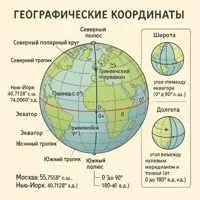
A time zone is a strip on the Earth's surface, extending from pole to pole, within which a single time is observed. The width of one zone is approximately 15° of longitude, because the Earth rotates 360° ÷ 24 = 15° in one hour.
Standard time is the uniform time adopted for an entire zone. Within a zone, everyone's clocks show the same time, and when moving to an adjacent zone, the time changes by exactly 1 hour: to the east — forward, to the west — backward.
Counting begins from the zero (initial) zone, which passes through the Greenwich Meridian (London). Its time is called Universal Time — UTC (or the outdated GMT). The time of any other zone is recorded as an offset from zero: for example, Moscow is UTC+3, meaning it is 3 hours ahead of Greenwich.
Zones are numbered from 0 (zero) to the east. It is helpful to visualize the strip from UTC−12 to UTC+12 as a ribbon: the further east the zone, the higher the time on its clocks.
How many time zones are there in the world and in Russia?
There are 24 time zones in the world — exactly as many as there are hours in a day. In practice, the boundaries of the zones are not strictly vertical: they are adjusted to fit the borders of countries and regions to avoid unnecessary confusion within a single state, and some countries use half-hour (India — UTC+5:30) or even 45-minute (Nepal — UTC+5:45) offsets.
In Russia, there are 11 time zones — more than in any other country. They cover offsets from UTC+2 (Kaliningrad) to UTC+12 (Kamchatka and Chukotka). The reference point within the country is usually Moscow time (MSK = UTC+3), and the time of other regions is indicated as "MSK+n". For example, Yekaterinburg is MSK+2, and Vladivostok is MSK+7.
| City | Zone | Difference from Moscow |
|---|---|---|
| Kaliningrad | UTC+2 | MSK −1 h |
| Moscow | UTC+3 | MSK (0 h) |
| Samara | UTC+4 | MSK +1 h |
| Yekaterinburg | UTC+5 | MSK +2 h |
| Omsk | UTC+6 | MSK +3 h |
| Krasnoyarsk | UTC+7 | MSK +4 h |
| Irkutsk | UTC+8 | MSK +5 h |
| Yakutsk | UTC+9 | MSK +6 h |
| Vladivostok | UTC+10 | MSK +7 h |
| Magadan | UTC+11 | MSK +8 h |
| Kamchatka, Chukotka | UTC+12 | MSK +9 h |
How to determine a time zone and time difference
To determine your time zone, it is enough to know your region's offset from the prime meridian. It can be approximately calculated using geographic longitude: 15° of longitude corresponds to one time zone, so zone number ≈ longitude ÷ 15 (use a "plus" sign for east longitude, "minus" for west). For example, Omsk's longitude is about 73° E, 73 ÷ 15 ≈ 5, and taking regional boundaries into account, Omsk is assigned the UTC+6 offset.
The time difference between two cities is calculated as the difference between their offsets. The formula is simple:
Examples of calculating standard time
Example 1. What time is it in another city
Problem. It is 14:00 in Moscow. What time is it in Vladivostok?
Step 1. Write down the zone offsets: Moscow — UTC+3 (N₁ = 3), Vladivostok — UTC+10 (N₂ = 10).
Step 2. Find the difference: N₂ − N₁ = 10 − 3 = 7 hours. Vladivostok is east of Moscow, so the time there is greater.
Step 3. Add the difference to Moscow time: 14:00 + 7 = 21:00.
Answer: when it is 14:00 in Moscow, it is 21:00 in Vladivostok.
Example 2. Time difference between cities
Problem. How many hours is the time difference between Kaliningrad and Kamchatka?
Step 1. Offsets: Kaliningrad — UTC+2, Petropavlovsk-Kamchatsky — UTC+12.
Step 2. Difference = difference between offsets: 12 − 2 = 10 hours.
Step 3. Kamchatka is further east, so it is 10 hours ahead. When it is 8:00 AM in Kaliningrad, it is already 18:00 PM on Kamchatka — almost half a day's difference within one country.
Example 3. How to determine a zone by longitude
Problem. In which time zone is a point with a longitude of 90° E located?
Step 1. One zone is 15° of longitude (360° ÷ 24).
Step 2. Divide the longitude by 15: 90 ÷ 15 = 6. The longitude is east, so the offset is positive — approximately UTC+6.
Step 3. On the map, this is the Omsk area (UTC+6). In practice, exact zone boundaries are adjusted to regional borders, so calculation by longitude gives a close, but not always perfectly precise value.
Common mistakes
-
Confusing the direction: subtracting time when going east, and adding when going west.
The opposite is true. The Earth meets a new day earlier in the east, so time is greater there — add. To the west — it is less, subtract. Rule: "east — forward, west — backward."
-
Calculating the difference as the sum of offsets: getting 12 hours between UTC+2 and UTC+10.
The difference is the subtraction of offsets, not the sum: 10 − 2 = 8 hours. You only add the absolute values when cities are on opposite sides of zero (e.g., UTC−5 and UTC+3 → 5 + 3 = 8 hours).
-
Forgetting about the International Date Line: getting the time but not noticing that the day has changed.
With a very large difference, the time in the east may "cross" midnight — then it is already the next day. When crossing the International Date Line (near 180° longitude) to the east, subtract a day; to the west, add a day.
-
Mixing up standard and local (solar) time.
Local (solar) time is specific to each meridian and is determined by the position of the Sun. Standard time is uniform for the entire zone, introduced specifically so that clocks within the strip show the same time. In everyday life, we use standard time.
-
Thinking that "Moscow time" and "zero zone time" are the same thing.
The zero zone is UTC (Greenwich). Moscow is in the UTC+3 zone, meaning it is 3 hours ahead. Within Russia, it is convenient to count from Moscow time (MSK), but the global reference point is Greenwich.
Questions and answers
How many time zones are there in the world in total?
There are 24 time zones in the world — one for each hour of the day. Each zone is about 15° of longitude wide. In practice, zone boundaries are adjusted to fit state borders, and some countries use half-hour or 45-minute offsets.
How many time zones are there in Russia?
There are 11 time zones in Russia — from UTC+2 (Kaliningrad) to UTC+12 (Kamchatka and Chukotka). This is the country with the widest time span in the world. Moscow time (MSK = UTC+3) is taken as the internal reference point.
What are UTC and GMT?
UTC (Coordinated Universal Time) is the time of the zero time zone, from which all others are counted. GMT (Greenwich Mean Time) is its historical predecessor; in everyday life, these terms are used as synonyms. The offset of any zone is recorded as UTC±N hours.
How to determine your time zone?
The easiest way is to check your region's offset in a directory or device settings (e.g., UTC+3). Approximately, the zone can be calculated by geographic longitude: zone number ≈ longitude ÷ 15, with a "plus" sign for east longitude and "minus" for west.
What is the International Date Line?
This is a conventional line approximately along the 180° meridian, on opposite sides of which the calendar day differs by one day. Crossing it from west to east, you "remove" a day from the calendar, and from east to west, you add one. It is needed so that the time difference between zones does not accumulate infinitely.
How does standard time differ from local time, and what is decree time?
Local (solar) time is specific to each meridian and is determined by the Sun's position. Standard time is uniform for the entire zone, introduced for convenience. Decree time is the shifting of clock hands one hour forward relative to standard time, which was in effect in the USSR and Russia; it is precisely because of this that Moscow time currently corresponds to UTC+3.