Day length and the sun's height above the horizon depend on two factors: the geographic latitude of a place and the time of year. Both trace back to one root cause — the tilt of Earth's axis. This page walks through clear diagrams, the four key dates of the year, the formula for calculating sun height, worked exam-style problems, and an interactive quiz you can use to test yourself right away.
What determines day length
Day length is the time from sunrise to sunset. Earth makes two motions: it spins on its axis (creating day and night) and it orbits the Sun over a year (creating the seasons). The key to the whole topic is the tilt of Earth's axis: it's tilted 23.5° from the perpendicular to the orbital plane, and it points at the same spot in the sky — the North Star — all year round.
Because of this tilt, the hemispheres take turns facing the Sun's rays. When your hemisphere is tilted toward the Sun, it's summer: the sun climbs high, and the day is long. When your hemisphere is tilted away, it's winter: the sun stays low, and the day is short. Without the axial tilt, day would always equal night everywhere, and the seasons would disappear.
Solstices and equinoxes: the four key dates
Over a year, Earth passes through four key points of its orbit. On the equinoxes, the sun stands at its zenith over the equator at noon, and day equals night everywhere on the planet. On the solstices, the sun is at its zenith over one of the tropics (latitude 23.5°), and the gap between day and night is at its widest. These four dates are the anchor points for any problem on this topic — worth knowing by heart.
Sun height above the horizon in winter and summer
The sun's height \(h\) is the angle between the plane of the horizon and the direction to the sun. It reaches its maximum at true noon, when the sun crosses the celestial meridian (in the Northern Hemisphere, that's the moment it's due south).
In summer, the sun's arc runs high above the horizon: sunrise shifts toward the northeast, sunset toward the northwest, and the sun's path across the sky is long. In winter, the arc is low and short: sunrise is in the southeast, sunset in the southwest. That gives a direct rule at any fixed latitude: the higher the noon sun, the longer the daylight hours.
Sun height above the horizon: the formula
The noon sun height is calculated from the geographic latitude of a place \(\varphi\):
- on the equinoxes (March 21 and September 23): \(h = 90° - \varphi\);
- on the summer solstice (June 22): \(h = 90° - \varphi + 23.5°\);
- on the winter solstice (December 22): \(h = 90° - \varphi - 23.5°\).
The general form of the formula is: \(h = 90° - \varphi + \delta\), where \(\delta\) is the solar declination — its angular distance from the celestial equator. Over the year, the declination shifts smoothly from \(-23.5°\) (December 22) to \(+23.5°\) (June 22), passing through \(0°\) at the equinoxes.
Two useful consequences follow. If the calculation gives \(h \le 0°\), the sun doesn't rise above the horizon at noon at all — that latitude is experiencing polar night. And the formula also solves the reverse problem: by measuring the noon sun height, you can find the latitude of a place — \(\varphi = 90° - h + \delta\). That's exactly how sailors navigated for centuries.
How day length and sun height change moving from north to south
A classic exam question: what happens to day length and sun height as you move toward the equator?
Sun height is straightforward: moving south (in the Northern Hemisphere) decreases latitude, and by the formula \(h = 90° - \varphi + \delta\), the noon height increases in every season — the sun is always higher the closer you are to the equator.
Day length behaves differently. In winter, days are longer farther south. In summer it's the opposite — shorter: at high latitudes the summer sun traces a very long arc and barely sets (or doesn't set at all) — up to polar day. So the answer to "where is day length longer" depends on the season: in winter, closer to the equator; in summer, closer to the pole.
| Moving south, toward the equator | In winter | In summer |
|---|---|---|
| Noon sun height | rises ↑ | rises ↑ |
| Day length | grows ↑ | shrinks ↓ |
Worked examples
Example 1. Calculating sun height with the formula (Moscow)
Problem: find the noon sun height in Moscow (latitude 56° N) on the equinoxes and solstices.
Step 1. Equinoxes (March 21, September 23): \(h = 90° - \varphi = 90° - 56° = 34°\).
Step 2. Summer solstice (June 22): \(h = 90° - 56° + 23.5° = 57.5°\).
Step 3. Winter solstice (December 22): \(h = 90° - 56° - 23.5° = 10.5°\).
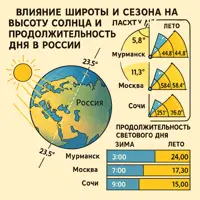
Answer: 34°, 57.5°, and 10.5°. Notice the range: over half a year, the noon sun in Moscow "drops" by nearly 47° — exactly twice the axial tilt.
Example 2. Murmansk and Sochi in May: where is the day longer?
Problem: on May 12, in Murmansk (69° N) the sun height is 39° and the day lasts 20 h 40 min; in Sochi (43° N) it's 64° and 14 h 37 min. Explain the difference.
Step 1. Compare the latitudes: Murmansk is much farther north than Sochi.
Step 2. Sun height: Sochi has a lower latitude, so the sun is higher there (64° vs. 39°) — this holds in any season.
Step 3. Day length: May is nearly summer, and in summer the day is longer at high latitudes. Murmansk sits near the Arctic Circle, approaching polar day — 20 h 40 min versus 14 h 37 min in Sochi.
Conclusion: in summer, "higher sun" and "longer day" aren't the same thing: the sun is higher in the south, but the day is longer in the north.
Example 3. Ranking cities by day length on December 22
Problem: arrange Arkhangelsk (64° N), Moscow (56° N), and Sochi (43° N) in order of increasing day length on December 22.
Step 1. December 22 is the winter solstice: in winter, the day is longer the closer you are to the equator.
Step 2. Order the latitudes from highest to lowest: Arkhangelsk (64°) → Moscow (56°) → Sochi (43°).
Step 3. So the day length grows in the same order: shortest in Arkhangelsk, longest in Sochi.
Answer: Arkhangelsk, Moscow, Sochi. Sanity check: the farther north in winter, the closer to polar night.
Common mistakes
-
Assuming that in summer the day is always longer in the south — "it's warmer there, after all."
Within one hemisphere, in summer the day is longer at HIGH latitudes, up to polar day. In Murmansk on June 22 the sun never sets at all, while in Sochi the day is about 15 hours. Warmth in the south doesn't come from day length but from sun height: its rays hit closer to a straight angle.
-
Explaining the change of seasons by Earth's changing distance from the Sun.
Earth's orbit is nearly circular, and Earth is closest to the Sun in early January — the depths of winter in the Northern Hemisphere. The cause of the seasons is Earth's 23.5° axial tilt, not distance.
-
Confusing direction: "farther north" and "higher latitude" feel like separate ideas.
In the Northern Hemisphere, "farther north" = "higher latitude", and "closer to the equator" = "lower latitude". Write down the latitudes before comparing cities — half of these mistakes vanish on their own.
-
Losing track of the sign of the declination: adding 23.5° in winter instead of subtracting it.
Remember the extremes: on June 22 the declination is +23.5° (sun higher), on December 22 it's −23.5° (lower), and 0° at the equinoxes. Sanity-check your answer: the winter height must be lower than the spring one.
-
Thinking polar day means the sun is at its zenith over the pole.
During polar day, the sun simply doesn't set below the horizon, but it travels LOW above it. Above 23.5° latitude the zenith is never reachable at all: the sun stands at its zenith only between the tropics.
FAQ
What determines day length?
The geographic latitude of a place and the time of year. The root cause is Earth's 23.5° axial tilt: because of it, the hemispheres take turns tilting toward the Sun, changing day length and sun height over the year. At the equator, the day is always about 12 hours long, and the farther toward the poles, the stronger the yearly swings.
Where is day length longer?
It depends on the season. In winter, the day is longer closer to the equator; in summer, closer to the pole (up to polar day beyond the Arctic Circle). On the equinoxes, March 21 and September 23, the day is roughly 12 hours everywhere.
How does the sun's height change in winter?
The noon sun height decreases from the autumn equinox toward December 22, then rises again toward spring. In winter the sun is lower than in summer by twice the axial tilt — 47°. Moving south, the winter sun climbs higher: in February the noon height in Murmansk is about 8°, while in Sochi it's about 34°.
How are latitude and sun height related?
The higher the latitude (the farther from the equator), the lower the noon sun. The exact relationship is given by the formula h = 90° − φ + δ, where φ is the latitude and δ is the solar declination. So the latitude of a place can be calculated from a measured sun height — a method sailors have used for centuries.
What formula gives the sun's height above the horizon?
On the equinoxes, h = 90° − φ. On the solstices, the axial tilt of 23.5° is added (summer) or subtracted (winter). The universal form is h = 90° − φ + δ, where the declination δ shifts over the year from −23.5° to +23.5°.
What are polar day and polar night?
These are periods when the sun doesn't set below the horizon for more than a day (polar day) or doesn't rise at all (polar night). They occur beyond the polar circles — at latitudes above 66.5°. At the pole itself, both day and night last nearly six months.