Present Continuous — 英语中的现在进行时:用于描述正在发生的事情(I am reading — 我正在读书)或当前阶段正在持续的动作。其构成公式为 am / is / are + 动词 -ing 形式。本页面包含规则表格、-ing 结尾拼写、否定句与疑问句、时间状语、状态动词、Present Simple 与 Present Continuous 的区别,以及 10 组练习题来巩固知识点。
检测一下:10 组练习,每组 12 个句子,每个答案后都有解析。
打开训练器什么是 Present Continuous
Present Continuous(也称为 Present Progressive)是英语中的现在进行时。它表示动作正在进行中:动作已经开始,尚未结束,且正在此时或当前阶段发生。
俄语中没有专门的“进行时”:无论是“我每天晚上读书”还是“我现在正在读书”,表达方式都一样。但在英语中,这是两种不同的时态——Present Simple 和 Present Continuous。因此,你需要问自己的核心问题是:这是习惯,还是正在进行的动作?
- Look! It is raining. — 看!正在下雨。(此时此刻)
- I am talking on the phone right now. — 我现在正在打电话。
- She is studying for her exams this week. — 这周她正在为考试复习。(暂时性)
Present Continuous:构成 — am, is, are + -ing
Present Continuous 由两部分组成:现在时的助动词 to be(am, is 或 are)和带有 -ing 结尾的实义动词。选择哪种 be 形式取决于主语。在口语和给朋友写信时,形式通常会缩写:I'm, she's, we're, they're。
没有 am / is / are 的动词 -ing 形式不是谓语。She playing tennis — 错误:缺少 is。
| 人称 | 例句 |
|---|---|
I am · I'm | I am reading a book.我正在读书。 |
he / she / it is · she's | She is playing tennis.她正在打网球。 |
you / we / they are · they're | They are watching TV.他们正在看电视。 |
-ing 结尾的拼写规则
在大多数情况下,直接在动词后加 -ing 即可。但有三种情况会改变词根的拼写——这正是考试中最容易丢分的地方。
Present Continuous 的否定句与疑问句
在这个时态中,所有的“语法工作”都由 am / is / are 完成,而带有 -ing 的实义动词保持不变。在否定句中,助动词后加 not;在疑问句中,助动词提前到主语之前。这里不需要 do 和 does — 它们属于 Present Simple。
I 'm not working today.
What are you doing?
Present Continuous 的用法
- 说话时刻的动作 — 我们说话时正在发生的事情。
Listen! Somebody is playing the piano. - 暂时性情况 — 动作持续一段时间(今天、这周、这个月),但不是永久的。
My dad is working from home this month. - 变化与趋势 — 正在逐渐改变的事物。
The weather is changing. The days are becoming shorter. - 近期的未来计划,且已达成协议:买了票、约好了见面。
I am meeting John tomorrow. We are flying to Paris next week. - 令人恼火的习惯,常与 always, constantly 连用 — 说话者表示不满。
He is always complaining! — 他总是抱怨!
Present Continuous 的时间状语:now, at the moment, Look!
时间状语提示我们需要使用哪种时态。感叹词 Look!, Listen!, Be quiet! 也是状语:我们请求对方看或听正在发生的事情。
状态动词:哪些动词不用于 Present Continuous
有些动词表示的不是动作,而是状态 — 感觉、观点、知识、拥有。状态没有过程,因此这些动词(stative verbs)通常不用于 Continuous,即使是在谈论“现在”。
其中一部分动词有第二个含义 — 表示动作,这时可以使用 Continuous:
- I think this film is boring. — 我认为(观点)。 / She is thinking about her answer. — 她正在思考答案(过程)。
- He has a big family. — 他有一个大家庭(拥有)。 / He is having lunch. — 他正在吃午饭(动作)。
- I see a bird on the roof. — 我看见(感知)。 / I am seeing the doctor tomorrow. — 我明天要去见医生(约定)。
| 类别 | 动词 |
|---|---|
| 感觉与愿望 | like, love, hate, want, need, prefer |
| 思维与知识 | know, understand, believe, remember, forget, mean |
| 感知 | see, hear, smell, taste |
| 拥有 | have (拥有), own, belong |
| 其他状态 | be, seem, cost, contain |
Present Simple 还是 Present Continuous:有什么区别
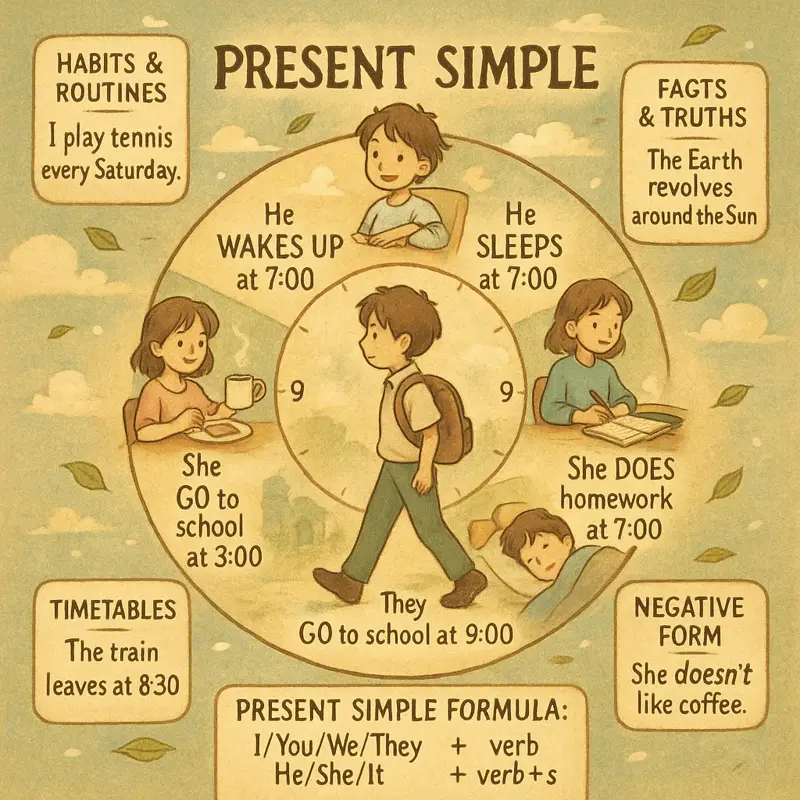
Present Simple 讲述的是普遍情况:习惯、时刻表、事实。Present Continuous — 关于现在或暂时发生的事情。对比:I walk to school every day(习惯)和 Today I am walking to school with my friend(今天的情况)。
为了选择时态,请按顺序问三个问题:
- 这是状态动词吗(know, like, want, have = 拥有)? → Present Simple。
- 有习惯状语吗(every day, usually, often, on Mondays)或者这是事实? → Present Simple。
- 动作正在进行、暂时发生或是约定吗(now, Look!, this week, tomorrow)? → Present Continuous。
| Present Simple | Present Continuous |
|---|---|
| 表达含义 | |
| 习惯、重复、时刻表、事实 | 说话时刻的动作、暂时情况、变化、计划 |
| 构成方式 | |
| V / V‑s do / does | am / is / are + V‑ing |
| 时间状语 | |
| every day, usually, often, always, never, on Mondays | now, at the moment, Look!, Listen!, today, this week |
| 例句 | |
| He drinks coffee every morning. | Today he is drinking tea. |
| 否定句与疑问句 | |
| He doesn't drink milk. Does he drink milk? | He isn't drinking milk. Is he drinking milk? |

例句解析:括号填空
例句 1. 状语 Listen!
题目: Listen! The neighbours ___ (argue) again.
第一步: “Listen!” — 让我们听听正在发生的事情。所以是 Present Continuous。
第二步: 主语 the neighbours — 复数(他们) → are。
第三步: Argue 以不发音的 -e 结尾:去掉 -e → arguing。
答案: Listen! The neighbours are arguing again.
例句 2. 习惯与 -es 结尾
题目: Tim ___ (study) French twice a week.
第一步: Twice a week — 规律性动作,习惯 → Present Simple。
第二步: 主语 Tim — 是“他”,所以需要 -s 结尾。
第三步: Study 以辅音 + y 结尾:y 变 i,加 -es。
答案: Tim studies French twice a week.
例句 3. 否定句中的状态动词
题目: I ___ (not / know) where my bag is.
第一步: 看起来是在谈论“现在”,想写 am not knowing。
第二步: 但 know 是状态动词(知识),不用于 Continuous。
第三步: I 的 Present Simple 否定句:do not → don't + 动词原形。
答案: I don't know where my bag is.
例句 4. Present Continuous 的疑问句
题目: ___ (they / dance) now?
第一步: Now — 说话时刻的动作 → Present Continuous。
第二步: 疑问句中助动词位于主语前;they 对应 are。
第三步: Dance → 去掉不发音的 -e → dancing。
答案: Are they dancing now? — Yes, they are. / No, they aren't.
Present Continuous 的常见错误
-
漏掉助动词:*She reading a book.*
没有 am / is / are 就没有谓语:She is reading a book.
-
be 形式用错:*They is singing.*
I — am, he / she / it — is, you / we / they — are: They are singing.
-
拼写 -ing 出错:*runing*, *writeing*, *lieing*.
短元音后双写辅音 (running),去掉不发音的 -e (writing),-ie 变 -y (lying)。
-
状态动词用于 Continuous:*I am wanting a new bike.*
Want, know, like, need 等状态动词保持 Present Simple:I want a new bike.
-
用 Continuous 谈论习惯:*I am going to school every day.*
Every day 是 Present Simple 的状语:I go to school every day.
-
用 do / does 构成疑问句和否定句:*Do you reading? She doesn't playing.*
Continuous 中只有 am / is / are 起作用:Are you reading? She isn't playing.
关于 Present Continuous 的问答
简单来说,什么是 Present Continuous?
这是现在进行时:用于谈论正在发生或当前阶段正在进行且尚未结束的动作。例如:I am reading — 我正在读书(现在,进行中)。
Present Continuous 如何构成?
公式:主语 + am / is / are + 动词 -ing 形式。I 用 am,he / she / it 用 is,you / we / they 用 are。否定句在 am / is / are 后加 not,疑问句将 am / is / are 放在主语前。
Present Continuous 有哪些时间状语?
Now, right now, at the moment, at present, today, this week, these days,以及感叹词 Look! 和 Listen!。用于未来计划时 — tonight, tomorrow, next week。
Present Simple 和 Present Continuous 有什么区别?
Present Simple — 关于习惯、时刻表和事实(every day, usually, often)。Present Continuous — 关于现在或暂时发生的事情(now, at the moment, this week)。She plays the piano — 她会弹且经常弹;She is playing the piano — 她现在正在弹。
哪些动词不用于 Present Continuous?
状态动词:感觉(like, love, hate, want, need)、思维(know, understand, believe, remember)、感知(see, hear)、拥有(have 表示“拥有”时,own, belong),以及 seem, cost。正确的是 I know,而不是 I am knowing。
Present Continuous 可以用于未来吗?
可以,如果谈论的是近期约定:We are moving to a new flat next month。通常旁边会有时间指示 — tonight, tomorrow, next week。如果没有,句子会被理解为“现在”。
几年级学习 Present Continuous?
通常在 3–4 年级首次接触,5–7 年级详细复习 Present Simple 和 Present Continuous 的区别。本页面的规则适用于任何年级。