What the Knight of Wands means in Tarot
The Knight of Wands is a court card of the Wands suit, and primarily it is about action, not the outcome. If this were a person in a company, the Knight of Wands would be the one who stands up from the table first and says "let's go," without waiting for others to finish arguing.
An important caveat that applies to any minor arcana: the card does not describe a person's entire life, as the major arcana do. It is about an episode — a specific conversation, trip, or decision this week, not fate as a whole. The Knight of Wands is not "this is your character forever," but "this is the energy you need to act with now" or "this is who appeared nearby and what they brought."
Essentially, the card describes a burst of initiative: the desire to take off, start something new, and prove something through action rather than talk. Fire as an element is read literally here — fast, bright, sometimes uneven. The Knight of Wands rarely calculates risks in advance: in the deck, that is the job of other cards (the curiosity of the Page or the endurance of the King), not the Knight.
Reversed Knight of Wands: meaning
The reversed Knight of Wands is the same impulse, but it either finds no outlet or goes in the wrong direction. Usually, the spread can be reduced to one of three options.
- There is energy, but no action. The person is wound up, full of plans, but time and again postpones the start — the familiar story of "I'll start on Monday."
- Action happened, but too hastily. The decision was made on emotion, without checking the circumstances, and now they are dealing with the consequences.
- The impulse turned into irritation. Instead of a leap forward — a flash, a sharp word, a slammed door; the same fire, but directed the wrong way.
The difference from the upright position is simple: the upright card is about movement, the reversed one is about movement getting stuck at the start or breaking off halfway.
Knight of Wands in a "yes or no" spread
In "yes/no" spreads, the Knight of Wands is usually read as a confident yes — but with a condition: you need to act quickly while you have the determination. The card is not about long deliberation or the perfect moment that will come later; it is about the fact that taking a step now is better than waiting.
If the question is "should I take a risk" or "should I start," the answer is likely positive, but without guarantees of a neat result: the Knight of Wands is not about everything going smoothly, but about the fact that standing still is worse than taking a step.
The reversed position in this spread shifts the answer to "not yet" — not because the idea is bad, but because the timing is poor: there isn't enough determination yet, or haste has already interfered with the matter, spoiling everything.
Knight of Wands in relationships and feelings
In a relationship spread, the upright Knight of Wands is rapid development: a meeting that quickly turns into a plan to go somewhere together, a confession without long preparation, relationships where everything happens faster than the usual advice of "don't rush."
In the position of feelings, the card describes passion, not attachment: a bright, exciting infatuation that burns strongly but does not promise it will burn for long. The Knight of Wands is not about stability — it is about the intensity of the moment here and now.
There is also a flip side: the same fire can mean impatience with a partner who cannot keep up with the pace, or resentment that the other side is slow to respond. An important nuance often lost in retellings: the Knight of Wands rarely wants to hurt — he just doesn't know how to wait.
The reversed position in relationships is cooling down after the first burst: an infatuation that faded as quickly as it flared up, or an argument out of nowhere from accumulated irritation.
Knight of Wands in work and money
In career spreads, the Knight of Wands is changing jobs without long deliberation, launching a project that has been postponed for months, negotiations where the one who makes the offer first wins. The card well describes business trips, moving for work, and sudden business travel.
In money, the Knight of Wands is more often about impulsive spending or investing on enthusiasm rather than after calculation: buying equipment for a new idea, investing in a project that sparked interest from the first conversation. Neighboring cards will show whether the impulse will pay off — with the Ace of Pentacles or Ten of Pentacles, it is a successful risk; with the Five of Swords or the Tower — it is overestimated confidence.
The reversed position in work is a project that was started with fire and then abandoned halfway: a typical trap of the Knight of Wands — inspiration burns bright and fades quickly if there is no one nearby to see the matter through to the end.
Knight of Wands as a person: man and woman
When the Knight of Wands appears in the "what kind of person" position, it is a description of a specific type, not a literal hint at age or gender. This is someone who appears in life as an accelerator: with them, plans that have been stalling for months suddenly move forward in one conversation.
The Knight of Wands man is direct, charismatic, impatient; he promises quickly and does things quickly, but loses interest just as quickly if the matter drags on. The Knight of Wands woman is the one who is the first to suggest taking a risk, the first to buy tickets, the first to say out loud what others have been thinking about for a week.
This type has a flip side: it is easy to get burned next to them — not out of malice, but because they don't always calculate where their impulse will lead. A good companion for a sprint, not always for a marathon.
Knight of Wands sa posisyon ng pag-iisip
Sa posisyon ng pag-iisip, ang Knight of Wands ay isang estado kung saan ang desisyon ay halos nagawa na at ang tao ay hindi na nagtatanong kung "dapat ba" kundi "paano" at "kailan". Ang isip ay nakatuon sa isang konkretong plano ng pagkilos, hindi sa pagdududa.
Minsan ito ay isang malusog na kawalan ng pasensya — oras na para tumigil sa pag-iisip at magsimulang kumilos. Minsan naman ay isang nakakabalisa na pagmamadali, kung saan nagmamadali ang isa hindi dahil handa na sila, kundi dahil hindi nila matagalan ang kawalan ng katiyakan. Ang mga katabing baraha ang tumutulong upang makita ang pagkakaiba: sa tabi ng Star o Sun, ito ay isang tiwala na disposisyon; sa tabi ng Five of Wands o mga espada, ito ay isang nerbiyosong pagnanais na matapos na ang paghihintay.
Ano ang gagawin kung lumabas ang Knight of Wands
Payo ng baraha: kumilos habang may determinasyon, ngunit huwag kalimutan ang simpleng pagsusuri. Ang Knight of Wands ay bihirang mabigo dahil sa bilis — nabibigo siya dahil nakakalimutan niyang tumingin sa paligid bago tumalon.
Ano ang dapat gawin:
- Tukuyin kung ano ang talagang kailangan. Ang tunay na pagkakataon o simpleng pagkabagot lang sa kawalan ng ginagawa — magkaiba ang mga ito, at ang huli ay hindi dahilan para sa padalos-dalos na desisyon.
- Bigyan ang sarili ng isang araw, hindi isang buwan. Ang kahulugan ng baraha ay hindi ang magpatumpik-tumpik, kundi ang huwag ipagpalit ang bugso ng damdamin sa isang plano.
- Humanap ng taong magtatapos nito. Kung mahaba ang gawain, pag-isipan nang maaga kung sino ang magpapatuloy nito kapag nawala na ang unang sigla.
- Huwag ibuhos ang inis sa mga mas mabagal. Ang pagkainis sa bilis ng iba ay ang pinakakaraniwang side effect ng enerhiyang ito.
At isa pa: kung ang desisyon na tinatanong sa reading ay tungkol sa pera, kalusugan, o seryosong relasyon — ang pagmamadali ay hindi mabuting tagapayo. Ipinapakita ng mga baraha ang mood ng sandali, ngunit ang timbang na desisyon ay nasa tao pa rin.
Ano ang nakaguhit sa baraha
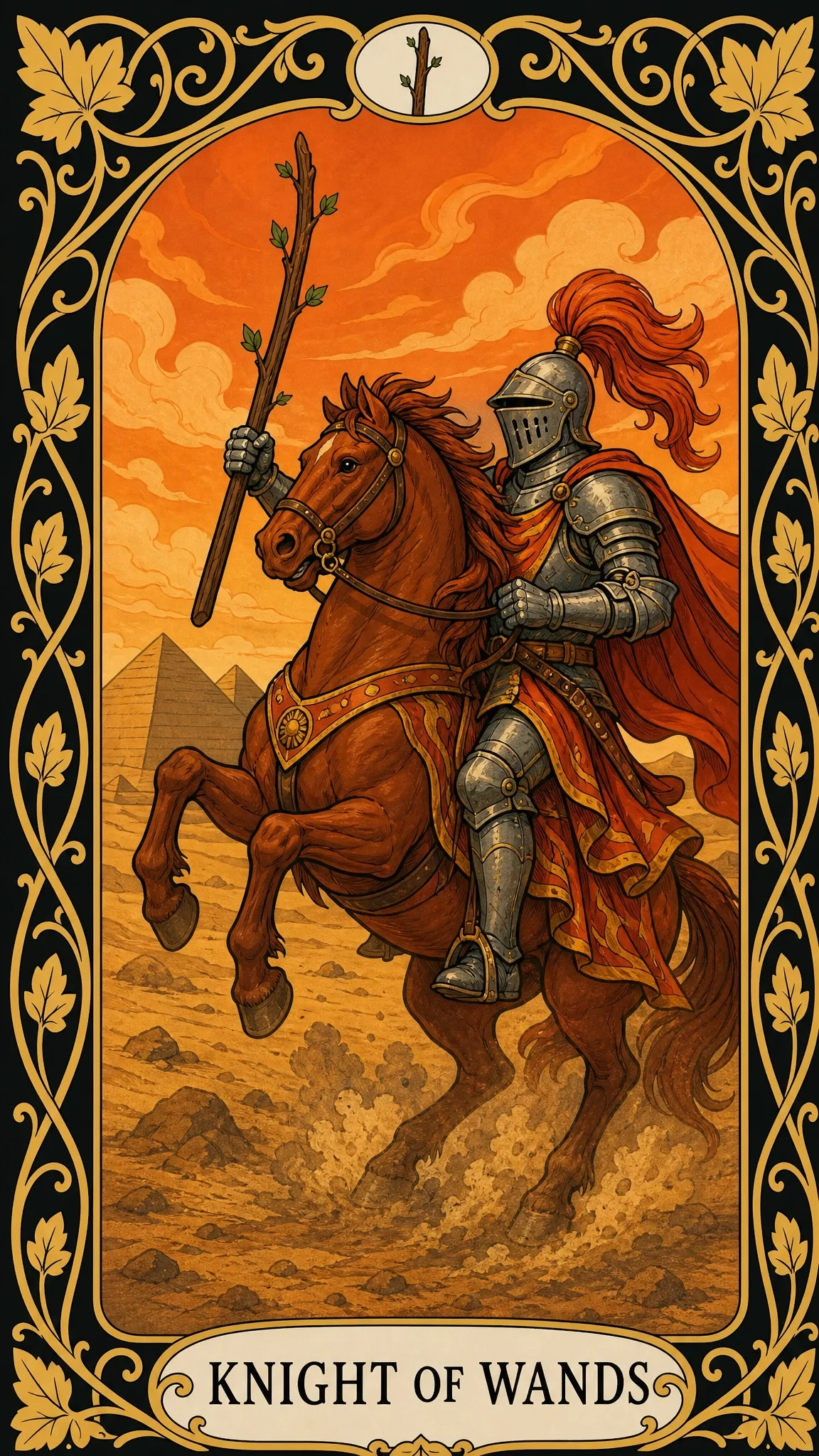
Sa ating baraha, ang Knight of Wands ay isang mandirigma na nakasuot ng buong pilak na baluti sa isang nagwawala na pulang kabayo, sa background ng mainit na orange na langit at disyerto na may mga silweta ng mga piramide sa malayo. Mula sa ilalim ng helmet na may puwang para sa mga mata, lumalabas ang isang matingkad na pulang plume, at sumusunod ang mahabang pulang kapa.
Ganito binabasa ang eksena:
- Nagwawala na kabayo — ang kabayo ay hindi tumatakbo, kundi tumatayo sa dalawang paa: purong bugso, na hindi pa nagiging pasulong na kilos. Ito ang eksaktong imahe ng Knight of Wands — ang lahat ng lakas ay natipon na, ngunit lalabas ito sa susunod na segundo, hindi ngayon.
- Wand na may berdeng dahon sa nakataas na kamay — ang parehong buhay na tumutubong tungkod na nasa ibang baraha ng suit na Wands: ang ideya ay hindi patay, ito ay nasa proseso ng paglago, kahit na dala mo ito habang nakasakay.
- Disyerto at mga piramide sa abot-tanaw — isang malayo at banyagang landas. Ang Knight of Wands sa apat na suit ay ang pinaka-siguradong aalis para sa isang paglalakbay, at ang tanawin ay direktang nagsasabi nito.
- Baluti sa halip na karaniwang magaan na tunika — ang ating deck ay nagbibigay sa Knight ng higit na proteksyon kaysa sa klasikong iconograpiya. Maaari itong basahin bilang isang diin: kahit ang pinaka-impulsibong tao sa deck na ito ay hindi lumalabas nang walang proteksyon — may baluti siya, ang tanong lang ay kung nagagamit niya ito sa ganitong bilis.
Sa ibaba ng baraha ay ang tatak na KNIGHT OF WANDS, sa itaas sa isang medalyon — ang parehong wand na may mga dahon: isang tanda na ang nasa harap natin ay ang Knight ng suit na Wands, hindi mapagkakamalan sa tatlo pang iba.
Knight of Wands bilang baraha ng araw
Ang Knight of Wands bilang baraha ng araw ay isang senyales na huwag ipagpaliban ang mga bagay na dapat nang gawin: tumawag, mag-alok, umalis nang maaga, sumagot agad, sa halip na "pag-isipan hanggang gabi". Ito ay isang araw kung saan ang pagiging desidido ay mas nakakatulong kaysa sa pagiging maingat.
Kapaki-pakinabang na mindset para sa araw na ito: isang matalim na kilos — oo, pero sampu — sobra na iyon. Mas mabuting pumili ng isang gawain kung saan mahalaga ang bilis, dalhin ito sa isang kapansin-pansing resulta, at huwag ubusin ang lahat ng apoy sa pagkakalat sa iba't ibang ideya. At huwag kalimutan: ang taong gumagalaw nang mas mabagal sa tabi mo ay hindi sinasadya — may iba lang siyang baraha ng araw.
Mga madalas itanong tungkol sa barahang Knight of Wands
Ito ba ay Major o Minor Arcana?
Minor Arcana, court card ng suit na Wands, elementong Apoy. May 56 na Minor Arcana sa Tarot deck — 14 na baraha sa bawat isa sa apat na suit, at ang Knight ay isa sa apat na court rank sa loob ng suit na Wands.
Ano ang pagkakaiba ng Knight of Wands sa Knight of Cups?
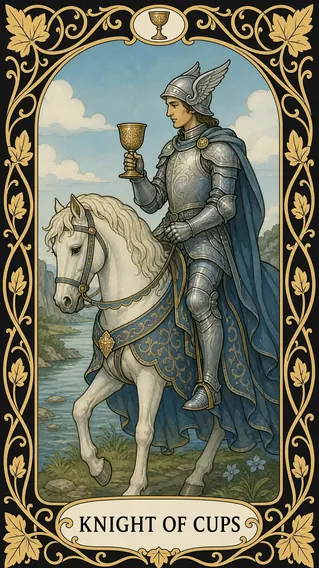
Parehong court cards sa rank na Knight, ngunit magkaiba ang elemento. Ang Knight of Wands (Apoy) — tungkol sa bugso, bilis, at pagkilos nang walang mahabang pag-iisip. Ang Knight of Cups (Tubig) — tungkol sa alok na galing sa damdamin, mas malambot at walang pagmamadali ng Wands. Kung ang lumabas sa reading ay ang Knight of Wands, dapat bigyang-diin ang bilis at inisyatiba, hindi ang emosyonal na lalim.
Ang Knight of Wands ba ay oo o hindi?
Malamang na oo, ngunit may kondisyon na kumilos nang mabilis habang may determinasyon. Ang baraha ay hindi nangangako ng madaling resulta — ito ay tungkol sa katotohanan na mas mabuting kumilos ngayon kaysa maghintay ng perpektong sandali.
Ano ang ibig sabihin ng baligtad na Knight of Wands?
Ang parehong bugso na walang labasan: may enerhiya, pero walang kilos, o kaya naman ay masyadong padalos-dalos ang desisyon at pinagdadaanan na ang mga bunga nito. Isa pang opsyon — pagkainis sa halip na pag-abante.
Ang Knight of Wands sa relasyon — tungkol ba ito sa bagong pag-ibig?
Kadalasan oo: inilalarawan ng baraha ang isang mabilis at matingkad na pagkahumaling na mas mabilis na umuunlad kaysa sa karaniwan. Ngunit hindi nito ginagarantiya ang katagalan — ang Knight of Wands ay tungkol sa intensity ng sandali, hindi tungkol sa katatagan sa loob ng maraming taon.