What the Knight of Cups means in Tarot
The Knight of Cups is a court card of the suit of cups, the element of water. Among the four knights of the deck, he is the most peaceful: on the card, the horse walks at a slow, steady pace, rather than galloping like the other suits. This is also the meaning — the Knight of Cups does not rush into attack, he offers.
An important nuance often lost in retellings: a court card describes a role in a specific episode, not a person's character for life. The Knight of Cups is a moment when someone (including the querent themselves) makes a beautiful, emotional gesture: confesses, invites someone to meet, calls for a joint project, or brings good news with the intention of making an impression. It is not a major theme of destiny, but a specific offer here and now.
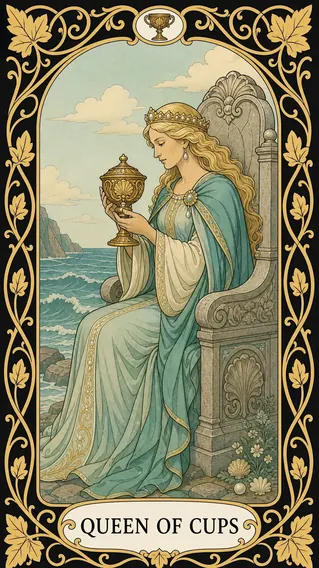
The upright position is read as a sincere impulse: the person acts out of feeling, not calculation, and wants the gesture to be noticed. The flip side of the same card is that the Knight of Cups is in love with the gesture itself as much as the result, and sometimes a beautiful offer turns out to be more important than its execution. How reliable this specific offer will be is suggested by neighboring cards — for example, the Queen of Cups nearby adds depth and constancy to the feeling, while Swords nearby hint that one should check the facts behind the beautiful words.
Reversed Knight of Cups: meaning
The reversed Knight of Cups is the same romantic impulse, but lacking a foundation. Usually, the spread refers to one of three options.
- Beautiful words without action. The offer was made, but nothing follows it: no call, no next step.
- Emotional swings. The mood jumps from delight to disappointment in a single day, and it is difficult to rely on this mood.
- Escaping into fantasy instead of action. The person dreams of a romantic outcome but avoids the real conversation or action that would bring it closer.
There is also a softer reading: sometimes the reversed position is not deception, but the ordinary insecurity of a romantic who is afraid of appearing intrusive and therefore retreats prematurely. The difference lies in whether there is any intention behind the beautiful facade to see things through to the end.
The Knight of Cups in a "yes or no" spread
In "yes/no" spreads, the Knight of Cups in the upright position is read as yes, but check for sincerity: the offer or chance will indeed appear, the question is whether real steps are ready to follow it. If the question is "will he or she take the first step," "will I receive an invitation," "will I be offered an interesting project" — the answer is likely yes.
If the question is about the reliability of the result ("can I count on this," "is it worth believing the promise") — the card answers with a cautious "too early," because the knight describes an intention, not a completed action.
The reversed position in this spread is "no, it remained just words": the gesture was there, but there will be no continuation until someone takes the next step themselves.
The Knight of Cups in relationships and feelings
In a relationship spread, the Knight of Cups is one of the most favorable cards for romance: a confession, an invitation to a date, a beautiful and sincere sign of attention. This is a card of courtship, not an established union — it is about the moment when a feeling is first voiced aloud or shown through an action.
In the position of feelings, the knight describes infatuation through idealization: the partner is seen as a little better, more romantic, and more interesting than in everyday life. This is not deception, but a natural stage — but it is useful to remember that later the relationship will have to withstand the test of everyday life, not just beautiful gestures.
If the relationship is already long-term, an upright Knight of Cups in a spread is a signal that one of the partners wants to bring back romance: to arrange something special, to surprise, to remind of feelings through an action, not just talk.
A reversed Knight of Cups in relationships means jealousy, inconstancy, or courtship that does not transition into a real relationship: there is talk of the future, but no specifics.
The Knight of Cups in work and money
In career spreads, the Knight of Cups is an offer made on inspiration: a creative project, an invitation to collaborate, an idea that is liked for its own sake, not just for its profit. The card well describes negotiations where the decision is made not by calculation, but by sympathy for the idea or the person proposing it.
In money, the upright position speaks more of a generous gesture or an attractive offer than a guaranteed income: it is important to check the favorable terms separately, because the Knight of Cups sells the idea beautifully, not necessarily profitably.
A reversed Knight of Cups in work is an offer that sounds promising but is not backed by specifics: deadlines, amounts, obligations. The advice is the same as in relationships: before agreeing, it is worth translating beautiful words into a concrete plan.
The Knight of Cups as a person: man and woman
When the Knight of Cups appears in the "what kind of person" position, he describes a romantic and a dreamer: someone who courts beautifully, knows how to talk about feelings, brings gifts, and makes gestures that are remembered later. Usually, this is a person with an artistic nature — interested in art, music, poetry, and loves beautiful details.
The Knight of Cups man is charming, sensitive, courts slowly, and knows how to surprise; the downsides are that he falls in love easily and cools down just as easily. The Knight of Cups woman is the one who is the first to offer a romantic step, is finely attuned to the moods of others, and expects the same in return.
The flip side for both is the same: such a person can confuse the act of courtship with true attachment. If the card is important as a forecast for reliability, it is worth looking at the neighboring cards — the Queen of Cups nearby adds constancy, while Swords say that one should check the facts behind the words.
Knight of Cups sa posisyon ng pag-iisip
Sa posisyon ng pag-iisip, ang Knight of Cups ay isang mapangarapin at medyo idealistikong estado ng isip: ang isang tao ay naglalaro ng mga romantikong senaryo sa kanyang ulo, nag-iisip ng magandang resulta ng isang pag-uusap o pagkikita, at nakatuon sa mga kilos sa halip na sa mga katotohanan.
Ito ay isang kaaya-ayang estado, ngunit madali itong humiwalay sa realidad: ang ninanais ay itinuturing na nangyari na. Kung may mga Swords sa tabi sa pagbasa, dapat mong suriin ang pantasya gamit ang mga katotohanan; kasama ang Pentacles, ang ideya ay mas malamang na magkaroon ng praktikal na pagpapatuloy sa halip na manatiling isang pangarap lamang.
Ano ang gagawin kung lumabas ang Knight of Cups
Ang payo ng Knight of Cups ay: gumawa ng magandang kilos, ngunit huwag huminto roon. Ang card ay mahusay sa sandali ng pagtatapat, paanyaya, o malikhaing mungkahi — at mahina kung hindi ito susundan ng isang konkretong hakbang.
Ano ang dapat gawin sa esensya:
- Gawing aksyon ang kilos. Kung may mungkahi, magtakda ng petsa at pag-usapan ang mga detalye, huwag hayaang nakabitin lang ang magagandang salita.
- Suriin ang katapatan sa pamamagitan ng sariling mga aksyon, hindi lang sa iba. Madaling madala sa sariling idealisasyon gaya ng sa pangako ng iba.
- Huwag ipagkamali ang pagiging mahusay magsalita sa pagiging maaasahan. Ang matatamis na salita at tunay na obligasyon ay magkaibang bagay, lalo na sa pera at trabaho.
- Bigyan ng oras ang damdamin. Inilalarawan ng Knight of Cups ang simula ng panliligaw, hindi ang isang matatag na pagsasama — huwag madaliin ang mga pangyayari.
Kung ang tanong ay tungkol sa isang seryosong desisyon — halimbawa, ang pagtitiwala sa isang tao sa usaping pera o pagbabago ng buhay dahil sa isang romantikong bugso — ang pagbasa ay hindi kapalit ng matino at seryosong pag-uusap sa taong pinagkakatiwalaan o sa isang eksperto.
Ano ang nakaguhit sa card
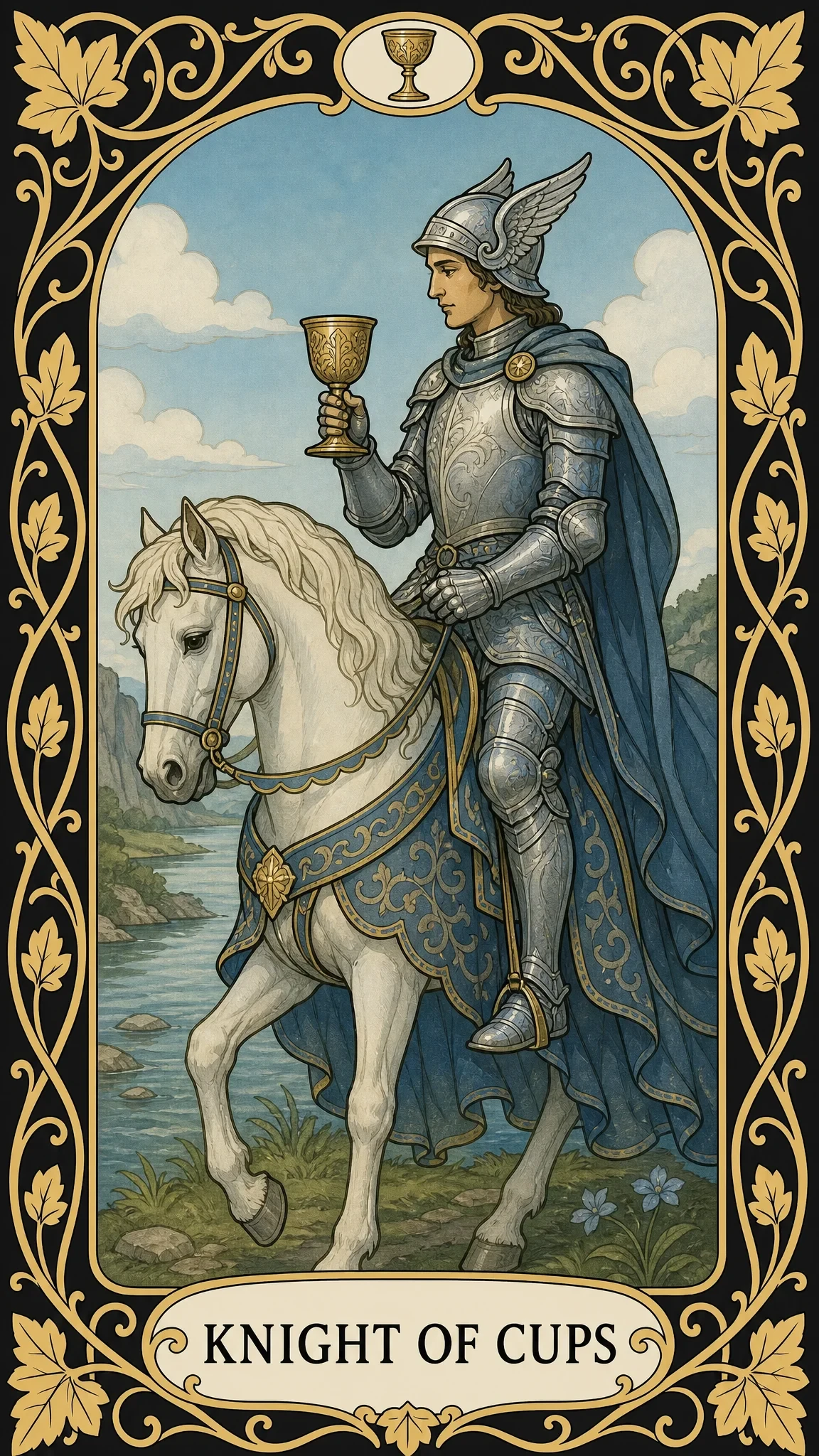
Sa ating card ay may isang batang kabalyero na nakasuot ng pilak na baluti at helmet na may pakpak sa gilid, na nakaharap sa profile. Sa kanyang nakataas na kamay, hawak niya ang isang gintong kopa na may kakaibang hugis, na tila iniaabot ito pasulong sa halip na dala-dala lang. Sa kanyang likod ay humahampas ang asul na kapa na may gintong disenyo, at ang kabayo na may burdadong asul na sapot ay humahakbang sa berdeng pampang sa isang mabagal at halos seremonyal na paraan — hindi tulad ng mga kabalyero ng ibang suit, walang karera o pag-atake rito.
Ganito binabasa ang eksena:
- Nakataas na kopa — isang kilos na nakatuon sa labas, sa ibang tao: hindi ito card ng nag-iisang damdamin, kundi card ng mungkahi, pagtatapat, at paanyaya.
- May pakpak na helmet — imahinasyon at kagaanan kung paano sinusundan ng kabalyero ang damdamin nang hindi tumitingin sa mga hadlang.
- Kalmadong hakbang ng kabayo — isang mahalagang detalye ng kabalyerong ito: hindi siya nagmamadali at hindi pinipilit ang pangyayari, ang damdamin ay dahan-dahang nagbubukas.
- Ilog sa tabi ng daan — ang elemento ng tubig ay pisikal na naroroon sa tanawin, na nagpapaalala na ang landas ng kabalyero ay dumadaloy kasabay ng emosyon, hindi laban dito.
Sa ibaba ng card ay may plake na may Ingles na pangalan na KNIGHT OF CUPS, sa itaas sa loob ng medalyon ay ang kopa mismo bilang simbolo ng suit: ang ating deck ay iginuhit sa tradisyon ng Rider-Waite, kung saan ang bawat suit ay may sariling simbolo sa gilid.
Knight of Cups bilang card ng araw
Ang Knight of Cups bilang card ng araw ay isang magandang pagkakataon para sa isang romantiko o malikhaing kilos: magtapat, mag-imbita, magmungkahi ng ideya, o gumawa ng isang bagay na maganda nang hindi nag-iisip ng agarang kapalit. Ang araw ay paborable sa damdamin, hindi sa mga transaksyon.
Kung ang card ay lumabas na baligtad — maging mas maingat sa mga pangako ng iba at sa sarili mo: madaling mangako ng higit sa kayang gawin. Ang kapaki-pakinabang na mindset para sa araw na ito ay ang maging tapat sa damdamin at intensyon, ngunit suriin ang mga ito sa pamamagitan ng susunod na aksyon, hindi lang sa mga salita.
Mga madalas itanong tungkol sa Knight of Cups card
Ito ba ay Major o Minor Arcana?
Minor Arcana, suit ng Cups, elementong Tubig. May kabuuang 56 na Minor Arcana sa Tarot deck — 14 na card bawat isa sa apat na suit, at ang Knight ang ikatlong court card sa suit ng Cups, sa pagitan ng Page at Queen.
Ano ang pagkakaiba ng Knight of Cups sa Knight of Swords?
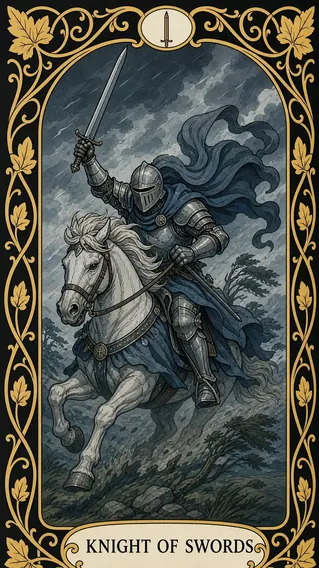
Ang parehong kabalyero ay mga court card ng aksyon, ngunit magkaiba ng elemento. Ang Cups ay elemento ng tubig, damdamin: ang Knight of Cups ay tungkol sa romantikong mungkahi, panliligaw, at paggalaw patungo sa layunin sa pamamagitan ng emosyon. Ang Swords ay elemento ng hangin, kaisipan at salita: ang Knight of Swords ay tungkol sa matalas na argumento, mabilis na desisyon, at pagpupursige sa debate, hindi sa damdamin. Kung ang interes sa pagbasa ay relasyon at pagtatapat — ito ay tungkol sa Cups; kung debate, negosasyon, o biglaang kilos — tungkol sa Swords.
Ang Knight of Cups ba ay oo o hindi?
Malamang na oo, ngunit may babala: ang card ay nangangako ng pagdating ng isang mungkahi o kilos, hindi garantiya na susundan ito ng pagpapatuloy. Kung ang tanong ay tungkol sa pagkakataon mismo — ang sagot ay positibo; kung tungkol sa pagiging maaasahan ng resulta, kailangang tingnan ang mga katabing card.
Ano ang ibig sabihin ng baligtad na Knight of Cups?
Ang parehong romantikong bugso, ngunit walang pundasyon: magagandang salita na walang gawa, emosyonal na pagbabago-bago, o pagtakas sa pantasya sa halip na totoong hakbang. Minsan ito ay kawalan lang ng tiwala ng isang romantiko na natatakot magmukhang mapilit — ang pagkakaiba ay kung mayroon bang kahit anong intensyon sa likod ng kilos.
Ang Knight of Cups sa relasyon — tungkol ba ito sa seryosong damdamin?
Hindi kinakailangang tungkol sa lalim, kundi mas tungkol sa yugto: ito ay card ng panliligaw at unang pagtatapat, hindi ng matatag na pagsasama. Para sa matagalang relasyon, madalas nitong ibig sabihin na may gustong ibalik ang romansa sa pamamagitan ng isang kilos, hindi na sinusubok ang damdamin sa unang pagkakataon.