Что означает Пятёрка жезлов в Таро
Пятёрка жезлов — карта шумного, но не смертельного столкновения. Пятеро человек скрещивают шесты, каждый тянет в свою сторону, ни у кого нет явного перевеса — и в этом суть карты: это не война на уничтожение, а стычка за место, за очерёдность, за то, чью версию услышат первой.
Важно сразу отделить эту карту от старших арканов. Башня или Дьявол описывают крупную тему на годы вперёд; Пятёрка жезлов — гораздо скромнее по масштабу. Это конкретный спор на созвоне, перепалка в чате, соревнование за внимание в компании, а не судьбоносный перелом. Прочитать её как «в жизни начнётся хаос» значит раздуть карту не по чину: младшие арканы про эпизод, а не про судьбу.
Стихия Огонь и масть Жезлов задают тон: энергии много, она рвётся наружу, но направлена криво — все толкаются, никто не договорился заранее о правилах. Отсюда классическое значение: соперничество, трения, мелкие конфликты, распылённые усилия. Часто карта выпадает там, где несколько людей одновременно правы по-своему и никто не готов уступить первым.
Перевёрнутая Пятёрка жезлов: значение
Перевёрнутая Пятёрка жезлов — та же толкотня, только придушенная. Три частых прочтения, между которыми выбирают по вопросу расклада:
- Спор закончился — но не тем, что кто-то переубедил кого-то, а тем, что все устали. Формальное перемирие без реального согласия.
- Конфликт ушёл внутрь. Снаружи тихо, а раздражение и соперничество никуда не делись — просто их перестали показывать.
- Стычка идёт нечестно. Один голос заглушает остальных, и видимость борьбы «на равных» из прямого положения пропадает — кто-то один продавливает своё.
Перевёрнутое положение — сигнал, что открытого столкновения, которое описывает прямая карта, не случилось или его сознательно избегают. Иногда это к лучшему, иногда — просто тот же разговор, отложенный на потом.
Пятёрка жезлов в раскладе «да или нет»
В раскладе «да или нет» Пятёрка жезлов обычно читается как да, но не без борьбы. Вопрос вроде «получится ли» отвечается утвердительно — только результат придётся отстаивать, а не получить сразу и без сопротивления.
Если вопрос про спокойствие — «обойдётся ли без спора», «согласятся ли без возражений» — карта скорее отвечает нет: трения будут, кто-то обязательно выскажется против.
Перевёрнутая версия смягчает ответ до «конфликт не назрел» или «стороны уже устали спорить»: практический смысл в том, что открытой борьбы, которую сулит прямое положение, в ближайшее время не предвидится.
Пятёрка жезлов в отношениях и чувствах
В отношениях прямая Пятёрка жезлов — это партнёры, которые постоянно немного соревнуются: кто больше вложился, кто прав в бытовом споре, чьё мнение весомее при принятии решений. Само по себе это не приговор паре — многие пары так живут годами, и трение даже держит интерес живым.
Часто карта появляется там, где на одного человека претендуют сразу несколько сторон: прямой соперник за внимание или просто конкурирующие обязательства — семья, работа, старые отношения, — которые тянут в разные стороны. Ровного, спокойного чувства эта карта не описывает ни в прямом, ни в перевёрнутом положении.
В позиции чувств это скорее азарт, чем нежность: желание доказать, быть услышанным, не уступить в споре, который на деле не стоит такого накала.
Перевёрнутая Пятёрка жезлов в отношениях — либо спор, который загнали внутрь и не проговорили, либо, наоборот, короткое перемирие после ссоры, которое не решило исходную причину.
Пятёрка жезлов в работе и деньгах
В рабочих раскладах это открытая конкуренция: несколько человек претендуют на один проект, бюджет делят с боем, совещание превращается в перекрикивание вместо обсуждения. Часто это команда, где роли не распределены чётко, и каждый тянет одеяло на себя не со зла, а потому что иначе никто не услышит его вклад.
В деньгах карта — про спор из-за суммы: кто сколько должен, кто за что платит, торг при разделе имущества или расходов. Прямого убытка карта не обещает — обещает борьбу за то, как распределится то, что есть.
Что Пятёрка жезлов советует по существу: прежде чем спорить дальше, договориться о правилах спора — кто говорит первым, что вообще делится и на сколько частей. Хаос на карте — это не отсутствие ресурса, а отсутствие регламента.
Пятёрка жезлов как человек: мужчина и женщина
Когда Пятёрка жезлов выпадает как описание человека, это тот, кто спорит по любому поводу — не обязательно из вредности, а потому что ему важно отстоять свою позицию вслух. Рядом с таким человеком редко бывает тихо: он проверяет чужие аргументы на прочность и ждёт того же в ответ.
Мужчина-Пятёрка жезлов — азартный спорщик, любит соревновательные ситуации, легко ввязывается в перепалку и так же легко выходит из неё без обиды. Женщина-Пятёрка жезлов — та, кто не спускает и не отмалчивается, даже если спор неудобный или невыгодный по статусу.
Это не описание конфликтного или злого человека — скорее того, кому важно быть услышанным в общем шуме, и он готов за это побороться.
Five of Wands in the position of thoughts
In the position of thoughts, the Five of Wands is the mind, where several inner voices argue simultaneously: one insists on its own version, another objects, a third doubts everything at once. It is difficult to concentrate precisely because thoughts compete with each other, rather than lining up in order.
This is often the state before an important conversation or decision: a person mentally rehearses arguments that have not yet happened, preparing arguments for all sides at once. Neighboring cards will help determine if this internal struggle is productive or just exhausting in vain.
What to do if the Five of Wands appears
The card's advice is simple, though not the most pleasant: don't disengage from the argument, but don't turn it into a war of annihilation. The Five of Wands is about energy scattered on trifles, and the first task is to gather it back.
What to do specifically:
- Identify what the argument is really about. Often, a more serious unresolved issue lies behind a squabble over a trifle.
- Agree on rules, not just content. Who speaks, in what order, by what deadline is the result needed.
- Don't confuse competition with personal offense. The excitement of an argument doesn't mean the opponent is an enemy.
- Leave room for a draw. Not every clash must have a clear winner.
If the card represents not a petty squabble but a prolonged, exhausting conflict, the spread describes the dynamics but doesn't resolve them; in such cases, direct conversation or a mediator helps, not another card in the deck.
What is depicted on the card
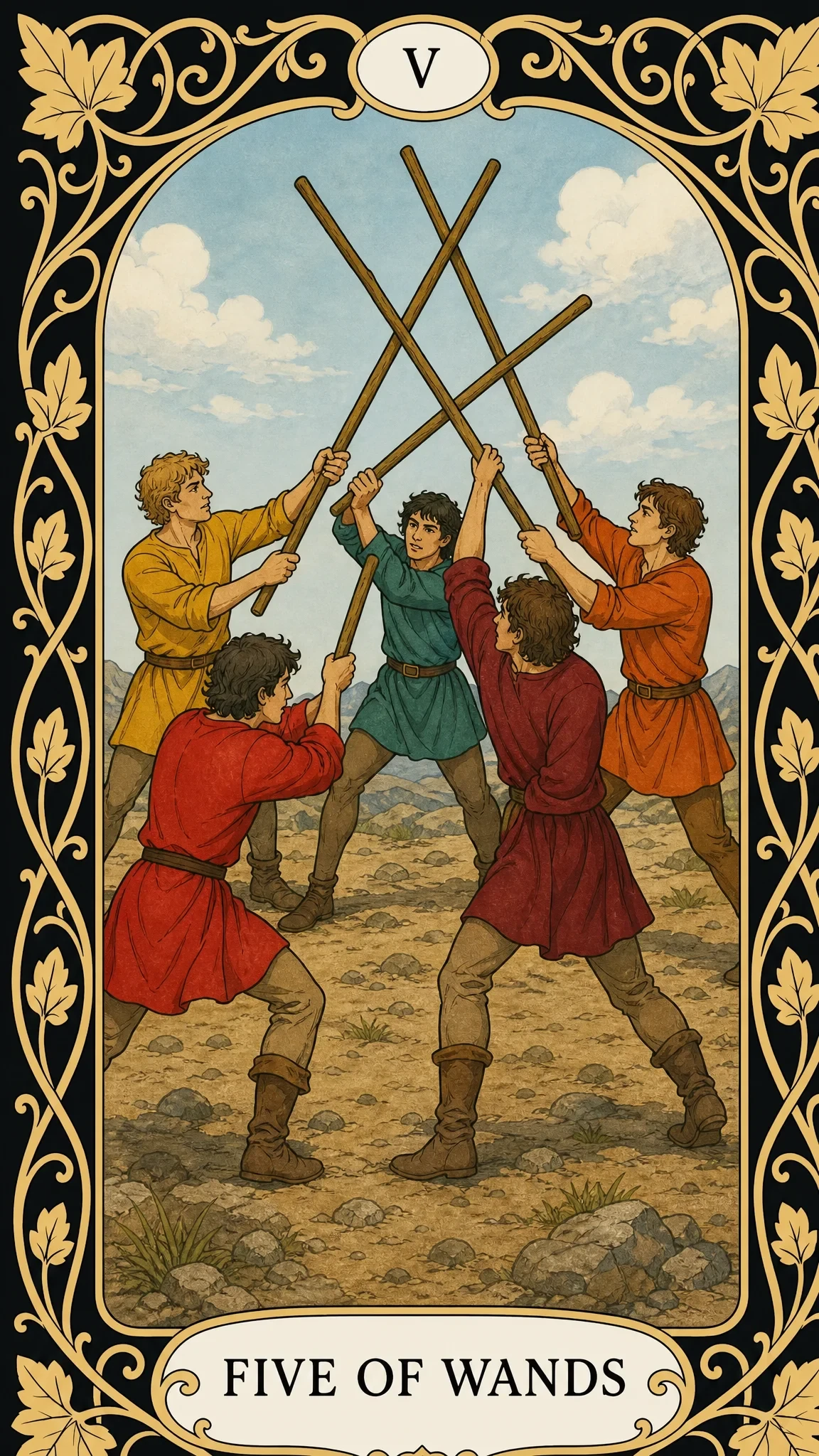
On our Five of Wands, there are five young men in a rocky wasteland, and each holds his own single wand: no one grips two at once, nor shares one wand with a neighbor. All five stand at full height in a loose circle, simultaneously raising their wands above their heads, so that the wands converge in the sky in a sweeping cross. Their poses indicate a brawl, not a one-on-one duel: someone pulls a wand, someone pushes it away, and the young man in the turquoise tunic in the center holds his with both hands, squeezed by others' wands from both sides.
The scene is interpreted as follows:
- Five tunics — five equal positions. Golden-yellow, red, turquoise-green, dark red, and orange. The colors are deliberately mismatched. This is a dispute among equals, not a hierarchy where one is clearly superior.
- Each has exactly one wand. No wand is shared, and none are left over: no extra wands on the ground or in free hands — the balance of power in the skirmish is fair, without bias.
- Wands crossed high above heads — no blow is fully delivered, no one is wounded or defeated: it looks more like an excited scuffle than a real fight.
- Rocky, dry ground and bare hills in the background — the setting is resource-poor, and the clash is partly about who gets the little that exists.
- Light sky with clouds — unlike cards of real misfortune, the background here is calm: the storm is only among people, not around them.
At the top of the card is the Roman numeral V, and at the bottom is the English name FIVE OF WANDS: our deck is drawn in the Rider-Waite tradition, where this card is the fifth in the suit of Wands.
Five of Wands as the card of the day
The Five of Wands as the card of the day signifies a day with increased background friction: someone will definitely argue on a call, in a chat, in line, or at home over a trifle. This in itself is not a bad sign — rather, it's a signal to prepare to defend your point of view more often than usual.
A useful mindset for such a day: do not perceive every objection as an attack, and do not get involved in others' arguments that do not directly concern you. The excitement of this day quickly burns out on its own if you don't add fuel to the fire.
Frequently asked questions about the Five of Wands card
Is it a Major or Minor Arcana?
The Five of Wands is a Minor Arcana, suit of Wands, element of Fire. There are 56 Minor Arcana in the Tarot deck – 14 in each of the four suits, and the Five of Wands is one of them.
How does the Five of Wands differ from the Five of Swords?
Both cards are about conflict, but in different ways. The Five of Swords is about a dispute with a clear loser and a lingering feeling after a victory at any cost. The Five of Wands is softer: it's a noisy competition without a single winner and without real enmity – the parties let off steam, rather than destroying each other.
Does the Five of Wands mean a fight?
Not literally. The card describes the energy of rivalry and friction – arguments, competition, a struggle for attention, not physical violence. The five figures on the card are waving wands, but none of them are injured: the meaning is in the scuffle itself, not its outcome.
What does the reversed Five of Wands mean?
Usually one of three options: the conflict is resolved out of exhaustion, not by agreement of the parties; the dispute has gone internal and is not verbalized; or, conversely, one person is pushing their agenda, and the appearance of a fair fight from the upright position is lost.
Is the Five of Wands a bad card?
No, rather neutral. It describes an energy-consuming but not destructive period: competition, arguments, scattered efforts. The card does not bring real misfortune or loss – what a person does with this friction is more important than the fact of its existence.