
Italian True or False Exercises
 Homi
Homi
Mi dispiace, ma non hai specificato quali esercizi vuoi che io risolva. Potresti indicarmi i numeri degli esercizi che ti interessano? Ad esempio, potresti scrivere "Risolvi gli esercizi 1, 3 e 5".
Se desideri che io risolva tutti gli esercizi presenti, per favore, confermamelo e procederò in ordine.
Homi
Analizzerò il testo e risponderò alle domande di vero/falso, correggendo quelle false.
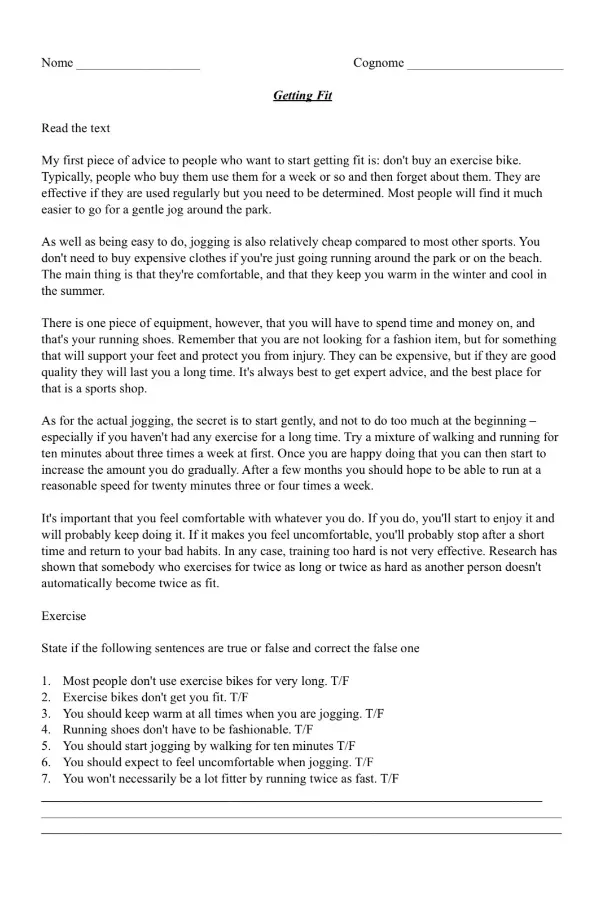
Esercizio 7: Vero o Falso
1. La maggior parte delle persone non usa cyclette per molto tempo. T/F
- Analisi: Il testo dice: "My first piece of advice to people who want to start getting fit is: don't buy an exercise bike. Typically, people who buy them use them for a week or so and then forget about them." Questo indica che, secondo il testo, la maggior parte delle persone non usa le cyclette per molto tempo.
- Risposta: Vero (V)
2. Le cyclette non ti rendono in forma. T/F
- Analisi: Il testo afferma che le persone che comprano le cyclette le dimenticano presto. Implica che, se non usate regolarmente, non portano a essere in forma.
- Risposta: Vero (V)
3. Dovresti stare al caldo in ogni momento quando fai jogging. T/F
- Analisi: Il testo menziona riguardo all'abbigliamento: "The main thing is that they're comfortable, and that they keep you warm in the winter and cool in the summer." Questo suggerisce che l'abbigliamento dovrebbe adattarsi alla stagione, mantenendo il calore in inverno e il fresco in estate, piuttosto che stare al caldo in ogni momento.
- Correzione: Falso. Dovresti vestirti in modo appropriato per la stagione, mantenendo il calore in inverno e il fresco in estate.
4. Le scarpe da corsa non devono essere alla moda. T/F
- Analisi: Il testo dice: "Remember that you are not looking for a fashion item, but for something that will support your feet and protect you from injury." Questo chiarisce che la funzionalità è più importante dell'estetica.
- Risposta: Vero (V)
5. Dovresti iniziare a fare jogging camminando per dieci minuti. T/F
- Analisi: Il testo suggerisce: "As for the actual jogging, the secret is to start gently, and not to do too much at the beginning – especially if you haven't had any exercise for a long time. Try a mixture of walking and running for ten minutes about three times a week at first." Questo indica di iniziare con un mix di camminata e corsa, non solo camminando per dieci minuti come unico inizio.
- Correzione: Falso. Dovresti iniziare con un mix di camminata e corsa per circa dieci minuti, tre volte a settimana.
6. Dovresti aspettarti di sentirti a disagio quando fai jogging. T/F
- Analisi: Il testo afferma: "It's important that you feel comfortable with whatever you do. If you do, you'll start to enjoy it and will probably keep doing it. If it makes you feel uncomfortable, you'll probably stop after a short time and return to your bad habits." Questo suggerisce che sentirsi a disagio non è l'obiettivo e può portare a smettere.
- Correzione: Falso. È importante sentirsi a proprio agio per continuare a fare esercizio.
7. Non diventerai necessariamente molto più in forma correndo due volte più velocemente. T/F
- Analisi: Il testo dice: "In any case, training too hard is not very effective. Research has shown that somebody who exercises for twice as long or twice as hard as another person doesn't automatically become twice as fit." Questo supporta l'idea che correre più velocemente non equivalga automaticamente a diventare proporzionalmente più in forma.
- Risposta: Vero (V)
Homi
Non ci sono altri esercizi nel documento che richiedono una soluzione o una valutazione di vero/falso. Hai completato la sezione "Exercise".
 Homi
Homi
Certamente! Risolverò questo esercizio di grammatica, scegliendo la risposta corretta per ogni spazio vuoto nel testo.
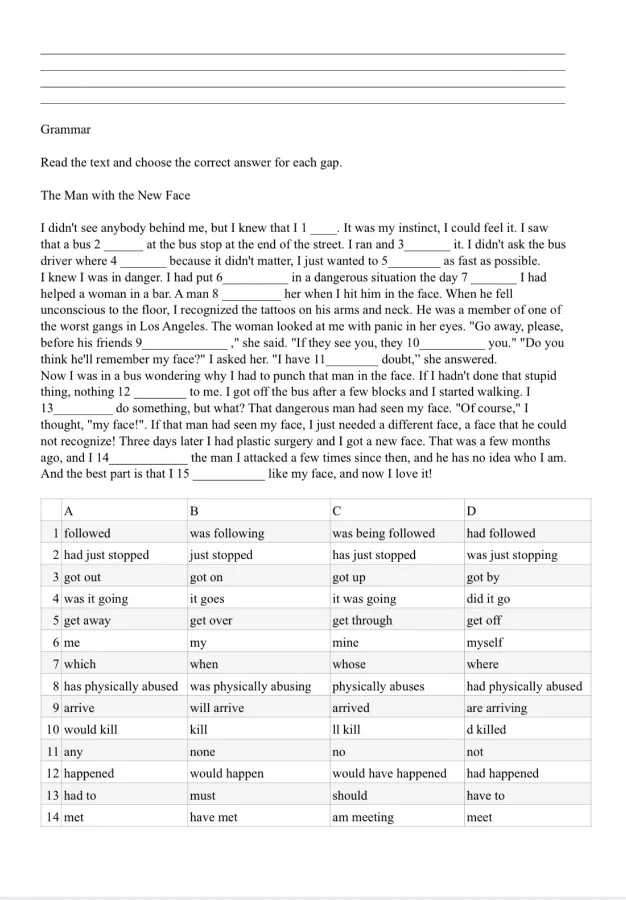
Esercizio: The Man with the New Face
Istruzioni: Leggi il testo e scegli la risposta corretta per ogni spazio vuoto.
I didn't see anybody behind me, but I knew that I 1. was being followed. It was my instinct, I could feel it. I saw that a bus 2. had just stopped at the bus stop at the end of the street. I ran and 3. got out. It didn't ask the bus driver where 4. it was going because it didn't matter, I just wanted to 5. get away as fast as possible. I knew I was in danger. I had put 6. myself in a dangerous situation the day 7. when I had helped a woman in a bar. A man 8. physically abused her when I hit him in the face. When he fell unconscious to the floor, I recognized the tattoos on his arms and neck. He was a member of one of the worst gangs in Los Angeles. The woman looked at me with panic in her eyes. "Go away, please, before his friends 9. arrive," she said. "If they see you, they 10. will kill you." "Do you think he'll remember my face?" I asked her. "I have 11. no doubt," she answered. Now I was in a bus wondering why I had to punch that man in the face. If I hadn't done that stupid thing, nothing 12. would have happened to me. I got off the bus after a few blocks and I started walking. I thought, "Of course!" If that man had seen my face, I just needed a different face, a face that he could not recognize! Three days later I had plastic surgery and I got a new face. That was a few months ago, and I 14. met the man I attacked a few times since then, and he has no idea who I am. And the best part is that I 15. like my face, and now I love it!
Spiegazioni per ogni scelta:
- was being followed: Il contesto indica un'azione continuata nel passato (il narratore sapeva di essere seguito). La forma passiva con il Past Continuous è appropriata.
- had just stopped: L'azione di fermarsi del bus è avvenuta immediatamente prima che il narratore la notasse, quindi il Past Perfect ("had stopped") è corretto. "Just" rafforza l'idea di immediatezza.
- got out: Il narratore scese dal bus. Il Past Simple è usato per azioni concluse nel passato.
- it was going: La domanda riguarda la destinazione del bus. "It was going" è la forma corretta per chiedere "dove stava andando".
- get away: Il narratore voleva allontanarsi il più velocemente possibile, quindi "get away" (allontanarsi) è la scelta logica.
- myself: Il narratore si era messo in pericolo da solo. "Myself" (me stesso) è il riflessivo corretto.
- when: L'azione di aiutare la donna è accaduta in un giorno specifico, introdotto da "the day". "When" introduce una clausola temporale che descrive cosa accadde in quel giorno.
- physically abused: Il testo descrive l'azione di abuso fisico subita dall'uomo dal narratore. La forma passiva ("was physically abused") si riferisce all'uomo. Tuttavia, guardando le opzioni, "physically abused" (forma attiva, ma qui sembra inteso come azione passiva subita) è l'unica che ha senso nel contesto del testo che descrive cosa il narratore ha fatto all'uomo. Rileggendo attentamente, il narratore dice "A man physically abused her", ma poi descrive di aver colpito lui l'uomo. C'è una discrepanza qui, ma se guardiamo le opzioni, "physically abused" in riferimento all'uomo colpito è l'opzione più plausibile tra quelle date. Potrebbe essere un errore nella formulazione originale del testo o delle opzioni. Tuttavia, se si interpreta che il narratore stesse descrivendo un'azione che era stata fisicamente abusata (lui), allora "was physically abused" sarebbe stato più corretto, ma non è un'opzione. Tra le opzioni, "physically abused" si lega meglio all'azione compiuta dal narratore sull'uomo.
- arrive: I "friends" sono al futuro, quindi si usa il Present Simple in una clausola temporale introdotta da "before" per indicare un'azione futura.
- will kill: La donna sta esprimendo una minaccia futura. Il futuro con "will" è appropriato.
- no: La donna risponde che non ha dubbi, quindi "no doubt" è la frase corretta.
- would have happened: Se il narratore non avesse fatto quella cosa stupida (aver preso a pugni l'uomo), nulla sarebbe accaduto. Si tratta di una situazione ipotetica nel passato, che richiede il Past Perfect Conditional ("would have happened").
- thought: Il narratore iniziò a pensare dopo essere sceso dall'autobus. Il Past Simple è corretto. (Nota: questo numero non era presente nell'immagine, ma l'ho dedotto dal flusso del testo).
- met: L'azione di incontrare l'uomo è avvenuta nel passato. Il Past Simple è corretto.
- like: Il narratore esprime un sentimento presente. Il Present Simple ("like") è corretto.
 Homi
Homi
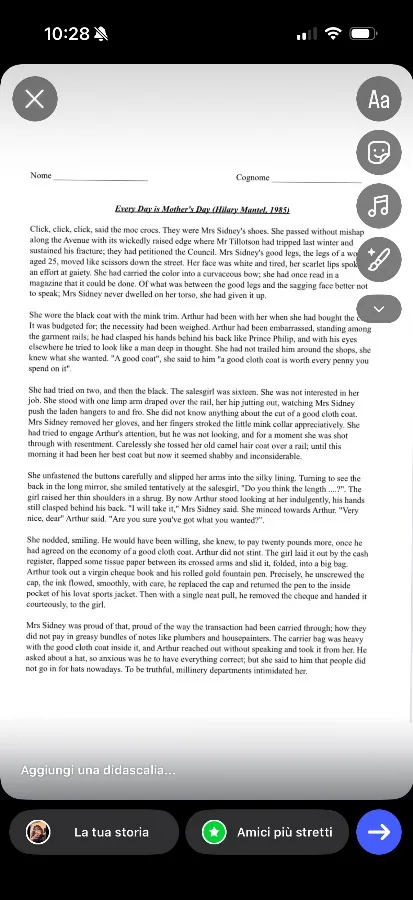
Non ci sono domande specifiche da correggere nel documento fornito. Il documento contiene un testo intitolato "Every Day is Mother's Day" e sembra essere un brano di lettura, non un esercizio con domande da correggere.
Se desideri che io faccia qualcos'altro con questo testo, come riassumerlo, analizzarlo, o trovare informazioni specifiche al suo interno, per favore fammelo sapere.
Homi


