What the Eihwaz Rune Means
Eihwaz is named after the yew tree — an evergreen tree that lives for several hundred years in northern forests and is almost resistant to decay. Bows were made from its wood: yew accumulates tension and releases it in one precise movement, so the rune is associated not with fuss, but with strength that stands and waits for its time.
The second layer of meaning is that yew is poisonous in almost all parts, except for the berry pulp, and the northern peoples knew this: a tree that heals and kills at the same time became a symbol of the boundary between life and death. Eihwaz is the rune of the axis around which events are held, and resilience that is not spectacular, but reliable. In a spread, it rarely answers the question "when", but more often the question "will I endure?"
 Free to try · Rune tattoo
A tattoo sketch with the Eihwaz rune
AI will draw a tattoo sketch with this rune in the style you pick
Free to try · Rune tattoo
A tattoo sketch with the Eihwaz rune
AI will draw a tattoo sketch with this rune in the style you pick
How Eihwaz Looks and How to Draw it Correctly
The inscription of Eihwaz is ᛇ: a vertical trunk with two short notches extending from the middle in opposite directions — one upwards, the other downwards, at the same angle. Because of this, the sign is mirror-symmetrical about the center: rotate it half a turn, and you get the same rune.
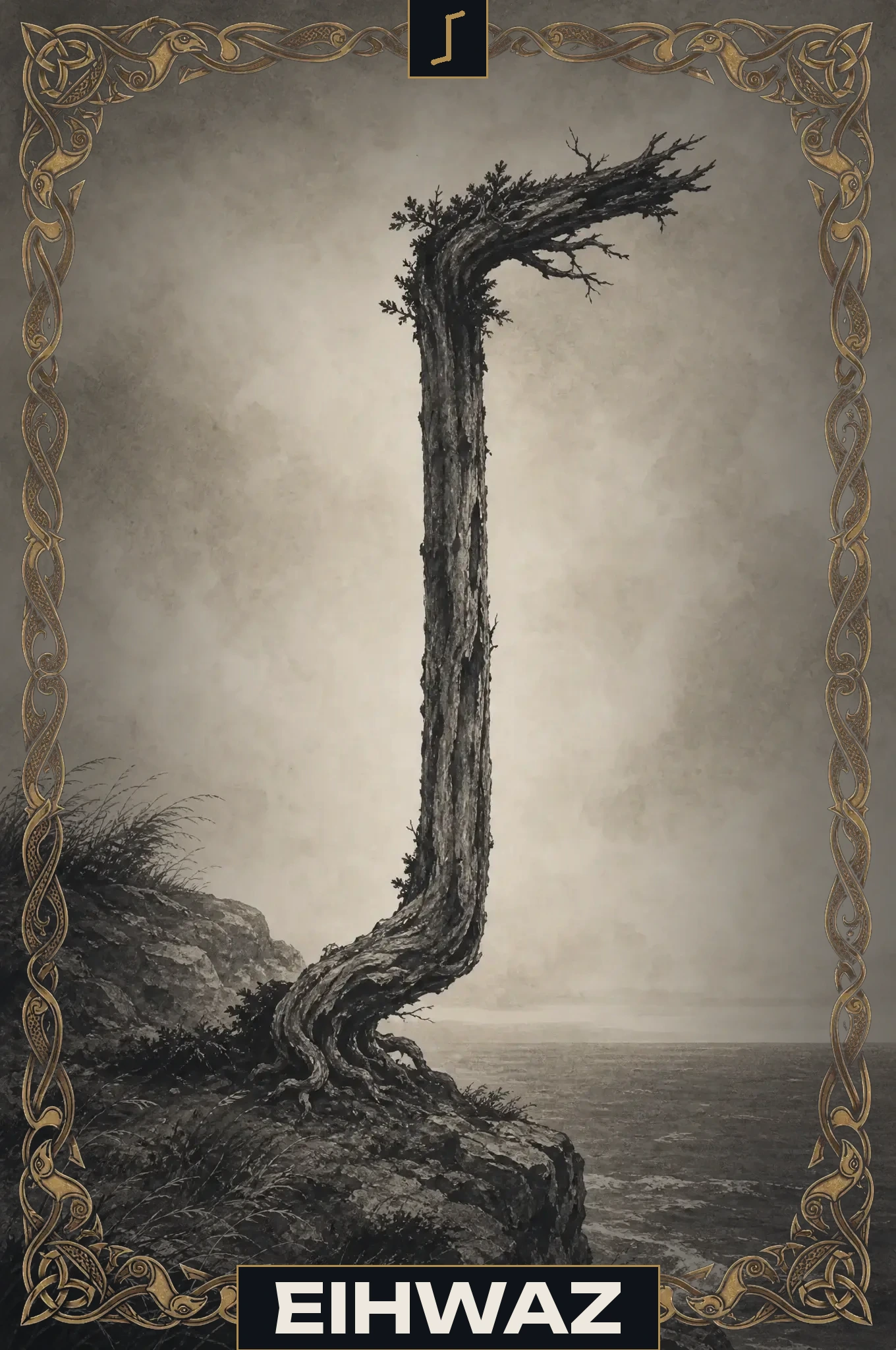
Eihwaz is written in one movement from top to bottom: first the trunk, then the upper notch, then the lower one, exactly opposite the first. On our card, the rune is formed from an old yew tree on a rocky cliff — the twisted root at the bottom and the broken top at the top give the same two hooks as in the sign itself, and the straight trunk holds the tree over the abyss.
You can only make a mistake in the proportions of the notches: if one is shorter than the other, the sign stops being read as Eihwaz. But you can't flip it in principle — ᛇ is the same from both sides.
Eihwaz in the Upright Position
Eihwaz in a spread is a call to hold on, not to rush. It appears when the result cannot be accelerated: the matter requires time, health requires treatment, relationships require patience. The rune does not promise ease, but it promises that resilience will pay off — like a yew tree that grows slower than a pine, but outlives it for centuries.
Often Eihwaz indicates a hidden reserve: strengths that are not wasted, but accumulate and one day work all at once, like a bowstring released from a bow. It is the rune of people who look calm on the outside but keep the situation under control from the inside.
In a spread about change, Eihwaz speaks of a transition that occurs without breaking: the old does not collapse, but grows into the new. Next to runes of ending, it reads softer than others — as a transition, not an abrupt end.
Why Eihwaz Has No Reversed Position
Unlike fifteen other runes in the row, Eihwaz has no reversed depiction: the sign ᛇ is symmetrical about the center, and no matter how you turn it, you get the same sign. The yew is consistent in this regard — the tree does not change its nature because it is looked at from a different side, and the rune has literally inherited this property.
Interpreters traditionally do not invent a reversed Eihwaz, but they do not leave it unambiguous either. Instead of changing position, they read the shadow meaning: the same resilience, taken to the extreme — stubbornness instead of patience, getting stuck instead of waiting, refusal to change where change is needed. The poison of the yew reminds: the same tree heals in small doses and kills in excess.
A second way to read a difficult Eihwaz is by its neighbors in the spread. Next to runes of loss and breakdown (Hagalaz, Nautiz), resilience turns into exhausting resistance; next to runes of growth — into patient, justified waiting.
Eihwaz in Relationships and Feelings
In a relationship spread, Eihwaz speaks of a connection that is tested by time, not by a flash. It's not about love at first sight — it's about two people staying together through a difficult period and becoming stronger, not weaker, because of it.
For a person asking about a partner's feelings, Eihwaz is a sign of restraint, not indifference: the feeling is there, but it is not displayed, it is held, just as the trunk holds the crown. Such a person finds it difficult to talk about their experiences aloud, but they stay close precisely when it would be easier to leave.
A difficult, shadowy Eihwaz in this area is about relationships that are held together by inertia: not because they are alive, but because breaking up is harder than staying. Here, it is worth honestly asking yourself, is this resilience or stubbornness.
Eihwaz in Work and Money
In work matters, Eihwaz rarely promises a quick result — it speaks of a project that is done slowly and is bound to succeed through perseverance, not luck. It is the rune of those who invest in a business that will unfold in months or years: training, reputation building, a long contract.
For money, Eihwaz is a sign of reserve, not income: it fits well with questions about savings, insurance, a safety net. The rune suggests not spending everything at once, but keeping some in reserve — after all, yew is a tree of reserve strength.
A difficult reading in business is getting stuck: a project that moves neither forward nor backward because people are afraid to change it. Then Eihwaz advises not to abandon what has been started, but to honestly assess whether it is still worth the invested time.
Eihwaz — Yes or No
Eihwaz is not a quick answer. It answers "yes", but with the condition "not now" or "later": if the question is about a result that requires time, the rune supports it, but asks not to rush things.
As an independent piece of advice, Eihwaz is closer to "stay the course" than to a direct "yes" or "no". In a decision spread, it more often advises not to change the plan, but to bring what has been started to an end — even if it will be difficult along the way.
If Eihwaz falls next to difficult runes, the answer shifts towards a cautious "no, not in this form": it is worth reconsidering the approach, but not the course itself.
If Eihwaz Appears in a Spread
In the past position, Eihwaz says that the current situation grew out of a long, not easy period — and it was this period that provided the stability that exists now. In the present, it indicates that the right moment is not to act rashly, but to strengthen what already stands. In the future, Eihwaz promises not a quick outcome, but a result that needs to be lived to, maintaining the course.
Eihwaz sets the tone for the entire spread: the theme will require patience from beginning to end. Eihwaz read last signifies a supportive outcome — what the whole journey was for: stability, not triumph.
Since the rune has no reversed depiction, its meaning in a spread is determined by its neighbors: with light runes, it signifies well-deserved rest; with difficult runes, it signifies a trial that has not yet ended.
Combinations of Eihwaz with Other Runes
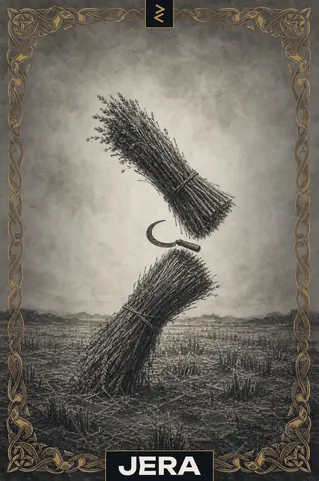
Eihwaz and Jera — patience, which is rewarded with time: enduring labor bears fruit precisely when it should, not sooner.
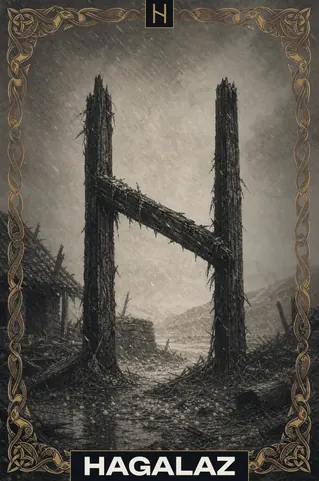
Eihwaz and Hagalaz — a test of strength: a breakdown from the outside checks how firmly the trunk holds.
Eihwaz and Dagaz — a long wait is replaced by a breakthrough to the new: a transition that finally concludes.
Eihwaz and Isa — stagnation doubles: a period when it's better not to force anything and just wait it out.
Eihwaz and Uruz — resilience, reinforced by strength: endurance that will not break under load.
Eihwaz and Nauthiz — patience through need: a difficult but necessary period that cannot be skipped.
Eihwaz and Algiz — defense through endurance: protection through steadfastness, not through attack.
Eihwaz as a symbol: a talisman, tattoo, and amulet
Eihwaz was traditionally applied to objects that needed long service: weapon handles, door frames, the bow — the wood from which the rune got its name. The meaning was practical: let the thing last as long as the yew tree.
As a personal symbol, Eihwaz is more often chosen not for quick luck, but for inner support — a tattoo or amulet for a person going through a long, difficult period who wants a reminder that resilience leaves a mark. The symmetry of the symbol is convenient here: it cannot be applied "the wrong way around"; Eihwaz is always read the same.
Like other runes, Eihwaz should be perceived as part of the cultural tradition of the Northern peoples, not as a tool that changes the course of events. Wearing the symbol is more of a reminder to yourself to stay the course than a way to influence the outcome.
 Free to try · Try it
A funny caricature from a photo
AI will draw a friendly caricature — for a gift or an avatar
Free to try · Try it
A funny caricature from a photo
AI will draw a friendly caricature — for a gift or an avatar
Frequently asked questions about the Eihwaz rune
What does the Eihwaz rune mean in simple terms?
Resilience and patience: the ability to stay the course when the result cannot be accelerated. The rune's name means "yew" — a tree that lives for centuries precisely because it does not hurry.
Is Eihwaz a money rune or about relationships?
Neither directly: it is a rune of reserve and support that manifests in any area. In finances, it's about savings and a safety net; in relationships, it's about a bond tested by time.
Why doesn't Eihwaz have an inverted position?
The inscription ᛇ is symmetrical about its center: no matter how you turn the rune, you get the same symbol. An inverted version physically does not exist for it.
How to read Eihwaz if the spread looks difficult?
Through its neighbors and through the shadow of its meaning: the same resilience, taken to the extreme, is read as stubbornness or getting stuck. Look at which runes lie nearby — they set the direction.
Is Eihwaz good in a relationship spread?
Yes, if the question is about the strength of the bond: the rune says that two people become stronger through difficulties. But it's about restraint, not about outward displays of affection.
How to distinguish Eihwaz from other runes when writing?
By two short notches extending from the middle of the stem in strictly opposite directions and at the same angle. If the notches are of different lengths or point in the same direction, it is already a different symbol.