Present Simple is the simple present tense in English. It is used when talking about habits, facts, and schedules: I get up at seven, Cows eat grass. The main rule fits in one line: for he, she, it, the verb gets an -s ending, and in negation and questions, the helper do / does appears. On this page, you will find a conjugation table, -s / -es rules, time markers, exceptions, a breakdown of common mistakes, and a 10-variant practice drill.
Check yourself: 10 variants of 12 sentences each, breakdown after each answer.
Open the trainerPresent Simple: when to use
Present Simple describes what happens in general, regularly, or always, not right now. It is the most common tense in English: it is used to talk about oneself, daily routines, habits, and how the world works.
Remember the main question: what usually happens? If the answer is "it happens regularly" or "that's how it is," you need Present Simple. Four typical cases are below.
Present Simple: conjugation table — affirmative, negative, question
The whole tense relies on one rule: for subjects he, she, it, the verb changes; for everyone else, it does not.
- Affirmative. Take the verb in its base form (V). For he, she, it, add the ending -s or -es.
- Negative. Before the verb, put the auxiliary don't (do not) or doesn't (does not, only for he, she, it). The verb itself stays in the base form.
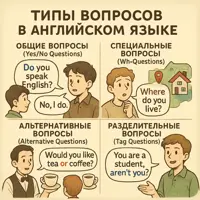
- Question. Move Do or Does to the beginning, followed by the subject and the verb in the base form.
- Short answer. Repeat only the helper: Yes, I do. No, she doesn't. The main verb is not needed in the short answer.
| I, you, we, they | he, she, it |
|---|---|
| +Affirmative | |
| VI work.They work. | V + s / esShe works.He watches. |
| −Negative | |
| don't + VI don't work. | doesn't + VShe doesn't work. |
| ?Question | |
| Do + … + V?Do you work? | Does + … + V?Does she work? |
| !Short answer | |
| Yes, I do.No, I don't. | Yes, she does.No, she doesn't. |
-s / -es endings in Present Simple: spelling rules
The ending for he, she, it is written differently depending on what the verb ends with. There are only four rules, and they are the same as for the plural of nouns: box — boxes, city — cities.
The ending is also pronounced in three ways: [s] after voiceless sounds (works), [z] after voiced sounds and vowels (reads, lives), and [ɪz] after sibilants (washes, passes).
Negation and question: don't / doesn't and Do / Does
The main secret of negation and questions: the -s ending is used in a sentence only once. As soon as the auxiliary verb does appears, it takes the ending, and the main verb remains in the base form. Hence the most common mistake — doesn't lives, Does he lives? — the ending is added twice.
Question words (where, what, when, why, how often) are placed before do / does: Where do they live? When does the film start? The order remains the same: question word → do / does → subject → verb.
An exception is a question to the subject with the word who or what: Who knows the way? Here, the helper is not needed, and the verb gets -s, just like after he.
Present Simple time markers
Markers are hint words that immediately show that an action is repeated. If you see always, usually, or every day, you almost certainly need Present Simple.
Watch the position of frequency adverbs: She often visits her granny (before the main verb), but She is often late (after is).
Who is he, she, it: how not to make a mistake with the subject
The -s ending is needed not only after the words he, she, it themselves, but also after any subject that can be replaced by them. Therefore, before choosing the form, ask yourself: what pronoun can replace the subject?
If the subject is long (the girl with red hair), find the main word in it — girl, which is she. Words that come after the main word only clarify it and do not affect the verb form.
- one name or one object: Kevin, the teacher, my phone
- substance or concept: milk, music, money
- words ending in -body and -one: somebody, someone
- several people or objects: my brothers, the trees
- two people joined by and: Kevin and Lena
- special plural without -s: people, men, mice
Exceptions: have → has, do → does, go → goes
Almost all verbs get -s according to the four rules above. Three of the most common ones should be memorized separately:
- have → has. This is the only verb that changes completely for he, she, it: I have a bike — My sister has long hair. In negation and questions, it's have again: She doesn't have a bike. Does he have a dog?
- do → does [dʌz] and go → goes [gəʊz] — are written according to the "-o → -es" rule, but are not pronounced as one might think from the letters.
And another group: modal verbs can, must, should never get endings: He can swim, not He cans swim.
The verb to be in Present Simple
The verb to be (to be, to be located, to be something) lives by its own rules. It has three forms — am, is, are — and it does not need do / does: negation is formed with the particle not, and questions are formed by inversion.
She is ready. — She isn't ready. — Is she ready?
Do not mix to be with other verbs: I am go or She is likes — this is a mistake. Either I go or I am at school.
| Affirmative | Negative | Question |
|---|---|---|
| I am | I am not | Am I…? |
| he, she, it is | he isn't | Is he…? |
| you, we, they are | they aren't | Are they…? |
Examples with analysis
Example 1. From affirmative to negative and question
Task: make a negative and a question from the sentence Kevin's sister studies Chinese.
Step 1. The subject Kevin's sister = she, so the helper is does.
Step 2. Does takes the ending, the verb returns to the base form: studies → study (i becomes y again).
Answer: Kevin's sister doesn't study Chinese. Does Kevin's sister study Chinese?
Example 2. Ending after -ch
Task: Mrs Lee ___ (teach) history at the local school.
Step 1. Mrs Lee = she → need a form with an ending.
Step 2. The verb ends in -ch → write -es.
Answer: Mrs Lee teaches history at the local school. — Mrs Lee teaches history at the local school.
Example 3. Question with a question word
Task: ask a where? question for the sentence My cousins live in Kazan.
Step 1. My cousins = they → helper do.
Step 2. Order: Where → do → subject → verb.
Answer: Where do your cousins live?
Example 4. Subject trap
Task: The people next door ___ (have) a big dog.
Step 1. The main word is people. There is no -s at the end, but it is still plural ("people") = they.
Step 2. With they, the verb have does not change.
Answer: The people next door have a big dog. — The neighbors have a big dog.
Common mistakes in Present Simple
-
Forgetting the ending for he, she, it: ❌ My dad work in a bank.
The subject my dad = he, so ✅ My dad works in a bank.
-
Adding the ending twice — both to does and to the verb: ❌ She doesn't speaks German. ❌ Does he lives here?
The -s ending in a sentence is used once, does takes it: ✅ She doesn't speak German. Does he live here?
-
Confusing do and does: ❌ Do Lena like dogs? ❌ He don't know.
With he, she, it — only does: ✅ Does Lena like dogs? He doesn't know.
-
Writing the ending without rules: ❌ studys, watchs, gos.
Consonant + y → -ies, after ch, sh, s, x, o → -es: ✅ studies, watches, goes.
-
Adding am / is / are to a regular verb: ❌ I am go to school. ❌ She is likes music.
To be and another verb do not appear in the same Present Simple affirmative sentence: ✅ I go to school. She likes music.
-
Adding -s after can or must: ❌ He cans swim.
Modal verbs do not change, and the verb after them does not either: ✅ He can swim.

Questions and answers
What is Present Simple in simple terms?
It is the simple present tense in English. It describes what happens regularly or is always true: habits, facts, schedules, feelings, and states. For example: I get up at seven — I get up at seven (every day).
When is -s added to a verb, and when is -es added?
The ending is needed only with he, she, it in an affirmative sentence. Usually, -s is added (works), after s, ss, sh, ch, x, z, and o — -es (washes, goes), after a consonant + y — y changes to i and -es is added (studies).
How is negation formed in Present Simple?
Before the verb, put don't (do not) or doesn't (does not — only for he, she, it), and the verb itself remains in the base form: I don't work, she doesn't work.
How to ask a question in Present Simple?
Put Do or Does before the subject, and leave the verb in the base form: Do you work? Does she work? A question word is placed at the very beginning: Where does she work?
What are the time markers for Present Simple?
Frequency adverbs always, usually, often, sometimes, rarely, never and expressions every day, every week, on Mondays, at the weekend, once a week, in the morning.
How does Present Simple differ from Present Continuous?
Present Simple is about what happens regularly (He plays chess on Sundays), while Present Continuous is about what is happening right now (He is playing chess now). Markers for Present Continuous are now, at the moment, look!
Is do / does needed with the verb to be?
No. To be has its own forms am, is, are: negation — with not (She isn't at home), question — by inversion (Is she at home?).
In what grade is Present Simple taught?
Introduction begins in elementary school, most often in 2nd–3rd grade, with simple affirmatives like I like… Negations and questions with do / does are practiced in 3rd–5th grades, and in 5th–7th grades, Present Simple is compared with Present Continuous.