English Grammar: The Complete Guide
Introduction
English grammar forms the foundation of effective communication in English. Whether you're a beginner or looking to refine your skills, understanding grammar principles will help you express yourself clearly and confidently.
Parts of Speech
Nouns
Nouns name people, places, things, or ideas.
- Common nouns: general names (book, city, teacher)
- Proper nouns: specific names (London, Shakespeare, Monday)
- Countable nouns: can be counted (one book, two books)
- Uncountable nouns: cannot be counted (water, information)
Pronouns
Pronouns replace nouns to avoid repetition.
- Personal: I, you, he, she, it, we, they
- Possessive: my, your, his, her, its, our, their
- Reflexive: myself, yourself, himself, herself, itself, ourselves, yourselves, themselves
- Relative: who, whom, whose, which, that
Verbs
Verbs express actions, states, or occurrences.
- Action verbs: run, jump, speak
- Linking verbs: be, seem, become
- Auxiliary verbs: be, do, have
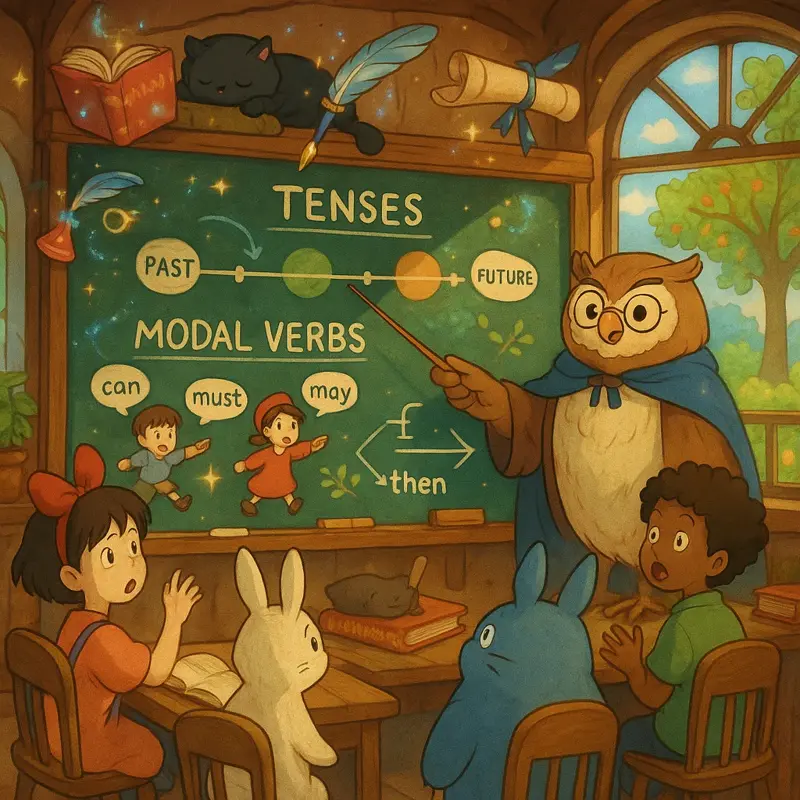
- Modal verbs: can, could, may, might, shall, should, will, would, must
Adjectives
Adjectives describe or modify nouns.
- Descriptive: beautiful, tall, interesting
- Quantitative: many, few, several
- Demonstrative: this, that, these, those
Adverbs
Adverbs modify verbs, adjectives, or other adverbs.
- Manner: quickly, carefully, well
- Time: now, yesterday, soon
- Place: here, there, everywhere
- Frequency: always, often, never
Tenses
Present Tenses
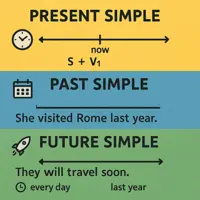
- Present Simple: I work (habits, facts)
- Formula: Subject + V1 (+ s/es for 3rd person singular)
-
Example: She works in London.
-
Present Continuous: I am working (actions happening now)
- Formula: Subject + am/is/are + V-ing
-
Example: They are studying for their exam.
-
Present Perfect: I have worked (past actions with present relevance)
- Formula: Subject + have/has + V3 (past participle)
-
Example: I have visited Paris twice.
-
Present Perfect Continuous: I have been working (ongoing actions that started in the past)
- Formula: Subject + have/has been + V-ing
- Example: She has been working here for five years.
Past Tenses
- Past Simple: I worked (completed actions in the past)
- Formula: Subject + V2 (past tense)
-
Example: We visited Rome last summer.
-
Past Continuous: I was working (actions in progress at a specific time in the past)
- Formula: Subject + was/were + V-ing
-
Example: I was sleeping when you called.
-
Past Perfect: I had worked (actions completed before another past action)
- Formula: Subject + had + V3 (past participle)
-
Example: She had already left when I arrived.
-
Past Perfect Continuous: I had been working (ongoing actions before another past action)
- Formula: Subject + had been + V-ing
- Example: They had been living there for ten years before they moved.
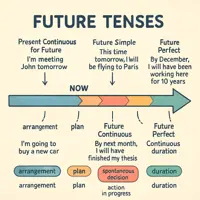
Future Tenses
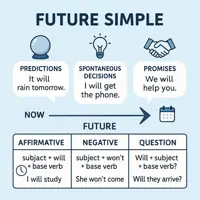
- Future Simple: I will work (predictions, spontaneous decisions)
- Formula: Subject + will + V1
-
Example: I will help you tomorrow.
-
Future Continuous: I will be working (actions in progress at a specific time in the future)
- Formula: Subject + will be + V-ing
-
Example: This time next week, I will be flying to New York.
-
Future Perfect: I will have worked (actions that will be completed before a specific time in the future)
- Formula: Subject + will have + V3
-
Example: By next month, I will have finished my project.
-
Future Perfect Continuous: I will have been working (ongoing actions before a specific time in the future)
- Formula: Subject + will have been + V-ing
- Example: By December, I will have been working here for five years.
Sentence Structure
Basic Sentence Patterns
- Subject + Verb: Birds fly.
- Subject + Verb + Object: She reads books.
- Subject + Verb + Indirect Object + Direct Object: He gave me a gift.
- Subject + Verb + Complement: She is a doctor.
Types of Sentences
- Simple: contains one independent clause
-
Example: The dog barked.
-
Compound: contains two or more independent clauses
-
Example: The dog barked, and the cat ran away.
-
Complex: contains one independent clause and one or more dependent clauses
-
Example: When the dog barked, the cat ran away.
-
Compound-Complex: contains two or more independent clauses and one or more dependent clauses
- Example: When the dog barked, the cat ran away, and the bird flew off.
Common Grammar Challenges
Articles (a, an, the)
- A/An: used with singular countable nouns (a book, an apple)
- The: used with specific nouns (the book we discussed)
- No article: often used with plural or uncountable nouns in general statements (Books are important.)
Prepositions
- Time: at 3 o'clock, in May, on Monday
- Place: at home, in London, on the table
- Movement: to the store, through the door, across the street
Conditionals
- Zero Conditional: If + present simple, present simple (general truths)
-
Example: If you heat water to 100°C, it boils.
-
First Conditional: If + present simple, will + infinitive (possible future situations)
-
Example: If it rains, I will stay home.
-
Second Conditional: If + past simple, would + infinitive (hypothetical present/future situations)
-
Example: If I had more time, I would learn French.
-
Third Conditional: If + past perfect, would have + past participle (hypothetical past situations)
- Example: If I had studied harder, I would have passed the exam.
Reported Speech
- Direct speech: "I am happy," she said.
- Reported speech: She said (that) she was happy.
Active and Passive Voice
- Active: The cat chased the mouse.
- Passive: The mouse was chased by the cat.
- Formula: Subject + be + past participle (+ by + agent)
Common Mistakes to Avoid
-
Subject-Verb Agreement: Ensure the verb agrees with the subject in number.
- Incorrect: The group of students are here.
- Correct: The group of students is here. -
Misplaced Modifiers: Place modifiers close to what they modify.
- Unclear: Walking down the street, the trees were beautiful.
- Clear: Walking down the street, I saw beautiful trees. -
Confusing Similar Words:
- Their/There/They're
- Your/You're
- Its/It's
- Affect/Effect -
Double Negatives: Avoid using two negative words in the same clause.
- Incorrect: I don't have no money.
- Correct: I don't have any money. -
Incorrect Verb Forms:
- Irregular verbs (go → went → gone)
- Confusing -ed and -ing adjectives (interested vs. interesting)
Practice Tips
- Read extensively in English to internalize grammar patterns.
- Write regularly and get feedback on your writing.
- Speak aloud to practice using grammar in real-time.
- Use grammar checkers but don't rely on them completely.
- Learn from mistakes by keeping a log of your common errors.
Remember, mastering English grammar is a journey. Be patient with yourself and celebrate your progress along the way!