Present Continuous is the present progressive tense in English: it describes an action happening right now (I am reading) or occurring over a current period. It is formed using the formula am / is / are + verb with -ing. This page contains the rule with tables, -ing spelling, negatives and questions, time markers, stative verbs, the difference between Present Simple and Present Continuous, and a 10-level trainer to master the topic.
Test yourself: 10 sets of 12 sentences, analysis after each answer.
Open the trainerWhat is Present Continuous
Present Continuous (also called Present Progressive) is the present progressive tense in English. It shows an action in progress: it has already started, has not yet finished, and is happening right now or during the current period.
In many languages, there is no separate "progressive" tense: both "I read every evening" and "I am reading right now" sound similar. In English, these are two different tenses — Present Simple and Present Continuous. Therefore, the main question to ask yourself is: is it a habit or a process happening now?
- Look! It is raining.
- I am talking on the phone right now.
- She is studying for her exams this week. (temporarily)
Present Continuous: formation — am, is, are + -ing
Present Continuous is built from two parts: the auxiliary verb to be in the present tense (am, is, or are) and the main verb with the -ing ending. Which form of be to choose depends on the subject. In speech and informal writing, forms are almost always contracted: I'm, she's, we're, they're.
A verb with -ing without am / is / are is not a predicate. She playing tennis — error: is is missing.
| Who | Example |
|---|---|
I am · I'm | I am reading a book.I am reading a book. |
he / she / it is · she's | She is playing tennis.She is playing tennis. |
you / we / they are · they're | They are watching TV.They are watching TV. |
Rules for adding -ing
In most cases, -ing is simply added to the verb. But there are three cases where the spelling of the base changes — these are the ones most often missed on tests.
Negatives and questions in Present Continuous
All the "grammatical work" in this tense lies with am / is / are, and the main verb with -ing does not change. In negatives, not is placed after the auxiliary verb; in questions, the auxiliary verb moves to the front, before the subject. The words do and does are not needed here — they belong to Present Simple.
I 'm not working today.
What are you doing?
When to use Present Continuous
- Action at the moment of speech — what is happening right now, while we are speaking.
Listen! Somebody is playing the piano. - Temporary situation — the action lasts for a period (today, this week, this month), but not permanently.
My dad is working from home this month. - Changes and trends — things that are gradually changing.
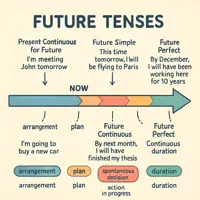
The weather is changing. The days are becoming shorter. - Plans for the near future that have already been agreed upon: tickets bought, meeting scheduled.
I am meeting John tomorrow. We are flying to Paris next week. - Annoying habits with words like always, constantly — the speaker is unhappy.
He is always complaining!
Present Continuous markers: now, at the moment, Look!
Marker words suggest which tense is needed. Exclamations like Look!, Listen!, Be quiet! are also markers: we are asking someone to look or listen to what is happening right now.
Stative verbs: which verbs are not used in Present Continuous
Some verbs denote not an action, but a state — a feeling, opinion, knowledge, or possession. A state has no process, so such verbs (stative verbs) are usually not put in Continuous, even if it is about "now".
Some of these verbs have a second meaning — an action, and then Continuous is possible:
- I think this film is boring. (opinion). / She is thinking about her answer. (process).
- He has a big family. (possession). / He is having lunch. (action).
- I see a bird on the roof. (perception). / I am seeing the doctor tomorrow. (arrangement).
| Group | Verbs |
|---|---|
| Feelings and desires | like, love, hate, want, need, prefer |
| Thoughts and knowledge | know, understand, believe, remember, forget, mean |
| Perception | see, hear, smell, taste |
| Possession | have (to possess), own, belong |
| Other states | be, seem, cost, contain |
Present Simple or Present Continuous: what is the difference
Present Simple tells about what happens in general: habits, schedules, facts. Present Continuous — about what is happening now or temporarily. Compare: I walk to school every day (habit) and Today I am walking to school with my friend (today's case).
To choose the tense, ask three questions in order:
- Is it a stative verb (know, like, want, have = possess)? → Present Simple.
- Is there a habit marker (every day, usually, often, on Mondays) or is it a fact? → Present Simple.
- Is the action happening now, temporarily, or is it an arrangement (now, Look!, this week, tomorrow)? → Present Continuous.
| Present Simple | Present Continuous |
|---|---|
| What it expresses | |
| Habits, repetitions, schedules, facts | Action at the moment of speech, temporary situation, changes, plans |
| How it is formed | |
| V / V‑s do / does | am / is / are + V‑ing |
| Markers | |
| every day, usually, often, always, never, on Mondays | now, at the moment, Look!, Listen!, today, this week |
| Example | |
| He drinks coffee every morning. | Today he is drinking tea. |
| Negative and question | |
| He doesn't drink milk. Does he drink milk? | He isn't drinking milk. Is he drinking milk? |
Examples with analysis: filling in the blanks
Example 1. Marker Listen!
Task: Listen! The neighbours ___ (argue) again.
Step 1. "Listen!" — we are asked to listen to what is heard right now. So, Present Continuous.
Step 2. The subject the neighbours is plural (they) → are.
Step 3. Argue ends in a silent -e: it is dropped → arguing.
Answer: Listen! The neighbours are arguing again.
Example 2. Habit and -es ending
Task: Tim ___ (study) French twice a week.
Step 1. Twice a week — regular action, habit → Present Simple.
Step 2. The subject Tim is "he", so the -s ending is needed.
Step 3. Study ends in a consonant + y: y changes to i, add -es.
Answer: Tim studies French twice a week.
Example 3. Stative verb in negative
Task: I ___ (not / know) where my bag is.
Step 1. It seems that it is about "now", and one wants to write am not knowing.
Step 2. But know is a stative verb (knowledge), it is not used in Continuous.
Step 3. Present Simple negative with I: do not → don't + verb without endings.
Answer: I don't know where my bag is.
Example 4. Question in Present Continuous
Task: ___ (they / dance) now?
Step 1. Now — action at the moment of speech → Present Continuous.
Step 2. In a question, the auxiliary verb stands before the subject; with they — are.
Step 3. Dance → silent -e is dropped → dancing.
Answer: Are they dancing now? — Yes, they are. / No, they aren't.
Common mistakes in Present Continuous
-
Skipping the auxiliary verb: *She reading a book.*
Without am / is / are there is no predicate: She is reading a book.
-
Using the wrong form of be: *They is singing.*
I — am, he / she / it — is, you / we / they — are: They are singing.
-
Mistakes in -ing spelling: *runing*, *writeing*, *lieing*.
Double the consonant after a short vowel (running), remove the silent -e (writing), change -ie to -y (lying).
-
Putting stative verbs in Continuous: *I am wanting a new bike.*
Want, know, like, need, and other stative verbs remain in Present Simple: I want a new bike.
-
Talking about a habit in Continuous: *I am going to school every day.*
Every day is a Present Simple marker: I go to school every day.
-
Building questions and negatives with do / does: *Do you reading? She doesn't playing.*
In Continuous, only am / is / are work: Are you reading? She isn't playing.
Questions and answers about Present Continuous
What is Present Continuous in simple words?
It is the present progressive tense: it is used to talk about an action that is happening right now or during the current period and has not yet finished. For example: I am reading — I am reading (now, in progress).
How is Present Continuous formed?
By the formula: subject + am / is / are + verb with -ing ending. Am — with I, is — with he, she, it, are — with you, we, they. In negatives, add not after am / is / are; in questions, put am / is / are before the subject.
What are the marker words for Present Continuous?
Now, right now, at the moment, at present, today, this week, these days, as well as exclamations Look! and Listen!. For future plans — tonight, tomorrow, next week.
What is the difference between Present Simple and Present Continuous?
Present Simple — about habits, schedules, and facts (every day, usually, often). Present Continuous — about what is happening now or temporarily (now, at the moment, this week). She plays the piano — she knows how and plays regularly; She is playing the piano — she is playing right now.
Which verbs are not used in Present Continuous?
Stative verbs: feelings (like, love, hate, want, need), thoughts (know, understand, believe, remember), perception (see, hear), possession (have meaning "to possess", own, belong), as well as seem, cost. Correct is I know, not I am knowing.
Can Present Continuous be used for the future?
Yes, if it is about an arrangement for the near future: We are moving to a new flat next month. Usually, there is a time reference nearby — tonight, tomorrow, next week. Without it, the phrase will be understood as "now".
In what grade is Present Continuous taught?
Usually for the first time — in 3rd–4th grade, and the comparison of Present Simple and Present Continuous is reviewed in detail in 5th–7th grades. The rule on this page is suitable for any year of study.