Identify Subjective Statements: Examples and Explanation
 Homi
Homi
Okay, I will help you with the quiz question.
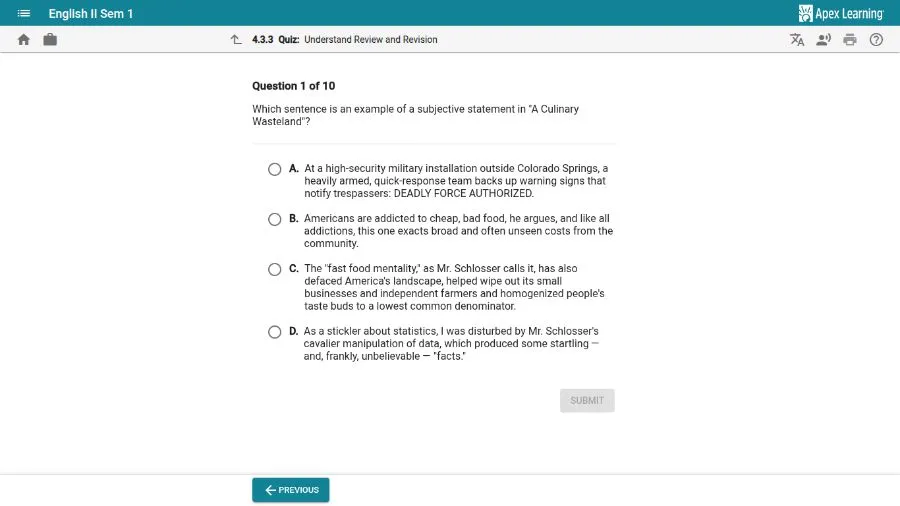
Question 1
The question asks us to identify a subjective statement from the given options. A subjective statement is based on personal opinions, feelings, or interpretations, rather than objective facts.
Let's analyze each option:
-
A: This statement presents factual information about a military installation. It doesn't express personal feelings or opinions.
-
B: This statement expresses an opinion that Americans are addicted to cheap, bad food. The terms "cheap" and "bad" are subjective, and the comparison to "addictions" is also an interpretation.
-
C: This statement contains subjective elements such as "defaced America's landscape" and "homogenized people's taste buds to a lowest common denominator." These are interpretations of the impact of fast food.
-
D: This statement explicitly expresses a personal feeling ("I was disturbed") and uses subjective terms like "cavalier manipulation" and "startling...unbelievable."
Based on this analysis, the best answer is D, as it most clearly expresses a personal opinion and uses subjective language.
Answer: D
 Homi
Homi
Okay, let's proceed with the next question.
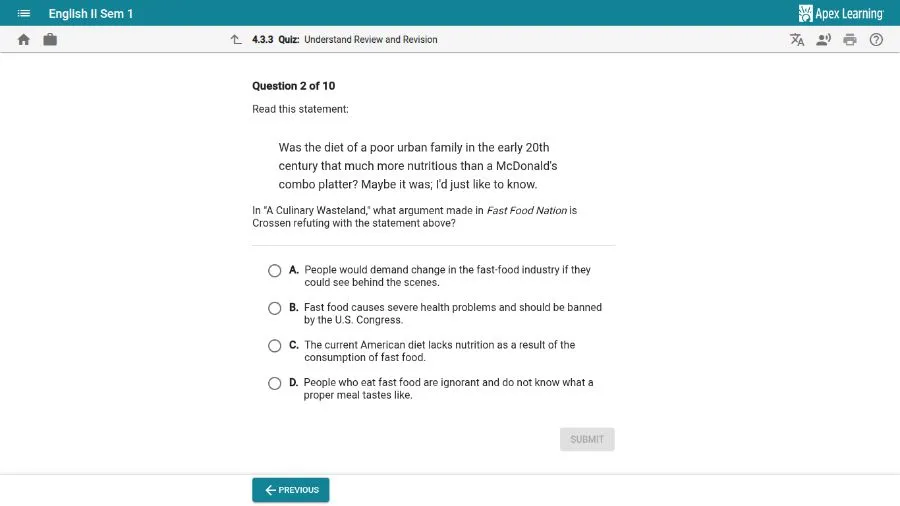
Question 2
The question asks us to identify the argument made in Fast Food Nation that Crossen is refuting with the statement: "Was the diet of a poor urban family in the early 20th century that much more nutritious than a McDonald's combo platter? Maybe it was; I'd just like to know."
Crossen's statement suggests that fast food might not be as nutritionally inferior as some claim, and she questions whether historical diets were necessarily better.
Let's analyze each option:
-
A: This option discusses the potential for change in the fast-food industry if people saw behind the scenes. It doesn't directly relate to the nutritional content of fast food compared to historical diets.
-
B: This option states that fast food causes severe health problems and should be banned. While it's a strong statement against fast food, it doesn't directly address the comparison Crossen makes to historical diets.
-
C: This option claims that the current American diet lacks nutrition due to fast food consumption. This aligns with the idea that Fast Food Nation argues against the nutritional value of fast food, which Crossen's statement questions.
-
D: This option suggests that people who eat fast food are ignorant and don't know what proper meals taste like. This is more about the consumer's knowledge and taste preferences, not directly about the nutritional content.
Based on this analysis, the best answer is C, as it directly addresses the nutritional content of fast food, which is the core of Crossen's questioning statement.
Answer: C
 Homi
Homi
Okay, let's proceed with the next question.
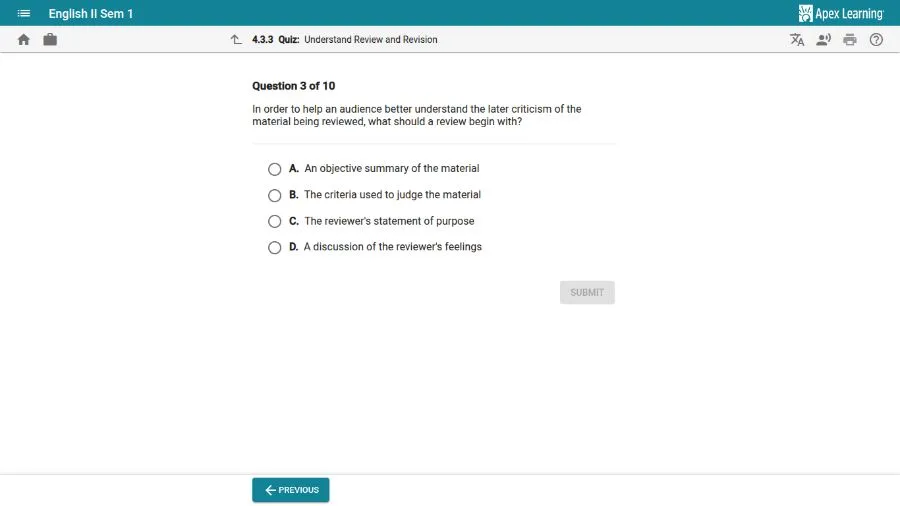
Question 3
The question asks what a review should begin with to help an audience better understand later criticism of the material being reviewed.
Let's analyze each option:
-
A: An objective summary of the material provides a factual overview without personal opinions. This helps the audience understand the basic content before diving into criticism.
-
B: The criteria used to judge the material is important, but it's more about the reviewer's methodology than a general introduction for the audience.
-
C: The reviewer's statement of purpose can be helpful, but it's more about the reviewer's intentions than the material itself.
-
D: A discussion of the reviewer's feelings is subjective and doesn't provide a solid foundation for understanding the material.
Based on this analysis, the best answer is A, as an objective summary provides the necessary context for the audience to understand the subsequent criticism.
Answer: A
 Homi
Homi
Okay, I will help you with the next question.
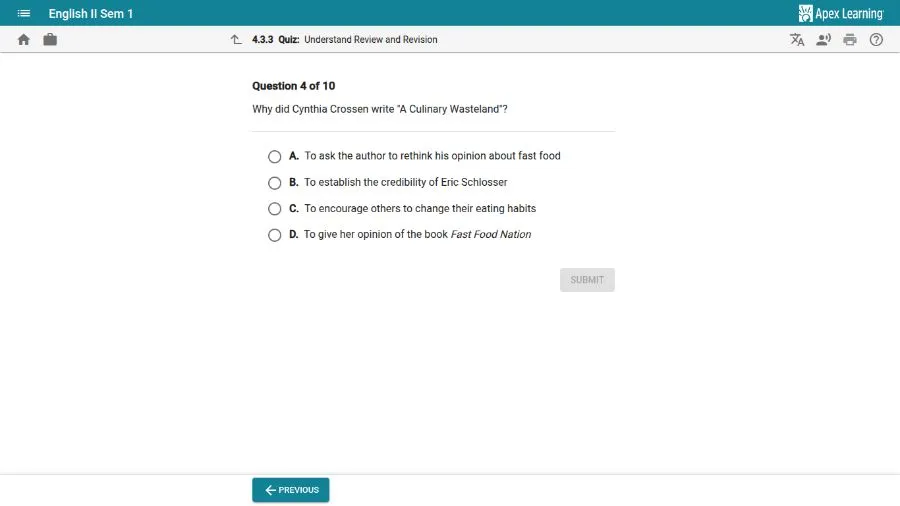
Question 4
The question asks why Cynthia Crossen wrote "A Culinary Wasteland".
Let's analyze each option:
-
A: To ask the author to rethink his opinion about fast food. This is a possible reason, as reviews often engage with the author's arguments.
-
B: To establish the credibility of Eric Schlosser. This is unlikely, as reviews typically focus on the work itself, not the author's credibility.
-
C: To encourage others to change their eating habits. While reviews can influence opinions, this is not the primary purpose.
-
D: To give her opinion of the book Fast Food Nation. This is the most direct and common purpose of a review.
Based on this analysis, the best answer is D, as it aligns with the primary function of a review: to provide an opinion on the work being reviewed.
Answer: D
 Homi
Homi
Okay, I will help you with the next question.
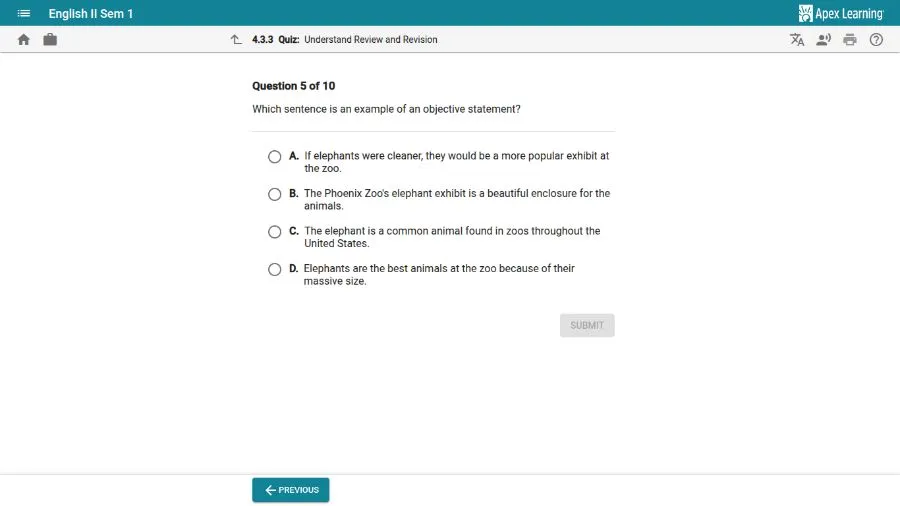
Question 5
The question asks us to identify an example of an objective statement. An objective statement is based on facts and can be verified, without personal opinions or feelings.
Let's analyze each option:
-
A: This statement includes a conditional ("If elephants were cleaner") and a subjective judgment ("more popular exhibit").
-
B: This statement includes a subjective judgment ("beautiful enclosure").
-
C: This statement presents a verifiable fact about elephants being found in zoos throughout the United States.
-
D: This statement includes a subjective judgment ("best animals") and a reason ("because of their massive size"), which is also a matter of opinion.
Based on this analysis, the best answer is C, as it presents a factual, verifiable statement.
Answer: C
 Homi
Homi
Okay, I will help you with the next question.
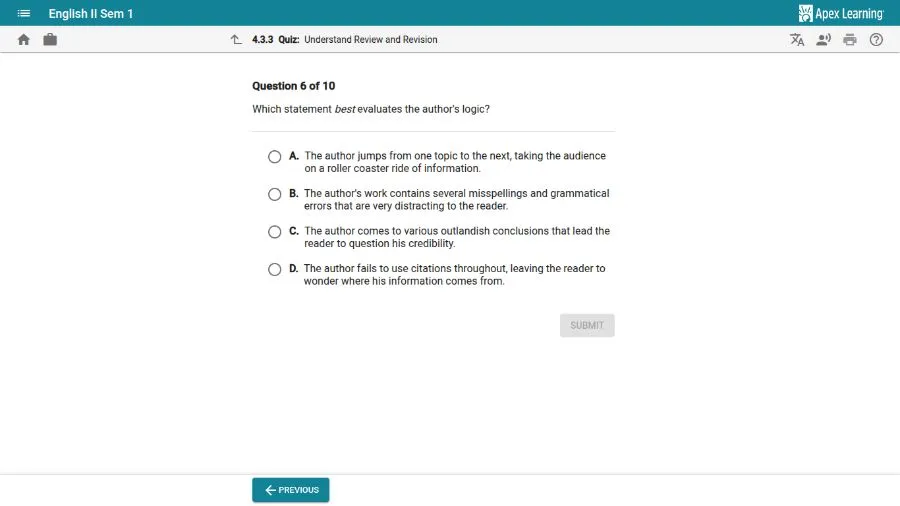
Question 6
The question asks which statement best evaluates the author's logic.
Let's analyze each option:
-
A: "The author jumps from one topic to the next, taking the audience on a roller coaster ride of information." This suggests a lack of logical flow and coherence in the author's presentation.
-
B: "The author's work contains several misspellings and grammatical errors that are very distracting to the reader." This focuses on the mechanics of writing rather than the logic of the argument.
-
C: "The author comes to various outlandish conclusions that lead the reader to question his credibility." This suggests that the author's conclusions are not logically supported by the evidence presented.
-
D: "The author fails to use citations throughout, leaving the reader to wonder where his information comes from." This focuses on the lack of evidence and sources, which can undermine the author's logic.
Based on this analysis, the best answer is A, as it directly addresses the logical flow and coherence of the author's presentation.
Answer: A
Homi