Genotype and Phenotype Analysis in Pedigree
 Homi
Homi
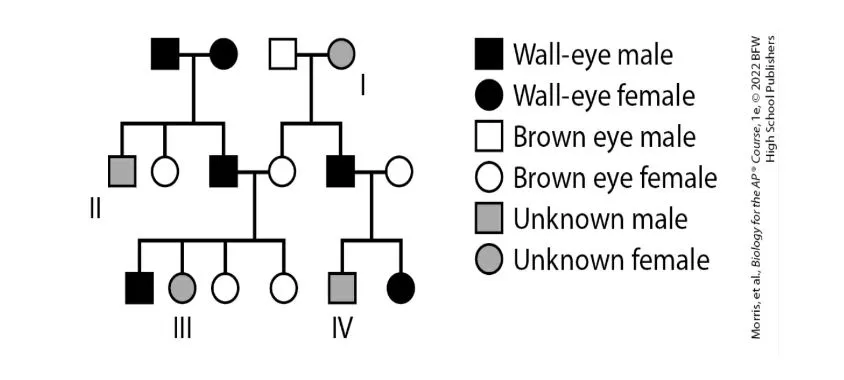
Okay, I will analyze the pedigree and determine the possible genotypes of the brother of individual II.
Task 1: Determine the Genotype(s) of the Brother of Individual II
Here's how we can determine the possible genotypes:
-
Identify the phenotype of the brother of individual II:
- From the pedigree, the brother of individual II is represented by a filled square, which indicates he has "wall-eye."
-
Determine the possible genotypes for the "wall-eye" phenotype:
- Since "wall-eye" is designated by the allele A, and "brown eye" is designated by the allele a, the possible genotypes for "wall-eye" are AA or Aa.
-
Analyze the parents of individual II and his brother:
- The parents are both "wall-eyed" (filled symbols), so their genotypes must contain at least one A allele each.
- However, they have a child (individual II's brother) with an unknown phenotype (gray square). This suggests that "wall-eye" is dominant, and the parents are both heterozygous (Aa).
-
Consider the possible genotypes of the brother of individual II:
- Since the parents are both Aa, we can use a Punnett square to determine the possible genotypes of their offspring:
A a A AA Aa a Aa aa - The possible genotypes are AA, Aa, and aa.
- Since the brother of individual II has "wall-eye," his genotype can be either AA or Aa.
Final Answer:
The possible genotypes of the brother of individual II are AA or Aa.
Homi
Task 2: Determine Which Individual with Unknown Phenotype is Most Likely to Have Wall-Eye
-
Review the pedigree:
- We need to identify individuals with an unknown phenotype (gray symbols) and assess their likelihood of having "wall-eye."
-
Analyze each individual with an unknown phenotype:
- Individual II (brother of individual II): We already determined his possible genotypes are AA or Aa, meaning he has "wall-eye."
- Individual III (daughter of two "wall-eyed" parents): Her parents both have "wall-eye," and one of them must carry the recessive allele 'a' since they have a child with brown eyes. Therefore, individual III could be either "wall-eye" (Aa) or "brown eye" (aa).
- Individual IV (son of one "wall-eyed" parent and one "brown-eyed" parent): Since the "wall-eyed" parent must be heterozygous (Aa) to have a "brown-eyed" child, individual IV has a 50% chance of inheriting the A allele and having "wall-eye" (Aa) and a 50% chance of inheriting the a allele and having "brown eye" (aa).
-
Compare the likelihood of each individual having "wall-eye":
- Individual II definitely has "wall-eye."
- Individual III has a high chance of having "wall-eye," but it's not guaranteed.
- Individual IV has a 50% chance of having "wall-eye."
Final Answer:
Individual III is most likely to have "wall-eye" among the individuals with an unknown phenotype.
 Homi
Homi
Okay, I will proceed with the next task based on the provided table.
Task 3: Analyze the Petal Color Data
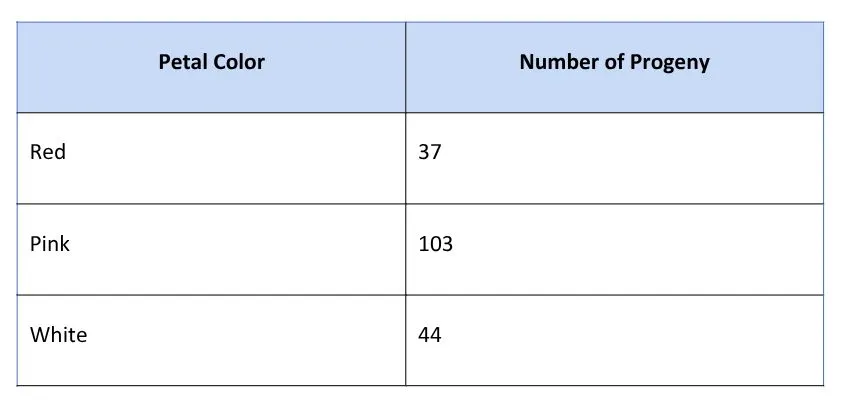
Based on the provided data, we have the following information about petal color and the number of progeny:
- Red: 37
- Pink: 103
- White: 44
To analyze this data, we can consider possible genetic inheritance patterns. Let's assume that petal color is determined by a single gene with two alleles. Since there are three phenotypes (red, pink, and white), this suggests incomplete dominance or codominance.
-
Calculate the total number of progeny:
- Total = 37 (Red) + 103 (Pink) + 44 (White) = 184
-
Determine the phenotypic ratios:
- Red: 37/184 ≈ 0.201
- Pink: 103/184 ≈ 0.560
- White: 44/184 ≈ 0.239
-
Interpret the ratios:
- The ratios are approximately 1:2:1. This suggests that the pink phenotype is heterozygous, while red and white are homozygous.
-
Assign genotypes:
- Let's assume:
- \(R\) represents the allele for red color.
- \(W\) represents the allele for white color.
- \(RR\) = Red
- \(RW\) = Pink
- \(WW\) = White
- Let's assume:
-
Possible Cross:
- If the cross is between two heterozygous individuals (\(RW \times RW\)), the expected ratio would be:
- \(RR\): 1/4 (Red)
- \(RW\): 1/2 (Pink)
- \(WW\): 1/4 (White)
- If the cross is between two heterozygous individuals (\(RW \times RW\)), the expected ratio would be:
Conclusion:
The observed phenotypic ratio (approximately 1:2:1) suggests that the petal color is likely determined by a single gene with two alleles exhibiting incomplete dominance. The pink phenotype is heterozygous, while red and white are homozygous.
Homi
Task 4: Determine the Proportion of Progeny Plants with RR Genotype
Based on the previous analysis, we determined that:
- Red phenotype corresponds to the RR genotype.
- The number of progeny with the red phenotype is 37.
- The total number of progeny is 184.
To find the proportion of progeny plants with the RR genotype, we can use the following formula:
\(\text{Proportion of RR} = \frac{\text{Number of RR progeny}}{\text{Total number of progeny}}\)
Plugging in the values:
\(\text{Proportion of RR} = \frac{37}{184}\)
Calculating the proportion:
\(\text{Proportion of RR} \approx 0.201\)
Final Answer:
The proportion of progeny plants that have an RR genotype is approximately 0.201 or 20.1%.
Homi
Task 5: Calculate the Expected Number of Progeny Plants with Pink Petals
Given the hypothesis that petal color is determined by a single gene with incompletely dominant alleles, we have:
- \(RR\) = Red
- \(RW\) = Pink
- \(WW\) = White
We previously determined that the cross is likely between two heterozygous individuals (\(RW \times RW\)). In such a cross, the expected genotypic ratio is 1:2:1 (RR:RW:WW). Therefore, the expected proportion of pink petals (RW) is 1/2 or 0.5.
To calculate the expected number of progeny plants with pink petals, we multiply the expected proportion by the total number of progeny:
\(\text{Expected number of pink petals} = \text{Proportion of RW} \times \text{Total number of progeny}\)
We know that the total number of progeny is 184. So:
\(\text{Expected number of pink petals} = 0.5 \times 184\)
\(\text{Expected number of pink petals} = 92\)
Final Answer:
The expected number of progeny plants that are expected to have pink petals is 92.
Homi
Please provide the statement you want me to justify. I need the statement to provide a justification based on the data provided in the image.
= Red
= Pink
= White
We previously determined that the cross is likely between two heterozygous individuals (
). In such a cross, the expected genotypic ratio is 1:2:1 (RR:RW:WW). Therefore, the expected proportion of pink petals (RW) is 1/2 or 0.5.
To calculate the expected number of progeny plants with pink petals, we multiply the expected proportion by the total number of progeny:
We know that the total number of progeny is 184. So:
Final Answer:
The expected number of progeny plants that are expected to have pink petals is 92.
Homi
Okay, I will justify the statement you provided based on the data and the hypothesis of incomplete dominance.
Justification of the Statement
The statement is:
"Given the hypothesis that petal color is determined by a single gene with incompletely dominant alleles, we have:
- \(RR\) = Red
- \(RW\) = Pink
- \(WW\) = White
We previously determined that the cross is likely between two heterozygous individuals (\(RW \times RW\)). In such a cross, the expected genotypic ratio is 1:2:1 (RR:RW:WW). Therefore, the expected proportion of pink petals (RW) is 1/2 or 0.5.
To calculate the expected number of progeny plants with pink petals, we multiply the expected proportion by the total number of progeny:
\(\text{Expected number of pink petals} = \text{Proportion of RW} \times \text{Total number of progeny}\)
We know that the total number of progeny is 184. So:
\(\text{Expected number of pink petals} = 0.5 \times 184 = 92\)
Final Answer:
The expected number of progeny plants that are expected to have pink petals is 92."
Justification:
-
Hypothesis of Incomplete Dominance:
- The hypothesis states that petal color is determined by a single gene with two alleles, where neither allele is completely dominant over the other. This results in a heterozygous phenotype (RW) that is intermediate between the two homozygous phenotypes (RR and WW).
-
Genotype Assignments:
- \(RR\) is assigned to the red phenotype.
- \(RW\) is assigned to the pink phenotype.
- \(WW\) is assigned to the white phenotype.
-
Cross Between Heterozygous Individuals (\(RW \times RW\)):
- When two heterozygous individuals (\(RW\)) are crossed, the expected genotypic ratio in the progeny is 1:2:1 (RR:RW:WW). This is based on the Punnett square for the cross:
R W R RR RW W RW WW - From the Punnett square, we can see that:
- 1/4 of the progeny are \(RR\) (Red)
- 2/4 (or 1/2) of the progeny are \(RW\) (Pink)
- 1/4 of the progeny are \(WW\) (White)
-
Expected Proportion of Pink Petals (RW):
- Based on the 1:2:1 genotypic ratio, the expected proportion of pink petals (\(RW\)) is 1/2 or 0.5.
-
Calculation of Expected Number of Pink Petals:
- To find the expected number of progeny with pink petals, we multiply the expected proportion of pink petals by the total number of progeny.
- Given that the total number of progeny is 184:
- \(\text{Expected number of pink petals} = 0.5 \times 184 = 92\)
-
Conclusion:
- Therefore, based on the hypothesis of incomplete dominance and the given data, the expected number of progeny plants with pink petals is 92. This is a logical conclusion derived from the principles of Mendelian genetics and the specific cross described.
The observed data (37 Red, 103 Pink, 44 White) can be compared to these expected values using a Chi-square test to determine if the observed data significantly deviates from the expected ratio.
 Homi
Homi
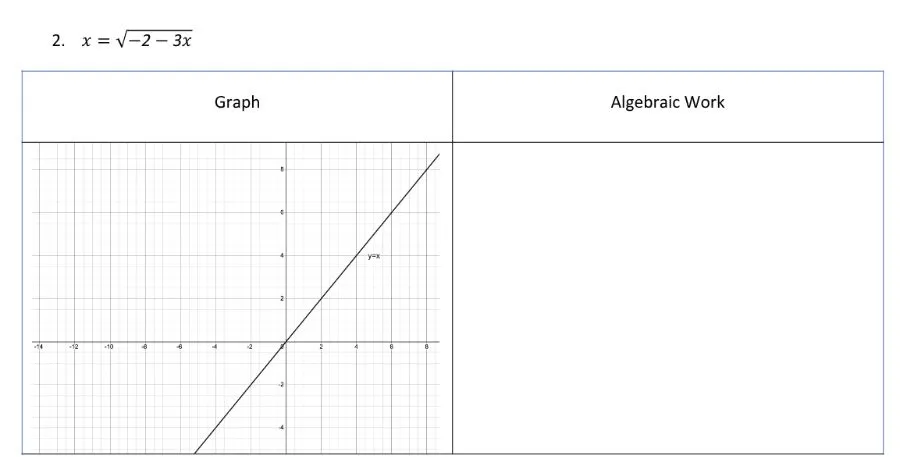
Okay, I will analyze the equation and the graph to provide the algebraic work.
Task 1: Algebraic Work for the Equation \(x = \sqrt{-2 - 3x}\)
The given equation is \(x = \sqrt{-2 - 3x}\). To solve this equation, we need to isolate the variable \(x\).
-
Square both sides of the equation:
- \((x)^2 = (\sqrt{-2 - 3x})^2\)
- \(x^2 = -2 - 3x\)
-
Rearrange the equation into a quadratic equation:
- \(x^2 + 3x + 2 = 0\)
-
Factor the quadratic equation:
- \((x + 1)(x + 2) = 0\)
-
Solve for x:
- \(x + 1 = 0\) or \(x + 2 = 0\)
- \(x = -1\) or \(x = -2\)
-
Check for extraneous solutions:
-
Since we squared both sides of the equation, we need to check if the solutions are valid by plugging them back into the original equation.
-
For \(x = -1\):
- \(-1 = \sqrt{-2 - 3(-1)}\)
- \(-1 = \sqrt{-2 + 3}\)
- \(-1 = \sqrt{1}\)
- \(-1 = 1\) (This is not true, so \(x = -1\) is an extraneous solution)
-
For \(x = -2\):
- \(-2 = \sqrt{-2 - 3(-2)}\)
- \(-2 = \sqrt{-2 + 6}\)
- \(-2 = \sqrt{4}\)
- \(-2 = 2\) (This is not true, so \(x = -2\) is also an extraneous solution)
-
-
Conclusion:
- Both \(x = -1\) and \(x = -2\) are extraneous solutions. Therefore, there is no real solution to the equation \(x = \sqrt{-2 - 3x}\).
Final Answer:
There is no real solution to the equation \(x = \sqrt{-2 - 3x}\).
 Homi
Homi
Okay, let's solve the first task.
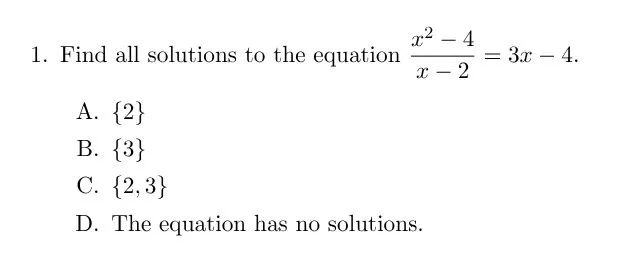
Task 1: Find all solutions to the equation \(\frac{x^2 - 4}{x - 2} = 3x - 4\)
To find the solutions to the equation \(\frac{x^2 - 4}{x - 2} = 3x - 4\), we need to simplify and solve for \(x\).
-
Factor the numerator:
- The numerator \(x^2 - 4\) is a difference of squares, so it can be factored as \((x - 2)(x + 2)\).
- The equation becomes: \(\frac{(x - 2)(x + 2)}{x - 2} = 3x - 4\)
-
Simplify the fraction:
- If \(x \neq 2\), we can cancel the \((x - 2)\) terms in the numerator and denominator.
- \(x + 2 = 3x - 4\)
-
Solve for x:
- Subtract \(x\) from both sides: \(2 = 2x - 4\)
- Add 4 to both sides: \(6 = 2x\)
- Divide by 2: \(x = 3\)
-
Check for extraneous solutions:
- We need to make sure that \(x \neq 2\) because the original equation is undefined at \(x = 2\). Since \(x = 3\), this condition is satisfied.
-
Verify the solution:
- Plug \(x = 3\) into the original equation:
- \(\frac{3^2 - 4}{3 - 2} = 3(3) - 4\)
- \(\frac{9 - 4}{1} = 9 - 4\)
- \(\frac{5}{1} = 5\)
- \(5 = 5\) (The solution is valid)
- Plug \(x = 3\) into the original equation:
Final Answer:
The solution to the equation is \(x = 3\). Therefore, the correct answer is B. {3}.
 Homi
Homi
Okay, I will evaluate the composite function \((g \circ f)(-4)\) given the functions \(f(x) = -2x + 3\) and \(g(x) = x^2 + 1\).
Задание 1
To evaluate \((g \circ f)(-4)\), we need to find \(g(f(-4))\). This means we first evaluate \(f(-4)\) and then substitute the result into \(g(x)\).
-
Evaluate \(f(-4)\):
\(f(x) = -2x + 3\)
\(f(-4) = -2(-4) + 3 = 8 + 3 = 11\) -
Evaluate \(g(f(-4))\), which is \(g(11)\):
\(g(x) = x^2 + 1\)
\(g(11) = (11)^2 + 1 = 121 + 1 = 122\)
Therefore, \((g \circ f)(-4) = 122\).
Final Answer: The final answer is \(\boxed{122}\)
Homi