US Senate Legislative Process: Filibuster and Cloture Vote
 Homi
Homi
Okay, I will analyze the image and provide structured answers to the tasks written on the pieces of paper.
Task Identification and Solution
Here are the tasks identified from the image, along with their solutions:
Задание 1
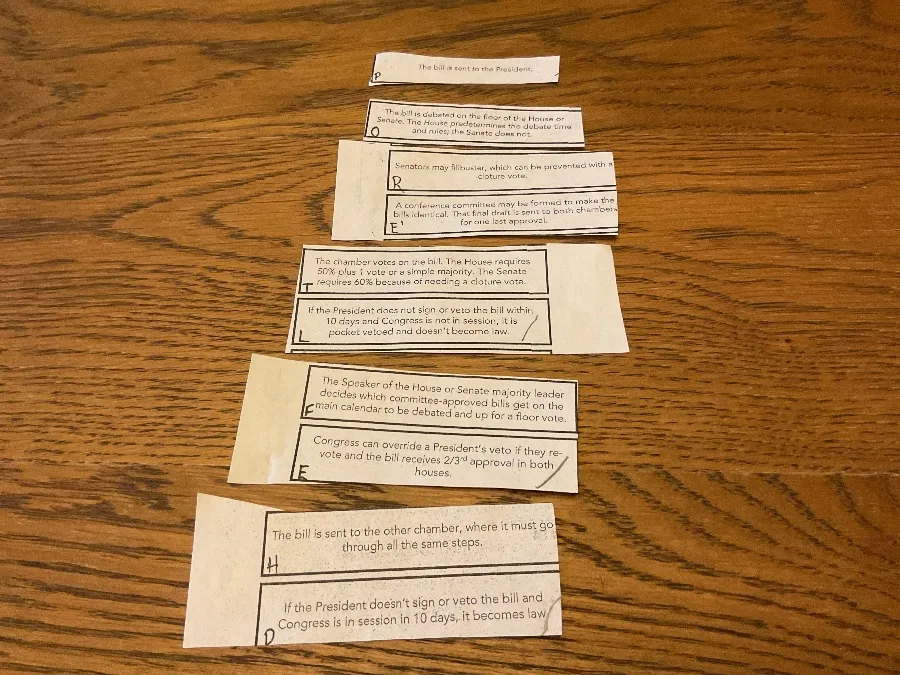
Text: The bill is sent to the President.
Letter: P
This statement describes the final step in the legislative process, where the approved bill is sent to the President for their signature or veto.
Задание 2
Text: The bill is debated on the floor of the House or Senate. The House predetermines the debate time and rules; the Senate does not.
Letter: O
This describes the debate phase of a bill in either the House or Senate. It highlights a key difference: the House sets time limits and rules for debate, while the Senate does not.
Задание 3
Text: Senators may filibuster, which can be prevented with a cloture vote.
Letter: R
This statement refers to the filibuster, a tactic used in the Senate to delay or block a vote on a bill. A cloture vote is the procedure used to end a filibuster.
Homi
Okay, I understand. You want me to continue solving the tasks from the image, providing the corresponding letters for each statement. Let's proceed with the remaining tasks.
Задание 4
Text: A conference committee may be formed to make the bills identical. That final draft is sent to both chambers for one last approval.
Letter: E
This describes the role of a conference committee, which is formed when the House and Senate pass different versions of the same bill. The committee's job is to reconcile the differences and create a single, identical version that is then sent back to both chambers for a final vote.
Задание 5
Text: The chamber votes on the bill. The House requires 50% plus 1 vote or a simple majority. The Senate requires 60% because of needing a cloture vote.
Letter: T
This statement describes the voting process in each chamber. It notes that the House requires a simple majority (50% + 1), while the Senate often needs 60% due to the possibility of a filibuster, which requires a cloture vote to overcome.
Задание 6
Text: If the President does not sign or veto the bill within 10 days and Congress is not in session, it is pocket vetoed and doesn't become law.
Letter: L
This describes a pocket veto, which occurs when the President doesn't sign a bill and Congress adjourns before the 10-day deadline, preventing the bill from becoming law.
Homi