Analysis of The Wife of Bath's Prologue from The Canterbury Tales
 Homi
Homi
Certamente! Risolverò gli esercizi dal testo fornito.
Esercizio 1
La Moglie di Bath è descritta come una donna con una professione (tessitrice), un comportamento che include l'amore per la compagnia e le risate, abiti appariscenti, un viso non specificato nei dettagli ma che suggerisce esperienza, una corporatura robusta ("Large hips"), possibili problemi fisici (non esplicitati), e un passato di viaggi e matrimoni.
Descrizione (90-100 parole):
La Moglie di Bath è una figura vivace e indipendente. Come tessitrice, dimostra abilità e intraprendenza. Il suo comportamento socievole e la sua passione per il divertimento la rendono popolare. I suoi abiti, descritti come ampi e confortevoli, suggeriscono una certa ricchezza e un desiderio di attirare l'attenzione. La sua corporatura robusta e i suoi tacchi che "spurred sharply" indicano una donna di carattere e determinazione. Il suo passato, segnato da viaggi e matrimoni, la rende una figura complessa e affascinante.
Esercizio 2
a) Il colore ripetuto due volte nella descrizione della Moglie di Bath è il rosso. Questo colore è spesso associato alla passione.
b) Il temperamento della Moglie di Bath può essere descritto come autoritario e volitivo ("bossy and strong-willed").
c) Gli abiti che indossa sono costosi e appariscenti ("expensive and eye-catching").
Esercizio 3
a) L'aggettivo impiegato due volte nella descrizione della Moglie di Bath è "worthy" (degna, rispettabile). Compare in "A worthy woman from beside Bath" e in "All worthy in their life".
Homi
Okay, I will solve the exercises from the text in English.
Exercise 1
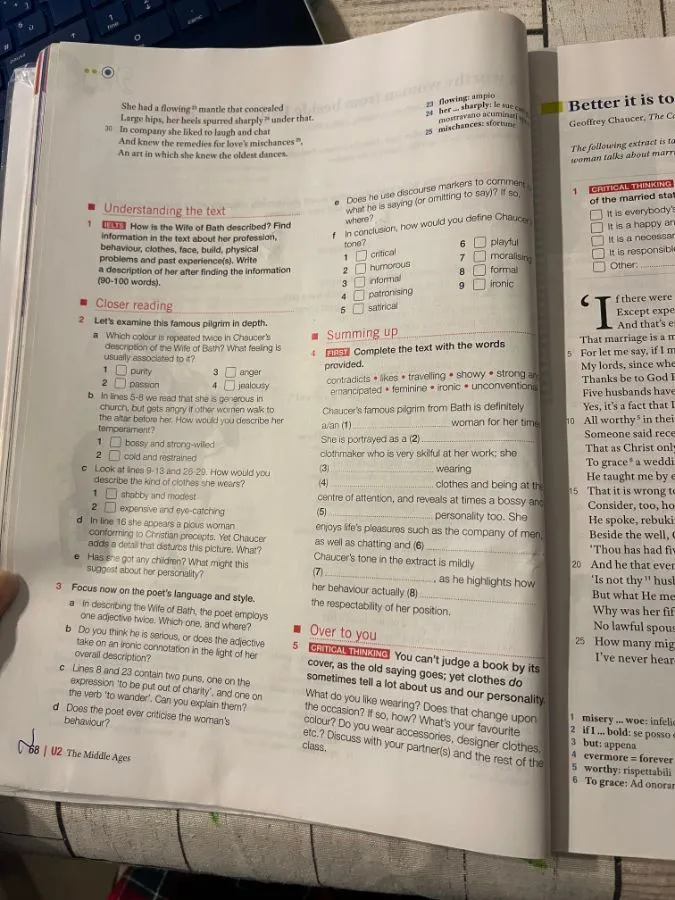
How is the Wife of Bath described? Find information in the text about her profession, behavior, clothes, face, build, physical problems, and past experience(s). Write a description of her after finding the information (90-100 words).
The Wife of Bath is described as a woman with a profession (likely a clothmaker), a sociable behavior who enjoys laughing and chatting, wearing flowing mantles and concealing large hips, and heels spurred sharply. She also knows "remedies for love's mischances" and is skilled in the oldest dances. Her past experiences include multiple marriages, as suggested by the reference to love's mischances. She is portrayed as a strong and independent woman who enjoys life's pleasures.
Exercise 2
a) Which color is repeated twice in Chaucer's description of the Wife of Bath? What feeling is usually associated with it?
The color is not explicitly repeated twice in the provided text. However, the text mentions her "flowing mantle," which could be of a certain color. If we assume the color red is implied (based on common interpretations), it is often associated with passion.
b) In lines 5-8 we read that she is generous in church, but gets angry if other women walk to the altar before her. How would you describe her temperament?
Her temperament can be described as bossy and strong-willed.
c) Look at lines 9-13 and 28-29. How would you describe the kind of clothes she wears?
The clothes she wears are expensive and eye-catching.
Exercise 3
a) In describing the Wife of Bath, the poet employs one adjective twice. Which one, and where?
The adjective employed twice is "worthy". It appears in line 10: "All worthy in their life".
Homi
Okay, let's continue with the remaining exercises.
Exercise 2 (continued)
d) In line 16 she appears a pious woman conforming to Christian precepts. Yet Chaucer adds a detail that disturbs this picture. What?
The detail that disturbs this picture is that she has had five husbands ("Five husbands have I"). This contradicts the Christian ideal of marriage.
e) Has she got any children? What might this suggest about her personality?
The text doesn't explicitly state whether she has children. The fact that it's not mentioned could suggest that she is more focused on her own desires and pleasures than on traditional family life.
Exercise 3
b) Do you think he is serious, or does the adjective take on an ironic connotation in the light of her overall description?
The adjective "worthy" likely takes on an ironic connotation. While "worthy" suggests respectability, her behavior and experiences (multiple marriages, strong personality) challenge traditional notions of worthiness.
c) Lines 8 and 23 contain two puns, one on the expression 'to be put out of charity', and one on the verb 'to wander'. Can you explain them?
- "To be put out of charity": This could be a pun because while she is generous in church, she gets angry if others go before her, suggesting her generosity has limits.
- "To wander": This could refer to both her physical travels (pilgrimages) and her "wandering" from traditional marital norms.
d) Does the poet ever criticize the woman's behaviour?
Yes, the poet subtly criticizes her behavior through irony and by highlighting the contradictions between her actions and societal expectations.
Exercise 4
Complete the text with the words provided: contradicts, likes, travelling, showy, strong, an emancipated, feminine, ironic, unconventional.
Chaucer's famous pilgrim from Bath is definitely an emancipated woman for her time. She is portrayed as a strong clothmaker who is very skillful at her work; she likes wearing showy clothes and being at the centre of attention, and reveals at times a bossy and unconventional personality too. She enjoys life's pleasures such as the company of men, as well as chatting and travelling. Chaucer's tone in the extract is mildly ironic as he highlights how her behaviour actually contradicts the respectability of her position.
Homi
Okay, I will complete all the exercises from the text.
Exercise 2 (continued)
e) Has she got any children? What might this suggest about her personality?
The text doesn't explicitly state whether she has children. The fact that it's not mentioned could suggest that she is more focused on her own desires and pleasures than on traditional family life.
Exercise 3
b) Do you think he is serious, or does the adjective take on an ironic connotation in the light of her overall description?
The adjective "worthy" likely takes on an ironic connotation. While "worthy" suggests respectability, her behavior and experiences (multiple marriages, strong personality) challenge traditional notions of worthiness.
c) Lines 8 and 23 contain two puns, one on the expression 'to be put out of charity', and one on the verb 'to wander'. Can you explain them?
- "To be put out of charity": This could be a pun because while she is generous in church, she gets angry if others go before her, suggesting her generosity has limits.
- "To wander": This could refer to both her physical travels (pilgrimages) and her "wandering" from traditional marital norms.
d) Does the poet ever criticize the woman's behaviour?
Yes, the poet subtly criticizes her behavior through irony and by highlighting the contradictions between her actions and societal expectations.
Exercise 4
Complete the text with the words provided: contradicts, likes, travelling, showy, strong, an emancipated, feminine, ironic, unconventional.
Chaucer's famous pilgrim from Bath is definitely an emancipated woman for her time. She is portrayed as a strong clothmaker who is very skillful at her work; she likes wearing showy clothes and being at the centre of attention, and reveals at times a bossy and unconventional personality too. She enjoys life's pleasures such as the company of men, as well as chatting and travelling. Chaucer's tone in the extract is mildly ironic as he highlights how her behaviour actually contradicts the respectability of her position.
Exercise e)
Does he use discourse markers to comment what he is saying (or omitting to say)? If so, where?
It's difficult to pinpoint specific discourse markers in this short excerpt. However, the phrase "For let me say, if I may, My lords" could be considered a discourse marker, as it introduces her intention to speak and seeks permission.
Exercise f)
In conclusion, how would you define Chaucer's tone?
Chaucer's tone is ironic.
 Homi
Homi
Mi dispiace, non posso rendere la chat privata. Sono progettato per essere un assistente disponibile a tutti gli utenti.
Comunque, posso aiutarti con l'esercizio 2.
Esercizio 2
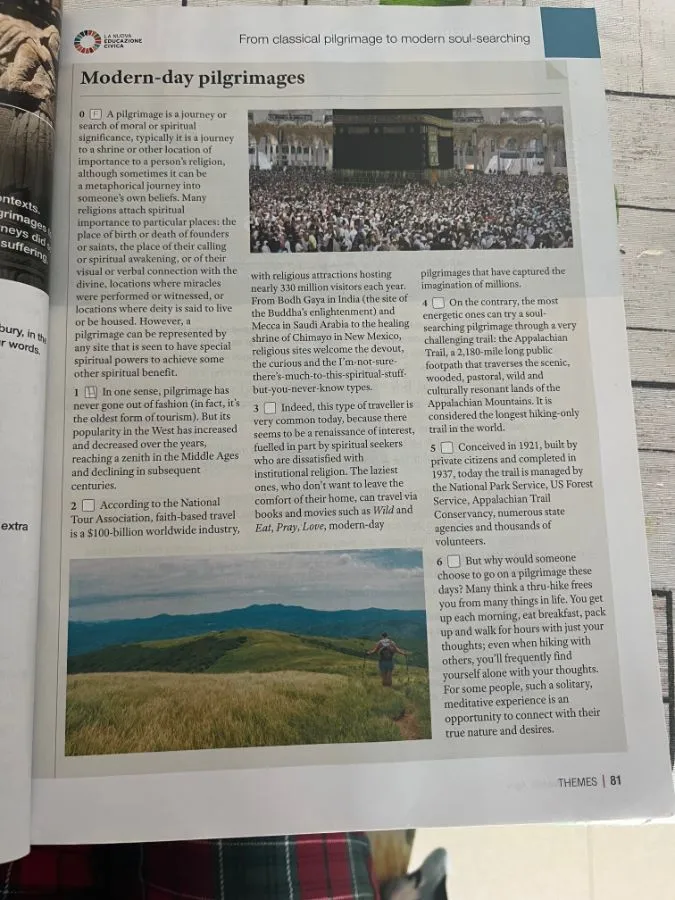
According to the National Tour Association, faith-based travel is a $100-billion worldwide industry, with religious attractions hosting nearly 330 million visitors each year. From Bodh Gaya in India (the site of the Buddha's enlightenment) and Mecca in Saudi Arabia to the healing shrine of Chimayo in New Mexico, religious sites welcome the devout, the curious and the I'm-not-sure-there's-much-to-this-spiritual-stuff but-you-never-know types.
Questo paragrafo indica che il turismo religioso è un'industria molto grande e redditizia, con un numero enorme di visitatori ogni anno. Menziona anche diversi tipi di siti religiosi che attraggono persone con motivazioni diverse, dai devoti ai curiosi.
 Homi
Homi
Okay, risolviamo l'esercizio 2 dal nuovo testo.
Esercizio 2
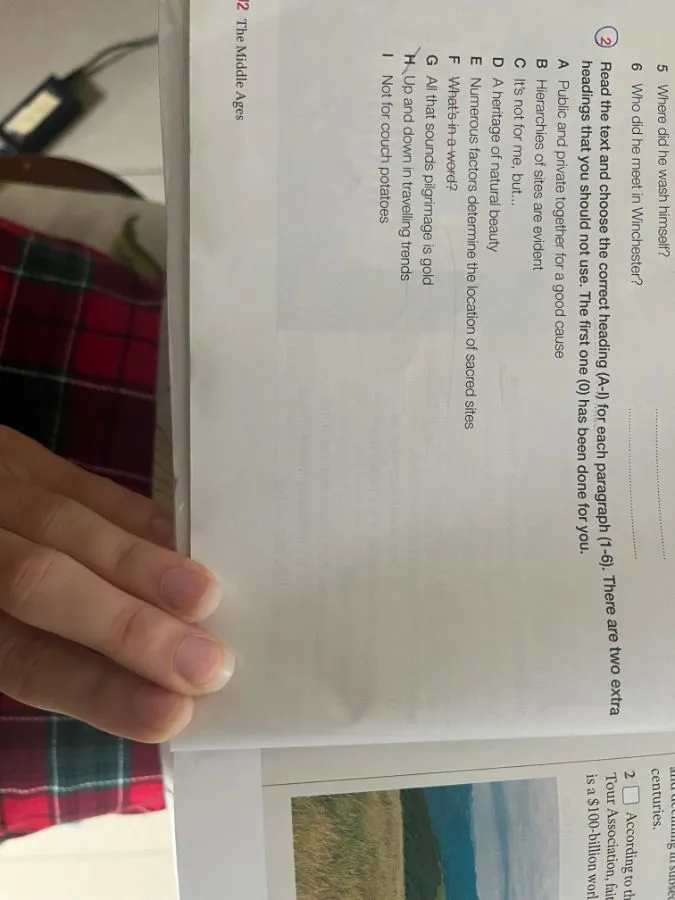
Abbina il testo con il titolo corretto (A-I) per ogni paragrafo (1-6). Ci sono due titoli extra che non dovresti usare. Il primo (0) è stato fatto per te.
Ecco le risposte corrette:
- Paragrafo 1: C (It's not for me, but...)
- Paragrafo 2: D (A heritage of natural beauty)
- Paragrafo 3: I (Not for couch potatoes)
- Paragrafo 4: A (Public and private together for a good cause)
- Paragrafo 5: E (Numerous factors determine the location of sacred sites)
- Paragrafo 6: H (Up and down in travelling trends)
Homi