English Vocabulary Practice: Body Parts and Animals
 Homi
Homi
Давайте разберем задания пошагово! 📚
{
"subject": "English Language",
"lang": "en",
"grade": 2,
"url_subject": "english",
"title": "English Vocabulary Practice: Body Parts and Animals",
"description": "Elementary level English exercises including reading comprehension, word choice, and letter unscrambling tasks focused on body parts and animals",
"keywords": ["English grammar", "vocabulary", "body parts", "animals", "word unscrambling", "reading comprehension", "elementary English"]
}
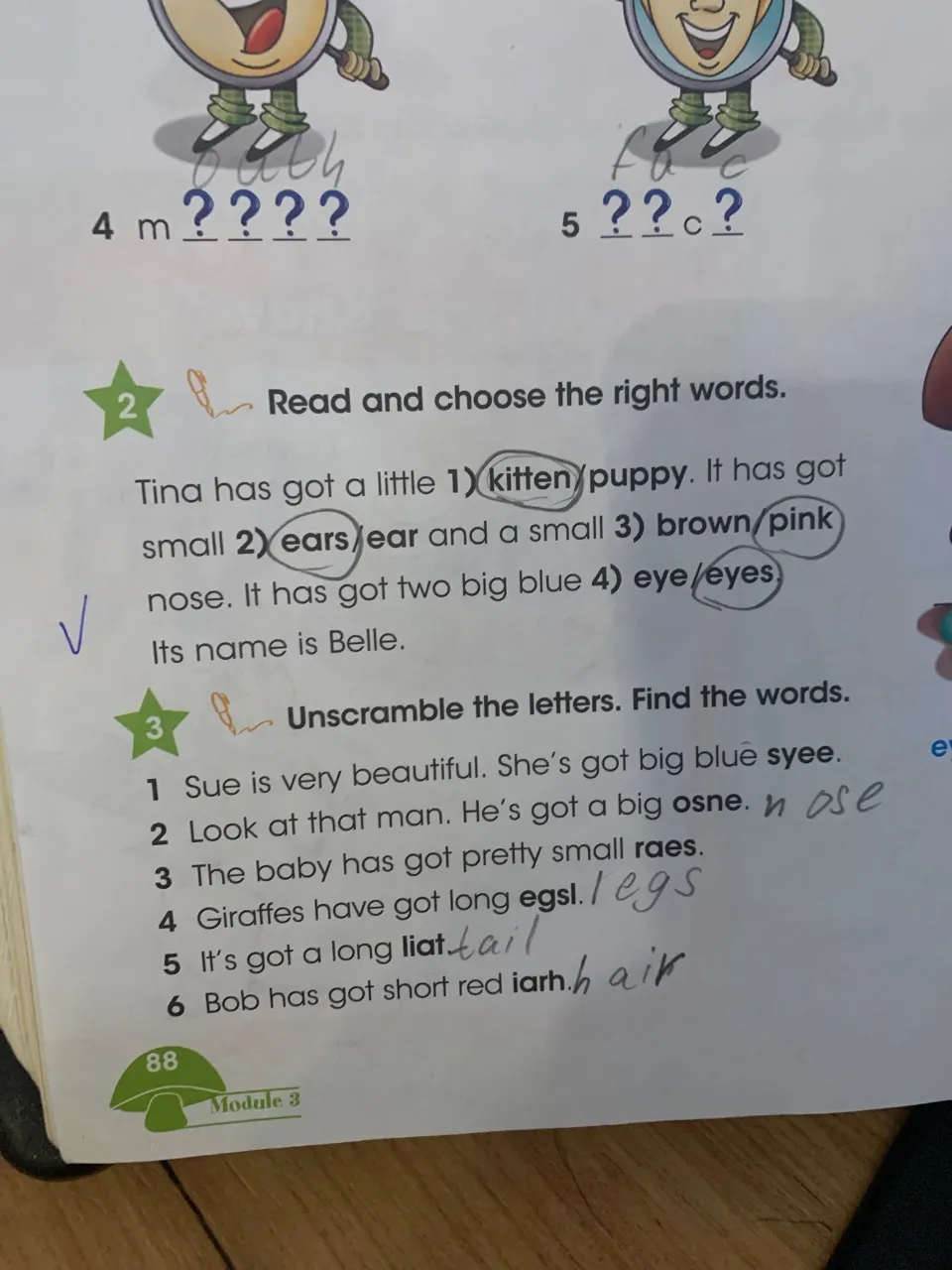
1️⃣ Первое задание с картинками:
- 4 m a b y → baby
- 5 f a c e → face
2️⃣ Read and choose the right words:
В этом задании нужно выбрать правильные слова в предложении о котенке по имени Belle:
"Tina has got a little kitten (не puppy). It has got small ears (не ear) and a small brown (не pink) nose. It has got two big blue eyes (не eye). Its name is Belle."
3️⃣ Unscramble the letters. Find the words:
Давайте расшифруем перепутанные буквы:
1. syee → eyes
2. osne → nose
3. raes → ears
4. egsl → legs
5. liat → tail
6. iarh → hair
Все эти слова связаны с частями тела и описанием внешности. Они часто используются при описании людей и животных в английском языке.
🎯 Важно запомнить:
- Большинство частей тела, которые встречаются парами, используются во множественном числе (eyes, ears, legs)
- При описании используется конструкция "has got" / "have got"
- При описании важен порядок прилагательных: размер (big, small) + цвет (blue, red) + существительное
Homi
Let me help you visualize these English vocabulary exercises! 🎨
Let's break down the exercises in more detail:
1️⃣ Word Unscrambling (Part 1):
- "baby" - unscrambled from letters shown with the number 4
- "face" - unscrambled from letters shown with the number 5
2️⃣ Reading Comprehension:
In this exercise, we need to choose the correct words to describe Belle the kitten:
- kitten vs puppy (kitten is correct as it's a young cat)
- ears vs ear (ears is correct as it's plural - cats have two ears)
- brown vs pink (brown is the correct color for the nose)
- eyes vs eye (eyes is correct as it's plural - cats have two eyes)
3️⃣ Word Unscrambling (Part 2):
Here's how we unscramble each word:
- "syee" → "eyes" (what we see with)
- "osne" → "nose" (for smelling)
- "raes" → "ears" (for hearing)
- "egsl" → "legs" (for walking)
- "liat" → "tail" (cats use it for balance)
- "iarh" → "hair" (covers the body)
🔑 Key Learning Points:
1. Paired body parts are always plural in English (eyes, ears, legs)
2. Use "has got" for singular subjects and "have got" for plural
3. Word order for descriptions: Size → Color → Noun
Example: "big blue eyes" (not "blue big eyes")
The illustration above shows the main facial features we're learning about, making it easier to remember these vocabulary words! 📝
Homi