Sweet Pea Genotype Identification and Explanation
 Homi
Homi
Okay, I will help you with that question!
Task 1
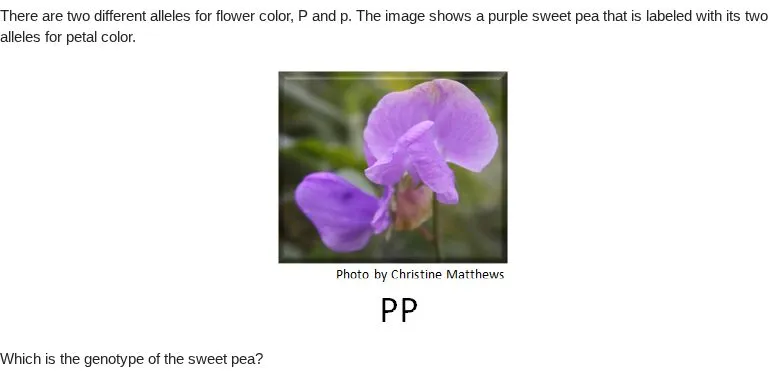
Question: Which is the genotype of the sweet pea?
Answer:
The genotype of the sweet pea, as labeled in the image, is PP.
 Homi
Homi
Task 1
Question: Which term describes an organism that has identical alleles for a trait?
Answer:
The term that describes an organism with identical alleles for a trait is homozygous.
- Homozygous: Having two identical alleles for a particular gene (e.g., PP or pp).
- Heterozygous: Having two different alleles for a particular gene (e.g., Pp).
- Dominant: An allele that expresses its trait even when paired with a recessive allele.
- Recessive: An allele that only expresses its trait when paired with another identical recessive allele.
 Homi
Homi
Task 1
Question: Gregor Mendel crossed homozygous tall plants (TT) with homozygous short plants (tt). All the resulting offspring were tall. From these results, what conclusion did Mendel draw?
Answer:
The correct conclusion Mendel drew from these results is:
- Tallness is a dominant trait.
Here's why:
- Since all the offspring (F1 generation) were tall despite having one allele for tallness (T) and one for shortness (t), the tallness allele must be dominant, masking the effect of the shortness allele.
 Homi
Homi
Task 1
Question: Which describes the notation Tt for the trait of plant height?
Answer:
The notation Tt describes a heterozygous genotype.
- Genotype refers to the genetic makeup of an organism, specifically the alleles it carries for a particular gene.
- Heterozygous means that the organism has two different alleles for that gene (in this case, T and t).
 Homi
Homi
Task 1
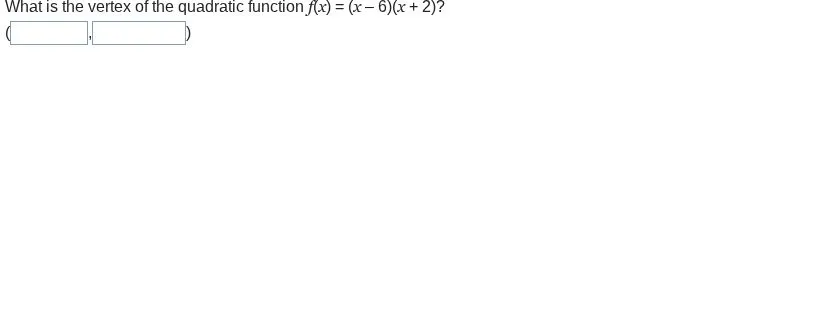
Question: What is the vertex of the quadratic function \(f(x) = (x-6)(x+2)\)?
Solution:
-
Find the x-intercepts (roots):
Set \(f(x) = 0\):
\((x-6)(x+2) = 0\)
So, \(x = 6\) or \(x = -2\) -
Find the x-coordinate of the vertex:
The x-coordinate of the vertex is the midpoint of the roots:
\(x_{vertex} = \frac{6 + (-2)}{2} = \frac{4}{2} = 2\) -
Find the y-coordinate of the vertex:
Plug \(x_{vertex}\) into the function:
\(f(2) = (2-6)(2+2) = (-4)(4) = -16\)
Therefore, the vertex of the quadratic function is \((2, -16)\).
Answer:
\((2, -16)\)
Homi