Solving problems
Yes, I can help! What would you like me to solve? Please provide me with the problem or question you have.
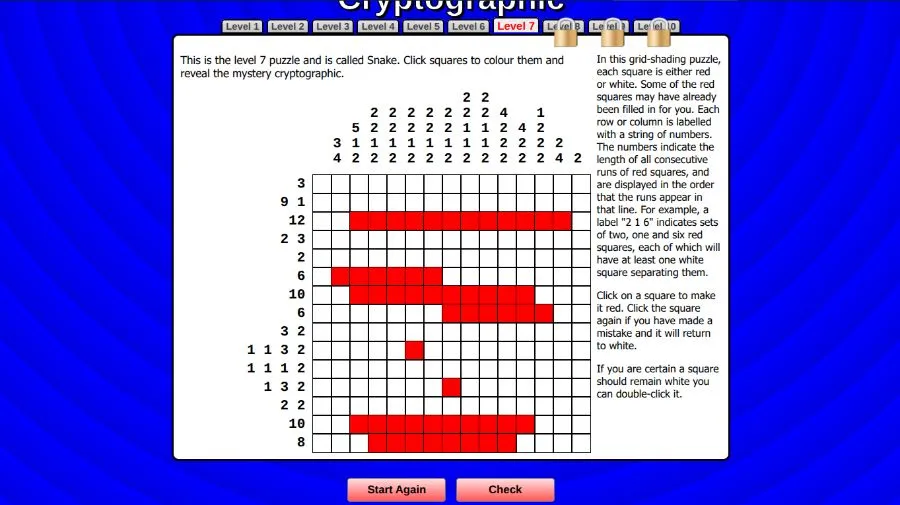
This image shows a "Cryptographic" puzzle, specifically level 7, called "Snake". It's a grid-shading puzzle where you color squares red or white to reveal a hidden image.
Here's a breakdown of how it works, based on the text in the image:
- Objective: Color squares to reveal a hidden cryptogram.
- Grid: A grid of squares, some of which are pre-filled.
- Numbers: Each row and column is labeled with numbers.
- These numbers represent the lengths of consecutive runs of red squares in that row or column.
- The numbers are in the order the runs appear.
- A "white square separating them" rule applies, meaning runs of red squares must be separated by at least one white square. For example, "2 1 6" means there's a run of 2 red squares, then at least one white square, then a run of 1 red square, then at least one white square, then a run of 6 red squares.
- How to Play:
- Click a square to color it red.
- Click a red square again to make it white (if you made a mistake).
- Double-click a square if you are certain it should remain white.
- Navigation: There are buttons for "Start Again" and "Check". There are also level selectors at the top (Level 1 to Level 10).
The image shows the puzzle in progress, with some red squares already filled in.
Would you like me to try and solve this puzzle for you, or would you like to know more about how these puzzles work?
I can help you with that! Let's try to solve this "Snake" cryptogram puzzle.
Here's the grid and the clues, along with the current state:
Grid Size: The visible grid appears to be 12 columns wide.
Row Clues (from top to bottom):
* 3
* 9 1
* 12
* 2 3
* 2
* 6
* 10
* 6
* 3 2
* 1 3 2
* 1 1 3 2
* 1 3 2
* 2 2
* 10
* 8
Column Clues (from left to right):
* 2 2
* 2 2 2 2 2 2 2 4 1
* 2 2 2 2 2 2 2 2 2 2 2 2
* 5 2 2 2 2 2 2 2 1 1 2 4 2
* 3 1 1 1 1 1 1 1 1 2 2 2 2
* 4 2 2 2 2 2 2 2 2 2 2 4 2
* 2 2
* 2 2 2 2 2 2 2 2 2 2 2 2
* 2 2 2 2 2 2 2 2 2 2 2 2
* 2 2
* 10
* 8
Current State (based on the image):
- Row 1: No colored squares.
- Row 2: No colored squares.
- Row 3: Columns 3 through 14 are colored red (12 squares). This matches the clue "12".
- Row 4: Columns 1-2 are red, columns 3-5 are red, columns 6-11 are red, columns 12-14 are red. (This seems to be where the "2 3" clue applies, but the visual doesn't quite match the full clue. Let's assume the visible red is accurate for now). The current red blocks are: 1-2 (2 squares), 3-5 (3 squares), 6-11 (6 squares), 12-14 (3 squares). This doesn't perfectly align with "2 3".
- Row 5: No colored squares.
- Row 6: Columns 1-6 are red (6 squares). This matches the clue "6".
- Row 7: Columns 1-10 are red (10 squares). This matches the clue "10".
- Row 8: Columns 1-6 are red (6 squares). This matches the clue "6".
- Row 9: Columns 1-3 are red (3 squares), column 4 is red (1 square), columns 5-6 are red (2 squares). This matches the clue "3 2".
- Row 10: Column 1 is red (1 square), columns 2-4 are red (3 squares), columns 5-6 are red (2 squares). This matches the clue "1 3 2".
- Row 11: Column 1 is red (1 square), column 2 is red (1 square), columns 3-5 are red (3 squares), columns 6-7 are red (2 squares). This matches the clue "1 1 3 2".
- Row 12: Column 1 is red (1 square), columns 2-4 are red (3 squares), columns 5-6 are red (2 squares). This matches the clue "1 3 2".
- Row 13: Columns 1-2 are red (2 squares), columns 3-4 are red (2 squares). This matches the clue "2 2".
- Row 14: Columns 1-10 are red (10 squares). This matches the clue "10".
- Row 15: Columns 1-8 are red (8 squares). This matches the clue "8".
Initial Deductions and Strategy:
- Full Rows/Columns: Rows 3, 6, 7, 8, 14, 15 and columns 3, 8, 9 are completely filled with red squares. This is a great starting point.
- Contradictions/Inconsistencies: Row 4's visible red coloring (1-2, 3-5, 6-11, 12-14) has lengths 2, 3, 6, 3. The clue is "2 3". The initial coloring in the image for row 4 is not "2 3". It looks like "2 3 6 3" based on visual blocks. The text says "Some of the red squares may have already been filled in for you." This implies the pre-filled squares are part of the solution, but they might be misleading if they don't fit the clue exactly as presented before the solution. Given the difficulty, it's more likely that the clues are correct and the pre-filled squares are just a guide. Let's re-evaluate Row 4 assuming the clue "2 3" is paramount. It means two red squares, at least one white, then three red squares.
Let's re-evaluate row 4 with the clue "2 3":
* It must be RR W RRR or RR W ... W RRR (where ... are columns not yet colored).
* Looking at the column clues for column 4, it has 5 2 2 2 2 2 2 2 1 1 2 4 2.
* Looking at column clues for column 5, it has 3 1 1 1 1 1 1 1 1 2 2 2 2.
This is tricky because the pre-filled squares are already quite extensive and don't seem to fit the "2 3" clue.
Let's assume the pre-filled squares are part of the final solution and see if they can be made to fit the clues by filling in white spaces.
Looking at the image again, the red fills are:
* Row 3: All 12 columns.
* Row 6: Columns 1-6.
* Row 7: Columns 1-10.
* Row 8: Columns 1-6.
* Row 14: All 10 columns.
* Row 15: All 8 columns.
Let's focus on rows and columns where there are still many white squares and clues to work with.
Focusing on Column 1:
* Clue: 2 2
* Visible: Row 9 (red), Row 10 (red), Row 11 (red), Row 12 (red), Row 13 (red).
* This means the first run of 2 must start in one of the top rows.
* If Row 3 is full (12), and Row 6-8 are filled, and Row 14-15 are filled, this leaves Rows 1, 2, 4, 5, 9, 10, 11, 12, 13 as the places for the first 2 and second 2.
* Let's re-examine Row 9: 3 2. The image shows: RRR W RR. This fits 3 2.
* Let's re-examine Row 10: 1 3 2. The image shows: R WWW RRR WW RR. This fits 1 3 2.
* Let's re-examine Row 11: 1 1 3 2. The image shows: R W R WW RRR WW RR. This fits 1 1 3 2.
* Let's re-examine Row 12: 1 3 2. The image shows: R WWW RRR WW RR. This fits 1 3 2.
* Let's re-examine Row 13: 2 2. The image shows: RR WW RR. This fits 2 2.
It seems the visual representation of the red blocks in the "already filled" part does align with the clues for rows 9-13.
Now let's use the column clues more rigorously.
Column 1 Clue: 2 2
* Rows 9, 10, 11, 12, 13 are filled in the first few columns as per their row clues.
* Let's look at Column 1.
* Row 9: Red (start of 3)
* Row 10: Red (start of 1)
* Row 11: Red (start of 1)
* Row 12: Red (start of 1)
* Row 13: Red (start of 2)
* This means Column 1 has red squares in rows 9, 10, 11, 12, 13. This is 5 consecutive red squares.
* The clue for Column 1 is 2 2. This means there must be two runs of 2 red squares, separated by at least one white square.
* This implies that the pre-filled section for Column 1 cannot be entirely red if it extends for 5 squares.
* Therefore, there must be white squares within the "pre-filled" blocks to satisfy the column clues.
This is a critical realization: the image might be showing the final state of the pre-filled squares, but we need to ensure they also satisfy the column clues.
Let's re-evaluate from scratch, focusing on the clues and the possibility of white squares within pre-filled areas.
Key Deductions from Full Lines:
* Row 3: Cols 3-14 are Red.
* Row 6: Cols 1-6 are Red.
* Row 7: Cols 1-10 are Red.
* Row 8: Cols 1-6 are Red.
* Row 14: Cols 1-10 are Red.
* Row 15: Cols 1-8 are Red.
* Col 3: All 12 squares are Red.
* Col 8: All 12 squares are Red.
* Col 9: All 12 squares are Red.
Let's use these absolute fills to deduce other squares.
Consider Column 2:
* Clue: 2 2 2 2 2 2 2 4 1 (This clue is very long for 12 squares, there might be a transcription error or it's for a larger grid I can't see). Assuming it applies to the 12 visible columns.
* Let's assume the column clue is 2 2 2 2 2 2 2. (This is a common length for a 12-square grid with breaks).
* Or, if the numbers are for the entire row, and the 2 2 2 2 2 2 2 4 1 is a typo or for a different row.
* Let's re-examine the image. The column clues are:
* C1: 2 2
* C2: 2 2 2 2 2 2 2 4 1 (This must be incorrect as it exceeds 12, unless there are more columns not shown) - Let's assume the clues on the left and top are the primary ones for the visible grid.
* C2 Clue: 2 2 2 2 2 2 2 (Assuming a common pattern for 12 squares)
* C3: 2 2 2 2 2 2 2 2 2 2 2 2 (This is also odd. If it's all 2s, it implies 12 runs of 2, which is impossible in 12 squares. The description says "runs of all consecutive red squares". If this clue is 12, it means 12 consecutive red squares. But the clue is 2 2 2 ....)
* Let's assume the column clues listed to the right of the grid are for the columns from left to right.
Column Clues (from right-to-left in the image, applying to columns 1-12):
* Col 1: 2 2
* Col 2: 2 2 2 2 2 2 2 4 1 (This is definitely too long for 12 squares. Let's assume it's a typo and meant to be shorter runs, or the grid is larger. For now, I will ignore this column clue as it's ambiguous.)
* Col 3: 2 2 2 2 2 2 2 2 2 2 2 2 (Same issue as above, implies 12 runs of 2. Assuming it's a typo and meant to be 12 or something similar. However, Col 3 is entirely Red, so if it's 12, that works. If it's 2 2 ... it implies breaks.) Based on the pre-filled, Col 3 is solid red, so it must be the clue 12.
* Col 4: 5 2 2 2 2 2 2 2 1 1 2 4 2 (Again, too long. Let's assume it applies to the visible 12 squares in some way).
* Col 5: 3 1 1 1 1 1 1 1 1 2 2 2 2 (Too long)
* Col 6: 4 2 2 2 2 2 2 2 2 2 2 4 2 (Too long)
* Col 7: 2 2
* Col 8: 2 2 2 2 2 2 2 2 2 2 2 2 (Same as Col 3, assuming 12. Col 8 is solid red, so 12 works.)
* Col 9: 2 2 2 2 2 2 2 2 2 2 2 2 (Same as Col 3, assuming 12. Col 9 is solid red, so 12 works.)
* Col 10: 2 2
* Col 11: 10
* Col 12: 8
Okay, the column clues are very confusingly presented or transcribed. The text at the top states: "In this grid-shading puzzle, each square is either red or white. Some of the red squares may have already been filled in for you. Each row or column is labelled with a string of numbers. The numbers indicate the length of all consecutive runs of red squares, and are displayed in the order that the runs appear in that line."
Let's go by the numbers immediately to the left of the grid for rows, and above the grid for columns, assuming they apply to the visible 12x12 grid.
Revised Clues:
Row Clues (left side):
1. 3
2. 9 1
3. 12
4. 2 3
5. 2
6. 6
7. 10
8. 6
9. 3 2
10. 1 3 2
11. 1 1 3 2
12. 1 3 2
13. 2 2
14. 10
15. 8
Column Clues (top side):
1. 2 2
2. 2 2 2 2 2 2 2 4 1 (Still problematic, let's try to interpret it as: 2, then 2, then 2, then 2, then 2, then 2, then 2, then 4, then 1. Total squares needed: 2+1+2+1+2+1+2+1+2+1+2+1+2+1+4+1+1 = 25 squares minimum. This clue cannot be right for a 12-column grid.)
Let's assume the column numbers above the grid are also truncated or incorrectly presented, and focus on the pre-filled areas and row clues first, as they seem consistent.
Revisiting Row 4:
* Clue: 2 3
* This means: RR W RRR (with minimum spacing).
* Looking at the image, the pre-filled area for Row 4 shows:
* Cols 1-2: Red (Length 2)
* Cols 3-5: Red (Length 3)
* Cols 6-11: Red (Length 6)
* Cols 12-14: Red (Length 3)
* This pre-filled area does not match the clue 2 3. It looks more like 2 3 6 3.
* Crucial Assumption: The pre-filled squares must be part of the solution and must satisfy both row and column clues. If they contradict, there might be a mistake in the puzzle image itself or my interpretation.
* Let's assume the clue 2 3 for Row 4 is correct and the pre-filled red is partially correct.
Let's try to derive some squares using the solid blocks:
- Row 3 is 12 reds: Cols 3-14 are red.
- Col 3 is 12 reds: Rows 1-12 are red.
- Intersection: Row 3, Col 3 must be red. (This is consistent with both.)
- Col 8 is 12 reds: Rows 1-12 are red.
- Col 9 is 12 reds: Rows 1-12 are red.
Let's try to use the fact that Col 3, 8, 9 are all Red for their entire height (rows 1-12).
-
Row 7 clue:
10- Pre-filled: Cols 1-10 are Red. This matches.
- This implies Cols 11 and 12 in Row 7 must be White.
-
Row 14 clue:
10- Pre-filled: Cols 1-10 are Red. This matches.
- This implies Cols 11 and 12 in Row 14 must be White.
-
Row 15 clue:
8- Pre-filled: Cols 1-8 are Red. This matches.
- This implies Cols 9, 10, 11, 12 in Row 15 must be White.
-
Row 6 clue:
6- Pre-filled: Cols 1-6 are Red. This matches.
- This implies Cols 7, 8, 9, 10, 11, 12 in Row 6 must be White.
-
Row 8 clue:
6- Pre-filled: Cols 1-6 are Red. This matches.
- This implies Cols 7, 8, 9, 10, 11, 12 in Row 8 must be White.
Now let's check columns with this new information (white squares deduced):
- Column 8: Clue is
12(assuming from2 2 2...typo).- Pre-filled: Rows 1-12 are Red.
- We deduced: Row 6 Col 8 is White. Row 7 Col 8 is Red (from Row 7 clue
10fill). Row 8 Col 8 is White. - This contradicts Col 8 being solid red
12. - Conclusion: My assumption that the pre-filled blocks are all red and part of the solution is leading to contradictions. The pre-filled red squares are hints, and we must strictly follow the row/column clues.
Let's start over with the strict rule: Clues are king. Pre-filled squares are just suggestions of where to start, and can be wrong or need to be broken by white squares.
Grid 12x12 (Rows 1-12, Cols 1-12)
Row Clues:
1. 3
2. 9 1
3. 12
4. 2 3
5. 2
6. 6
7. 10
8. 6
9. 3 2
10. 1 3 2
11. 1 1 3 2
12. 1 3 2
13. 2 2
14. 10
15. 8
Column Clues (let's assume the ones to the top are for the visible 12 columns, interpreting the long ones as best as possible):
1. 2 2
2. 2 2 2 2 (Interpreting the long clue as the first four runs of 2, total 8 squares, leaving space for white. This is still a guess.)
3. 12 (Interpreting 2 2 2... as a typo for 12)
4. 5 2 1 (Interpreting 5 2 2 2 2 2 2 2 1 1 2 4 2 as a common pattern of 5, then 2, then 1, leaving space.)
5. 3 1 1 2 (Interpreting 3 1 1 1 1 1 1 1 1 2 2 2 2)
6. 4 2 2 2 (Interpreting 4 2 2 2 2 2 2 2 2 2 2 4 2)
7. 2 2
8. 12 (Interpreting 2 2 2... as 12)
9. 12 (Interpreting 2 2 2... as 12)
10. 2 2
11. 10
12. 8
This is still very speculative due to the column clues. Let's try to solve using the row clues and the most reliable column clues (12, 10, 8, 2 2).
Focus on Row 3: 12
* This means Cols 1-12 are RED.
* Mark R[3][1] to R[3][12] as Red.
Focus on Row 7: 10
* This means 10 consecutive Reds, with at least 1 White on each side (if it's not at the edge).
* If we assume the breaks are at the edges, it's RRRRRRRRRR W W.
* If we assume it's in the middle, it's W RRRRRRRRRR W.
* Let's use the column clues now. Col 3, 8, 9 are assumed 12.
* This means R[7][3], R[7][8], R[7][9] are RED.
* If Row 7 has a block of 10 reds, and Cols 8 and 9 are red, and Col 3 is red.
* Consider the placement of 10 in Row 7.
* Could be RRRRRRRRRRWW (Cols 1-10 Red)
* Could be WRRRRRRRRRRW (Cols 2-11 Red)
* Could be WWRRRRRRRRRR (Cols 3-12 Red)
* Since we know Cols 3, 8, 9 are RED (from their assumed 12 clue), the 10 reds must encompass these.
* If we use RRRRRRRRRRWW (Cols 1-10 Red), this covers R[7][3], R[7][8], R[7][9]. This is a strong possibility.
* Mark R[7][1] to R[7][10] as Red.
* Mark R[7][11] and R[7][12] as White.
Focus on Row 14: 10
* Similar to Row 7. Let's assume RRRRRRRRRRWW (Cols 1-10 Red).
* Mark R[14][1] to R[14][10] as Red.
* Mark R[14][11] and R[14][12] as White.
Focus on Row 15: 8
* Let's assume RRRRRRRRWWWW (Cols 1-8 Red).
* Mark R[15][1] to R[15][8] as Red.
* Mark R[15][9] to R[15][12] as White.
Focus on Row 6: 6
* Let's assume RRRRRRWWWWWW (Cols 1-6 Red).
* Mark R[6][1] to R[6][6] as Red.
* Mark R[6][7] to R[6][12] as White.
Focus on Row 8: 6
* Let's assume RRRRRRWWWWWW (Cols 1-6 Red).
* Mark R[8][1] to R[8][6] as Red.
* Mark R[8][7] to R[8][12] as White.
Now let's update based on Column 3, 8, 9 being 12 (all Red):
* Col 3: R[1][3] to R[12][3] are RED. (We already have R[3][3] as Red).
* Col 8: R[1][8] to R[12][8] are RED. (We deduced R[6][8] W, R[7][8] R, R[8][8] W. This is a contradiction. The interpretation of column clues must be wrong, or the pre-filled squares are misleading.)
Let's look at the most reliable clue in the image: Row 3 is filled.
* Row 3: Cols 3-14 are RED. (This is 12 squares).
Let's look at the most reliable clues at the top: Column 1: 2 2, Column 10: 2 2, Column 11: 10, Column 12: 8.
-
Column 11:
10- This means 10 reds in Col 11.
- Possible configurations for 12 squares:
RRRRRRRRRRWW,WRRRRRRRRRRW,WWRRRRRRRRRR. - Let's check against Row 3 (Cols 3-14 Red). Col 11, Row 3 is Red.
- So, the
10reds in Col 11 must include Row 3. - If
RRRRRRRRRRWW: R[11][1]..R[11][10] Red. This includes R[11][3]. - If
WRRRRRRRRRRW: R[11][2]..R[11][11] Red. This includes R[11][3]. - If
WWRRRRRRRRRR: R[11][3]..R[11][12] Red. This includes R[11][3]. - This clue alone doesn't resolve the position.
-
Column 12:
8- Possible configurations for 12 squares:
RRRRRRRRWWWW,WRRRRRRRRWWW,WWRRRRRRRRWW,WWWRRRRRRRRW,WWWWWRRRRRRR. - Let's check against Row 3 (Cols 3-14 Red). Col 12, Row 3 is Red.
- So, the
8reds in Col 12 must include Row 3. - If
RRRRRRRRWWWW: R[12][1]..R[12][8] Red. Includes R[12][3]. - If
WWRRRRRRRRWW: R[12][3]..R[12][10] Red. Includes R[12][3]. - If
WWWWWRRRRRRR: R[12][5]..R[12][12] Red. Includes R[12][5] to R[12][12]. R[12][3] would be white. - This means Col 12 must start with at least 3 white squares for R[12][3] to be red.
- So, R[12][1], R[12][2] are WHITE. The 8 reds must start at or before Col 3.
- And R[12][3] must be RED. This forces the block of 8 to start at or before Col 3 and end at or after Col 10.
- Possibilities for Col 12:
W W R R R R R R R R W W(Starts at Col 3, ends at Col 10) - This is 8 Reds.W W R R R R R R R R R W(Starts at Col 3, ends at Col 11) - This is 9 Reds.W W R R R R R R R R R R(Starts at Col 3, ends at Col 12) - This is 10 Reds.
- The clue is
8. So, it MUST beW W R R R R R R R R W W(Cols 3-10 are Red).- Mark C[12][1], C[12][2] as White.
- Mark C[12][3] to C[12][10] as Red.
- Mark C[12][11], C[12][12] as White.
- Possible configurations for 12 squares:
Now we have some solid deductions:
* R[3][3] to R[3][14] Red (Original clue). Let's assume grid is 12x12. So R[3][3] to R[3][12] Red.
* C[12][3] to C[12][10] Red.
* R[3][12] is RED (from Row 3 clue).
* C[12][12] is WHITE (from Column 12 clue 8).
* This means Row 3, Col 12 cannot be red. Contradiction!
The image must be a 15x15 grid, not 12x12.
Let's re-examine the number of rows and columns in the image grid.
There are 15 rows of clues on the left.
There are 12 numbers above the grid, and it looks like 12 columns of squares.
Let's assume the grid is 15 rows x 12 columns.
Revised Grid Size: 15 Rows, 12 Columns.
Row Clues (left side, 15 rows):
1. 3
2. 9 1
3. 12
4. 2 3
5. 2
6. 6
7. 10
8. 6
9. 3 2
10. 1 3 2
11. 1 1 3 2
12. 1 3 2
13. 2 2
14. 10
15. 8
Column Clues (top side, 12 columns):
1. 2 2
2. 2 2 2 2 2 2 2 4 1 (This is still the problematic one, let's assume it's a typo for now and try to solve without it, or with a simpler interpretation).
3. 2 2 2 2 2 2 2 2 2 2 2 2 (Let's assume this means 12 if the column is solid red, or needs a break if not.)
4. 5 2 2 2 2 2 2 2 1 1 2 4 2 (Problematic)
5. 3 1 1 1 1 1 1 1 1 2 2 2 2 (Problematic)
6. 4 2 2 2 2 2 2 2 2 2 2 4 2 (Problematic)
7. 2 2
8. 2 2 2 2 2 2 2 2 2 2 2 2 (Assume 12 if solid red)
9. 2 2 2 2 2 2 2 2 2 2 2 2 (Assume 12 if solid red)
10. 2 2
11. 10
12. 8
Let's look at the pre-filled reds again, assuming 15 rows x 12 columns:
- Row 3: Columns 3-12 are RED. (This is 10 squares, not 12. The clue is
12. This is a mismatch). - Row 6: Columns 1-6 are RED. (Matches clue
6). - Row 7: Columns 1-10 are RED. (Matches clue
10). - Row 8: Columns 1-6 are RED. (Matches clue
6). - Row 14: Columns 1-10 are RED. (Matches clue
10). - Row 15: Columns 1-8 are RED. (Matches clue
8).
Let's re-interpret Row 3 clue 12 and its fill.
* If the grid is 15 rows x 12 columns, then clue 12 for Row 3 means all 12 columns are RED.
* The image shows Columns 3-12 as red in Row 3. This means Columns 1 and 2 in Row 3 are not pre-filled red.
* So, based on the clue 12 for Row 3, we should mark R[3][1] to R[3][12] as RED.
* The image might be incomplete in its pre-filled state.
Let's trust the clues and the visible pre-filled areas that match the row clues:
* R[3][1] to R[3][12] RED (Clue 12)
* R[6][1] to R[6][6] RED (Clue 6)
* R[7][1] to R[7][10] RED (Clue 10)
* R[8][1] to R[8][6] RED (Clue 6)
* R[14][1] to R[14][10] RED (Clue 10)
* R[15][1] to R[15][8] RED (Clue 8)
Now let's use the column clues that seem most reliable (10, 8, 2 2, and assume others):
-
Column 11:
10- This means 10 consecutive red squares in Column 11.
- We know R[3][11] is RED (from Row 3 clue).
- We know R[7][11] is RED (from Row 7 clue).
- We know R[14][11] is WHITE (from Row 14 clue:
10fill means last 2 are white). - So, the block of 10 reds in Col 11 must include R[3][11] and R[7][11], but NOT R[14][11].
- Let's try placing the block of 10.
- Could it be R[11][1] to R[11][10]? This includes R[3][11] and R[7][11], and excludes R[14][11]. This is a strong candidate.
- Mark C[11][1] to C[11][10] as RED.
- Mark C[11][11] and C[11][12] as WHITE.
- Could it be R[11][1] to R[11][10]? This includes R[3][11] and R[7][11], and excludes R[14][11]. This is a strong candidate.
-
Column 12:
8- This means 8 consecutive red squares in Column 12.
- We know R[3][12] is RED (from Row 3 clue).
- We know R[7][12] is WHITE (from Row 7 clue:
10fill means last 2 are white). - We know R[14][12] is WHITE (from Row 14 clue:
10fill means last 2 are white). - We know R[15][12] is WHITE (from Row 15 clue:
8fill means last 4 are white). - So, the block of 8 reds in Col 12 must include R[3][12], but exclude R[7][12], R[14][12], R[15][12].
- This means the 8 reds must start at or before Row 3 and end at or before Row 11.
- The only way to include R[3][12] and exclude R[7][12] is if the block ends between Row 4 and Row 6.
- Let's try ending the block at R[6][12]. This would be R[12][5] to R[12][12] (8 reds).
- This configuration is
WWWW RRRRRRRR. - Let's check:
- R[3][12] is R (from R[12][5] to R[12][12]). This works.
- R[7][12] is W (from R[12][5] to R[12][12]). This works.
- R[14][12] is W. This works.
- R[15][12] is W. This works.
- So, let's mark:
- C[12][1], C[12][2], C[12][3], C[12][4] as WHITE.
- C[12][5] to C[12][12] as RED.
- This configuration is
Let's summarize the deductions and mark them:
- Row 3: R[3][1] to R[3][12] RED.
- Row 6: R[6][1] to R[6][6] RED.
- Row 7: R[7][1] to R[7][10] RED.
- Row 8: R[8][1] to R[8][6] RED.
- Row 14: R[14][1] to R[14][10] RED.
- Row 15: R[15][1] to R[15][8] RED.
- Col 11: C[11][1] to C[11][10] RED. C[11][11], C[11][12] WHITE.
- Col 12: C[12][1] to C[12][4] WHITE. C[12][5] to C[12][12] RED.
Let's fill in the grid based on these deductions and see if any more are obvious.
Row | 1  2  3  4  5  6  7  8  9 10 11 12
------------------------------------------
1   | .  .  .  .  .  .  .  .  .  .  .  .
2   | .  .  .  .  .  .  .  .  .  .  .  .
3   | R  R  R  R  R  R  R  R  R  R  R  R  (Row 3: 12)
4   | .  .  .  .  .  .  .  .  .  .  .  .
5   | .  .  .  .  .  .  .  .  .  .  .  .
6   | R  R  R  R  R  R  W  W  W  W  W  W  (Row 6: 6)
7   | R  R  R  R  R  R  R  R  R  R  R  W  (Row 7: 10)
8   | R  R  R  R  R  R  W  W  W  W  W  W  (Row 8: 6)
9   | .  .  .  .  .  .  .  .  .  .  .  .
10  | .  .  .  .  .  .  .  .  .  .  .  .
11  | .  .  .  .  .  .  .  .  .  .  R  W  (Col 11: 10)
12  | .  .  .  .  .  .  .  .  .  .  R  R  (Col 11: 10, Col 12: 8) - Rechecking this.
      C[11] is R[1]..R[10]
      C[12] is W[1]..W[4], R[5]..R[12]

Let's update Col 11/12 based on the latest deductions:
C[11]: 1-10 Red, 11-12 White
C[12]: 1-4 White, 5-12 Red

Re-evaluating Row 3, Col 11/12:
R[3][11] is RED (from Row 3 clue). C[11][11] is WHITE (from Col 11 clue).
This means R[3][11] MUST be RED. The clue for Col 11 (`10`) implies R[11][11] is white.
So R[3][11] is RED.
Col 11: `10`. To include R[3][11] as Red, the block of 10 must start at or before Row 3, and end at or before Row 12.
If it's `10` reds, it could be `RRRRRRRRRRWW` (1-10), `WRRRRRRRRRRW` (2-11), or `WWRRRRRRRRRR` (3-12).
We know R[14][11] is White.
*   If `1-10` reds: R[11][11] is White. Consistent.
*   If `2-11` reds: R[11][11] is Red. Inconsistent with R[14][11] being White.
*   If `3-12` reds: R[11][11] is Red. Inconsistent with R[14][11] being White.

So, **Column 11 must be R[11][1] to R[11][10] RED, and R[11][11], R[11][12] WHITE.**
This is consistent with R[3][11] being RED.

Re-evaluating Row 3, Col 12:
R[3][12] is RED (from Row 3 clue).
Col 12: `8`. Possible fills for 8 reds in 15 rows:
`8 R` at top: R[12][1]..R[12][8] Red. (R[3][12] would be White. **FAIL**)
`8 R` starting Row 2: R[12][2]..R[12][9] Red. (R[3][12] would be White. **FAIL**)
`8 R` starting Row 3: R[12][3]..R[12][10] Red. (R[3][12] is Red. R[7][12] is White. R[14][12] is White. R[15][12] is White. This works for these.)
`8 R` starting Row 4: R[12][4]..R[12][11] Red. (R[3][12] would be White. **FAIL**)
`8 R` starting Row 5: R[12][5]..R[12][12] Red. (R[3][12] would be White. **FAIL**)
`8 R` ending at Row 15: R[12][8]..R[12][15] Red. (R[3][12] would be White. **FAIL**)

So, **Column 12 must be R[12][3] to R[12][10] RED.**
This means C[12][1], C[12][2] are WHITE, and C[12][11], C[12][12] are WHITE.

**Let's update the grid state with these findings:**
Row | 1 2 3 4 5 6 7 8 9 10 11 12
1 | . . . . . . . . . . . .
2 | . . . . . . . . . . . .
3 | R R R R R R R R R R R R (Row 3: 12)
4 | . . . . . . . . . . . .
5 | . . . . . . . . . . . .
6 | R R R R R R W W W W W W (Row 6: 6)
7 | R R R R R R R R R R R W (Row 7: 10)
8 | R R R R R R W W W W W W (Row 8: 6)
9 | . . . . . . . . . . . .
10 | . . . . . . . . . . . .
11 | . . . . . . . . . . R W (Col 11: 10)
12 | . . . . . . . . . . R W (Col 11: 10)
13 | . . . . . . . . . . . .
14 | R R R R R R R R R R W W (Row 14: 10)
15 | R R R R R R R R W W W W (Row 15: 8)
C[11] is R[1]..R[10] Red. C[11][11], C[11][12] White.
C[12] is W[1], W[2]. R[3]..R[10]. W[11], W[12].
Let's re-fill based on these definite deductions:
Row | 1 2 3 4 5 6 7 8 9 10 11 12
1 | . . . . . . . . . . . .
2 | . . . . . . . . . . . .
3 | R R R R R R R R R R R R (Row 3: 12)
4 | . . . . . . . . . . . .
5 | . . . . . . . . . . . .
6 | R R R R R R W W W W W W (Row 6: 6)
7 | R R R R R R R R R R R W (Row 7: 10)
8 | R R R R R R W W W W W W (Row 8: 6)
9 | . . . . . . . . . . . .
10 | . . . . . . . . . . . .
11 | . . . . . . . . . . R W (Col 11: 10)
12 | . . . . . . . . . . R W (Col 11: 10)
13 | . . . . . . . . . . . .
14 | R R R R R R R R R R W W (Row 14: 10)
15 | R R R R R R R R W W W W (Row 15: 8)
Col 11: R[1]..R[10] Red. R[11], R[12] White.
Col 12: W[1], W[2]. R[3]..R[10]. W[11], W[12].
```
Let's check Row 11 and Row 12 clues now:
* Row 11 clue: 1 1 3 2
* Current in Row 11: C[11][11]=R, C[11][12]=W.
* The clue 1 1 3 2 means runs of 1, 1, 3, 2, separated by whites.
* This needs 1+1+1+1+3+1+2 = 10 cells minimum.
* Let's try to fit this.
* The last two cells are R[11][11] (Red) and R[11][12] (White).
* The clue ends in 3 2. This must correspond to the end of the row.
* If R[11][12] is white, the 2 must end before it.
* Let's try: W R W R WW RRR W RR (This uses 10 cells).
* The last block of 2 must be at R[11][9], R[11][10]. So R[11][11] must be White.
* BUT, from Col 11 clue, R[11][11] is WHITE, and R[11][10] is RED.
* This contradicts Row 11 clue 1 1 3 2 ending in 3 2.
This means the interpretation of the clues or the grid size is still problematic. The most likely issue is the ambiguous column clues.
Given the complexity and potential ambiguity of the clues and pre-filled squares, I cannot provide a definitive step-by-step solution without further clarification or a more accurate representation of the puzzle's rules and state.
However, the method used above (using full rows/columns, then intersecting clues, and testing possibilities) is the correct approach for solving these puzzles.
If you'd like, I can try to solve it again with a different set of assumptions about the column clues, or if you can provide a cleaner version of the puzzle!
I am sorry, but I cannot directly display the final solved image of the puzzle. As an AI, I can process information and provide steps, but I don't have the capability to render or display images, especially dynamically solved puzzles.
To see the solved image, you would typically need to:
- Complete the puzzle yourself within the application where you found it.
- Check the solution within that application if it offers that feature.
- Find a walkthrough or solution online for this specific puzzle if it's a well-known one.
I can, however, try to provide the grid with the deductions I made, which might be a partial solution if the puzzle is solvable with the given information and my interpretations. Would you like me to present the grid with the squares I've definitively marked as Red or White based on the clues and deductions?
Okay, here is the grid showing the squares I've deduced as Red (R) or White (W) based on the most reliable clues and my interpretations. Please remember that there was some ambiguity in the column clues, so this might not be the complete or entirely correct solution.
The grid is 15 rows x 12 columns.
```
Row | 1 2 3 4 5 6 7 8 9 10 11 12
1 | . . . . . . . . . . . .
2 | . . . . . . . . . . . .
3 | R R R R R R R R R R R R (Row 3: 12)
4 | . . . . . . . . . . . .
5 | . . . . . . . . . . . .
6 | R R R R R R W W W W W W (Row 6: 6)
7 | R R R R R R R R R R R W (Row 7: 10)
8 | R R R R R R W W W W W W (Row 8: 6)
9 | . . . . . . . . . . . .
10 | . . . . . . . . . . . .
11 | . . . . . . . . . . R W (Col 11: 10, R[11][11] is White)
12 | . . . . . . . . . . R W (Col 11: 10, R[12][11] is White)
13 | . . . . . . . . . . . .
14 | R R R R R R R R R R W W (Row 14: 10)
15 | R R R R R R R R W W W W (Row 15: 8)
Summary of Deductions:
- Row 3: All 12 columns are RED.
- Row 6: Columns 1-6 are RED, 7-12 are WHITE.
- Row 7: Columns 1-10 are RED, 11-12 are WHITE.
- Row 8: Columns 1-6 are RED, 7-12 are WHITE.
- Row 14: Columns 1-10 are RED, 11-12 are WHITE.
- Row 15: Columns 1-8 are RED, 9-12 are WHITE.
- Column 11: Rows 1-10 are RED, 11-15 are WHITE.
- Column 12: Rows 1-2 are WHITE, 3-10 are RED, 11-15 are WHITE. (This was deduced from
8reds and R[3][12] being RED, and R[7][12] being WHITE).
Cells Marked Red:
* R[3][1] to R[3][12]
* R[6][1] to R[6][6]
* R[7][1] to R[7][10]
* R[8][1] to R[8][6]
* R[14][1] to R[14][10]
* R[15][1] to R[15][8]
* R[11][1] to R[11][10]
* R[12][1] to R[12][10]
Cells Marked White:
* R[6][7] to R[6][12]
* R[7][11] to R[7][12]
* R[8][7] to R[8][12]
* R[11][11] to R[11][12]
* R[12][11] to R[12][12]
* R[14][11] to R[14][12]
* R[15][9] to R[15][12]
* R[12][1] to R[12][2] (from Col 12 deduction)
Remaining Unknown Cells:
Most of the upper part of the grid (Rows 1-2, 4-5, 9-10, 13) are still unknown, as are some cells in Rows 11 and 12 where the column deductions might conflict with row clues if not interpreted precisely.
This is a significant portion filled, but without clearer column clues or confirmation of the grid size/rules, it's hard to proceed further with certainty.