What the Ace of Cups means in Tarot
The Ace of Cups is the first card of the Minor Arcana of the Cups, the suit of water and feelings. While the Major Arcana describe major life themes—calling, crisis, maturation—the Minor Arcana speak of episodes: a specific conversation, meeting, letter, a moment when the heart suddenly opens. Not a destiny for years to come, but the beginning of one specific feeling.
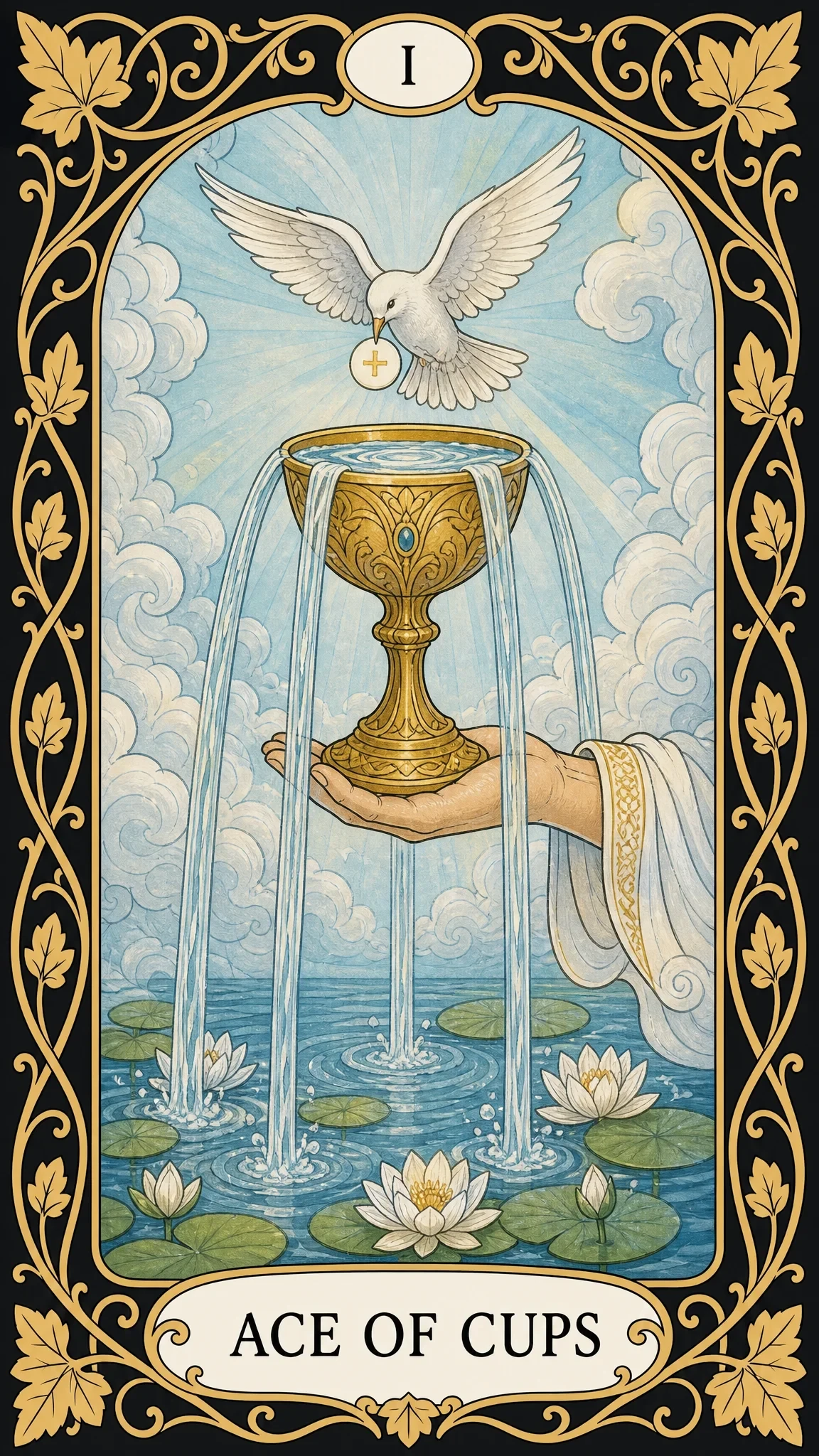
The main image of the card is an overflowing cup from which water pours over the edge. This depicts an excess: of feelings, too much to hold inside. It could be infatuation, a surge of tenderness towards someone already known, inspiration that wants to come out, or simply a desire to trust after a long period of being closed off.
A crucial nuance that gets lost in retellings: The Ace is an offer, not a guarantee. The card shows the moment a feeling is born and offered to a person, not what will happen to it in six months. Whether the other person reciprocates, whether the episode develops into something more—this is decided by the subsequent cards in the spread and the people themselves.
Reversed Ace of Cups: Meaning
The Reversed Ace of Cups is the same overflowing cup, but turned so that the water cannot find an outlet. Usually, the spread unfolds into one of three scenarios.
- There is a feeling, but it is not shown. The cup is full, but one hesitates to say it aloud—out of fear, pride, or habit of hiding emotions.
- Disappointment after openness. A person has already offered their feelings, but they were not accepted or were accepted differently than expected.
- Emotional stagnation. Nothing flows in or out: feelings have dulled, relationships or work are maintained by inertia, without the former warmth.
The reversed position almost always signifies not the absence of feeling, but its blockage. The difference from the upright Ace is that the water in the reversed card flows nowhere—and the first step in such a spread is usually about letting it flow again.
Ace of Cups in a Yes/No Reading
In "yes/no" readings, the Ace of Cups is read as one of the most confident yes cards in the deck, if the question concerns feelings: will a relationship begin, will the person reciprocate, should one open up. The card literally depicts an offer being extended—and it answers with consent.
The caveat applies to questions not about feelings, but about facts and deadlines: will the deal succeed, will the work issue be resolved. Here, the Ace of Cups is more like "yes, but through an emotional component," meaning the outcome depends on whether personal sympathies are involved in the matter, not just calculation.
The reversed Ace in this reading means "not yet": the offer either wasn't voiced, or it wasn't accepted the first time. It's not a final refusal, but a signal that the feeling hasn't been acted upon yet.
Ace of Cups in Relationships and Feelings
In a relationship reading, the Ace of Cups is one of the most favorable cards: a new feeling, the beginning of a romance, mutual sympathy that is just forming. If a relationship already exists, the card speaks of a fresh wave of tenderness—as if feelings have been refilled, like a cup with water.
In the position of feelings, it describes an excess: a person feels more than they show outwardly, or more than they are willing to admit even to themselves. Sometimes it's a one-sided infatuation in the early stages, when the feeling is already overflowing, but there has been no reciprocal step yet.
If cards of doubt or the past are nearby in the spread, the Ace of Cups indicates that the new feeling is genuine, but not yet time-tested. By itself, it doesn't guarantee a long-term relationship—only that the spark is there and it's honest.
The Reversed Ace in this reading signifies a feeling kept to oneself: fear of scaring it away, fear of rejection, or simply not yet ready to voice what is already understood internally.
Ace of Cups in Work and Money
In work readings, the Ace of Cups rarely speaks directly about money—it's a card of inspiration, not calculation. More often, it describes a project started not for profit, but because it is genuinely liked: a career change to a beloved profession, a creative idea, a team where it is suddenly warm to work.
In terms of money, the card is more about an offer made from the heart: a gift, a bonus, unexpected support, rather than systematic income. Neighboring Pentacles cards will show whether this sincere initiative turns into stable earnings.
The card's advice in a business reading is to trust your initial emotional response when choosing, but don't forget to verify it with calculation a little later: the Ace of Cups is good at starting things, but bad at keeping books.
The Reversed Ace here signifies work that has lost its soul, or an offer made sincerely but not appreciated properly.
Ace of Cups as a Person: Man and Woman
When the Ace of Cups appears in the "what kind of person" position, it describes not the entire character, but a specific gesture—the moment when a person first offers their feelings. This is someone who doesn't see the need to hide their affection and takes the first step towards you.
A Man-Ace of Cups in a reading is someone who openly shows tenderness, speaks directly about their feelings, sometimes even before expected. A Woman-Ace of Cups is someone who sincerely and without calculation shows that she is interested in a person, without playing indifferent.
This is not a description of being easily infatuated as a permanent character trait—rather, it's a momentary state of an open heart that a particular person is experiencing right now, in connection with the specific situation in question.
Ace of Cups in the Position of Thoughts
Ở vị trí suy nghĩ, lá Ace of Cups là cảm xúc chiếm trọn tâm trí: người đó cứ mãi nghĩ về một người hoặc một khoảnh khắc ấm áp gần đây. Những suy nghĩ này không gây lo lắng mà thiên về sự mơ mộng, có chút lơ đãng vì sự dịu dàng đang tràn ngập.
Đôi khi đây là giai đoạn đầu của tình yêu, khi lý trí chưa kịp can thiệp. Đôi khi là sự mong chờ một cuộc hòa giải hoặc một cuộc trò chuyện ấm áp sắp diễn ra. Các lá bài Kiếm (Swords) nằm cạnh ở vị trí này sẽ cho biết liệu người đó có đang nhầm lẫn giữa cảm xúc chân thành với một hình ảnh tự tưởng tượng hay không.
Cần làm gì khi rút được lá Ace of Cups
Lời khuyên của lá Ace of Cups rất đơn giản: nếu cảm xúc là thật, hãy để nó tự nhiên phát triển thay vì kìm nén vì thận trọng. Lá bài hiếm khi khuyên bạn chờ đợi thời điểm thích hợp — thời điểm đã đến rồi, chiếc cốc đã đầy.
Những việc cụ thể nên làm:
- Gọi tên cảm xúc — với chính mình hoặc với người liên quan. Khi chưa được nói ra, nó chỉ là trạng thái nội tâm.
- Đừng nhầm lẫn cường độ với sự bền vững. Cảm xúc mạnh mẽ lúc này không đồng nghĩa với mối quan hệ lâu dài trong tương lai — đây chỉ là sự khởi đầu, không phải kết quả.
- Hãy dành không gian cho đối phương. Ace of Cups mô tả lời đề nghị của bạn, không phải sự đảm bảo về câu trả lời.
- Đừng làm loãng khoảnh khắc bằng sự tính toán. Ở đây, tin tưởng sẽ tốt hơn là tính toán rủi ro ngay lập tức — vì trong trải bài đã có những lá bài khác để đánh giá tỉnh táo.
Nếu lá bài xuất hiện sau một cuộc chia tay đau buồn hoặc mất mát gần đây — hãy nhớ rằng cảm xúc mới không nhất thiết phải thay thế nỗi đau đã qua, và trải bài không thay thế cho việc trò chuyện với người thân hoặc chuyên gia.
Hình ảnh trên lá bài
Trên lá bài của chúng tôi là một bàn tay trong ống tay áo trắng với viền vàng đang vươn ra từ những đám mây, cầm một chiếc cốc vàng chạm khắc với viên đá xanh trên miệng cốc. Chiếc cốc đầy tràn và đổ ra ngoài thành năm dòng nước mỏng, chảy xuống hồ nước có những bông hoa súng trắng. Phía trên, trên nền những tia sáng tỏa ra và những đám mây, một con chim bồ câu trắng bay xuống phía chiếc cốc, trong mỏ ngậm một chiếc bánh thánh tròn nhỏ có hình chữ thập.
Cảnh tượng này được hiểu như sau:
- Năm dòng nước — sự dư thừa cảm xúc: chiếc cốc không chỉ đầy mà còn tràn ra ngoài ở nhiều nơi, không thể giữ lại bên trong được nữa.
- Chim bồ câu với bánh thánh — dấu hiệu cho thấy cảm xúc không đến từ mong muốn cá nhân, mà là một món quà thuần khiết, không toan tính.
- Hoa súng trong nước — cảm xúc không rơi vào hư không mà vào một môi trường sẵn sàng đón nhận: cuộc sống xung quanh đang nở rộ nhờ sự dư thừa này.
- Tia sáng sau đám mây — nguồn gốc của cảm xúc nằm ngoài những tính toán đời thường, tạo cảm giác nó đến từ "phía trên" chứ không phải được lên kế hoạch trước.
Phía trên lá bài là chữ số La Mã I, phía dưới là tên tiếng Anh ACE OF CUPS: bộ bài của chúng tôi được vẽ theo truyền thống Rider-Waite, nơi lá Ace mở đầu cho bộ Cốc.
Ace of Cups là lá bài của ngày
Ace of Cups với tư cách là lá bài của ngày thường báo hiệu một ngày với những bất ngờ về cảm xúc: một cuộc trò chuyện ấm áp bất ngờ, một tin nhắn không mong đợi, một khoảnh khắc dịu dàng ở nơi bạn không ngờ tới.
Lời khuyên hữu ích cho ngày này là đừng dập tắt cảm xúc bằng lý trí quá sớm và đừng ngại ngần thể hiện nó trước. Lá bài của ngày hiếm khi sai về tâm trạng: nếu buổi sáng tâm hồn bạn thấy nhẹ nhàng hơn bình thường, hãy tin tưởng vào trạng thái đó thay vì tìm kiếm lời giải thích logic cho nó.
Các câu hỏi thường gặp về lá Ace of Cups
Đây là lá Ẩn chính hay Ẩn phụ?
Ẩn phụ. Ace of Cups mở đầu cho bộ Cốc, nguyên tố của lá bài là Nước. Tổng cộng trong bộ bài Tarot có 56 lá Ẩn phụ: mỗi bộ có 14 lá.
Ace of Cups khác gì với Ace of Swords?
Cả hai lá Ace đều là sự khởi đầu, nhưng bản chất khác nhau. Ace of Cups nói về cảm xúc: tình yêu mới, sự dịu dàng, sự cởi mở về cảm xúc. Ace of Swords nói về tư duy: sự rõ ràng, quyết định trung thực, chiến thắng của lý trí thay vì trái tim. Nếu trong trải bài bạn nhầm lẫn hai lá này, hãy kiểm tra xem đó là về những gì người ta cảm nhận hay những gì người ta đã quyết định.
Lá Ace of Cups ngược có ý nghĩa gì?
Cảm xúc không tìm được lối thoát: bị che giấu, sợ thể hiện hoặc đã thể hiện nhưng không được chấp nhận. Ít phổ biến hơn — sự trì trệ về cảm xúc, khi sự ấm áp trước đây bị phai nhạt. Đây không phải là sự thiếu vắng cảm xúc, mà là sự tắc nghẽn của nó.
Ace of Cups trong tình yêu — luôn là một mối tình mới?
Không nhất thiết là người mới — đôi khi đó là một bước ngoặt cảm xúc trong mối quan hệ hiện tại: sự dâng trào dịu dàng như bắt đầu lại từ đầu. Nếu bên cạnh trong trải bài có các lá bài về sự khởi đầu, thì thường nói về một mối quan hệ mới.
Ace of Cups là "có" hay "không"?
Trong các câu hỏi về cảm xúc — là một câu trả lời "có" chắc chắn: lá bài cho thấy một lời đề nghị đang được đưa ra. Trong các câu hỏi không về cảm xúc, mà về sự kiện và thời hạn, câu trả lời nhẹ nhàng hơn: "có, nếu có sự thiện cảm cá nhân", thay vì chỉ dựa trên tính toán khô khan.