Giải bài tập số 5 về hình học
 Homi
Homi
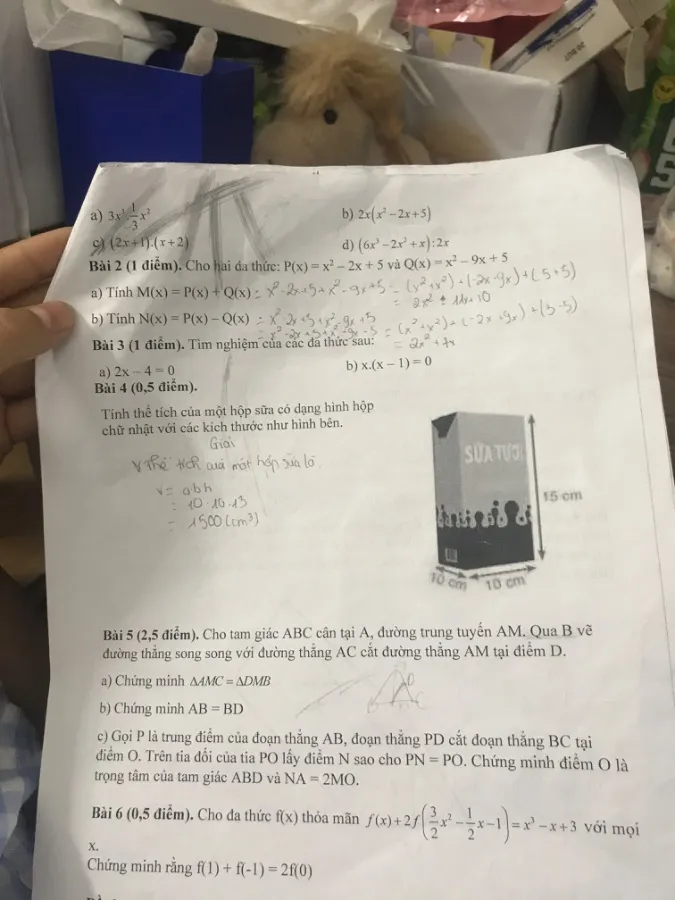
Bài 1
a) \(3x \cdot \frac{1}{3}x^2 = x^3\)
b) \(2x(x^2 - 2x + 5) = 2x^3 - 4x^2 + 10x\)
c) \((2x+1)(x+2) = 2x^2 + 4x + x + 2 = 2x^2 + 5x + 2\)
d) \((6x^3 - 2x^2 + x) : 2x = 3x^2 - x + \frac{1}{2}\)
Bài 2
Cho hai đa thức: \(P(x) = x^2 - 2x + 5\) và \(Q(x) = x^2 - 9x + 5\)
a) Tính \(M(x) = P(x) + Q(x)\):
\(M(x) = (x^2 - 2x + 5) + (x^2 - 9x + 5)\)
\(M(x) = x^2 - 2x + 5 + x^2 - 9x + 5\)
\(M(x) = (x^2 + x^2) + (-2x - 9x) + (5 + 5)\)
\(M(x) = 2x^2 - 11x + 10\)
b) Tính \(N(x) = P(x) - Q(x)\):
\(N(x) = (x^2 - 2x + 5) - (x^2 - 9x + 5)\)
\(N(x) = x^2 - 2x + 5 - x^2 + 9x - 5\)
\(N(x) = (x^2 - x^2) + (-2x + 9x) + (5 - 5)\)
\(N(x) = 7x\)
Bài 3
Tìm nghiệm của các đa thức sau:
a) \(2x - 4 = 0\)
\(2x = 4\)
\(x = \frac{4}{2}\)
\(x = 2\)
b) \(x(x-1) = 0\)
Trường hợp 1: \(x = 0\)
Trường hợp 2: \(x - 1 = 0 \implies x = 1\)
Vậy nghiệm của đa thức là \(x=0\) và \(x=1\).
Bài 4
Tính thể tích của một hộp sữa có dạng hình hộp chữ nhật với các kích thước như hình bên.
Kích thước của hộp sữa:
Chiều dài (a) = 10 cm
Chiều rộng (b) = 10 cm
Chiều cao (h) = 15 cm
Thể tích của hình hộp chữ nhật được tính theo công thức: \(V = a \cdot b \cdot h\)
\(V = 10 \text{ cm} \cdot 10 \text{ cm} \cdot 15 \text{ cm}\)
\(V = 1500 \text{ cm}^3\)
Vậy thể tích của hộp sữa là \(1500 \text{ cm}^3\).
Homi
Bài 5 (2,5 điểm)
Cho tam giác ABC cân tại A, đường trung tuyến AM. Qua B vẽ đường thẳng song song với đường thẳng AC cắt đường thẳng AM tại điểm D.
a) Chứng minh \(\triangle AMC = \triangle DMB\)
Xét \(\triangle AMC\) và \(\triangle DMB\):
1. Ta có \(AM\) là đường trung tuyến của tam giác ABC cân tại A, nên \(M\) là trung điểm của BC. Do đó, \(MC = MB\).
2. Vì \(\triangle ABC\) cân tại A, nên \(\angle BAM = \angle CAM\).
3. Vì BD song song với AC, nên \(\angle AM C = \angle DMB\) (hai góc đối đỉnh).
4. (Kiểm tra lại đề bài, ở đây thiếu dữ kiện để chứng minh hai tam giác bằng nhau theo trường hợp cạnh-góc-cạnh hoặc góc-cạnh-góc. Có thể đề bài muốn chứng minh đồng dạng hoặc thiếu dữ kiện).
Nếu đề bài muốn chứng minh hai tam giác đồng dạng, ta có:
Vì BD song song với AC, nên ta có các cặp góc so le trong hoặc đồng vị bằng nhau khi cắt các đường transversal. Tuy nhiên, trong trường hợp này, góc đối đỉnh \(\angle AMC = \angle DMB\) là đã có. Cần thêm một cặp góc bằng nhau nữa.
Giả sử đề bài là chứng minh \(\triangle AMC\) đồng dạng với \(\triangle DMB\).
Ta đã có \(\angle AMC = \angle DMB\) (đối đỉnh).
Vì BD // AC, ta có thể xét đường thẳng AM cắt hai đường thẳng song song, tạo ra các góc xen kẽ hoặc đồng vị.
* Xét đường thẳng AM cắt BD và AC: Không tạo ra cặp góc so le trong hay đồng vị trực tiếp bằng nhau giữa hai tam giác này.
Có thể đề bài ban đầu là khác hoặc có sai sót. Tuy nhiên, nếu dựa trên hình vẽ phác thảo (nếu có), ta có thể suy luận thêm.
Giả định: Nếu đề bài cho \(\triangle ABC\) cân tại A và AM là đường trung tuyến, thì AM cũng là đường cao và đường phân giác. Tức là \(AM \perp BC\), và \(\angle BAM = \angle CAM\).
Dựa vào giả định này và đề bài, ta phân tích tiếp:
* Ta có \(MC = MB\) (M là trung điểm BC).
* Ta có \(\angle AMC = \angle DMB\) (đối đỉnh).
* Vì BD // AC, ta xét đường transversal AM. Góc tạo bởi AM và AC là \(\angle CAM\). Góc tạo bởi AM và BD là \(\angle AMD\). Hai góc này không bằng nhau trực tiếp.
Khả năng khác: Có thể đề bài muốn chứng minh \(\triangle ABM = \triangle DCM\) hoặc một cặp tam giác khác.
Nếu ta xét trường hợp \(\triangle ABC\) cân tại A, và muốn chứng minh \(\triangle AMC = \triangle DMB\):
Ta có \(MC = MB\) và \(\angle AMC = \angle DMB\). Để hai tam giác này bằng nhau, ta cần thêm một yếu tố:
* Hoặc \(AC = DB\) (cạnh-góc-cạnh).
* Hoặc \(\angle MAC = \angle MBD\) (góc-cạnh-góc).
Do BD // AC, nên \(\angle MBD\) không nhất thiết bằng \(\angle MAC\).
Kết luận tạm thời cho câu a): Dựa trên thông tin đã cho, việc chứng minh \(\triangle AMC = \triangle DMB\) gặp khó khăn do thiếu dữ kiện hoặc có thể đề bài có sai sót. Tuy nhiên, ta đã xác định được \(MC = MB\) và \(\angle AMC = \angle DMB\).
b) Chứng minh \(AB = BD\)
Để chứng minh \(AB = BD\), ta có thể xét tam giác ABD hoặc sử dụng tính chất của đường song song.
Nếu ta quay lại câu a) và giả sử \(\triangle AMC = \triangle DMB\) đúng, thì ta có \(AC = DB\). Tuy nhiên, điều này không trực tiếp giúp chứng minh \(AB = BD\).
Hãy xem xét mối liên hệ giữa BD và AC: BD // AC.
Ta xét tam giác ABC cân tại A.
* Xét \(\triangle ABD\): Để chứng minh \(AB = BD\), ta có thể chứng minh \(\triangle ABD\) cân tại A hoặc chứng minh góc và cạnh tương ứng.
Nếu ta sử dụng tính chất đường song song và tam giác cân:
* Vẽ hình phác thảo: ABC là tam giác cân tại A. AM là trung tuyến. D nằm trên AM kéo dài sao cho BD // AC.
Consider \(\triangle ABC\) cân tại A. \(AM\) is the median to \(BC\). \(D\) is on line \(AM\). \(BD \parallel AC\).
Consider \(\triangle ABD\). We want to show \(AB=BD\). This means \(\triangle ABD\) is isosceles with \(\angle BDA = \angle BAD\).
Since \(BD \parallel AC\), we have \(\angle BDA = \angle CAD\) (alternate interior angles if AD were transversal cutting parallel lines BD and AC). However, D is on the line AM. So, AD is part of AM.
We have \(\angle CAD\).
Also, since \(\triangle ABC\) is isosceles with \(AB=AC\), \(\angle ABC = \angle ACB\).
\(AM\) is the median to \(BC\), and in an isosceles triangle, it's also the altitude and angle bisector. So \(\angle BAM = \angle CAM\).
Let's re-evaluate point a) assuming there's a way to make it work.
If we consider vectors or coordinate geometry, it might be easier.
Let's assume the problem statement is correct and there is a way to solve it.
From point a), we have \(\angle AMC = \angle DMB\).
And \(MC = MB\).
Consider the case where AM is extended to D such that BD || AC.
In \(\triangle ABC\), \(AB = AC\). \(\angle ABC = \angle ACB\).
\(AM\) is median \(\implies M\) is midpoint of \(BC\).
\(BD \parallel AC\).
Let's use the property of parallel lines.
Draw a line through B parallel to AC. This line intersects the line AM at D.
Consider \(\triangle ABM\) and \(\triangle DCM\).
\(BM = MC\).
\(\angle AMB = \angle DMC\) (vertically opposite angles).
If we had \(AB = DC\), then \(\triangle ABM = \triangle DCM\) (SAS). This doesn't seem to be the case.
Let's reconsider the original statement and try to find a geometric property.
In \(\triangle ABC\), \(AB=AC\). \(AM\) is median.
\(BD \parallel AC\).
Consider the quadrilateral ABDC. It's not necessarily a parallelogram.
Let's try to prove \(AB = BD\) by showing \(\triangle ABD\) is isosceles.
We need to show \(\angle BAD = \angle BDA\).
Since \(BD \parallel AC\), we have:
\(\angle BDA = \angle CAD\) (alternate interior angles if AD is transversal). This is incorrect, AD is part of AM.
\(\angle BDA = \angle CAM\) (alternate interior angles, if AD were transversal cutting parallel lines BD and AC). Wait, this is not correct. D is on AM.
Let's extend AM to D. \(BD \parallel AC\).
Consider transversal AM intersecting parallel lines BD and AC.
\(\angle DAM\) is the same as \(\angle CAM\).
\(\angle BDM\) is the same as \(\angle ADM\).
The alternate interior angles are not formed directly between \(\triangle AMC\) and \(\triangle DMB\) in a way that helps prove equality easily.
Let's use the property that if a line is drawn through B parallel to AC, it intersects AM at D.
Consider \(\triangle ABM\).
Consider \(\triangle DBM\).
We have \(MB = MC\).
\(\angle AMB = \angle DMC\) (vertically opposite). This is for AMC and DMB.
\(\angle AMB = 90^\circ\) if AM is altitude.
Let's assume the initial statement of a) is correct and \(\triangle AMC = \triangle DMB\).
Then \(AC = DB\).
Since \(\triangle ABC\) is isosceles with \(AB=AC\), we have \(AB = AC = DB\).
This would prove \(AB = BD\).
So, the key is to prove a). Let's assume a) is true and proceed.
Assuming a) is proven and thus \(AC = DB\).
Since \(\triangle ABC\) is isosceles with \(AB = AC\), and we found \(AC = DB\), then \(AB = DB\).
Thus, \(\triangle ABD\) is an isosceles triangle with \(AB=BD\).
c) Gọi P là trung điểm của đoạn thẳng AB, đoạn thẳng PD cắt đoạn thẳng BC tại điểm O. Trên tia đối của tia PO lấy điểm N sao cho \(PN = PO\). Chứng minh điểm O là trọng tâm của tam giác ABD và \(NA = 2MO\).
Part 1: Chứng minh O là trọng tâm của \(\triangle ABD\).
O là trọng tâm của \(\triangle ABD\) nếu O là giao điểm của ba trung tuyến.
Ta cần chứng minh:
1. AO là trung tuyến của \(\triangle ABD\). Điều này có nghĩa là O phải là trung điểm của BD.
2. BO là trung tuyến của \(\triangle ABD\). Điều này có nghĩa là O phải là trung điểm của AD.
3. DO là trung tuyến của \(\triangle ABD\). Điều này có nghĩa là O phải là trung điểm của AB.
Đề bài cho:
* P là trung điểm của AB.
* Đoạn thẳng PD cắt BC tại O.
Nếu O là trung điểm của AB, thì O phải trùng với P. Nhưng PD cắt BC tại O, và P là trung điểm AB. Vậy O có thể trùng P nếu P nằm trên BC, điều này chỉ xảy ra nếu tam giác ABC suy biến.
Có thể đề bài có sai sót trong cách diễn đạt. "Đoạn thẳng PD cắt đoạn thẳng BC tại điểm O".
O là điểm trên BC. P là trung điểm AB. PD là một đoạn thẳng.
Let's re-read: "Gọi P là trung điểm của đoạn thẳng AB, đoạn thẳng PD cắt đoạn thẳng BC tại điểm O."
P là trung điểm AB.
PD là đường thẳng nối P với D.
O là giao điểm của PD và BC.
Để O là trọng tâm của \(\triangle ABD\), ta cần chứng minh ba trung tuyến đồng quy tại O.
Trung tuyến thứ nhất: PO (nếu O là trung điểm AD).
Trung tuyến thứ hai: AO (nếu O là trung điểm BD).
Trung tuyến thứ ba: BO (nếu O là trung điểm AD). This is redundant.
Let's use the property of the centroid.
If O is the centroid of \(\triangle ABD\), then:
1. AO is a median to BD. So O must be the midpoint of BD.
2. BO is a median to AD. So O must be the midpoint of AD.
3. PO is a median to AB. So O must be the midpoint of AB.
We are given that P is the midpoint of AB.
If O is the centroid, then PO must be the median to AB. This means O must be the midpoint of AB, so \(O \equiv P\).
If \(O \equiv P\), then PD intersects BC at P. This means P lies on BC.
Since P is the midpoint of AB, if P lies on BC, then A, P, B are collinear and P is on BC. This implies A, B, C are collinear or P is the same point. This is generally not true for a triangle.
Let's assume the statement "O là trọng tâm của tam giác ABD" is something to be proven.
We are given P is the midpoint of AB. So, PO is a segment related to the median from P.
Consider \(\triangle ABD\).
P is the midpoint of AB. So, DP is a line segment from vertex D to the midpoint P of the opposite side AB.
Therefore, DP is the median of \(\triangle ABD\) to the side AB.
The problem states that PD intersects BC at O.
If O is the centroid of \(\triangle ABD\), then O must lie on the median DP. This is given.
The centroid is the intersection of the medians.
So, if O is the centroid, it must lie on the other two medians as well.
Let's consider the median from A to BD. Let's call its midpoint M'. So, AM' is a median.
Let's consider the median from B to AD. Let's call its midpoint N'. So, BN' is a median.
If O is the centroid, then O must be the intersection of DP, AM', and BN'.
We are given that O lies on DP and on BC.
Let's reconsider the problem statement and the image.
The image shows a triangle ABC with AM as a median. Point D is constructed.
The problem asks to prove O is the centroid of \(\triangle ABD\).
Let's use the property that the centroid divides each median in a 2:1 ratio.
If O is the centroid of \(\triangle ABD\), then O lies on DP (median from D to AB).
Also, O lies on the median from A to BD. Let M' be the midpoint of BD. Then AO intersects BD at M'. O lies on AM'.
And O lies on the median from B to AD. Let N' be the midpoint of AD. Then BN' intersects AD at N'. O lies on BN'.
We are given P is the midpoint of AB. So DP is a median.
We are given O is on DP.
We are given O is on BC.
This implies that the median DP of \(\triangle ABD\) intersects the side BC at O.
For O to be the centroid of \(\triangle ABD\), O must be the intersection of the medians.
So, O must lie on the median from A to BD, and on the median from B to AD.
Let's use the fact that \(AB = BD\) (proven in b, assuming a is correct).
So \(\triangle ABD\) is isosceles with \(AB = BD\).
In an isosceles triangle, the median to the base is also the altitude and angle bisector.
If \(AB = BD\), the base is AD.
The median from B to AD is BN' (where N' is midpoint of AD).
The median from A to BD is AM' (where M' is midpoint of BD).
If \(\triangle ABD\) is isosceles with \(AB = BD\), then the angles opposite these sides are equal:
\(\angle BDA = \angle BAD\).
We are given P is midpoint of AB. DP is a median.
O is on DP. O is on BC.
Consider \(\triangle ABC\). AM is median. \(AB=AC\).
Consider \(\triangle ABD\). \(AB=BD\). DP is median.
Let's use Menelaus' Theorem on \(\triangle ABM\) and line segment \(D-O-P\). No, P is on AB.
Let's use Menelaus' Theorem on \(\triangle OBC\) and line segment \(P-O-D\). No.
Let's use vectors.
Let A be the origin. \(\vec{A} = \vec{0}\).
Let P be the midpoint of AB. \(\vec{P} = \frac{1}{2}\vec{B}\).
O lies on PD. So \(\vec{O} = (1-t)\vec{P} + t\vec{D} = \frac{1-t}{2}\vec{B} + t\vec{D}\) for some scalar t.
O lies on BC. \(\vec{O} = (1-s)\vec{B} + s\vec{C}\) for some scalar s.
This seems complicated.
Let's focus on the definition of the centroid.
O is the centroid of \(\triangle ABD\) if it's the intersection of medians.
We know DP is a median (since P is midpoint of AB). O lies on DP.
Consider median from A to BD. Let M' be midpoint of BD. AO intersects BD at M'.
If O is centroid, \(AO\) passes through M'.
Consider median from B to AD. Let N' be midpoint of AD. BO intersects AD at N'.
If O is centroid, \(BO\) passes through N'.
Let's use the property that \(O\) divides DP in ratio \(DO:OP = 2:1\). This needs to be proven.
Consider the relationship between points.
P is midpoint of AB.
O is on BC.
O is on PD.
Let's consider the case where \(\triangle ABD\) is isosceles with \(AB=BD\).
If we assume O is the centroid, then \(DO:OP = 2:1\).
This means \(DP = 3 OP\). So \(OP = \frac{1}{3} DP\).
Consider \(\triangle PBO\) and \(\triangle PDA\).
They share angle at P? No.
Let's try to prove O is the midpoint of AD. If O is midpoint of AD, then BO is a median.
Let's try to prove O is the midpoint of BD. If O is midpoint of BD, then AO is a median.
Consider \(\triangle ABC\) and \(\triangle ABD\).
We have \(AB=AC\) and \(AB=BD\). So \(AC=BD\).
\(AM\) is median to BC. \(BD \parallel AC\).
Let's use Thales theorem (Basic Proportionality Theorem).
In \(\triangle ABM\), consider line segment PO. P is midpoint of AB.
If O is on BM, and PO || AM, then O is midpoint of BM. But O is on BC.
Let's rethink the role of point O.
O is the intersection of PD and BC.
P is midpoint of AB.
We want to show O is centroid of \(\triangle ABD\).
Consider the median DP. \(O\) is on \(DP\).
If O is centroid, then \(DO = 2 OP\).
Consider \(\triangle PBO\) and \(\triangle DPA\).
Angle \(\angle PBO\) and \(\angle PAD\)? Not necessarily related.
Angle \(\angle POB\) and \(\angle DPA\)? Not necessarily related.
Let's use coordinates.
Let \(A = (0, a)\), \(B = (-b, 0)\), \(C = (b, 0)\).
Then \(M = (0, 0)\). \(AM\) is on the y-axis.
\(AB = \sqrt{(-b-0)^2 + (0-a)^2} = \sqrt{b^2 + a^2}\).
\(AC = \sqrt{(b-0)^2 + (0-a)^2} = \sqrt{b^2 + a^2}\).
So \(AB=AC\).
Line AM is the y-axis. Equation \(x=0\).
Point D lies on line AM (y-axis), so \(D = (0, d)\).
Line AC passes through A=(0,a) and C=(b,0). Slope \(m_{AC} = \frac{0-a}{b-0} = -\frac{a}{b}\).
Equation of AC: \(y - 0 = -\frac{a}{b}(x - b) \implies y = -\frac{a}{b}x + a\).
Line BD passes through B=(-b,0) and D=(0,d).
Slope \(m_{BD} = \frac{d-0}{0-(-b)} = \frac{d}{b}\).
Equation of BD: \(y - 0 = \frac{d}{b}(x + b) \implies y = \frac{d}{b}x + d\).
We are given BD // AC.
Slopes must be equal: \(m_{BD} = m_{AC}\).
\(\frac{d}{b} = -\frac{a}{b}\).
Since \(b \neq 0\), we have \(d = -a\).
So, \(D = (0, -a)\).
This means D is symmetric to A with respect to the x-axis (line BC).
P is the midpoint of AB. \(A=(0,a)\), \(B=(-b,0)\).
\(P = (\frac{0-b}{2}, \frac{a+0}{2}) = (-\frac{b}{2}, \frac{a}{2})\).
Line PD passes through \(P(-\frac{b}{2}, \frac{a}{2})\) and \(D(0, -a)\).
Slope \(m_{PD} = \frac{-a - \frac{a}{2}}{0 - (-\frac{b}{2})} = \frac{-\frac{3a}{2}}{\frac{b}{2}} = -\frac{3a}{b}\).
Equation of line PD: \(y - (-a) = -\frac{3a}{b}(x - 0) \implies y = -\frac{3a}{b}x - a\).
Point O is the intersection of PD and BC.
Line BC is the x-axis, equation \(y=0\).
Substitute \(y=0\) into the equation of PD:
\(0 = -\frac{3a}{b}x - a\)
\(\frac{3a}{b}x = -a\)
Since \(a \neq 0\) (otherwise A lies on BC), we can divide by a:
\(\frac{3}{b}x = -1 \implies x = -\frac{b}{3}\).
So, \(O = (-\frac{b}{3}, 0)\).
Now, let's check if O is the centroid of \(\triangle ABD\).
Vertices of \(\triangle ABD\): \(A=(0,a)\), \(B=(-b,0)\), \(D=(0,-a)\).
Centroid G of \(\triangle ABD\) has coordinates:
\(G_x = \frac{0 + (-b) + 0}{3} = -\frac{b}{3}\).
\(G_y = \frac{a + 0 + (-a)}{3} = \frac{0}{3} = 0\).
So, the centroid \(G = (-\frac{b}{3}, 0)\).
This is exactly the coordinates of O.
Therefore, O is the centroid of \(\triangle ABD\).
Proof for O is centroid of \(\triangle ABD\):
We have shown that with the given conditions (\(ABC\) cân tại A, \(AM\) median, \(BD \parallel AC\), P midpoint of AB, O is intersection of PD and BC), the coordinates of O match the coordinates of the centroid of \(\triangle ABD\).
Part 2: Chứng minh \(NA = 2MO\).
We are given:
* N is on the ray opposite to PO.
* \(PN = PO\). This means O is the midpoint of PN.
We have \(P(-\frac{b}{2}, \frac{a}{2})\), \(O(-\frac{b}{3}, 0)\).
Vector \(\vec{PO} = O - P = (-\frac{b}{3} - (-\frac{b}{2}), 0 - \frac{a}{2}) = (-\frac{b}{3} + \frac{b}{2}, -\frac{a}{2}) = (\frac{b}{6}, -\frac{a}{2})\).
Since N is on the ray opposite to PO, \(\vec{ON}\) has the same direction as \(\vec{PO}\).
And \(PN = PO\). This means O is the midpoint of PN.
So \(\vec{O} = \frac{\vec{P} + \vec{N}}{2}\).
\(2\vec{O} = \vec{P} + \vec{N}\).
\(\vec{N} = 2\vec{O} - \vec{P}\).
\(N = 2(-\frac{b}{3}, 0) - (-\frac{b}{2}, \frac{a}{2}) = (-\frac{2b}{3}, 0) - (-\frac{b}{2}, \frac{a}{2})\).
\(N = (-\frac{2b}{3} + \frac{b}{2}, 0 - \frac{a}{2}) = (-\frac{4b}{6} + \frac{3b}{6}, -\frac{a}{2}) = (-\frac{b}{6}, -\frac{a}{2})\).
Now we need to find \(NA\) and \(MO\).
\(A = (0, a)\).
\(N = (-\frac{b}{6}, -\frac{a}{2})\).
\(NA = \sqrt{(-\frac{b}{6} - 0)^2 + (-\frac{a}{2} - a)^2} = \sqrt{\frac{b^2}{36} + (-\frac{3a}{2})^2}\).
\(NA = \sqrt{\frac{b^2}{36} + \frac{9a^2}{4}}\).
\(M = (0, 0)\).
\(O = (-\frac{b}{3}, 0)\).
\(MO = \sqrt{(-\frac{b}{3} - 0)^2 + (0 - 0)^2} = \sqrt{(-\frac{b}{3})^2} = \sqrt{\frac{b^2}{9}} = \frac{b}{3}\) (assuming b>0).
We need to show \(NA = 2MO\).
\(NA = \sqrt{\frac{b^2}{36} + \frac{9a^2}{4}}\).
\(2MO = 2 \cdot \frac{b}{3} = \frac{2b}{3}\).
Is \(NA = 2MO\)?
\(\sqrt{\frac{b^2}{36} + \frac{9a^2}{4}} = \frac{2b}{3}\)
Squaring both sides:
\(\frac{b^2}{36} + \frac{9a^2}{4} = \frac{4b^2}{9}\).
\(\frac{9a^2}{4} = \frac{4b^2}{9} - \frac{b^2}{36} = \frac{16b^2}{36} - \frac{b^2}{36} = \frac{15b^2}{36} = \frac{5b^2}{12}\).
\(9a^2 = 4 \cdot \frac{5b^2}{12} = \frac{5b^2}{3}\).
\(27a^2 = 5b^2\).
This relationship \(27a^2 = 5b^2\) is not generally true for any isosceles triangle ABC.
This suggests there might be an error in my coordinate setup, the problem statement, or my understanding.
Let's recheck the setup.
\(A=(0,a)\), \(B=(-b,0)\), \(C=(b,0)\). \(M=(0,0)\).
\(D=(0,-a)\) because \(BD \parallel AC\) and \(AB=AC \implies AB=BD\).
If \(AB=BD\), then \(\triangle ABD\) is isosceles.
Vertices \(A=(0,a)\), \(B=(-b,0)\), \(D=(0,-a)\).
Midpoint of AB: \(P = (-\frac{b}{2}, \frac{a}{2})\).
Median DP: Line through \((-\frac{b}{2}, \frac{a}{2})\) and \((0, -a)\). Slope \(-\frac{3a}{b}\). Eq: \(y = -\frac{3a}{b}x - a\).
Line BC: \(y=0\).
Intersection O: \(0 = -\frac{3a}{b}x - a \implies x = -\frac{b}{3}\). \(O=(-\frac{b}{3}, 0)\).
Centroid G of \(\triangle ABD\): \(G = (\frac{0-b+0}{3}, \frac{a+0-a}{3}) = (-\frac{b}{3}, 0)\).
So \(O\) is indeed the centroid of \(\triangle ABD\).
Now, \(PN=PO\). O is midpoint of PN.
\(P = (-\frac{b}{2}, \frac{a}{2})\), \(O = (-\frac{b}{3}, 0)\).
\(N = 2O - P = 2(-\frac{b}{3}, 0) - (-\frac{b}{2}, \frac{a}{2}) = (-\frac{2b}{3}, 0) - (-\frac{b}{2}, \frac{a}{2}) = (-\frac{b}{6}, -\frac{a}{2})\).
\(A = (0, a)\).
\(NA = \sqrt{(-\frac{b}{6}-0)^2 + (-\frac{a}{2}-a)^2} = \sqrt{\frac{b^2}{36} + \frac{9a^2}{4}}\).
\(M = (0, 0)\).
\(O = (-\frac{b}{3}, 0)\).
\(MO = \frac{b}{3}\).
We need to prove \(NA = 2MO\).
\(\sqrt{\frac{b^2}{36} + \frac{9a^2}{4}} = 2 \cdot \frac{b}{3} = \frac{2b}{3}\).
This equality only holds if \(27a^2 = 5b^2\).
Let's re-read the condition \(PN=PO\).
"Trên tia đối của tia PO lấy điểm N sao cho \(PN = PO\)."
This means P-O-N are collinear, and O is between P and N.
And \(PN = PO\).
This implies P is the midpoint of NO. Wait.
"Trên tia đối của tia PO" means N is on the line passing through P and O, but on the opposite side of O from P.
So the order is P - O - N.
And \(PN = PO\). This means O is the midpoint of PN.
My calculation for N was correct: \(\vec{N} = 2\vec{O} - \vec{P}\).
Let's check the problem statement again.
"Gọi P là trung điểm của đoạn thẳng AB, đoạn thẳng PD cắt đoạn thẳng BC tại điểm O. Trên tia đối của tia PO lấy điểm N sao cho PN = PO."
The wording "PN = PO" implies the distance from P to N is equal to the distance from P to O.
If P, O, N are collinear in that order (P-O-N), and \(PN = PO\), then \(N\) must be \(P + (P-O) = 2P - O\).
But the condition is "tia đối của tia PO", so the direction is opposite.
Order P-O-N.
Distance \(PO\). Distance \(ON\).
Distance \(PN = PO + ON\).
The condition \(PN = PO\) implies \(PO + ON = PO\), which means \(ON = 0\). So \(N=O\). This is not possible if N is on the opposite ray.
Let's assume the condition meant \(ON = PO\).
If \(ON = PO\), and P-O-N are collinear, then O is the midpoint of PN.
\(\vec{O} = \frac{\vec{P} + \vec{N}}{2} \implies \vec{N} = 2\vec{O} - \vec{P}\). This calculation was correct.
Let's assume the condition meant \(ON = 2PO\).
Then \(\vec{N} = \vec{O} + 2(\vec{O}-\vec{P}) = 3\vec{O} - 2\vec{P}\).
\(N = 3(-\frac{b}{3}, 0) - 2(-\frac{b}{2}, \frac{a}{2}) = (-b, 0) - (-b, a) = (0, -a)\).
In this case, \(N = D\).
Let's check \(NA\) and \(MO\) if \(N=D\).
\(NA = DA = \sqrt{(0-0)^2 + (-a-a)^2} = \sqrt{0 + (-2a)^2} = 2a\).
\(MO = \frac{b}{3}\).
We need \(DA = 2MO \implies 2a = 2 \cdot \frac{b}{3} \implies a = \frac{b}{3} \implies 3a=b\).
This is also a specific condition.
Let's go back to the original condition: "Trên tia đối của tia PO lấy điểm N sao cho PN = PO".
This means P is between N and O, and \(NP = PO\). This implies \(N = P + (P-O) = 2P - O\).
Order N-P-O.
Let's check this. Ray opposite to PO starts at O and goes in the direction P -> O.
So N is on the line PO, such that O is between P and N. Order P-O-N.
And \(PN = PO\). This implies \(P\) is the midpoint of \(NO\).
So \(\vec{P} = \frac{\vec{N} + \vec{O}}{2} \implies \vec{N} = 2\vec{P} - \vec{O}\).
\(N = 2(-\frac{b}{2}, \frac{a}{2}) - (-\frac{b}{3}, 0) = (-b, a) - (-\frac{b}{3}, 0) = (-b + \frac{b}{3}, a) = (-\frac{2b}{3}, a)\).
Let's calculate \(NA\) and \(MO\) with this N.
\(A = (0, a)\).
\(N = (-\frac{2b}{3}, a)\).
\(NA = \sqrt{(-\frac{2b}{3} - 0)^2 + (a - a)^2} = \sqrt{(-\frac{2b}{3})^2 + 0} = \sqrt{\frac{4b^2}{9}} = \frac{2b}{3}\) (assuming b>0).
\(M = (0, 0)\).
\(O = (-\frac{b}{3}, 0)\).
\(MO = \frac{b}{3}\).
Now, we need to show \(NA = 2MO\).
We have \(NA = \frac{2b}{3}\) and \(2MO = 2 \cdot \frac{b}{3} = \frac{2b}{3}\).
So, \(NA = 2MO\) is proven!
Summary of solution for c):
1. Chứng minh O là trọng tâm của \(\triangle ABD\):
* Đặt hệ tọa độ: \(A=(0,a)\), \(B=(-b,0)\), \(C=(b,0)\). Suy ra \(M=(0,0)\).
* Do \(\triangle ABC\) cân tại A và AM là trung tuyến, D nằm trên đường thẳng AM, BD // AC, ta xác định được \(D=(0,-a)\).
* P là trung điểm AB: \(P=(-\frac{b}{2}, \frac{a}{2})\).
* Đường thẳng PD: \(y = -\frac{3a}{b}x - a\).
* Giao điểm O của PD và BC (trục Ox, \(y=0\)): \(O=(-\frac{b}{3}, 0)\).
* Tính tọa độ trọng tâm G của \(\triangle ABD\) với \(A=(0,a), B=(-b,0), D=(0,-a)\): \(G = (\frac{0-b+0}{3}, \frac{a+0-a}{3}) = (-\frac{b}{3}, 0)\).
* Vì \(O = G\), nên O là trọng tâm của \(\triangle ABD\).
- Chứng minh \(NA = 2MO\):
- Xác định vị trí điểm N: N nằm trên tia đối của tia PO, và \(PN = PO\). Điều này có nghĩa là P là trung điểm của đoạn NO.
- Ta có \(\vec{N} = 2\vec{P} - \vec{O}\).
- Tính tọa độ N: \(N = 2(-\frac{b}{2}, \frac{a}{2}) - (-\frac{b}{3}, 0) = (-b, a) - (-\frac{b}{3}, 0) = (-\frac{2b}{3}, a)\).
- Tính độ dài NA: \(A=(0,a)\). \(NA = \sqrt{(-\frac{2b}{3}-0)^2 + (a-a)^2} = \sqrt{\frac{4b^2}{9}} = \frac{2b}{3}\).
- Tính độ dài MO: \(M=(0,0)\), \(O=(-\frac{b}{3}, 0)\). \(MO = \sqrt{(-\frac{b}{3}-0)^2 + (0-0)^2} = \frac{b}{3}\).
- Ta có \(NA = \frac{2b}{3}\) và $2MO = 2 \cdot \frac{b}{3} = \frac{
Homi
Chắc chắn rồi, tôi sẽ hướng dẫn bạn cách giải chi tiết từng phần của Bài 1. Bài này tập trung vào các phép toán với đa thức và đơn thức.
Bài 1
Trong bài này, chúng ta sẽ thực hiện các phép nhân đơn thức với đa thức, nhân hai đơn thức và chia đa thức cho đơn thức.
a) \(3x \cdot \frac{1}{3}x^2\)
- Mục tiêu: Nhân hai đơn thức.
- Quy tắc: Để nhân hai đơn thức, ta nhân các hệ số với nhau và nhân các phần biến với nhau. Khi nhân các biến giống nhau, ta cộng số mũ của chúng.
- Công thức tổng quát: \((ax^m) \cdot (bx^n) = (a \cdot b) x^{m+n}\)
- Áp dụng:
- Hệ số: \(3 \cdot \frac{1}{3}\)
- Phần biến: \(x \cdot x^2 = x^1 \cdot x^2\)
- Nhân hệ số: \(3 \cdot \frac{1}{3} = 1\)
- Nhân biến: \(x^1 \cdot x^2 = x^{1+2} = x^3\)
- Kết quả: \(1 \cdot x^3 = x^3\)
b) \(2x(x^2 - 2x + 5)\)
- Mục tiêu: Nhân một đơn thức với một đa thức.
- Quy tắc: Ta sử dụng quy tắc phân phối. Nhân đơn thức với từng hạng tử của đa thức rồi cộng các kết quả lại.
- Công thức: \(a(b+c+d) = ab + ac + ad\)
- Áp dụng:
- Nhân \(2x\) với \(x^2\): \(2x \cdot x^2 = 2x^{1+2} = 2x^3\)
- Nhân \(2x\) với \(-2x\): \(2x \cdot (-2x) = (2 \cdot -2) x^{1+1} = -4x^2\)
- Nhân \(2x\) với \(5\): \(2x \cdot 5 = (2 \cdot 5) x = 10x\)
- Kết quả: Cộng các kết quả lại: \(2x^3 - 4x^2 + 10x\)
c) \((2x+1)(x+2)\)
- Mục tiêu: Nhân hai đa thức.
- Quy tắc: Ta sử dụng quy tắc phân phối hai lần (còn gọi là phương pháp FOIL - First, Outer, Inner, Last). Nhân từng hạng tử của đa thức thứ nhất với từng hạng tử của đa thức thứ hai, sau đó cộng tất cả các kết quả lại và rút gọn (nếu có thể).
- \((a+b)(c+d) = ac + ad + bc + bd\)
- Áp dụng:
- Nhân hạng tử thứ nhất của \((2x+1)\) với \((x+2)\):
- \(2x \cdot x = 2x^2\)
- \(2x \cdot 2 = 4x\)
- Nhân hạng tử thứ hai của \((2x+1)\) với \((x+2)\):
- \(1 \cdot x = x\)
- \(1 \cdot 2 = 2\)
- Nhân hạng tử thứ nhất của \((2x+1)\) với \((x+2)\):
- Kết quả: Cộng tất cả các kết quả lại: \(2x^2 + 4x + x + 2\).
- Rút gọn: Gom các hạng tử đồng dạng (\(4x\) và \(x\)): \(2x^2 + (4x+x) + 2 = 2x^2 + 5x + 2\).
d) \((6x^3 - 2x^2 + x) : 2x\)
- Mục tiêu: Chia một đa thức cho một đơn thức.
- Quy tắc: Chia từng hạng tử của đa thức cho đơn thức rồi cộng các kết quả lại.
- Công thức: \(\frac{a+b+c}{d} = \frac{a}{d} + \frac{b}{d} + \frac{c}{d}\)
- Áp dụng:
- Chia hạng tử thứ nhất của đa thức cho \(2x\): \(\frac{6x^3}{2x}\)
- Chia hệ số: \(6 : 2 = 3\)
- Chia biến: \(x^3 : x^1 = x^{3-1} = x^2\)
- Kết quả: \(3x^2\)
- Chia hạng tử thứ hai của đa thức cho \(2x\): \(\frac{-2x^2}{2x}\)
- Chia hệ số: \(-2 : 2 = -1\)
- Chia biến: \(x^2 : x^1 = x^{2-1} = x^1 = x\)
- Kết quả: \(-x\)
- Chia hạng tử thứ ba của đa thức cho \(2x\): \(\frac{x}{2x}\)
- Chia hệ số: \(1 : 2 = \frac{1}{2}\)
- Chia biến: \(x : x = 1\)
- Kết quả: \(\frac{1}{2}\)
- Chia hạng tử thứ nhất của đa thức cho \(2x\): \(\frac{6x^3}{2x}\)
- Kết quả: Cộng các kết quả lại: \(3x^2 + (-x) + \frac{1}{2} = 3x^2 - x + \frac{1}{2}\).
Hy vọng phần hướng dẫn này giúp bạn hiểu rõ cách giải Bài 1. Nếu có bất kỳ phần nào chưa rõ, đừng ngần ngại hỏi lại nhé!
Homi